Build leaven
8-12 hrs1 tbsp starter + 200g flour + 200g water. Float test when ready.
Calculator & Planner
Pick a bread off the shelf. The bench lays out your ingredients, tools, and timeline.
Today's bake
Robertson (Tartine Bread)Liquid levain
Hydration · baker's percentage
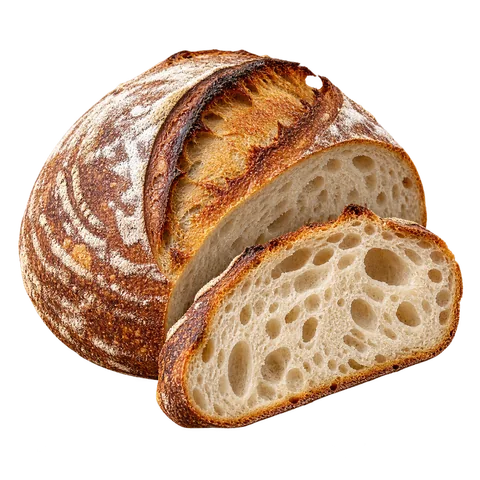
Representative bake. Shape, crust, and crumb will vary with your shaping, proofing, and oven.
Scale your formula
Schedule preference
Recipe Card · Robertson (Tartine Bread)
The classic high-hydration country loaf — open crumb, complex flavor, thick crust.
Robertson uses young leaven — harvest before peak acidity for sweetness without sourness. The float test is the go/no-go signal.
1 tbsp starter + 200g flour + 200g water. Float test when ready.
Mix flour + water (with leaven). Rest — no salt yet.
Dissolve salt in reserved 50g water. Squeeze through dough until incorporated.
Turn every 30 min for first 2 hours (4 turns total). Then rest undisturbed.
Turn out onto unfloured surface. Divide. Pre-shape into rounds with bench knife.
Rest uncovered on work surface.
Shape into boule or batard. Build surface tension without tearing.
In banneton. Room temp 3-4 hrs, or refrigerate up to 12 hrs.
Dutch oven at 500°F. Lid on 20 min, lid off 20-25 min. Deep mahogany color.
Do not cut until fully cooled. The crumb sets as it cools.
The Baker's Bench is a free sourdough hydration calculator and baker's percentage calculator in one: choose a bread style, set your loaf count, and it returns exact ingredient weights, hydration percentage, water temperature, and a full baking timeline — no spreadsheet, no mental math.
Every loaf of bread begins as a ratio. Professional bakers have known this for centuries, which is why the baker's percentage system exists: every ingredient expressed as a percentage of total flour weight, flour itself always at 100%. This elegant framework lets you scale any formula from a single boule to a hundred loaves without ever re-deriving the recipe. The Baker's Bench puts that system in your hands with zero mental math.
When you select a bread style above, you're choosing a formula grounded in the published work of authors like Chad Robertson, Ken Forkish, and Jeffrey Hamelman — bakers who spent decades refining these ratios. A Robertson country sourdough at 75% hydration produces a fundamentally different loaf than a Forkish Saturday White at 72%, and not just because of the water. Hydration interacts with protein content, fermentation length, and shaping technique to determine everything from crumb openness to crust character.
Hydration is where most home bakers first stumble. The difference between 68% and 78% hydration is the difference between a smooth, easy-to-shape dough and a slack, sticky mass that requires coil folds and a bench scraper. Higher hydration produces more open, irregular crumb structures — think of the wild holes in a ciabatta versus the tight, uniform crumb of a sandwich loaf — but it demands more confident handling and longer fermentation to develop adequate gluten strength through folding rather than intensive mixing.
The water temperature calculation deserves special attention. When the tool shows you a target water temperature, it's applying Hamelman's Desired Dough Temperature (DDT) formula. This isn't a suggestion — it's how professional bakers control fermentation rate. Yeast approximately doubles its activity with every 17°F increase in temperature (Reinhart's rule), which means a dough mixed at 82°F will ferment roughly twice as fast as one mixed at 65°F. If your kitchen is warm and you use warm water, you'll over-ferment before your schedule allows you to shape. If your kitchen is cool and you use cold water, you'll wait hours past your planned bake time. The DDT formula accounts for room temperature, flour temperature, and friction from mixing to calculate exactly what water temperature you need to hit your target.
Pre-ferments — poolish, biga, levain — appear in many of these formulas because they solve a fundamental problem: quick doughs taste flat. When you pre-ferment a portion of the flour overnight, you're building a reservoir of organic acids, alcohols, esters, and Maillard reaction precursors that no amount of yeast can produce in a three-hour bulk fermentation. Hamelman's poolish baguette pre-ferments 50% of the total flour at 100% hydration with a tiny amount of yeast, creating that sweet, nutty complexity that defines a proper French baguette.
The timeline feature exists because bread doesn't conform to your schedule — you conform to the dough's. But by choosing your schedule first (same-day, overnight, weekend), you can select formulas that naturally fit your life. Forkish's Overnight White uses just 0.08% instant yeast — less than a gram per kilogram of flour — specifically so the bulk fermentation stretches to 12–14 hours while you sleep. His Saturday White uses 0.4% yeast for a 5-hour same-day window. The yeast quantity is the throttle; time is the flavor accelerator.
One more thing worth understanding: the loaf weight targets here are not arbitrary. A 900-gram country loaf produces the ideal ratio of crust to crumb for a hearth bread baked in a Dutch oven. Scale too small and you get all crust, no soft interior. Scale too large and the center won't bake through before the crust burns. The Baker's Bench handles this scaling so you can focus on what matters — reading your dough, not your calculator.