Diagnostic
The Crumb Lens
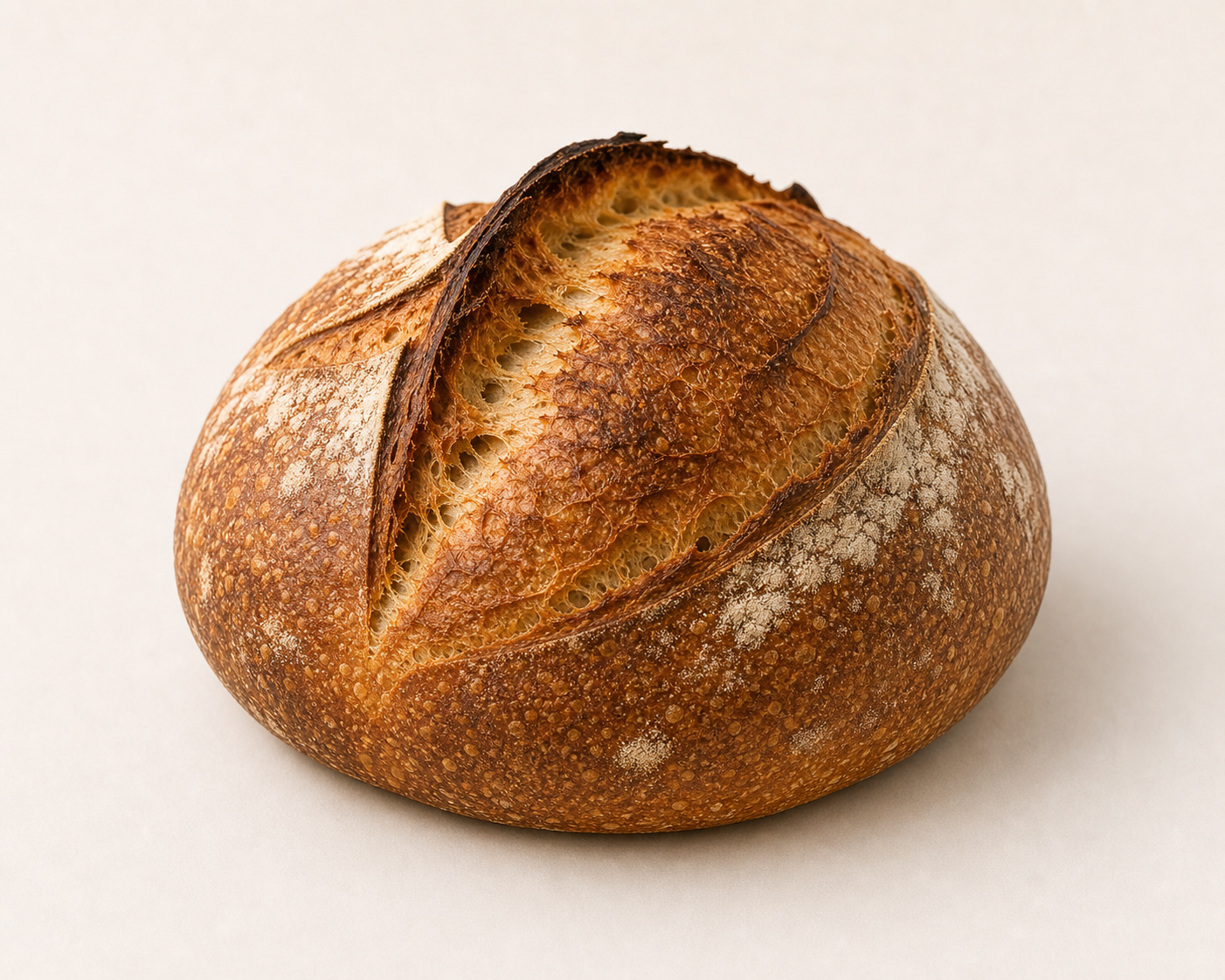
Click a numbered zone on the crumb. The inspection ring follows your selection, and the report ranks possible causes.
Diagnostic
Click a numbered zone on the crumb. The inspection ring follows your selection, and the report ranks possible causes.
You pulled a loaf from the oven, let it cool, sliced into it — and something isn't right. Maybe the crumb is dense and tight when you wanted open and airy. Maybe the crust is pale when you expected deep mahogany. Maybe there's a gummy layer at the bottom that won't set no matter how long you bake. The Crumb Lens helps you diagnose what went wrong and, more importantly, why.
Bread defects are rarely random. Almost every problem traces back to one of five variables: fermentation (too much, too little, or wrong temperature), hydration (dough too wet or too dry for the flour), gluten development (under-mixed, over-mixed, or wrong flour), shaping (insufficient surface tension), or baking (wrong temperature, wrong steam, wrong timing). The Crumb Lens organizes these by the zone where you see the symptom — crust, crumb, base, shape, or flavor — because that's how you encounter the problem: you look at the bread and something is off.
Crumb structure defects are the most common. A dense, tight crumb with uniform small holes almost always means under-fermentation — the yeast didn't produce enough carbon dioxide to inflate the gas cells that were incorporated during mixing. Buehler's key insight is that gas does not create new bubbles; it inflates bubbles that were already mixed into the dough. So if you didn't mix enough to incorporate air, or didn't ferment long enough to inflate those cells, you get a tight crumb regardless of hydration. The fix isn't more water — it's more time, or warmer dough, or more active leaven.
Conversely, huge irregular tunnels or a collapsed structure usually indicate over-proofing. The gluten network stretched to its limit, the gas cells merged into large voids, and the structure couldn't hold during oven spring. The bread may also taste overly sour, since extended fermentation means extended acid production by lactobacilli. The fix is baking sooner — catching the dough when the poke test shows it springs back slowly and partially, not when it stays dented.
Crust problems typically come down to steam and temperature. Pale crust is the single most common home-baking error, according to Robertson. Home bakers pull the bread when it looks golden, but golden isn't done — deep mahogany is done. The Maillard reaction that produces crust flavor and color accelerates dramatically above 300°F at the surface, and it needs both amino acids (from protease activity during fermentation) and reducing sugars (from amylase activity) as substrates. Long-fermented doughs have more Maillard precursors, which is one reason sourdough produces better crust than quick yeasted bread.
Base problems — a pale, soft, or soggy bottom — usually mean the baking surface wasn't hot enough. A properly preheated baking stone, steel, or Dutch oven delivers intense bottom heat that sets the base crust quickly. Without that thermal mass, moisture from the dough steams downward and keeps the base soft.
Shape problems — flat loaves, lateral spread, blowouts on the sides — connect back to either proofing (over-proofed dough can't hold its shape) or shaping technique (insufficient surface tension lets the dough relax outward instead of springing upward). The scoring pattern matters too: deep scores on over-proofed dough will deflate it, while under-proofed dough needs deeper cuts to accommodate the vigorous oven spring ahead.
Every diagnosis in The Crumb Lens is sourced from the published work of Buehler, Hamelman, Robertson, and Forkish. The fixes are actionable, the causes are ranked by likelihood, and the prevention tips are designed to stop the problem before your next bake.