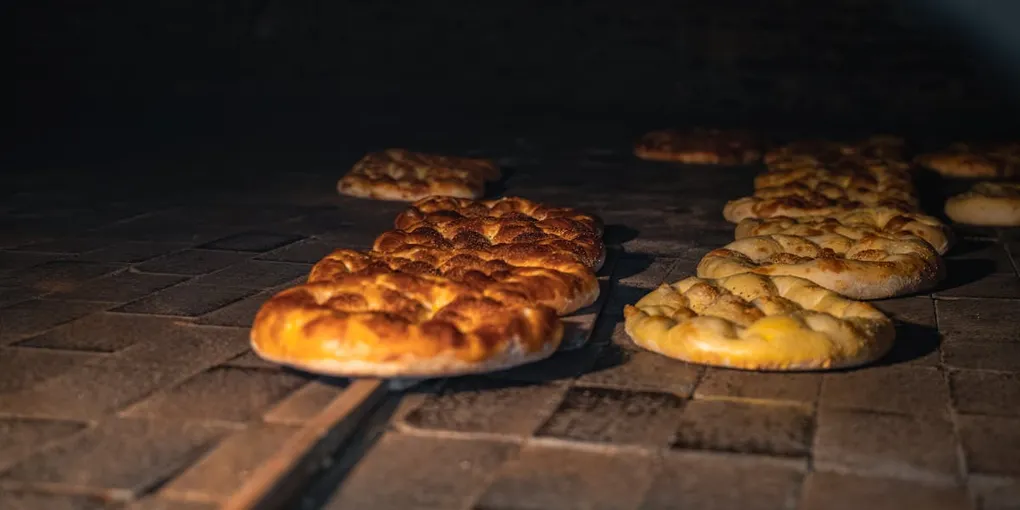
Steam during the first phase of baking is what separates artisan bread from ordinary bread. It’s why bakery loaves have thin, glossy, deeply caramelized crusts while home-baked loaves often come out thick, dull, and pale.
Professional bread ovens inject steam directly into the baking chamber. Home ovens don’t have this feature, but several workarounds exist — and the best one (the Dutch oven method) actually works better than most commercial steam systems.
What Steam Does: The Two-Phase Science
Phase 1: Condensation
When the loaf enters the hot oven, steam in the air condenses on the cool dough surface. This condensation releases latent heat — about 2,260 joules per gram of water — directly onto the crust.
The effect is rapid, intense surface heating. The dough surface gets hot fast, but it doesn’t dry out because the condensed water keeps it moist. This does three things:
-
Keeps the surface extensible. A moist, warm crust stretches. A dry crust sets. Extensible crust means the loaf can expand during oven spring without cracking.
-
Gelatinizes surface starch. The water penetrates the outermost layer of starch granules, causing them to swell and form a thin gel. This gel eventually dries into the glossy, glassy crust that gives artisan bread its characteristic sheen and crisp snap.
-
Keeps surface enzymes active. Amylase continues breaking starch into sugars. More sugars on the surface means more Maillard substrates when the steam is removed.
Phase 2: Evaporative Cooling
As the dough surface warms past the dew point, condensation stops and evaporation begins. This extends the oven spring window — the interior is still expanding, and the soft, extensible crust allows that expansion to continue.
The combined result: more oven spring, thinner crust, better sheen, deeper color, and more complex flavor than bread baked without steam.
Steam Timing
Steam ON: First 10-15 minutes of baking. This is the oven spring phase.
Steam OFF: Remove or vent steam for the remainder. This is the browning and crisping phase.
Leaving steam in the oven for the entire bake produces soft, pale crust — the moisture prevents the surface from reaching Maillard browning temperatures (250 degrees F+) and caramelization (330 degrees F+).
Method 1: The Dutch Oven (Best for Home Bakers)
The Dutch oven is the home baker’s steam injection system. A sealed, preheated cast-iron vessel traps the moisture that the dough itself releases, creating a miniature steam chamber.
Robertson’s Protocol
- Preheat Dutch oven at 500 degrees F for 20+ minutes
- Score the loaf, carefully lower it into the hot Dutch oven
- Lid on: 20 minutes at 500 degrees F — steam phase
- Lid off: 20-25 minutes at 450-500 degrees F — browning phase
- Target color: deep mahogany, not pale gold
Forkish’s Protocol
- Preheat Dutch oven at 475 degrees F for 45 minutes minimum
- Transfer loaf seam-side up (no scoring)
- Lid on: 30 minutes at 475 degrees F — steam phase
- Lid off: 15-20 minutes until dark brown
Robertson preheats hotter and bakes the steam phase shorter. Forkish preheats longer and extends the steam phase. Both produce excellent bread.
Method 2: Pan of Water
Place a heavy metal pan on the lowest oven rack while preheating. When you load the bread, pour 1 cup of boiling water into the hot pan. Close the oven door immediately. After 15 minutes, remove the pan.
Upgrading: Add lava rocks or old chain links to the pan before preheating. The increased surface area produces more steam.
Method 3: Ice Cubes
Toss a handful of ice cubes onto the oven floor or into a pan at loading. The slow melt provides sustained steam. Caution: Can crack glass oven floors.
Method 4: Spray Bottle
Spray the oven walls (not the bread) with water immediately after loading, then again 2 minutes later. Opens the oven door (loses heat) and produces minimal steam compared to other methods.
Method 5: Covered Baking
A large stainless steel bowl or deep roasting pan inverted over the loaf on a baking stone serves the same purpose as a Dutch oven — it traps the dough’s own moisture. Remove after 15-20 minutes.
When NOT to Use Steam
High-Rye Bread
Hamelman specifically warns against steam for high-rye breads (80%+). Rye crust blisters and forms undesirable thick skin when exposed to steam.
Enriched Breads
Breads with high butter, egg, or sugar content (brioche, challah) brown easily on their own. Excessive steam can prevent proper browning. An egg wash provides the glossy finish these breads need.
Soft Sandwich Breads
If you want a soft crust, steam is counterproductive. Bake without steam. Brush with melted butter after baking for an even softer finish.
The Starch Gelatinization Effect
During the steam phase, water from condensation penetrates the surface starch granules. They swell and form a thin gel. When the steam is removed and the surface dries, this gel hardens into a thin, glassy layer.
That glassy layer is what gives artisan bread its characteristic sheen and crisp snap. Without steam, the surface starch never gelatinizes properly, producing a thicker, duller, more matte crust.
Diagnosing Steam Problems
| Symptom | Likely Cause | Fix |
|---|---|---|
| Pale, dull crust | Not enough steam | Use Dutch oven or increase steam source |
| Thick, hard crust | No initial steam, or too short | Ensure steam for full 15 minutes |
| Soft, pale crust | Steam left too long | Remove steam source or lid at 15-20 min |
| Rye crust blistered | Too much steam for rye | Reduce or omit steam for high-rye |
| Good color but no sheen | Brief steam | Ensure moisture for full oven spring phase |
Why Home Ovens Struggle with Steam
Professional deck ovens have sealed chambers with direct steam injection. Home ovens vent steam constantly through the exhaust vent (it’s a safety feature). Any steam you create leaks out within minutes.
This is why the Dutch oven method dominates home bread baking. It bypasses the oven’s ventilation entirely — the steam stays inside the pot, where it belongs.
Frequently Asked Questions
- How long should steam be in the oven when baking bread?
- Steam should be present for the first 10-15 minutes of baking — the oven spring phase. After that, remove the steam source or lift the Dutch oven lid so the crust can dry out, brown, and caramelize. Leaving steam in for the entire bake produces a soft, pale crust.
- Is a Dutch oven better than a steam pan for bread baking?
- Yes, significantly. A Dutch oven traps the dough's own moisture in a sealed chamber, producing consistent, even steam throughout the oven spring phase. A steam pan creates an initial burst that quickly leaks out through the oven's exhaust vent. The Dutch oven is the single best investment a home bread baker can make for crust quality.
- Can I use steam for every type of bread?
- No. High-rye breads (80%+ rye) blister with steam. Enriched breads (brioche, challah) have enough sugars and proteins to brown on their own. Soft sandwich breads benefit from baking without steam. Steam is primarily for lean hearth breads — sourdough, baguettes, country loaves.
- Why does my bread crust look dull even with steam?
- The steam wasn't sustained long enough or wasn't concentrated enough. Home ovens vent steam through the exhaust constantly. If using a pan of water, the steam may have dissipated before it could gelatinize the surface starch. Switch to a Dutch oven for the most reliable results.
- Can too much steam ruin bread?
- Yes. Excessive steam throughout the entire bake prevents the crust from reaching browning temperatures. The result is a soft, pale, thick crust with no caramelized flavor. Always remove steam after the first 15-20 minutes.