Scoring creates controlled weak points where the loaf expands during oven spring instead of ripping unpredictably. Use a curved lame at 30 degrees for ears on baguettes, and a straight lame perpendicular for open slashes on boules. Match depth to proof state: deep for under-proofed dough, medium for properly proofed dough, and very shallow for over-proofed dough. Cold dough scores dramatically better than warm.
Scoring is the act of cutting the surface of a shaped loaf just before it goes into the oven. Those cuts serve a mechanical purpose: they create a controlled weak point where the loaf can expand during oven spring rather than ripping unpredictably at the seams.
Buehler puts it precisely: “Scoring provides a weak spot for the expanding loaf to break through in a controlled way, rather than ripping unpredictably.”
Without scoring, a well-proofed loaf will find its own escape route — usually the side seam or an arbitrary crack. The bread still bakes fine, but the shape is unpredictable and the crust development is uneven. Scoring gives you control over the final shape and appearance.
The Tools
Curved Lame
A thin, flexible razor blade mounted on a curved handle. The curve allows you to hold the blade at a shallow angle, creating cuts that open into dramatic “ears” — the lifted flap of crust that’s the hallmark of a well-scored baguette or batard.
Best for: baguettes and oval loaves where you want ears. Hold at about 30 degrees to the horizontal surface of the dough.
Straight Lame
A razor blade on a straight handle. Cuts are made perpendicular to the dough surface, producing deeper, more open slashes without the ear effect.
Best for: round loaves (boules), decorative patterns, cross-hatches.
Scissors
Kitchen scissors or shears cut the dough surface by snipping rather than slashing. The tool of choice for epi de ble (the wheat-stalk shaped bread) and decorative rolls.
Dough Docker
A spiked roller that punctures the surface without cutting it. Used for high-rye breads (80%+) that are too sticky for blade scoring.
For detailed tool recommendations, see our best bread lame guide.
Scoring Depth by Proofing State
Match your cut depth to how far the dough has proofed
Under-proofed
Vigorous expansion ahead — use a decisive expansion cut
Properly proofed
Moderate expansion expected — use a standard expansion cut
Over-proofed
Exhausted gluten — minimize the risk of deflation
If your loaf is slightly over-proofed, shallow scores can save it from collapsing.
jayarrbread.comThe Technique
Angle Matters
Shallow angle (30 degrees): Creates a flap that lifts into an ear during baking. Used with a curved lame on baguettes and batards.
Perpendicular (90 degrees): Creates a symmetric opening. Used with a straight lame on boules and decorative patterns.
Depth Matters
This relationship between proofing and scoring depth is one of the most practical pieces of bread knowledge. If your loaf is slightly over-proofed, shallow scores can save it from collapsing. If it’s slightly under-proofed, deep scores prevent the sides from blowing out.
There is no universal inch target for every loaf. Published professional guidance varies with loaf shape and scoring style: Modernist Bread co-author Nathan Myhrvold recommends 3–6 mm for consistent cuts, while the American Society of Baking gives a broader 6–12 mm range and specifies that long loaves take shallower cuts than round loaves. King Arthur Baking similarly advises cutting through the shaped skin without compromising the loaf, with deeper expansion slashes and surface-level decorative cuts. None of these sources assigns a fixed measurement to each proof state, so use the proof-state direction above rather than treating one number as universal.
Speed and Confidence
Score with a single, decisive motion. Hesitation produces ragged cuts with torn dough edges that don’t open cleanly.
If the blade drags or sticks:
- The blade is dull (razor blades are cheap — replace after 3-5 uses)
- The dough surface is too wet (lightly dust with flour before scoring)
- You’re pressing too hard (let the blade’s sharpness do the work)
Cold Dough Scores Better
One of the practical advantages of cold retarding (overnight refrigeration after shaping) is that cold dough scores dramatically better than room-temperature dough. The firm, chilled surface cuts cleanly and holds its shape.
If you’re not cold retarding, you can put the shaped loaf in the freezer for 15-20 minutes before scoring to firm up the surface.
Set the loaf, proof state, blade angle, and cut depth below to see how one score becomes the baked expansion route.
Interactive scoring bench
Cut the route pressure will take.
A score is an engineered weak plane. Angle decides how it opens; proof state decides how deep the cut can safely go.
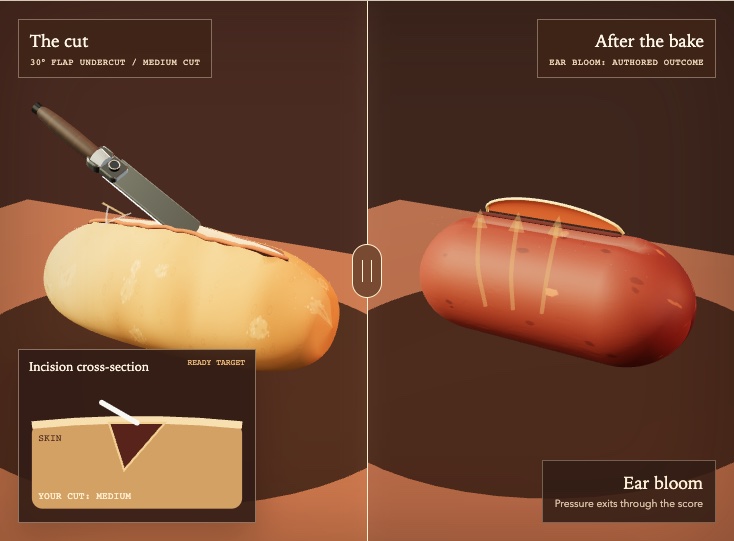
Ready dough target: medium
Choose the cut
Match the score to the dough.
The blade creates the loaf's easiest expansion route. A shallow 30° cut leaves a flap that can lift into an ear; a perpendicular 90° cut opens more symmetrically.
Use a medium score for ready dough, load immediately, and keep steam in the first 15 minutes.
Surface and split-view controls
Why the score matters
A mismatched score does not merely change decoration. Too little route for tight dough can force a side blowout; too deep a cut in exhausted dough can deflate it. Match angle and depth first, then make one swift cut while the surface is firm.
- Lightly flour the surface.
- Replace the blade at the first sign of drag.
- Do not saw back over the same cut.
The intermediate angle animation is explanatory. The article's recommended working points are 30° for an ear and 90° for a symmetric opening.
Common Scoring Patterns
Single Slash (Boule)
One curved cut across the surface of a round loaf. Simple, effective, and the standard for country-style sourdough. Curved lame at 30 degrees, slightly off-center.
Cross or X (Boule)
Two intersecting cuts. Distributes oven spring evenly in four directions. Use a straight lame and perpendicular, medium-depth expansion cuts.
Box or Square (Boule)
Four cuts forming a square on the top. A traditional European pattern. The center square lifts during baking.
Baguette Cuts
Five to seven diagonal cuts at a 30-degree angle, each overlapping the previous cut by 25-30%. This is the hardest scoring pattern to master. See our baguette guide for detailed instruction.
Wheat Stalk (Epi de Ble)
Not scored with a blade — cut with scissors at a 45-degree angle, pulling each cut piece to alternate sides.
Decorative Patterns
Leaves, spirals, geometric patterns — purely aesthetic. Score with a straight lame at medium depth.
Forkish’s No-Scoring Philosophy
Forkish is the notable exception among major bread bakers: he does not score his loaves. Instead, he bakes seam-side up and relies on the natural fissures that form when the seam splits during oven spring.
His approach works because his doughs are baked in a Dutch oven (which traps steam regardless of scoring), and seam-side-up baking creates a natural weak point at the seam. If you prefer a wild, cracked-earth look, try Forkish’s method.
Try It Yourself
The Baker's Round Table
Scoring is a four-to-one split among the five master bakers — Forkish is the only holdout. See all fourteen decisions where they contradict each other.
Open ToolHow Scoring Affects the Final Loaf
Direction of expansion. The loaf expands perpendicular to the score line. A single slash down the center of a batard pushes the loaf outward on both sides. Choosing your pattern is choosing how the loaf will grow in the oven.
Crust-to-crumb ratio. Deeper, more numerous scores increase total crust surface area. If you love crust, score aggressively.
Visual contrast. The score openings bake lighter than the smooth crust surface. Dusting the loaf with flour before scoring amplifies this effect.
The Ear: What It Is and How to Get One
The “ear” is the thin flap of crust that lifts away from the score line during baking.
Ears form when:
- The blade cuts at a shallow angle (30 degrees)
- The cut is slightly off-center
- Steam keeps the flap moist during oven spring
- The dough is properly proofed
- The dough surface is cold and firm
Don’t chase ears at the expense of good bread. A loaf with no ear but beautiful crumb and flavor is infinitely better than a loaf with a dramatic ear and gummy interior.
Scoring and Steam
Scoring and steam work together. Steam keeps the scored cuts moist and extensible during the first phase of baking, allowing them to open fully as the loaf expands. Without steam, the cuts seal over quickly and ears don’t develop.
In a Dutch oven, the trapped moisture from the dough itself provides the steam. On a baking stone or steel, you need an external steam source during the first 15 minutes.
Troubleshooting Scoring Problems
Cuts close up during baking. The dough is over-proofed. Score more shallowly, or bake sooner next time.
Cuts are ragged and torn. The blade is dull, or you hesitated. Replace the blade and commit to a single confident motion.
Bread rips at the sides instead of at the score. The cuts weren’t deep enough for the proofing state. Under-proofed bread generates vigorous oven spring that needs deep scores.
No ears forming. You need a curved lame at a shallow angle (30 degrees). A straight perpendicular cut won’t produce ears. Also verify adequate steam in the first phase.
Uneven opening. The dough is unevenly proofed or the scores are uneven in depth.
Getting Better at Scoring
Like shaping, scoring is a physical skill. Three things accelerate improvement:
- Use fresh blades. A dull blade turns a crisp cut into a ragged tear. Replace after every 3-5 loaves.
- Cold retard before scoring. Firm dough is dramatically easier to score.
- Commit to the cut. One swift motion. No going back over the same line.
Frequently Asked Questions
- Do I have to score bread before baking?
- No. Forkish bakes all his loaves unscored, seam-side up, relying on natural splits from the seam. The bread still bakes fine. However, most bakers score because it produces a more predictable shape, better ears, and more even crust development.
- What can I use if I don't have a bread lame?
- A sharp razor blade held directly between your fingers works. A box cutter or utility knife also works. The key is a very sharp, thin blade. A dull kitchen knife will drag through the dough and tear it. Replace blades frequently — every 3-5 loaves for a razor.
- How deep should I score sourdough bread?
- There is no universal inch target because loaf shape, scoring pattern, and dough condition all matter. Use a deep, decisive score for under-proofed dough, a medium score for properly proofed dough, and a very shallow score for over-proofed dough to reduce the risk of deflating its exhausted gluten structure.
- Why don't my score marks open up during baking?
- Three common causes: not enough steam in the first phase of baking (the cuts seal over before the loaf expands), the dough is over-proofed (no oven spring left to push the cuts open), or the blade was dull and the cuts were more like tears than clean slashes.
- Should I score cold dough or room-temperature dough?
- Cold dough scores dramatically better. If you cold-retard your loaves overnight in the fridge, score them straight from the refrigerator. The firm surface cuts cleanly and holds its shape. If you're not cold retarding, put the shaped loaf in the freezer for 15-20 minutes before scoring.