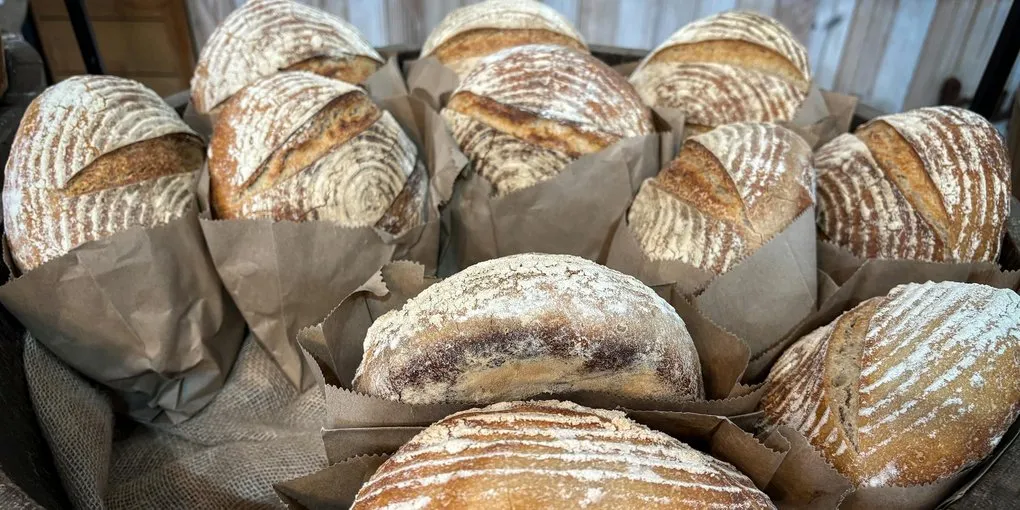
Choose a boule (round) for rustic-served loaves, Dutch oven baking, and a softer crumb-dominant eating experience. Choose a batard (oval) for sandwich slicing, stone or steel baking with steam, and a higher crust-to-crumb ratio. The dough is the same — the shape is a decision about how the loaf will be sliced, fit your oven, and present at the table.
Every lean artisan dough — country sourdough, pain de campagne, rustic wheat — can be shaped as either a boule (round) or a batard (oval). The dough does not know the difference. The oven does not care. Both shapes, done well, will produce a beautiful loaf with open crumb and dark crust. The choice between them is not really about flavor or fermentation. It is about the loaf’s use — what you want to do with it on the cutting board three hours later.
A boule is a sphere. A batard is an elongated oval, roughly two to three times longer than it is wide. They come from the same dough, are baked at the same temperature, and share every structural property of the crumb. What they do not share is how they slice, how they fit in an oven or a Dutch oven, how much surface area they present for crust formation, and how they score. This guide walks through each of those factors and gives you a decision framework. For the full step-by-step technique for executing each shape, see how to shape bread.
A quick note on the words
“Boule” comes from the Old French boule, meaning ball — the same root as boulanger (baker) and boulangerie (bakery). The word has been used for round loaves since at least the 12th century, and its primacy in the language explains why French bakers are named for the shape rather than for the oven or the grain.
“Batard” — from French bâtard, literally “bastard” — describes a loaf that is intermediate in form between two standard shapes. The word is not pejorative in baking context; it simply marks the loaf as in-between. The most common reading is that the batard sits between the long, thin baguette and the large round miche or boule, neither one nor the other. The shape became standardized in the 19th century as French bakery formats expanded beyond the two original silhouettes.
Knowing the names is not just trivia. It tells you what the shapes are for: a boule is a ball-shaped loaf descended from millennia of round-bread tradition. A batard is a deliberate compromise between the slicing utility of a long baguette and the volume of a country round.
The crust-to-crumb ratio is the real difference
A sphere is the most volumetrically efficient shape in geometry. For a given weight of dough, a boule has the least surface area of any shape you could form. That means proportionally less crust, proportionally more soft crumb, and a bread that skews toward the interior. A batard, because it is elongated, has more surface area for the same dough weight — roughly 10 to 20 percent more crust, depending on how aggressively you taper the ends. (The math is straightforward: a 2:1 batard has about 9 percent more surface than an equal-volume sphere, while a 3:1 batard pushes that to roughly 19 percent.) That higher surface-to-volume ratio translates into more Maillard-browned exterior per slice.
This is the single biggest difference in eating experience. If you love crust — the deep mahogany, caramelized, slightly bitter edge that comes from a well-baked artisan loaf — the batard gives you more of it per bite. If you prefer a softer, chewier eating experience where the interior dominates, the boule wins. Neither is better. They are different products from the same dough.
The ratio also affects how the loaf bakes. A batard, with its longer profile, heats through faster (less thickness for heat to penetrate) and develops crust faster at the ends. A boule, with its centralized mass, holds heat longer and produces a slightly wetter crumb at the very center — which is sometimes what you want (more moist, tender chew) and sometimes not (gummy if underbaked).
Sandwich-slicing vs rustic-tearing is a shape problem
The practical use of the loaf drives shape more than anything else. If you are going to slice this bread for sandwiches, toast, or consistent wedges, a batard is the right choice. The elongated profile slices into uniform ovals of roughly consistent size from end to end — every slice is sandwich-shaped. A boule sliced the same way produces wildly inconsistent rounds: tiny edge slices, huge middle slices, and a geometry that never quite fits a standard sandwich.
If the loaf is going to be torn, served as a rustic centerpiece, cut into wedges for dipping, or cubed for fondue or stuffing, the boule is fine and often preferable. A boule presents beautifully on a board. It tears in pleasing irregular chunks along the crumb structure. It fits cleanly into a bread basket. And nobody complains that the pieces are inconsistent, because inconsistency is the point.
A secondary factor is freezer efficiency. Batards pre-sliced and frozen can be pulled slice-by-slice and toasted from frozen — a practical weeknight pattern. Boules sliced the same way freeze awkwardly because the slice sizes vary, and the big middle rounds are often too wide for a standard toaster. For long-term storage tactics, see bread storage and freshness.
Oven fit is the hard constraint
Your oven and your baking vessel determine whether you have a choice at all. Most home Dutch ovens (4 to 7 quart cast iron) are round, with interior diameters between 9 and 11 inches. A 1 kg boule (about 6 inches across) fits naturally with room to spread. A batard fits only if it is short — roughly 9 to 10 inches long at most — which means you are compromising the classic elongated batard proportion to fit the round vessel.
If you are baking on a stone or steel, the oven itself is usually wider than deep, and batards become much easier. A 1 kg batard that is 10 to 11 inches long fits a standard 30-inch home oven comfortably; a longer batard requires either an oval Dutch oven (Le Creuset and Lodge both make 6.75-quart oval models that handle this) or a stone setup with a separate steam source.
The rule of thumb: if you only have a round Dutch oven, favor boules or short batards. If you have a stone or steel and can produce steam some other way (cast iron pan of lava rocks, steam injection, covered with a roaster lid), you get the full range of batard lengths. For true long batards — like Tartine or Forkish 1-kilogram batards — you need an oval Dutch oven or a stone-and-steam setup.
Scoring patterns differ by shape
The score pattern is not cosmetic. The cut creates a controlled weak spot for the oven spring to break through; without scoring, the loaf tears unpredictably. And the best pattern depends on the shape.
Boule scoring. One bold pattern across the top, 1/4 to 1/2 inch deep depending on proof state. The classic patterns are: a single curved slash (rustic look with a gentle ear on one side), a cross or X (equal oven spring from all four quadrants), or a square (four cuts creating a raised center panel). A boule’s score is typically made with a straight lame held perpendicular to the surface — the round shape resists expansion in all directions equally, so you want the cuts to open straight upward.
Batard scoring. The classic is a single long curved slash down the length, held at a 30-degree angle to the surface with a curved lame. This creates a dramatic “ear” — a lifted flap of crust that peels back during oven spring and caramelizes into one of the most visually striking features of French artisan bread. Alternatively, three to five diagonal slashes across the batard, each overlapping the previous by 25 to 30 percent, produce the baguette-style pattern adapted to a batard.
Shape dictates which patterns look right. A cross on a batard looks awkward. A long single slash on a boule often just rips across the equator unattractively. Match pattern to shape. For full scoring depth and angle technique, see how to score bread.
Boule vs Batard — Side by Side
Same dough, different geometry, different uses
| Factor | 01BOULE | 02BATARD |
|---|---|---|
| Shape | Round sphere | Elongated oval, ~2-3x longer than wide |
| Surface area per gram | Minimum (most crumb) | ~10-20% more (more crust) |
| Slicing | Inconsistent rounds; tiny edges, huge middle | Uniform ovals, sandwich-ready |
| Best use | Rustic tear, dipping, wedges, boards | Sandwiches, toast, consistent slices |
| Oven fit | Round Dutch oven (9-11 inch) | Needs oval Dutch oven or stone + steam |
| Shaping difficulty | Easier (cup-and-drag) | More technique (letter fold + roll + taper) |
| Classic scoring | Single arc, cross, or square (1/4-1/2 inch) | Single long slash at 30° (for ear) OR 3-5 diagonals |
| Oven spring character | Even rise in all directions | Dramatic upward rise along the score line |
Both shapes use the same dough, same hydration, same fermentation. The choice is downstream of how the loaf will be served.
jayarrbread.comBanneton choice follows shape
A round dough proofs in a round banneton; an oval dough proofs in an oval banneton. The proofing vessel does not just hold the dough — it actively shapes the surface during the final rise. A round basket forces a sphere; an oval basket forces an oval. Trying to proof a batard in a round basket gives you a thick, stubby short-batard with rounded ends, which does not slice cleanly into sandwich ovals.
For a typical 800-to-1,000 gram dough, a 9-inch round banneton holds a boule well; a 10-inch oval banneton holds a batard. Robertson and Hamelman both line their bannetons with rice flour (or a 50/50 rice and wheat flour blend) — rice flour does not absorb moisture into the dough the way wheat flour alone does, which prevents sticking far better. This applies regardless of shape.
If you only have one banneton, make it a 9-inch round and shape boules first. The round basket forgives a less-than-perfect shaping because the dough naturally settles into the bowl. The oval basket reveals every shaping flaw because the dough has to taper to fit.
A brief decision framework
Three questions, in order, will resolve the choice for almost any artisan dough:
- What will you do with this bread? Sandwiches, toast, consistent slicing → batard. Rustic centerpiece, tearing, dipping, wedges → boule.
- What is your oven setup? Round Dutch oven only → boule (or short batard if you must). Stone or steel with a steam strategy, or oval Dutch oven → either, your choice.
- What do you value more, crust or crumb? Crust lover (more Maillard surface per bite) → batard. Crumb lover (more soft chewy interior per bite) → boule.
Three answers, one shape. The question is rarely which one is “better” — it is which one fits this loaf, on this day, for this meal.
When the same dough should be both
A common pattern for serious home bakers is to bake the same recipe in both shapes across the week. A 2-kilogram batch of country sourdough divides into two 1-kilogram loaves: shape one as a boule for the dinner table on Saturday, shape the other as a batard for sandwiches and toast through the rest of the week. The dough does the same work; the shapes do different jobs.
This is the practical upshot of the whole guide. The shape is not a permanent allegiance. It is a decision you make at final shaping, after bulk fermentation, based on what the loaf will become. Knowing how to do both — and knowing why you would choose one over the other — gives you the vocabulary to make the right loaf for the right meal, every time.
The decision in one paragraph
Round loaf, rustic-torn use, Dutch oven only, crust-versus-crumb preference toward chewy interior — boule. Elongated loaf, sandwich-sliced, stone or steel oven (or oval Dutch oven), preference toward maximum crust per slice — batard. Neither shape is harder to execute well; they are different skills. Both are worth learning. Once you can cleanly shape both, the same dough will serve you differently every week of the year.
Frequently Asked Questions
- Is a boule or a batard easier for beginners?
- A boule is generally easier to execute cleanly. The shaping motion — cup the hands, drag the dough, rotate — is repeatable and forgiving. A batard requires a rectangular flatten, a letter fold, a controlled roll, and even tapering of the ends, which is more technique to learn at once. If this is your first lean artisan loaf, shape it as a boule and add batards to your vocabulary once the shaping motion feels automatic. Most professional bread curricula also teach boule first and then batard.
- Can I bake a batard in a round Dutch oven?
- Yes, if the batard is short enough. A 9-to-10-inch batard will fit diagonally in a 9-to-11-inch round Dutch oven. The result is a slightly squat batard with curved sides rather than the long elegant taper of a true batard, but it bakes well and slices reasonably. For a full-length batard (12 to 14 inches), you need an oval Dutch oven (such as the Lodge or Le Creuset 6.75-quart oval) or a stone-and-steam setup without a covered vessel.
- What is the weight difference per loaf for boule vs batard?
- The shapes are weight-neutral — both are typically made at 800 grams to 1 kilogram of total dough per loaf for home bakers. The shape changes how that dough presents, not how much of it there is. Some bakers scale batards slightly heavier (1 to 1.2 kg) because the longer profile can support more mass without the center bulging; boules over 1 kg tend to spread round and flat rather than tall and domed.
- Which shape has better oven spring?
- Neither shape has intrinsically better oven spring — both can produce excellent rise with good shaping and proper proofing. That said, a batard's elongated profile tends to spring upward more dramatically at the score line because the length distributes the expansion across a long cut. A boule springs outward evenly in all directions, which can look less dramatic but is often rounder and taller in the final loaf. If you are chasing the photogenic ear — the lifted flap of crust that peels back during oven spring — the batard with a single long curved slash at a 30-degree angle is the shape to use.
- Do boules and batards taste different?
- The crumb tastes identical — same flour, same ferment, same bake. The crust tastes subtly different because batards have more crust surface area per gram of dough, which means more Maillard and caramelization per slice. If you like crust flavor, you get more of it in a batard slice. If you prefer the softer, chewier interior dominating each bite, the boule gives you that ratio. It is a matter of crust-to-crumb preference, not fundamental flavor difference.
- What does the word batard actually mean?
- Batard is French for bastard — but in baking context the word simply means in-between or intermediate. A batard is the loaf that sits between the long, thin baguette and the large round boule, sharing the slicing utility of one and the volume of the other. The word standardized in 19th-century French bakery practice as bakeries expanded their formats. It is not pejorative; it is descriptive of the shape's middle position.