Oven spring is the rapid 30-50% volume increase that happens in the first 10-15 minutes of baking, driven by four simultaneous mechanisms: enzyme acceleration producing a final CO2 burst before yeast dies at 140°F, dissolved CO2 coming out of solution as dough heats, ethanol and water vaporizing inside gas cells, and simple thermal expansion of all gases. Steam delays crust formation so these mechanisms have time to work. Scoring directs the expansion.
Try It Yourself
The Crumb Lens
Upload a photo of your crumb to diagnose whether your oven spring problem is from proofing, steam, scoring, or gluten development.
Open ToolOven spring is the rapid expansion of bread dough during the first 10-15 minutes of baking. A properly proofed loaf can increase in volume by 30-50% before the crust sets and locks the structure in place. This expansion is not one thing — it is four distinct physical and biochemical mechanisms happening simultaneously inside the dough as temperature climbs from room temperature toward 212°F.
Understanding these mechanisms explains nearly every baking outcome. Why steam matters. Why scoring patterns affect loaf shape. Why over-proofed bread bakes flat. Why cold dough springs less. The science is precise, well-documented, and directly actionable. Once you understand what is happening inside the oven, you can diagnose and fix almost any spring problem.
The 4 Mechanisms of Oven Spring
Four distinct mechanisms drive oven spring, identified by Buehler in Bread Science. They overlap in time but operate through different physics. All four contribute to the total rise, and all four are happening inside every gas cell in the dough.
The 4 Mechanisms of Oven Spring
What's happening inside every gas cell as your bread bakes
| Mechanism | 01Active Range | 02Peak Zone | 03Ends At |
|---|---|---|---|
| Enzyme Acceleration | 77-176°F (25-80°C) | 122-158°F (50-70°C) | ~176°F — enzymes inactivated |
| CO₂ Solubility Decrease | 77-212°F (25-100°C) | 140-200°F (60-93°C) | Continuous through bake |
| Vapor Pressure (Ethanol + Water) | 172-212°F (78-100°C) | 190-212°F (88-100°C) | Ethanol bp 172°F, Water bp 212°F |
| Thermal Expansion | 77-212°F (25-100°C) | Proportional, no peak | Continuous through bake |
Source: Buehler, Bread Science. All four mechanisms operate simultaneously inside pre-existing gas cells nucleated during mixing.
jayarrbread.comMechanism 1: Enzyme Acceleration
As dough heats from room temperature toward 176°F (80°C), enzymatic activity accelerates dramatically. Amylase enzymes break down damaged starch into maltose and dextrins. Yeast metabolizes these sugars into CO2 and ethanol. The warmer the dough gets, the faster these reactions run — until the enzymes are inactivated.
Between 77-122°F (25-50°C), yeast fermentation is in overdrive. The yeast doubling rule (Reinhart) states that fermentation rate approximately doubles with every 17°F increase. Theoretically, four doublings would yield 16x the fermentation rate — but yeast begins dying at 116°F and hits thermal death by 140°F, so the sprint is intense but short-lived. This produces a final burst of CO2 that inflates gas cells just before the yeast is killed.
Yeast dies at 116-140°F (47-60°C). Amylase enzymes reach maximum activity around 140-158°F (60-70°C) and are inactivated by approximately 176°F (80°C). This means there is a narrow window — roughly the first 5-8 minutes after the dough enters a hot oven — where enzymes are running at maximum speed, generating the last rush of fermentable sugars and CO2 before the system shuts down permanently.
Mechanism 2: CO2 Solubility Decrease
Carbon dioxide dissolves in water. In cooler dough, a significant portion of the CO2 produced during fermentation is dissolved in the liquid phase of the dough rather than existing as gas inside bubbles. As the dough heats up, the solubility of CO2 in water decreases — the gas comes out of solution and joins the gas phase inside existing bubbles.
This is the same physics that makes a warm soda go flat faster than a cold one. CO2 is more soluble in cold liquid. Heat the liquid, the gas escapes. In bread dough, that escaping CO2 inflates gas cells that were already nucleated during mixing.
Buehler emphasizes that gas does not form new bubbles in dough — it inflates bubbles that were incorporated during mixing and folding. This is why proper mixing and folding technique matters even though the oven provides the final push. No pre-existing gas cells means no inflation sites for the CO2 coming out of solution.
Mechanism 3: Vapor Pressure Increase
Ethanol, a byproduct of yeast fermentation, has a boiling point of 78°C (172°F). Water boils at 100°C (212°F). As the dough interior climbs past these temperatures, both liquids vaporize inside gas cells. The phase change from liquid to gas produces enormous volume expansion — water vapor occupies roughly 1,600 times the volume of the liquid water it came from.
Ethanol vaporizes first (at 172°F), contributing to the early phase of oven spring. Water vaporization follows as the dough approaches 212°F. Together, these vapor pressure increases push gas cells outward from the inside, stretching the gluten membranes that form the cell walls.
This mechanism explains why higher-hydration doughs often have more dramatic oven spring than stiff doughs (all else being equal). More water in the dough means more potential vapor to inflate gas cells. It also explains why fermentation matters for spring even beyond CO2 production — the ethanol generated during fermentation becomes a vapor-phase leavener in the oven.
Mechanism 4: Thermal Expansion
Gas expands when heated. Charles’s Law states that gas volume is directly proportional to temperature (at constant pressure). Every gas bubble in the dough — containing CO2, ethanol vapor, water vapor, and air — expands as the dough temperature rises.
From 77°F to 200°F (25°C to 93°C), gas volume increases by roughly 22%. This is the most modest of the four mechanisms in terms of absolute volume contribution, but it applies to every gas cell uniformly and begins the instant the dough enters the oven.
All four mechanisms work together inside each gas cell. A bubble that was inflated by fermentation CO2 during bulk fermentation now receives additional CO2 coming out of solution, ethanol and water vapor from phase changes, and simple thermal expansion. The cumulative effect is the visible rise you see through the oven window.
Steam’s Role in Oven Spring
Steam is the environmental factor that determines whether the four mechanisms get to do their work or get cut short by premature crust formation.
When bread enters a hot oven, two things happen on the dough surface in sequence.
Phase 1 — Condensation. Steam from the oven environment condenses on the cool dough surface, releasing latent heat (approximately 2,260 joules per gram of water condensed). This rapidly heats the outer layer of the dough while keeping it moist and extensible. The surface warms but does not dry out.
Phase 2 — Evaporative cooling. As the surface heats further, the condensed moisture begins evaporating. Evaporation is an endothermic process — it absorbs heat from the surface, creating a cooling effect that delays crust formation. The dough surface stays extensible longer, allowing the internal mechanisms more time to push the loaf outward.
Without steam, the crust sets in the first 5-6 minutes. With steam, the crust stays flexible for 10-15 minutes. That extra time is the difference between a loaf that springs dramatically and one that barely rises.
Steam has additional effects beyond delaying the crust. It keeps surface enzymes active longer, allowing more Maillard reaction substrates to accumulate on the surface. When steam is finally removed, those substrates caramelize into the deep, glossy, crackly crust that defines artisan bread. Steam also gelatinizes surface starch, creating a thin glassy layer responsible for crust sheen and that satisfying snap when you break the bread.
For a complete guide to steam techniques, see our baking with steam guide.
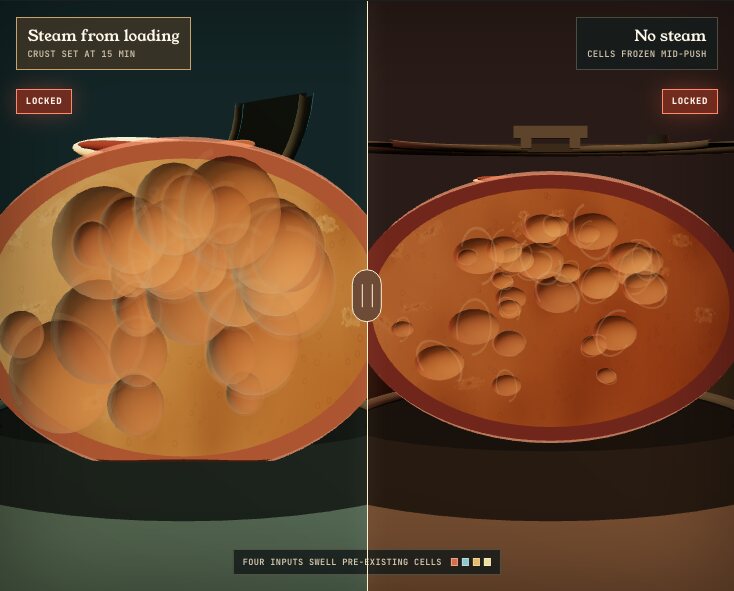
Scrub the first 15 minutes to see why steam preserves expansion time without creating the gas cells.
Interactive oven cutaway
Steam does not make lift. It buys time.
Scrub one oven clock and compare the same pre-existing gas cells with steam trapped from loading or with a dry surface.
- Surface
- Moist and flexible
- Gas cells
- Ready to inflate
- Structure
- Still extensible
Crust deadline lab
Scrub the spring window.
Heat sends four inputs into gas cells already formed during mixing. Steam only keeps the outer skin flexible while those cells grow.
Trap steam from the moment the loaf goes in. It delays crust set while the four spring mechanisms push outward.
Comparison and mechanism notes
If the shell hardens first, pressure can no longer enlarge the loaf or open the score cleanly. Late steam cannot unlock a rigid crust.
The cell growth is explanatory. The tool does not assign invented percentages to the four mechanisms or calculate finished loaf size.
The Dutch Oven: Home Baker’s Steam Chamber
The Dutch oven is the home baker’s best tool for oven spring because it solves the steam problem completely. A sealed cast-iron vessel traps moisture released by the dough itself, creating a miniature steam chamber that mimics a professional deck oven’s steam injection.
Robertson preheats his Dutch oven at 500°F for at least 20 minutes, then bakes with the lid on for 20 minutes (steam phase) before removing the lid for 20-25 minutes (crust phase). Forkish preheats at 475°F for 45 minutes, bakes lid-on for 30 minutes, then lid-off for 15-20 minutes.
The differences in temperature and timing reflect different philosophies, but both approaches produce excellent spring. The key shared principle: preheat the Dutch oven thoroughly (the thermal mass matters), keep the lid on for the first third of the bake (trap the steam), and remove the lid to finish (let the crust develop).
Robertson bakes hotter and faster. Forkish bakes slightly cooler and longer. Both insist on baking darker than most home bakers instinctively want. Robertson describes the target as “deep mahogany, not pale gold.” Forkish suggests baking “just shy of the point of burning it” at least once, to understand what full crust development looks like. For more on this approach, see our Dutch oven bread guide.
How Scoring Affects Oven Spring
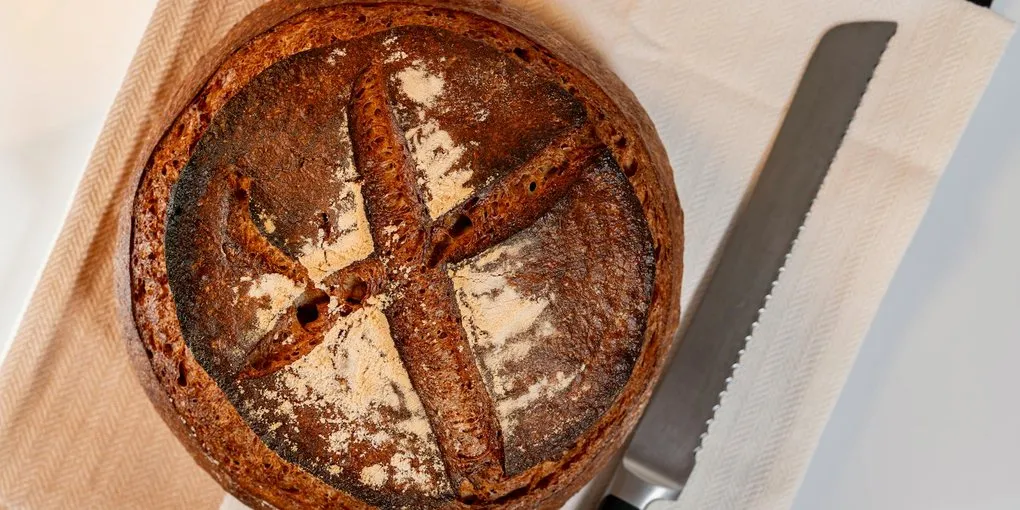
Scoring creates a controlled weak point in the dough surface. Without scoring, the expanding dough finds its own escape route — usually along the seam, at a thin spot in the crust, or wherever the surface happens to be weakest. The result is unpredictable tearing, uneven rise, and a misshapen loaf.
A deliberate score does three things. It controls where the loaf opens, directing expansion for even rise. It creates the decorative “ear” — the flap of crust that lifts and crisps during baking. And it prevents the pressure of internal expansion from blowing out the bottom or side of the loaf.
Scoring depth depends on proofing level. Buehler’s principle is precise: under-proofed dough needs deeper cuts because vigorous expansion lies ahead — the gluten still has plenty of strength and gas production capacity. Properly proofed dough gets medium-depth cuts. Over-proofed dough requires very shallow cuts because the gluten network is exhausted and deep cuts will cause deflation rather than controlled opening.
This is why scoring and proofing are linked. If your scored loaf deflates on the baking stone, the problem is not the score — it is over-proofing. If your loaf tears wildly around the score marks, the problem is under-proofing or insufficient scoring depth.
Forkish takes a contrarian position on scoring: he does not do it. He bakes seam-side up and relies on natural fissures from the seam splitting. The organic, rustic splits are part of his aesthetic. All other major authors (Hamelman, Robertson, Reinhart, Buehler) score their loaves. Both approaches produce bread with excellent oven spring — the difference is cosmetic, not structural.
For detailed scoring techniques, see our scoring guide.
What Kills Oven Spring
Oven spring fails for specific, diagnosable reasons. Each one maps back to the four mechanisms or the environmental conditions they require.
Over-Proofing
Over-proofing is the most common spring killer. Over-proofed dough has exhausted its fermentable sugars (Mechanism 1 has less fuel), stretched its gluten to the breaking point (gas cells cannot hold additional pressure), and used up much of its dissolved CO2 already (Mechanism 2 has less reserve). The poke test is your defense: if the dough does not spring back at all, bake immediately and expect compromised spring.
For detailed proofing assessment, see our overproofed vs. underproofed guide.
Cold Dough
Cold dough starts from a lower temperature, which means every mechanism takes longer to engage. Thermal expansion contributes less because the temperature differential is larger before gas expands meaningfully. Enzyme acceleration starts from a slower baseline. CO2 is more soluble in cold liquid, so it stays in solution longer.
This does not mean cold dough cannot spring — cold-retarded loaves bake beautifully from the fridge. But a cold oven or insufficient preheating compounds the cold dough problem. Forkish preheats his Dutch oven for 45 minutes at 475°F specifically to ensure maximum thermal mass. The hot vessel compensates for cold dough. Calculating your desired dough temperature before mixing helps manage this variable.
No Steam
Without steam, the crust sets in 5-6 minutes. Mechanisms 2, 3, and 4 are still ramping up at that point. A rigid crust constrains the loaf before internal forces have finished pushing outward. The result: dense crumb, pale crust, flat profile. If you are baking on a stone or steel without a Dutch oven, you need a steam injection method — a pan of boiling water, ice cubes, or a spray bottle. None are as effective as a sealed Dutch oven, but all are better than nothing.
Insufficient or Absent Scoring
Pressure needs somewhere to go. Without a scored weak point, expanding gas ruptures the crust at its weakest spot — usually the bottom or side of the loaf, where the skin is thinnest. The loaf blows out asymmetrically. Scoring directs the expansion upward, where you want it. A sharp bread lame makes clean, deliberate cuts.
Weak Gluten
The gluten network forms the walls of every gas cell. If the gluten is underdeveloped (under-mixed, no folds during bulk) or degraded (over-fermented, excessive protease activity), the cell walls cannot stretch to accommodate expanding gas. Instead of inflating, the cells rupture and merge, or simply collapse. The bread bakes flat and dense.
Gluten strength is built during mixing and folding, and maintained by proper fermentation timing. Salt at 2% of flour weight also plays a role — salt inhibits protease activity, which is one reason salted dough has stronger, more resilient gluten than unsalted dough.
Oven Temperature Too Low
All four mechanisms are temperature-dependent. A cool oven slows every one of them. The crust eventually sets before the interior has expanded fully, locking in a denser crumb. Use an oven thermometer to verify your oven’s actual temperature — most home ovens run hotter or cooler than the set point.
Lean doughs (baguettes, country bread) bake at 460-480°F. Enriched doughs bake lower (around 380°F) because the sugar and fat promote faster browning, but the spring window is still dependent on high initial heat.
Diagnosing Spring Problems from the Finished Loaf
The crumb and crust of a baked loaf tell you what went wrong — or right — during oven spring.
Dense, tight, uniform small holes throughout: Under-fermented or under-proofed. The gas cells never inflated sufficiently during bulk or the final proof. More fermentation time, warmer environment, or more active leaven.
Flat loaf, minimal rise, pale crust: Over-proofed, dead leaven, or no steam. Check the leaven with a float test before baking. Verify steam setup. Review proofing time.
Good height but large tunnels and collapsed structure: Over-proofed. Gas cells expanded beyond what the gluten could sustain, merged into tunnels, then partially collapsed.
Bread ripped open on the sides or bottom: Under-proofed combined with insufficient scoring. The dough had aggressive expansion energy but no controlled outlet. Deeper, more deliberate scores next time.
Open crumb near edges, dense center: Under-baked, or the dough was too cold in the center. The outer layer sprang while the interior was still warming up. Longer preheat, ensure dough is not ice-cold at the core. Check internal temperature with an instant-read thermometer.
For more crumb diagnostics, see our guide on why bread turns out dense.
Temperature Timeline: What Happens When
Understanding the sequence of events inside the oven puts all four mechanisms in context.
77-122°F (25-50°C) — The Sprint. Yeast fermentation accelerates dramatically. Enzymes run at increasing speed. Thermal expansion begins. CO2 starts leaving solution. This is the primary oven spring window — the dough is still flexible, the crust has not set, and all four mechanisms are pushing outward. Above 116°F, yeast begins dying; by 140°F it reaches thermal death. The sprint is intense but brief.
140-158°F (60-70°C) — The Transition. Yeast dies. Wheat starch begins gelatinizing. Gluten begins coagulating — the protein network transitions from elastic (stretchy) to rigid (permanent). Amylase enzymes reach peak activity, squeezing out a last burst of sugar and dextrins before they too are inactivated.
158-176°F (70-80°C) — The Lock. Gluten coagulation completes. The dough structure is now permanent — no further expansion is possible. Starch gelatinization is in full swing, absorbing water from the gluten network and setting the crumb. Enzyme activity ceases by approximately 176-194°F.
176-212°F (80-100°C) — The Set. The crumb interior reaches its maximum temperature (capped at 212°F by the evaporative ceiling — water cannot exceed its boiling point at atmospheric pressure). Remaining moisture redistributes. The internal structure is fully set.
212°F+ at the crust surface — The Finish. The crust, which lost its moisture earlier, climbs well above 212°F. Maillard reaction begins around 250°F, producing hundreds of flavor and aroma compounds. Caramelization follows at 330°F+. Together, these reactions create the color, flavor, and aroma of a properly baked crust.
For more on crust chemistry, see our Maillard reaction guide.
Putting It All Together
Oven spring is not mysterious. It is four physical mechanisms — enzyme acceleration, CO2 solubility decrease, vapor pressure increase, and thermal expansion — operating inside gas cells that were created during mixing and expanded during fermentation. Steam gives them time to work. Scoring gives them a direction to push. Proper proofing ensures the gluten can handle the stress.
Every variable you control as a baker — hydration, fermentation time, folding, shaping, proofing, oven temperature, steam — feeds into these four mechanisms either directly or by creating the conditions they need. When oven spring fails, it is because one or more mechanisms was undermined. When it succeeds, all four are working in concert inside a dough that was properly developed, properly proofed, and properly baked.
Frequently Asked Questions
- What causes oven spring in bread?
- Four mechanisms working simultaneously. Rising temperature accelerates enzyme activity and yeast fermentation, producing a final burst of CO2 before yeast dies at 116-140°F. CO2 dissolved in the dough's liquid phase comes out of solution as the dough heats (warm liquid holds less dissolved gas). Ethanol (boiling point 172°F) and water vaporize inside gas cells, expanding their volume dramatically. Existing gas bubbles expand according to Charles's Law as temperature increases. All four push outward against the gluten network before the crust sets.
- Why does steam help oven spring?
- Steam works in two phases. First, steam condenses on the cool dough surface, releasing latent heat that warms the outer layer while keeping it moist and flexible. Second, as that moisture evaporates, it creates a cooling effect that delays crust formation. Without steam, the crust sets in about 5-6 minutes. With steam, the crust stays extensible for 10-15 minutes — giving the four expansion mechanisms more time to push the loaf outward. A Dutch oven traps the dough's own moisture to create this steam environment automatically.
- Why did my bread not rise in the oven?
- The most common cause is over-proofing. Over-proofed dough has exhausted its fermentable sugars, stretched its gluten to the breaking point, and already released most of its dissolved CO2. Other causes: dead or inactive leaven (test with the float test), no steam in the oven (crust sets too early), oven temperature too low (slows all four mechanisms), or weak gluten from under-mixing or over-fermentation. Use the poke test before baking — if the indent doesn't spring back at all, the dough is over-proofed.
- How does scoring affect oven spring?
- Scoring creates a controlled weak point where expanding gas can push the crust open in a predictable direction. Without scoring, the dough ruptures wherever the surface is thinnest — usually the bottom or sides — producing uneven rise and a misshapen loaf. Scoring depth should match your proofing level: deep cuts for under-proofed dough (vigorous expansion ahead), medium cuts for properly proofed, and very shallow cuts for over-proofed (deep cuts will deflate exhausted gluten).
- Can I get good oven spring without a Dutch oven?
- Yes, but it requires a steam injection method. The most common approach: preheat a baking stone or steel, place a cast-iron pan on the rack below, and pour boiling water into the pan immediately after loading the bread. Some bakers spray the oven walls with water or toss ice cubes onto the hot pan. None of these methods match the sealed, self-steaming environment of a Dutch oven, but all improve spring significantly compared to baking with no steam at all. Remove the water pan after 15 minutes to let the crust dry and crisp.
Some links above are affiliate links. If you purchase through them, we earn a small commission at no extra cost to you.