Salt does five jobs in bread dough: it strengthens the gluten network, controls fermentation rate, inhibits protease enzymes that degrade gluten, enhances flavor perception, and preserves residual sugars for Maillard browning. The standard is 2% of flour weight (10g per 500g flour). Salt is always added after the autolyse — never during — because it inhibits water absorption and competes with flour hydration.
Salt is the smallest ingredient in bread by weight and the one that does the most jobs. At just 2% of flour weight — 10g per 500g of flour — salt simultaneously strengthens gluten structure, controls fermentation rate, inhibits enzymes that would degrade your dough, and adds the flavor that separates bread from edible cardboard.
Forget salt once and you’ll understand all five of its roles immediately. Bread made without salt ferments too fast, spreads flat, tastes bland, and has a pale, uninspiring crust. It’s the most instructive mistake you can make in baking.
Salt and Flavor
Salt enhances flavor perception. This is the obvious role, and the one most people think of first. But it’s worth being specific: salt doesn’t just make bread taste “salty.” At 2% of flour weight, salt is below the threshold where most people perceive saltiness directly. Instead, it amplifies the perception of other flavors — the wheaty sweetness of fermented flour, the subtle complexity from organic acids, the caramel notes from crust browning.
Bread baked without salt tastes flat and one-dimensional even when all other elements are perfect. The fermentation flavors are still there chemically, but your palate can’t pick them up without salt to boost the signal.
All five major bread authors — Hamelman, Robertson, Forkish, Reinhart, and Buehler — use salt at approximately 2% of flour weight, though exact numbers vary slightly.
Salt Percentage Across Major Bread Authors
All percentages are baker's percentage — weight of salt relative to total flour weight
| Author | 01Salt % | 02Context |
|---|---|---|
| Hamelman | 1.8–2.0% | Professional bakery standard |
| Robertson | 2.0% | Consistent across all Tartine recipes |
| Forkish | 2.1–2.2% | Slightly higher for bolder flavor |
| Reinhart | 2.0% | Standard recommendation |
| Buehler | 2.0% | Reference standard |
Source: Hamelman (Bread, 3rd Ed.), Robertson (Tartine Bread), Forkish (FWSY), Reinhart (BBA), Buehler (Bread Science)
jayarrbread.comSalt and Gluten Structure
Salt strengthens the gluten network. When salt dissolves in dough, sodium and chloride ions interact with the charged amino acid residues on glutenin and gliadin proteins. This tightens the protein network, making the dough more elastic and better able to retain gas.
The effect is measurable. Dough made with no salt is noticeably slack, sticky, and extensible — it stretches easily but doesn’t spring back. Add 2% salt and the same dough becomes tighter, more cohesive, and resilient. The gluten network holds its shape.
This is why salt is never added during autolyse. The autolyse step — mixing flour and water and resting before adding other ingredients — works precisely because salt is absent. Without salt tightening the gluten, the flour hydrates more completely and enzymes work more freely. Forkish puts it directly: “Salt inhibits water absorption and competes with the goals of the autolyse step.”
Salt and Protease Inhibition
Salt inhibits protease enzymes in flour. Proteases are endogenous enzymes that snip peptide bonds in glutenin chains, gradually reducing gluten strength over time. At low levels, this is beneficial — proteases soften tight gluten, improve extensibility, and release amino acids that serve as Maillard reaction precursors for crust flavor.
But left unchecked during long fermentations, proteases can degrade the gluten network to the point where the dough can no longer hold gas. The loaf deflates, spreads flat, and won’t spring in the oven.
Salt keeps proteases in check. By stabilizing the gluten structure, salt ensures that even during a 12–14 hour overnight fermentation, the dough retains enough structural integrity to produce a tall, well-risen loaf.
This is one reason why very long-fermented doughs (like Forkish’s Overnight White at 12–14 hours) still work despite minimal yeast — the salt is quietly protecting the gluten from enzymatic breakdown throughout the entire bulk fermentation.
Salt and Fermentation Rate
Salt slows yeast activity. Dissolved salt creates osmotic pressure that pulls water away from yeast cells, reducing their metabolic rate. The higher the salt percentage, the more pronounced the effect.
How Salt Percentage Affects Bread
From zero salt to oversalted — the full range of effects
| Salt % | 01Fermentation | 02Gluten | 03Flavor | 04Crust |
|---|---|---|---|---|
| 0% | Very fast, hard to control | Weak, slack, sticky | Bland, flat | Pale, anemic |
| 1% | Fast, some control | Some improvement | Still relatively flat | Light browning |
| 2% (standard) | Manageable pace | Strong, elastic, resilient | Full, complex | Golden brown |
| 2.5%+ | Significantly slowed | Noticeably tight | Can taste salty | Deep browning |
Adapted from Buehler, Bread Science
jayarrbread.comAt 0% salt, fermentation is very fast — almost uncontrollably so. The dough rises quickly but develops weak structure and bland flavor. At 2% salt, fermentation proceeds at a manageable pace that allows flavor to develop alongside volume. Above 2.5%, fermentation slows significantly, the gluten becomes noticeably tight, and the bread can taste salty.
This relationship between salt and fermentation timing is why bakers can’t simply add or remove salt without adjusting the entire formula. Cut the salt in half and you’ll need to cut the yeast too, or the dough will over-ferment before you can get to it. Double the salt and fermentation might stall entirely.
Salt and Crust Color
Salt affects crust browning indirectly. By slowing fermentation, salt ensures that not all of the flour’s sugars are consumed by yeast before baking. Those residual sugars participate in the Maillard reaction — the chemical reaction between amino acids and reducing sugars that produces the brown pigments and complex flavors of a well-baked crust.
Bread made without salt often has a pale, anemic crust. The yeast, unchecked by salt, consumed too much sugar during fermentation, leaving insufficient Maillard substrates for proper browning.
The Standard: 1.8–2.2%
Every major bread author lands in a narrow range for salt percentage, though their exact preferences differ:
- Hamelman: 1.8–2% (the professional standard)
- Robertson: 2% consistently
- Forkish: 2.1–2.2% (slightly higher than the norm, which he prefers for flavor)
- Reinhart: 2%
- Buehler: 2% reference
The differences are small but detectable. Forkish’s extra 0.1–0.2% contributes a slightly more assertive flavor and marginally slower fermentation. Robertson and Reinhart sit squarely at the center. Hamelman, writing from a professional bakery context where large-batch consistency matters, keeps the lower end.
For home baking, 2% is the safe default. If you like slightly more assertive bread, try 2.2%. Below 1.8%, most people will notice something missing.
For a guide to baker’s percentages, see our calculator and explainer.
Salt Types: Does It Matter?
For dough mixing, the type of salt makes almost no difference to the chemistry. Table salt, kosher salt, sea salt, and pink Himalayan salt all deliver sodium chloride. The only variable that matters is weight — and since you’re measuring by weight on a kitchen scale (you are, right?), the granule size differences between kosher and table salt become irrelevant.
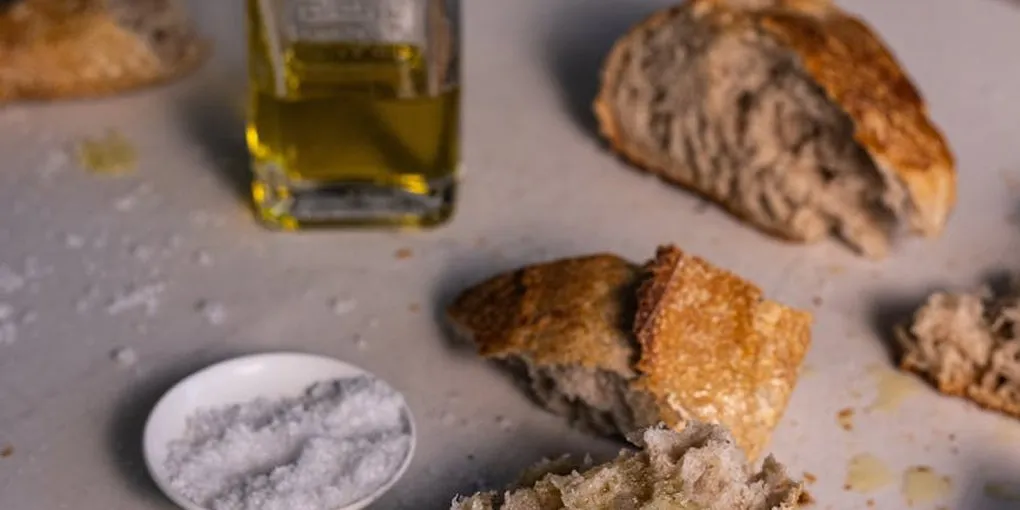
Where salt type matters is finishing. Flaky Maldon salt or coarse sea salt sprinkled on focaccia or pretzels before baking adds texture contrast and visual appeal. But in the dough itself, 10g of any salt is 10g of salt.
One exception: salts with high mineral content (some grey Celtic sea salts, Hawaiian black salt) can carry trace minerals that very slightly affect water hardness and enzyme activity. The effect is negligible for home baking but theoretically measurable at production scale.
When to Add Salt
Salt goes in after the autolyse, when used. The sequence matters:
- Mix flour and water. Rest 20–60 minutes (autolyse).
- Add salt (and yeast, and leaven if applicable).
- Mix until incorporated.
Adding salt at the beginning competes with hydration. Adding it during the autolyse defeats the purpose of the autolyse. Adding it after gives you the best of both worlds — fully hydrated flour with enzymatic head start, followed by salt’s structural tightening and fermentation modulation.
If you’re not using an autolyse (shorter recipes, quick breads, enriched doughs), add salt with the dry ingredients at the start. The autolyse timing question only applies to lean doughs with dedicated rest periods.
What Happens If You Forget Salt
You’ll know immediately during mixing. The dough will feel slack, sticky, and overly extensible. It won’t tighten up no matter how long you mix. During bulk fermentation, it will rise too fast and may over-proof before you expect it. The shaped loaf will spread flat. The crust will be pale. And the flavor will be aggressively bland — not subtly bland, but noticeably, almost offensively flat.
If you realize you’ve forgotten salt during mixing, you can add it late. Sprinkle it over the dough surface and fold it in with stretch-and-fold technique. It won’t distribute as evenly as if it had been mixed in from the start, and you may get pockets of saltiness, but it’s far better than baking without it.
If you realize after shaping — bake it anyway. Unsalted bread makes decent toast points, croutons, and bread crumbs. Treat it as a learning experience. You’ll never forget salt again.
Salt and Long Fermentation
Salt’s role becomes more critical as fermentation times increase. In a quick bread with heavy yeast that rises in 90 minutes, salt’s effect on fermentation timing is relatively minor — the yeast is so abundant that it overwhelms the salt’s inhibition. But in a long-fermented dough — Forkish’s Overnight White at 12–14 hours, or any cold-retarded sourdough — salt is doing essential structural work throughout.
During those long hours, protease enzymes are slowly snipping peptide bonds in the glutenin chains. Salt’s inhibition of protease activity is what prevents the gluten from degrading to the point of collapse. A 12-hour fermentation without salt would produce a puddle, not a loaf.
The organic acids produced during long fermentation also interact with salt. In sourdough baking, the combination of salt’s ionic effects and the acids’ pH effects on gluten produces a dough with distinctive handling properties — firm, slightly tacky, and remarkably resilient. This is why well-made sourdough has such satisfying structure.
Salt Reduction: How Low Can You Go?
Health-conscious bakers sometimes want to reduce salt below 2%. This is possible but requires adjustment.
At 1.5% salt, bread is still acceptable. Fermentation will be slightly faster — reduce yeast by 10–15% to compensate. Flavor will be subtly less complex but not bland.
At 1% salt, the changes become noticeable. Gluten structure weakens. Fermentation accelerates significantly. The bread tastes flat to most palates.
Below 1%, you’re baking a fundamentally different product. The fermentation is difficult to control, the structure suffers, and the flavor is genuinely compromised. If health requires salt reduction at this level, consider using potassium chloride as a partial substitute — it provides some of the ionic effects on gluten without the sodium.
The reality is that a single slice of bread at 2% salt contains about 200–250mg of sodium — roughly 10% of the daily recommended intake. Most dietary sodium comes from processed foods, restaurant meals, and condiments, not from homemade bread.
An Experiment Worth Trying
If you want to truly understand what salt does, bake two small loaves side by side — one with 2% salt, one with none. Use the same flour, same hydration, same yeast, same technique. The salted dough will feel tighter and more manageable during mixing. It will rise at a measured pace. It will shape cleanly with good surface tension. The crust will brown beautifully. And the flavor will have depth and complexity.
The unsalted dough will feel slack and sticky. It will over-proof if you’re not watching. It will spread flat during proofing. The crust will be pale. And the flavor will make you understand, in a way that no article can fully convey, exactly how much work 10 grams of salt is doing in every loaf you bake.
Frequently Asked Questions
- Can I use kosher salt instead of table salt in bread?
- Yes, as long as you measure by weight, not volume. Kosher salt has larger crystals than table salt, so a teaspoon of kosher salt weighs less than a teaspoon of table salt. On a kitchen scale, 10g is 10g regardless of crystal size. All major bread authors insist on weight measurement for exactly this reason.
- Why does bread taste bland even when I add salt?
- If you're using 2% salt and the bread still tastes flat, the issue is likely fermentation, not salt. Under-fermented bread hasn't developed enough organic acids, alcohols, and esters — the flavor compounds that salt enhances. Try a longer bulk fermentation, a cooler dough temperature, or a pre-ferment like poolish. More time equals more flavor for salt to amplify.
- Does salt kill yeast?
- Salt doesn't kill yeast at bread-baking concentrations (1.8–2.2%). It slows yeast activity by creating osmotic pressure that draws water from yeast cells, reducing their metabolic rate. This is actually beneficial — controlled fermentation produces better flavor and more manageable dough. Direct contact between undissolved salt and yeast can damage cells, which is why some bakers add them to opposite sides of the flour before mixing.
- How much sodium is in a slice of homemade bread?
- A standard slice from a loaf made with 2% salt contains roughly 200–250mg of sodium, about 10% of the recommended daily intake. This is comparable to commercial bread. Most excess dietary sodium comes from processed foods, not homemade bread.