Soft pretzels get their dark, burnished crust from an alkaline bath -- baking soda or food-grade lye dissolved in water. The alkalinity accelerates the Maillard reaction during baking, producing deep brown color and complex flavor at temperatures where regular bread stays pale. The dough is a stiff 58% hydration enriched with butter, shaped into twists, dipped for 20-30 seconds, and baked at 425 degrees F for 14-16 minutes.
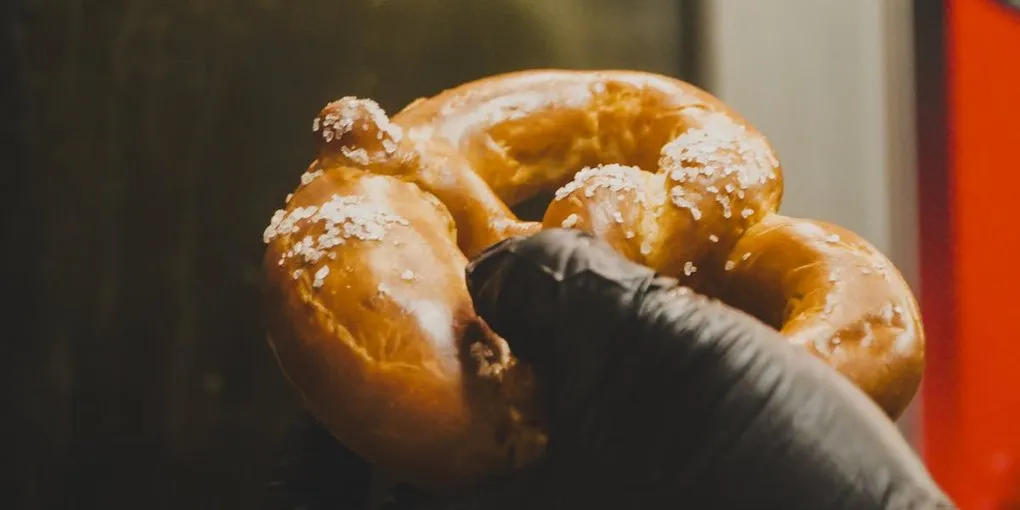
A proper soft pretzel has a dark, burnished crust that cracks when you bite through it and a soft, slightly chewy interior that pulls apart in tender layers. The surface is slick and glossy — not floury, not bready. Coarse salt crystals cling to the outside. It’s nothing like a dinner roll twisted into a shape.
That dark, distinctive crust comes from an alkaline bath. Before baking, the shaped pretzels take a brief dip in a baking soda solution (or, for professionals, food-grade lye). The alkalinity dramatically accelerates the Maillard reaction during baking, producing the deep brown color and complex flavor at temperatures where regular bread dough would still be pale and bland. No amount of egg wash or sugar glaze replicates this effect.
The whole process takes about 2.5 hours, most of it hands-off rising time. The shaping is the only step that requires practice, and even that gets easy after the third pretzel.
The Alkaline Bath: Why It Works
The Maillard reaction — amino acids combining with reducing sugars to produce brown pigments and hundreds of flavor compounds — is the primary browning mechanism in bread baking. It typically begins around 250F at the crust surface and accelerates with higher temperatures.
An alkaline environment shifts this chemistry. When the dough surface is alkaline (high pH), the Maillard reaction starts earlier and proceeds more aggressively. This means pretzels develop deep mahogany color and intense, slightly bitter, savory flavor in the same baking time and temperature where regular bread would barely turn golden.
You have two options for the alkaline bath:
Baking soda solution (home baker standard): 2 tablespoons baking soda per quart of water. This produces a pH around 8.5 — mildly alkaline. The result is a noticeably darker, shinier crust than unbathed dough, with a pleasant pretzel flavor. Good for home use.
Food-grade lye solution (traditional): 3-4% sodium hydroxide (food-grade lye) in water. This produces a pH around 13-14 — strongly alkaline. The result is the dark, almost black-brown crust with the sharp, distinctive pretzel flavor you recognize from Bavarian bakeries. This is how commercial pretzels are made. It’s safe when handled properly — wear gloves, don’t splash, and the lye is completely neutralized during baking. But baking soda gets you 80% of the way there with zero safety considerations.
The Recipe
Yield: 8 large soft pretzels
Ingredients
| Ingredient | Weight | Baker’s % |
|---|---|---|
| Bread flour | 500g | 100% |
| Water, warm (90-95F) | 290g | 58% |
| Unsalted butter, softened | 30g | 6% |
| Sugar | 15g | 3% |
| Salt | 10g | 2% |
| Instant dry yeast | 5g | 1% |
For the alkaline bath:
- 2 quarts water
- 4 tablespoons baking soda (or 60g food-grade lye for traditional method)
Finishing:
- Coarse pretzel salt or flaky sea salt
- 3 tablespoons melted butter (for brushing after baking)
Total hydration: 58%. This is a stiff, smooth dough — easy to shape and roll into ropes without the dough fighting back.
Try It Yourself
The Baker's Bench
Scale the pretzel formula for any batch size with the Baker's Bench tool -- it handles enriched doughs and baker's percentages.
Open ToolEquipment
- Kitchen scale
- Stand mixer with dough hook (or strong hands)
- Large pot or deep baking dish (for the alkaline bath)
- Sheet pan with parchment
- Slotted spoon
Method
Step 1: Mix the Dough
Combine flour, sugar, yeast, and salt in a stand mixer bowl. Add the warm water. Mix on low speed for 2 minutes until combined. Add the softened butter and mix on medium speed for 6-8 minutes.
The dough is ready when it’s smooth, slightly tacky, and pulls cleanly from the bowl sides. It should feel firmer than sandwich bread dough but not as stiff as bagel dough. The butter makes it pliable — this is a lightly enriched dough, and the fat lubricates the gluten strands for a tender final texture.
By hand: Combine ingredients, mix with a wooden spoon until a dough forms, then knead on an unfloured surface for 10-12 minutes. The butter incorporation is messy at first but smooths out quickly.
Step 2: Bulk Fermentation (1 hour)
Place the dough in a lightly oiled bowl, cover, and let rise at room temperature (75-78F) until doubled. About 1 hour with 1% yeast. One fold at the 30-minute mark helps organize the gluten structure without deflating too much gas.
Step 3: Shape the Pretzels
Divide the dough into 8 equal pieces (about 107-110g each). Working with one piece at a time (keep the rest covered), roll each piece into a rope about 24 inches long. The rope should be thinner at the ends and slightly thicker in the middle — this creates the classic pretzel proportions where the bottom arc is thick and chewy while the crossed arms are thinner and crispier.
The pretzel twist:
- Hold the rope in a U shape in front of you, with the ends pointing away.
- Cross the ends over each other twice, creating a twist about 2 inches from the tips.
- Fold the twisted ends down and press them firmly into the bottom of the U, at roughly the 4 o’clock and 8 o’clock positions.
- Press firmly to seal — if the ends don’t stick, dab a tiny bit of water on the contact points.
The shape should look like a classic pretzel with two loops and a thick bottom arc. Don’t stress about perfection — irregular pretzels taste exactly as good as symmetrical ones, and the shape firms up during proofing and baking.
Place shaped pretzels on a parchment-lined sheet pan, spaced 2 inches apart.
The Pretzel Twist -- Step by Step
From dough ball to classic pretzel shape
- 01
Roll the Rope
Roll each 110g piece into a 24-inch rope -- thinner at the ends, thicker in the middle
If the dough springs back, let it rest 5 min and try again
- 02
Form the U
Hold the rope in a U shape with the ends pointing away from you
- 03
Cross Twice
Cross the ends over each other twice, about 2 inches from the tips, creating a twist
- 04
Fold and Seal
Fold the twisted ends down and press firmly into the bottom of the U at 4 and 8 o'clock
Dab water on contact points if dough won't stick
Imperfect shapes taste just as good -- the form firms up during proofing and baking
jayarrbread.comStep 4: Rest (15-20 minutes)
Let the shaped pretzels rest uncovered at room temperature for 15-20 minutes. They’ll relax and puff slightly. This is a short proof — you don’t want them to fully double. Slightly under-proofed pretzels have better oven spring and a chewier texture.
Step 5: Alkaline Bath
Preheat your oven to 425F.
Baking soda method: Bring 2 quarts of water to a boil, add 4 tablespoons baking soda (it will foam up — use a big pot). Reduce to a gentle simmer.
Lye method: Dissolve 60g food-grade lye into 2 quarts of room-temperature water (always add lye to water, never water to lye). No heat needed — lye works at any temperature.
Using a slotted spoon, lower each pretzel into the solution for 20-30 seconds. For baking soda, both sides. For lye, a quick dip is sufficient — the higher pH works faster. Lift out, let excess liquid drain for a few seconds, and return to the parchment-lined sheet pan.
The pretzels will immediately look different — slightly yellow-tinged and slick. This is the alkaline surface that will produce the dark crust.
Step 6: Salt and Bake
Sprinkle coarse pretzel salt on the wet pretzels immediately — it sticks to the alkaline surface just like toppings stick to boiled bagels. If you want to score, a single slash across the thick bottom arc is traditional — it opens into a dramatic split during baking.
Bake at 425F for 14-16 minutes. The pretzels are done when they’re deep chestnut brown — much darker than you’d bake regular bread. This is the Maillard reaction running at full speed on the alkaline surface. Don’t pull them early because the color looks dark enough. That color IS the flavor.
Brush with melted butter immediately out of the oven. The butter soaks into the hot crust and adds richness that rounds out the alkaline bite.
Cool for 5-10 minutes. Soft pretzels are best eaten warm.
The Science of Alkaline Browning
Bread crust gets its color from two overlapping reactions: the Maillard reaction (amino acids + reducing sugars, onset around 250F at the surface) and caramelization (sugar thermal decomposition, onset around 330F). Both require the crust surface to reach temperatures well above 212F — which only happens after surface moisture evaporates.
An alkaline surface changes the equation. At higher pH, the amino groups on proteins become deprotonated and more reactive. The Maillard reaction starts at lower temperatures and produces different melanoidin compounds — the brown pigments responsible for that deep, almost ruddy pretzel color that regular bread never achieves.
This is the same chemistry behind century eggs, ramen noodles (kansui is an alkaline solution), and the browning of pretzels. The alkaline treatment doesn’t cook the dough — it primes the surface for accelerated browning once it hits the oven.
The baking soda solution produces a mildly alkaline surface (pH ~8.5). Food-grade lye produces a strongly alkaline surface (pH ~13-14). The lye-dipped pretzels brown more aggressively, develop a more complex bitter-savory flavor, and have the characteristic crackly surface texture. Both are fully safe to eat — the lye neutralizes during baking.
Variations
Pretzel bites: Instead of shaping full pretzels, roll the dough into ropes and cut into 1-inch pieces. Dip in the alkaline bath, bake at 425F for 10-12 minutes. Perfect for dipping in cheese sauce or mustard.
Cinnamon sugar pretzels: Skip the salt. After baking, brush with melted butter and roll in cinnamon sugar (1/4 cup sugar + 2 teaspoons cinnamon).
Stuffed pretzels: Roll the dough thinner, wrap around sticks of cheddar or mozzarella before shaping. Seal edges well. The cheese melts inside during baking.
Everything pretzels: Top with the same everything mix used for bagels — sesame, poppy, dried garlic, dried onion, flaky salt.
Sourdough discard version: Fold sourdough discard into the dough for fermented depth and a more tender crumb. Our full sourdough discard soft pretzels recipe covers both a real Bavarian lye bath (with a safety protocol) and a safer baked-baking-soda alternative.
Dipping Sauces
Soft pretzels are a delivery system for dipping. The classics: yellow mustard (the original), spicy brown mustard, beer cheese sauce, honey mustard. For something different: warm Nutella, marinara, or ranch.
Storing Soft Pretzels
Soft pretzels are at their peak within 2-3 hours of baking. The crust loses its crackle as it absorbs moisture from the interior, and the crumb stiffens as starch retrogradation begins. Reheating helps: 350F for 5-7 minutes revives some of the texture. For more on keeping bread fresh, see the bread storage guide.
Freezing: Cool completely, wrap individually in plastic, freeze for up to 2 months. Reheat from frozen at 350F for 10-12 minutes. Brush with butter again after reheating.
Since this is a lightly enriched dough (butter and sugar), it resists staling slightly longer than lean breads — the fat slows starch retrogradation. But not by much. Eat them fresh whenever possible.
Troubleshooting
Pretzels are pale, not dark brown: The alkaline bath was too dilute or the dip was too short. Use a full 4 tablespoons of baking soda per 2 quarts. Dip for a full 20-30 seconds. Also check oven temperature — 425F minimum.
Arms are crispy but the body is raw: Uneven dough thickness. Roll the ropes so the center is noticeably thicker than the ends — the thin arms bake faster, so the thick body needs a head start on heat.
Shape fell apart during baking: The ends weren’t sealed well enough, or the dough was over-proofed and too slack. Press the ends firmly into the body, and use a dab of water if the dough isn’t tacky enough to stick.
Too chewy/tough: Over-kneaded. Reduce mixing time. For pretzels, you want good gluten development but not aggressive — the dough should be smooth and supple, not tight and elastic.
Salt fell off: Applied after the alkaline surface dried. Salt must go on immediately after the bath, while the surface is still wet and slick.
For more general baking troubleshooting, see our bread troubleshooting guide.
Frequently Asked Questions
- Is food-grade lye safe for making pretzels at home?
- Food-grade lye (sodium hydroxide) is safe when handled properly -- wear gloves, don't splash, and always add lye to water (never water to lye). The lye is completely neutralized during baking, so the finished pretzels are safe to eat. This is the traditional method used in Bavarian bakeries and produces a deeper, more complex crust than baking soda. That said, a baking soda bath gets you about 80% of the flavor and color with no safety considerations at all.
- Why do soft pretzels need an alkaline bath?
- The alkaline bath raises the pH of the dough surface, which accelerates the Maillard reaction during baking. At higher pH, amino acids become more reactive and combine with reducing sugars at lower temperatures to produce the dark brown pigments and savory, slightly bitter flavor that define a pretzel. Without the alkaline treatment, pretzels bake to the same pale golden color as regular bread rolls.
- Can I use baking soda instead of lye for pretzels?
- Yes. A baking soda solution (2 tablespoons per quart of water, brought to a boil) produces a mildly alkaline surface (pH ~8.5) compared to lye's strongly alkaline surface (pH ~13-14). The result is a lighter brown color with less of the sharp pretzel bite, but it's still distinctly pretzel-like and far better than no bath at all. Most home bakers use baking soda and get great results.
- How do I shape a pretzel twist?
- Roll the dough into a 24-inch rope, thinner at the ends and thicker in the middle. Form a U shape, cross the ends over each other twice about 2 inches from the tips, then fold the twisted ends down and press firmly into the bottom of the U at the 4 and 8 o'clock positions. Press firmly to seal -- a dab of water helps if the dough isn't tacky enough.
- How do I reheat soft pretzels?
- Oven reheating works best: 350F for 5-7 minutes for room-temperature pretzels, 10-12 minutes from frozen. Brush with melted butter after reheating to restore richness. Microwaving makes pretzels rubbery -- avoid it. The oven heat partially reverses starch retrogradation, restoring some chew to the interior while re-crisping the crust.