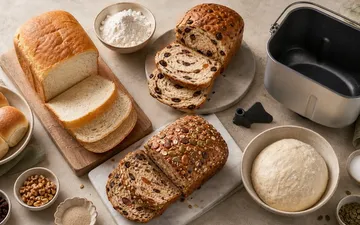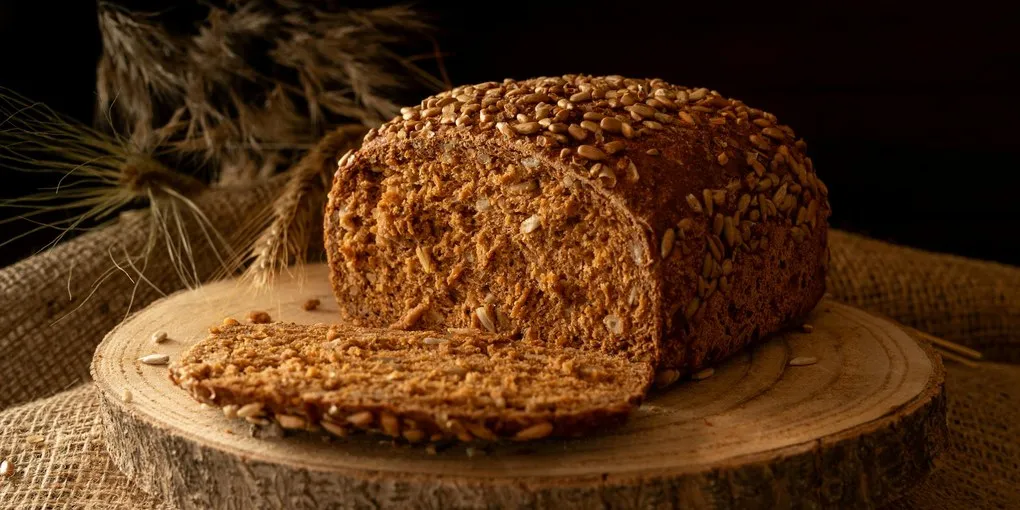
Spelt bakes into beautiful bread if you treat it like spelt instead of wheat. Drop hydration to 63-68%, keep mixing short (stand mixer under 5 minutes total, or stretch-and-fold by hand), bulk ferment only 1.5-2.5 hours to a 50-60% rise, and shape firmly but once. Spelt's gluten is weaker and more extensible than modern wheat gluten, so it overworks fast and collapses when over-fermented — but the trade is a nutty, faintly sweet crumb that plain bread flour can't match.
Before you buy or bake
- A gluten-free claim is not a wheat-free claim
- These are two different questions and they need two different label checks. Under US rules a food may carry a compliant gluten-free claim and still contain processed wheat starch, provided the finished gluten level is below the regulatory limit and wheat is declared as an allergen. If you are managing a wheat allergy, read the allergen declaration for wheat and follow your allergist’s guidance — a gluten-free claim, certified or not, is not evidence that wheat is absent.
Try It Yourself
The Baker's Bench
Scale this spelt formula for any loaf size and recalculate hydration on the fly with the Baker's Bench tool.
Open ToolSpelt is one of the oldest cultivated grains, a close relative of modern bread wheat with a distinct nutty, slightly sweet flavor that modern wheat can’t replicate. It makes beautiful bread — golden-crusted, with a tender crumb and a depth of flavor that stands on its own without elaborate fermentation schedules or special techniques. Like whole wheat bread, whole spelt carries bran and germ that add flavor but ask for a gentler hand.
But spelt is not modern bread wheat, and it doesn’t behave like it. Its gluten is weaker, its tolerance for rough handling is lower, and the margins for error are narrower. Bakers who approach spelt with white-wheat technique end up with flat, dense, spreading loaves and conclude that spelt “doesn’t work.” It works. It just requires you to recalibrate.
What Makes Spelt Different
Spelt is wheat, and it contains gluten. It is not a gluten-free grain, it is not safe for celiac disease, and for a wheat allergy it must be treated as wheat unless an allergist has specifically cleared it. That is worth stating up front, because spelt is often shelved and marketed as an alternative to wheat rather than as a variety of it.
Spelt (Triticum spelta) is an ancient grain — a close genetic relative of modern bread wheat (Triticum aestivum) that’s been cultivated since the Bronze Age. Like T. aestivum, spelt is a hexaploid wheat, but it wasn’t subjected to the same millennia of selective breeding for baking performance that shaped today’s bread wheat cultivars.
The key difference is gluten quality. Spelt contains gluten-forming proteins (glutenin and gliadin), but the gluten network it produces is weaker and more extensible than modern wheat gluten. The dough stretches more easily but springs back less. It’s more fragile — easier to overwork and quicker to break down.
Hamelman and Reinhart both characterize spelt as having weaker gluten that requires adjusted technique. The practical implications touch every stage of bread making, from hydration to mixing to fermentation to shaping.
Spelt vs Modern Wheat: Key Differences for Bakers
How to adjust technique when you swap bread flour for spelt
| Property | 01Modern Wheat (Bread Flour) | 02Spelt |
|---|---|---|
| Gluten strength | Strong, elastic | Weaker, more extensible |
| Ideal hydration | 68-78% | 63-68% |
| Mixing tolerance | High — forgiving of longer mixing | Low — overworks quickly |
| Autolyse benefit | Helpful | Essential |
| Bulk ferment time | 2-5 hours (varies) | 1.5-2.5 hours |
| Target rise | Roughly double | 50-60% volume increase |
| Flavor | Mild, neutral | Nutty, slightly sweet |
| Best mixing method | Stand mixer or hand knead | Stretch-and-fold preferred |
| Shaping | Multiple shapes, rework possible | Shape once, don't rework |
Start with a 30% spelt / 70% bread flour blend if you're new to the grain — standard wheat technique applies. Move toward 100% spelt as you get comfortable with the rules below.
jayarrbread.comFor more on how gluten works, see our gluten guide.
Rule 1: Lower Hydration
Spelt flour hydrates quickly but can’t hold onto that water the way modern wheat flour does. Despite having comparable protein content, spelt’s weaker gluten network can’t support the same hydration levels. Where a modern wheat bread flour might handle 72-78% hydration comfortably, spelt needs to stay lower.
Target hydration for 100% spelt bread: 63-68%
Target hydration for spelt-wheat blends: Scale between wheat and spelt targets proportionally. A 50/50 blend works well at 68-72%.
Going too high with hydration produces a slack, sticky dough that spreads flat during proofing and baking. The weaker gluten simply can’t hold the water and the gas simultaneously. Start at 65% for your first spelt loaf and adjust from there.
For more on hydration and how it affects dough, see our hydration guide.
Rule 2: Gentle Mixing
Spelt’s gluten develops faster than wheat gluten but also breaks down faster. There’s a narrow window between “sufficiently developed” and “overworked.” Overmixed spelt dough becomes sticky, slack, and loses its ability to hold gas — and unlike wheat dough, you can’t fix it by mixing more.
Stand mixer: First speed 2 minutes to combine, second speed 3-4 minutes maximum. This is significantly less than the 8-10 minutes typical for wheat bread. Check frequently.
Hand mixing: Stretch-and-fold is ideal for spelt. Mix to a shaggy mass, then do 3-4 sets of stretch-and-fold at 30-minute intervals during bulk fermentation. This develops gluten progressively without the sustained mechanical stress that breaks spelt gluten down.
Autolyse helps significantly. A 20-30 minute autolyse (flour and water only, no salt or yeast) lets the spelt proteins hydrate gently and begin forming gluten bonds without any mechanical input. This gives you a head start on gluten development, which means less mixing is needed after adding salt and yeast. If you knead by hand, autolyse is how you do most of the work without ever kneading.
Rule 3: Shorter Fermentation
Spelt dough is less tolerant of long fermentation than wheat dough. The weaker gluten network degrades faster under the influence of protease enzymes, and the dough’s ability to hold gas diminishes more quickly.
Bulk fermentation: 1.5-2.5 hours at 75-78F, depending on yeast quantity. This is shorter than a typical wheat bread bulk ferment. Watch for a 50-60% volume increase rather than the doubling you’d wait for with wheat.
Final proof: 45-60 minutes at room temperature, or overnight in the fridge (cold retard). The cold retard is particularly useful for spelt because it slows protease activity while allowing flavor to develop.
Over-fermentation is the enemy. Spelt dough that’s over-fermented doesn’t just get a little slack — it collapses. The gluten has degraded past the point of recovery. If you see the dough starting to flatten or pool at the edges, shape and bake immediately.
Rule 4: Shape Firmly but Quickly
Spelt dough is more extensible than wheat dough, which means it’s easier to stretch during shaping — but it’s also more prone to tearing if you work it too aggressively. The goal is a firm shape with good surface tension, achieved with decisive but gentle movements.
Pre-shape into a round, rest 15-20 minutes (not longer — the dough relaxes quickly), then do your final shape. Work efficiently. Spelt dough doesn’t benefit from repeated shaping attempts the way wheat dough does. If you need a refresher on boule technique, see our shaping guide.
For pan loaves, spelt is more forgiving — the pan provides structure that compensates for the weaker gluten. This makes spelt sandwich bread an excellent entry point.
The Recipe: 100% Spelt Country Loaf
Yield: 1 medium loaf (about 800g)
Ingredients
| Ingredient | Weight | Baker’s % |
|---|---|---|
| Whole spelt flour | 300g | 60% |
| White spelt flour | 200g | 40% |
| Water (85F / 29C) | 330g | 66% |
| Salt | 10g | 2% |
| Instant dry yeast | 4g | 0.8% |
| Honey | 10g | 2% |
Using a blend of whole and white spelt gives better structure than 100% whole spelt (less bran damage to the gluten network) while keeping the nutty spelt flavor front and center.
Method
-
Autolyse (20-30 minutes): Combine both spelt flours and water. Mix until no dry flour remains. Cover and rest 20-30 minutes.
-
Mix (4-5 minutes total): Add salt, yeast, and honey. Mix on low speed 2 minutes to incorporate, then medium speed 2-3 minutes. Stop as soon as the dough pulls from the bowl sides and looks cohesive. Do not overmix. The dough will feel softer and more extensible than wheat dough — this is normal.
-
Bulk ferment (1.5-2 hours at 75-78F): Perform 2 sets of stretch-and-fold at 30-minute intervals. After the second fold, leave undisturbed. Target a 50-60% volume increase.
-
Pre-shape and bench rest (15 minutes): Turn out onto a lightly floured surface. Shape into a loose round. Rest 15 minutes — no longer, as the dough will spread.
-
Final shape: Shape into a tight boule. Place seam-side up in a well-floured banneton (rice flour works best — spelt dough is sticky).
-
Proof — two options:
- Room temperature: 45-60 minutes. Use the poke test — slow spring-back with a slight indent means ready.
- Cold retard (recommended): Cover and refrigerate 8-12 hours. Bake directly from cold.
-
Bake: Preheat Dutch oven at 475F for 30 minutes. Score the loaf — a single decisive slash works well. Lower into the pot.
- Lid on: 25 minutes at 450F
- Lid off: 18-22 minutes at 425F until deep golden brown and an internal probe reads 205F
-
Cool: Wire rack, minimum 1.5 hours. Spelt bread’s crumb is more delicate than wheat — cutting early will compress it.
Spelt Sandwich Bread Variation
For a softer, sliceable loaf that’s more forgiving to bake:
- Use the same flour blend (300g whole spelt + 200g white spelt)
- Increase hydration to 68% (340g liquid — use 200g whole milk + 140g water)
- Add 30g softened butter and 1 egg
- Bake in a 9x5 loaf pan at 375F for 30-35 minutes
The enrichments (butter, egg, milk) tenderize the crumb and compensate for spelt’s weaker structure. The pan provides the structure that free-form shaping can’t.
For more on enriched bread technique, see our sandwich bread recipe.
Spelt-Wheat Blends
If full spelt intimidates you, blending spelt with modern wheat flour is an excellent middle path. The wheat provides structural backbone while the spelt contributes flavor.
Recommended starting blend: 30% spelt, 70% bread flour. At this ratio, you can use standard wheat-bread techniques with minimal adjustment. The spelt flavor is present but not dominant, and the wheat gluten handles the structural work.
50/50 blend: Requires slight hydration reduction (70-72%) and shorter mixing, but handles much like wheat dough with a nuttier flavor.
Beyond 70% spelt: You’re in full spelt territory — use the spelt-specific techniques described above.
Sourdough Spelt
Spelt and sourdough pair beautifully. The nutty grain flavor complements the tang of a sourdough leaven, and the shorter fermentation that spelt requires aligns well with sourdough’s natural pace.
Use a wheat-based starter (it’s stronger than a spelt-based one) and substitute spelt flour in the final dough. Keep the leaven at 15-20% of total flour weight. Bulk ferment until 50-60% volume increase — typically 2-3 hours at 78F.
The young leaven concept from Robertson works particularly well here. Use the leaven before peak acidity to get lift without excessive tang. The spelt’s sweetness balances the mild sourness beautifully.
For starter guidance, see our sourdough starter guide and sourdough starter science.
Troubleshooting Spelt Bread
Loaf spread flat: Too much hydration or over-fermented. Reduce hydration by 3-5% next time. Shorten bulk fermentation.
Dense, tight crumb with no holes: Under-fermented or under-mixed. Give the dough slightly more time, or add one more fold during bulk.
Gummy interior: Under-baked. Spelt bread can look done on the outside before the interior is fully set. Use a probe thermometer — target 205F internal for a hearth loaf.
Dough turned to soup during mixing: Overworked. Spelt gluten breaks down with sustained mixing. Next time, mix less and develop gluten through folds instead.
Sticky dough that won’t release from the banneton: Spelt is inherently stickier than wheat. Use rice flour generously in your banneton. A cloth-lined banneton with heavy rice flour dusting is the most reliable option.
For more on baking with alternative grains, see our ancient grains guide, einkorn guide, and whole wheat guide.
Frequently Asked Questions
- Is spelt gluten-free?
- No. Spelt contains gluten — it's a close hexaploid relative of modern bread wheat. Its gluten is weaker and more extensible than wheat gluten, but it's still present in significant quantities. Spelt is not gluten-free and is not safe for people with celiac disease. It is also important to separate the conditions here. For a wheat allergy, spelt is wheat -- it is Triticum spelta, a wheat species carrying the same allergenic protein fractions -- and must be treated as wheat unless an allergist has specifically cleared it; there is no tier of wheat allergy at which spelt becomes a reasonable thing to try. For non-celiac sensitivity, some people do report better tolerance with spelt, but this is individual, self-reported, and not clinically established, so it is not a basis for anyone to test a spelt loaf against medical advice.
- Can I substitute spelt 1:1 for wheat flour in a bread recipe?
- Not without adjustments. At minimum, reduce hydration by 5-8% (spelt's weaker gluten can't support as much water), reduce mixing time significantly (spelt overworks easily), and shorten fermentation time (spelt dough degrades faster). For your first attempt, try a 30% spelt / 70% wheat blend, which requires minimal adjustment to your normal technique.
- What's the difference between white spelt flour and whole spelt flour?
- White spelt flour has the bran and germ removed, similar to white wheat flour. It has a milder flavor and produces a lighter, less dense bread. Whole spelt flour includes the entire grain — more fiber, more nutrients, more flavor, but also more bran that further weakens the already-fragile gluten network. A 60/40 blend of whole to white spelt is a good balance of flavor and structure.
- Does spelt bread taste different from wheat bread?
- Noticeably so. Spelt has a distinctive nutty, slightly sweet flavor that's more complex than standard wheat bread, often described as mildly sweet with earthy undertones. It's one of the main reasons bakers choose spelt — not as a health compromise, but because it genuinely tastes good.
- What hydration should I start with for 100% spelt bread?
- Start at 65% hydration for your first 100% spelt loaf, then adjust. The workable range is 63-68% — going above 68% usually produces a slack dough that spreads flat. If your flour is particularly thirsty or you're in a dry climate, you can push toward 68%. If you're unsure, err low: a slightly stiff spelt dough is recoverable, but an over-hydrated one rarely is.
- Is spelt the same thing as einkorn or emmer?
- No. All three are ancient wheats with weaker gluten than modern bread flour, but they're genetically distinct. Einkorn is diploid (Triticum monococcum), emmer is tetraploid (Triticum dicoccum), and spelt is hexaploid (Triticum spelta) — the same ploidy level as modern bread wheat. Of the three, spelt produces the most conventional-looking bread. Einkorn is the most extensible and sticky; emmer is the densest and nuttiest.