Pain de mie is French sandwich bread baked in a lidded Pullman pan. The lid constrains the rise, producing a perfectly rectangular loaf with an ultra-fine, uniform crumb and almost no crust. The dough is moderately enriched -- 8% butter, milk, and a touch of sugar -- and bakes at 380F for 35-40 minutes. Fill the pan 2/3 full, proof until 1/2 inch below the rim, close the lid, and bake without opening.
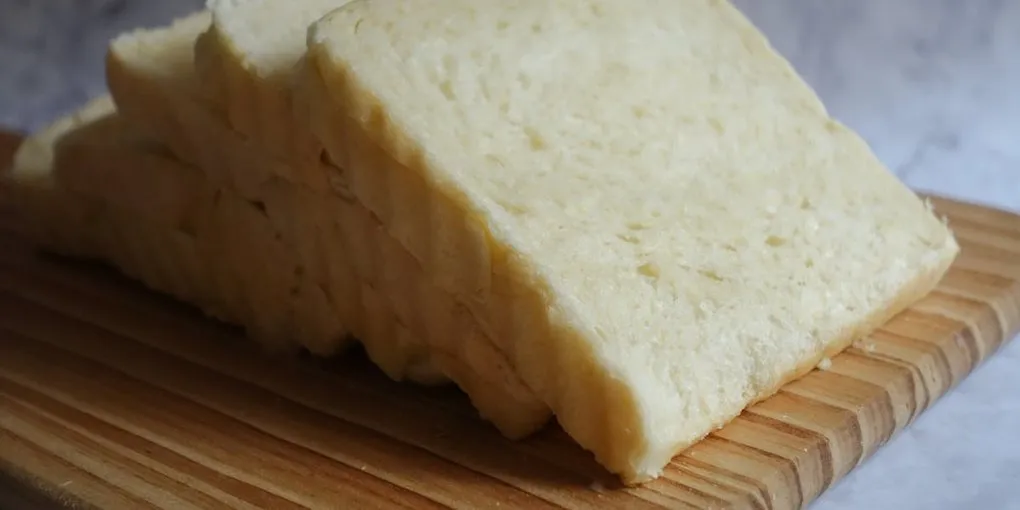
Pain de mie is French sandwich bread baked in a lidded Pullman pan. The lid constrains the rise, forcing the dough into a perfect rectangle with an ultra-fine, uniform crumb and almost no crust. Slice it and you get identical, edge-to-edge squares — no dome, no thick crust, no wasted corners. It’s the bread behind crustless tea sandwiches, the bread that makes the best toast, and the bread that every commercial sliced loaf is trying (and failing) to imitate.
The name translates roughly to “bread of the crumb” — the crust is deliberately minimized, and the interior is the point. Where artisan bread celebrates its crust, pain de mie celebrates its crumb: soft, fine-grained, with a tender chew that holds fillings without compressing or tearing.
This is a moderately enriched dough. Butter, milk, and a touch of sugar make it softer and richer than lean bread, but it’s nowhere near the enrichment level of brioche. Think of it as sandwich bread that went to finishing school.
The Formula
Baker’s Percentages
- Bread flour: 100% (600g)
- Whole milk (warm): 58% (348g)
- Butter (softened): 8% (48g)
- Sugar: 5% (30g)
- Salt: 2% (12g)
- Instant yeast: 1.5% (9g)
- Nonfat dry milk powder: 4% (24g, optional — boosts browning and softness)
Total dough weight: approximately 1,071g.
This is a deliberately moderate enrichment — just enough butter and sugar to soften the crumb and extend shelf life without creating a sweet bread. The milk and milk powder contribute proteins that enhance browning (more Maillard reaction substrates) and further soften the texture.
Try It Yourself
The Baker's Bench
Scale the pain de mie formula up or down with the Baker's Bench tool -- it handles enriched dough percentages and calculates weights for any pan size.
Open ToolThe Tangzhong Option
For an even softer crumb that stays fresh longer, use the tangzhong method. Cook 30g of the flour with 150g of the milk in a small saucepan over medium heat, stirring constantly, until it forms a thick paste (around 150F / 65C). Cool to room temperature before adding to the mixer.
The tangzhong pre-gelatinizes a portion of the starch, which absorbs significantly more water than raw starch. The result: a dough that’s more hydrated (and therefore softer) without being slack or difficult to handle. The pre-gelatinized starch also holds onto that moisture during storage, which slows staling. Japanese milk bread (shokupan) uses this same technique.
If using tangzhong, reduce the remaining milk in the formula by 150g (since it’s already incorporated into the paste) and reduce the flour by 30g.
Mixing
-
Combine dry ingredients: flour (minus tangzhong flour if using), sugar, salt, yeast, and milk powder in the stand mixer bowl.
-
Add liquids: Pour in the milk (or reduced milk + cooled tangzhong), then add the softened butter. Mix on low speed with the dough hook for 3-4 minutes until a shaggy dough forms and all flour is hydrated.
-
Develop gluten: Increase to medium speed (4-5 on a KitchenAid) and mix for 8-10 minutes. The dough should become smooth, elastic, and slightly tacky. It should pass the windowpane test — stretch a small piece thin enough to see light through without tearing.
At 8% butter, this is a lightly enriched dough. The fat’s interference with gluten development is minimal, so mixing is straightforward — no need for the phased butter addition that brioche demands. You can add the butter with the initial ingredients. The dough behaves more like a standard bread dough with a bit of luxury.
Bulk Fermentation
Transfer to a lightly oiled container. Cover and ferment at room temperature (75-78F) for 1-1.5 hours until doubled. One gentle fold at the 30-minute mark strengthens the gluten without overworking it.
This dough ferments faster than heavily enriched bread because the fat and sugar content is low enough that yeast activity isn’t significantly inhibited.
Shaping for a Pullman Pan
The Pullman pan is what makes pain de mie pain de mie. It’s a long, narrow, straight-sided loaf pan with a sliding lid. The lid traps the rising dough and forces it into a perfect rectangle. Without the lid, you’d just have a standard sandwich loaf with a domed top.
Pullman Pan Specs
Standard Pullman pans come in two sizes:
- 13 x 4 x 4 inches (the most common home-baker size)
- 16 x 4 x 4 inches (professional size)
For the formula above (approximately 1,071g of dough), the 13-inch pan is correct.
Browse Pullman pans on AmazonThe Critical Rule: Fill 2/3 Full
Grease the pan and the inside of the lid thoroughly. Divide the dough into 3 equal pieces (about 357g each). Shape each piece into a tight ball, let rest 5 minutes covered, then roll each into a short cylinder the width of the pan.
Place the three cylinders side by side in the pan. They should fill the pan to approximately 2/3 of its height — no more. If the dough is higher than 2/3, there’s too much dough and the lid won’t contain the rise. If it’s significantly less, the bread won’t fill the pan and you’ll have a short loaf.
The 2/3 fill is the precision point. The dough needs exactly enough room to proof upward and contact the lid, then expand slightly to press firmly against it. Too much dough and it forces the lid open (or bursts out the sides). Too little and the bread doesn’t fill the corners.
The 2/3 Rule: Filling a Pullman Pan
Get this wrong and the lid pops open or the loaf is too short
- 01
Divide into 3 equal pieces
~357g each for a 13-inch pan
- 02
Shape into cylinders
Width should match pan width. Place side by side.
- 03
Check the fill level
Dough should reach 2/3 of pan height -- no more, no less
Too much = lid pops. Too little = short loaf with gaps. - 04
Proof uncovered
Watch the dough. When it's 1/2 inch below the rim, close the lid.
- 05
Close lid and bake
380F, 35-40 min. Do not open during baking.
The 2/3 fill is the most important measurement in Pullman baking. Weigh your dough, know your pan volume.
jayarrbread.comProofing (With the Lid Nearby)
Cover the pan (without the lid) and proof at room temperature for 45-60 minutes. Watch the dough — when it has risen to about 1/2 inch below the rim of the pan, slide the lid closed. The dough will continue rising slightly and make contact with the lid.
The poke test still works here: press gently through the gap before closing the lid. When the indent springs back slowly and partially, close the lid and proceed to baking.
Baking
Pain de mie bakes at 380F (193C) — the standard enriched bread temperature. The lid traps steam from the dough’s own moisture, creating a miniature steam chamber similar in concept to the Dutch oven method used for artisan loaves.
Bake for 35-40 minutes with the lid on. Do not open the lid to check during baking — you’ll release the steam and compromise the crumb structure.
After 35 minutes, slide the lid open and check. The top should be pale golden — lighter than a standard loaf because the lid prevents direct radiant heat from reaching the surface. If you want more color on top, remove the lid and bake 5-8 minutes more. Most pain de mie bakers prefer the minimal-crust approach and stop as soon as the bread is done.
Internal temperature: 190-195F. Use a probe thermometer through the end of the loaf.
Cooling
Remove from the pan immediately after baking — the residual steam will make the crust soggy if left in the pan. Cool on a wire rack for at least 1 hour before slicing. The crumb is setting as it cools; cutting too early compresses the still-gelling starch and produces a gummy texture.
Pain de mie rewards patience. The crumb is so fine and uniform that a premature cut is especially noticeable — you’ll see compression lines from the knife.
Try It Yourself
The Crumb Lens
Use the Crumb Lens to diagnose issues with your pain de mie -- tap the problem zone on the bread cross-section for a ranked list of causes and fixes.
Open ToolPain de Mie vs. Standard Sandwich Bread
Pain de Mie vs. Standard Sandwich Bread
What the Pullman lid actually changes
| Attribute | 01Pain de Mie (Pullman) | 02Standard Sandwich Loaf |
|---|---|---|
| Top Shape | Flat -- lid constrains rise | Domed -- rises freely |
| Crumb Structure | Ultra-fine, uniform gas cells | Moderate, slightly irregular |
| Crust | Thin, soft, barely perceptible | Thicker, slightly chewy |
| Slice Shape | Perfect rectangle -- every slice identical | Arched top -- slices vary |
| Equipment | Pullman pan with sliding lid ($25-40) | Standard 9x5 loaf pan |
| Baking Temp | 380F (enclosed, moderate) | 375-400F (open) |
| Best For | Tea sandwiches, crustless sandwiches, toast | All-purpose sandwich bread |
| Enrichment | Butter 8%, milk, sugar -- moderate | Variable -- can be lean or enriched |
The dough recipe can be identical -- the difference is the pan and the lid. The lid transforms the bake.
jayarrbread.comUniform slices. No dome means every slice is the same size and shape. No trimming, no waste, no uneven sandwiches.
Minimal crust. The lid and lower baking temperature produce a thin, soft crust that’s barely distinguishable from the crumb. No tough crust to fight through. Perfect for tea sandwiches where the crust gets trimmed anyway.
Fine, even crumb. The constrained rise and moderate enrichment produce a crumb with small, uniform gas cells — none of the irregular holes you find in artisan bread. This means butter spreads evenly, fillings don’t squeeze through holes, and the bread holds together structurally.
Better keeping quality. The milk, butter, and sugar slow retrogradation (the starch crystallization that causes staling). Pain de mie stays soft for 3-4 days at room temperature — longer than lean bread’s 2-3 days. With the tangzhong method, 4-5 days is achievable.
The one downside: you need a Pullman pan. There’s no way to replicate the lid’s effect with a regular loaf pan and foil (the foil can’t contain the force of the rising dough). This is a specialized piece of equipment. A good one costs $25-40 and lasts indefinitely.
Uses for Pain de Mie
Pain de mie is designed for applications where the crumb is the star and the crust is irrelevant:
Tea sandwiches. The uniform rectangular slices with thin, soft crust are exactly what cucumber sandwiches, egg salad finger sandwiches, and smoked salmon canapes call for. Slice thin (1/3 inch), fill, trim the crusts (there’s barely any crust to trim), and cut into triangles or fingers. No other bread produces such clean, elegant tea sandwiches.
Croque monsieur and croque madame. The fine, even crumb soaks up bechamel without falling apart, and the flat, uniform slices stack neatly. Classic French bistro preparation starts with pain de mie for a reason.
Toast. The uniform thickness means every part of the slice toasts at the same rate. No thick edges that stay soft while the thin center burns. The moderate enrichment caramelizes beautifully under heat.
Kids’ sandwiches. The soft, crustless nature means no battles over crust removal. The fine crumb holds peanut butter and jelly without the filling squeezing through holes.
Adapting Any White Bread Recipe for Pullman Baking
You don’t need a dedicated pain de mie recipe to use a Pullman pan. Most white sandwich bread recipes can be adapted:
-
Calculate dough weight. Your Pullman pan has a specific volume. For a 13 x 4 x 4 inch pan, target approximately 1,000-1,100g of total dough.
-
Ensure some enrichment. A completely lean dough (no fat, no sugar) will produce a Pullman loaf, but the crumb will be drier and the shelf life shorter. Even a small addition of butter (3-5%) and milk instead of water makes a significant difference.
-
Follow the 2/3 rule. Fill the pan to 2/3 height, proof until 1/2 inch below the rim, close the lid, bake.
-
Reduce oven temperature. If your original recipe calls for 400F+ (common for lean bread), reduce to 380F. The enclosed environment and enrichment need a lower temperature.
-
Add 5-10 minutes to baking time. The lid traps moisture and slows heat penetration. A standard loaf recipe that bakes in 30 minutes open may need 35-40 minutes in a lidded Pullman pan.
Storage
Store pain de mie in a plastic bag at room temperature. The soft crust doesn’t have the crispness of artisan bread to preserve, so there’s no reason to use paper. The plastic retains moisture and keeps the crumb soft. For more on bread storage and freshness, that guide covers the science behind every storage method.
Never refrigerate — the 2-4C temperature zone accelerates retrogradation. The bread goes stale faster in the fridge than on the counter.
For longer storage, slice the entire loaf, stack with parchment paper between slices, wrap tightly in plastic and foil, and freeze. Pull individual slices as needed — they toast from frozen in under 2 minutes.
Pain de mie with tangzhong added stays softer longer than any other bread in this category. If shelf life matters to you — and for sandwich bread, it should — the tangzhong version is worth the 5 extra minutes of prep.
The Case for Making Your Own Sandwich Bread
Store-bought sliced bread costs $3-5 and lasts a week in a plastic bag. Pain de mie costs about $2 in ingredients (flour, milk, butter, yeast), takes 30 minutes of active work spread across 3-4 hours, and produces a loaf that is categorically better in every dimension: flavor, texture, freshness, and ingredient list. You control the enrichment level, the salt, the flour quality. There are no dough conditioners, no high-fructose corn syrup, no preservatives you can’t pronounce.
The one honest downside is time. You need to be home for the 3-4 hour window of mixing, fermenting, shaping, proofing, and baking. It’s not a set-it-and-forget-it project. But the active work is under 30 minutes — the rest is waiting. If you’re home on a weekend morning anyway, the effort-to-reward ratio is remarkably good. Make two loaves, slice and freeze the second, and you’ve got sandwich bread for two weeks from a single bake session.
Frequently Asked Questions
- Can I make pain de mie without a Pullman pan?
- Not the true version. The defining characteristic of pain de mie -- the flat top, perfectly rectangular cross-section, and ultra-fine crumb -- comes from the lidded pan constraining the rise. You can bake the same dough in a regular loaf pan and it will taste identical, but you'll get a standard domed sandwich loaf, not pain de mie. Some bakers place a heavy sheet pan on top of a regular loaf pan and weight it with bricks or a cast iron skillet. This can approximate the effect but it's difficult to get the pressure even, and the loaf often emerges lopsided.
- What's the difference between pain de mie and Japanese milk bread (shokupan)?
- They're close cousins. Both are enriched, lidded sandwich breads with fine, soft crumbs. The main differences: Japanese milk bread almost always uses tangzhong (a cooked flour-water paste) to achieve an even softer, more pillowy texture, and it typically uses slightly more sugar and more butter than classic pain de mie. Pain de mie tends to have a more restrained enrichment -- it's soft but not sweet. Japanese milk bread leans toward a noticeable sweetness and a cotton-like softness. The technique (Pullman pan, lid, 2/3 fill) is essentially the same for both.
- My bread pushed the lid open during baking. What went wrong?
- Too much dough for the pan, or the dough over-proofed before the lid was closed. The 2/3 fill rule is critical -- if the dough is higher than 2/3 of the pan when you place it, there's too much dough. Scale your recipe to match your pan volume. Over-proofing before closing the lid also produces excess gas that can force the lid. Close the lid when the dough is about 1/2 inch below the pan rim, not when it's already touching the rim.
- Why is my pain de mie gummy inside?
- Most likely it was sliced too early. Pain de mie needs at least 1 hour of cooling before cutting -- the starch is still setting as the bread cools, and slicing compresses the soft interior. The second possibility is under-baking: because the lid traps moisture, internal temperature must reach 190-195F to fully set the crumb. Use a probe thermometer, not guesswork. If your loaf reads 185F, give it another 5 minutes.
- Can I use whole wheat flour in a Pullman loaf?
- Up to 30% whole wheat substituted for bread flour works well. Beyond that, the bran physically punctures gluten strands, producing a weaker structure and a coarser, denser crumb. For a whole wheat Pullman loaf, increase hydration by 5-8% to compensate for the additional water absorption of whole wheat, and expect a slightly denser texture. White whole wheat flour gives you the nutritional benefits with less flavor impact and slightly better crumb structure than red whole wheat.