Free sample: PDF · 12 real pages · no email needed
164-page illustrated guide
7 chapters, each with a route
Practice with explained answers
Worksheets and reference pages
Who it's for
You can follow a recipe. Now understand it.
You want six rolls instead of twelve, some whole wheat in a white loaf, a loaf a little less salty. But which numbers need to change, and what else moves with them?
Baker’s percentages give you a common language for those questions. The book walks you from reading the balance in a recipe to choosing a change, working out the amounts and checking what your dough actually does.
Bring a complete recipe you trust and a calculator. The arithmetic is adding, subtracting, multiplying and dividing.
Try one decision from the book
A little less salt. What else changes?
Your usual loaf is a lean one you bake often: 500 g flour, 350 g water, 10 g salt and 2.5 g instant yeast. It tastes a little saltier than you want, so you decide to try 1.8% salt. Everything else stays the same.
How much salt would you weigh, and what might you notice?
Exercise 3.6 and its explained answer, from pages 52 and 56. It’s a teaching case, not a recipe: your own recipe supplies the method.
01Read
02Interpret
03Choose
04Calculate
05Check
Read
The usual loaf and the trial with less salt
Ingredient
Usual loaf
Your trial
Flour
500 g
500 g
Water
350 g
350 g
Salt
10 g 2.0%
? g 1.8%
Instant yeast
2.5 g
2.5 g
Choose
Salt from 2.0% to 1.8%, for flavor. Flour, water and yeast stay fixed.
Work it out+
Calculate
500 × 0.018 = 9 g
One gram less: 0.2 percentage points, and a tenth of the original salt, or 10% less. Flour, water and yeast keep their weights, so hydration stays at 70% and yeast at 0.5%.
Interpret
Both amounts sit inside the published general range of 1.8–2% (page 34). This is a small move, chosen for flavor.
Check
The batch contains a tenth less salt. Whether you can taste the difference in the cooled bread is part of what this bake tests. Less salt can also let the dough ferment a little faster and feel slightly slacker, although a change this small may show little of either.
Look at the first rise by its cue, at the dough’s hold at shaping, and at the flavor once the bread has cooled. Keep the flour, water, yeast and dough temperature comparable, and compare at the same stage.
Write the choice as one sentence
“I want a slightly less salty loaf, so I’ll move salt from 2.0% to 1.8%, 10 g to 9 g, keeping flour, water and yeast fixed. I expect less saltiness, and perhaps a slightly quicker, softer dough; I’ll look at the first rise by its cue, at the dough’s hold at shaping, and at the flavor once the bread has cooled.”
See inside
Real pages, as printed
Pages from the finished book, not mockups. Select a page to read it whole.
01 · Chapter 1 · pages 10–11
Carry the ratio
The book starts with one move: compare each ingredient with the flour instead of reading its weight alone. Here the same 70% hydration is carried through half, one and twice the batch. The next page asks the first real question: do you want more dough, or a different dough?
02 · Chapter 3 · page 36
Know which way a change goes
Water, salt and yeast each get a page like this: what raising or lowering the line usually does, why a baker might choose it, what to watch for, and where in the method to look. Each page states the conditions it assumes, and none turns a direction into a dose. All three are in the free sample.
03 · Chapter 7 · pages 127–130
Adapt a whole recipe
The last chapter takes one country-loaf card, written in cups with a starter, through all five steps. Each assumption is written down, each change is chosen for a reason, and the plan is checked before anything is mixed. The card is hypothetical; the arithmetic is real.
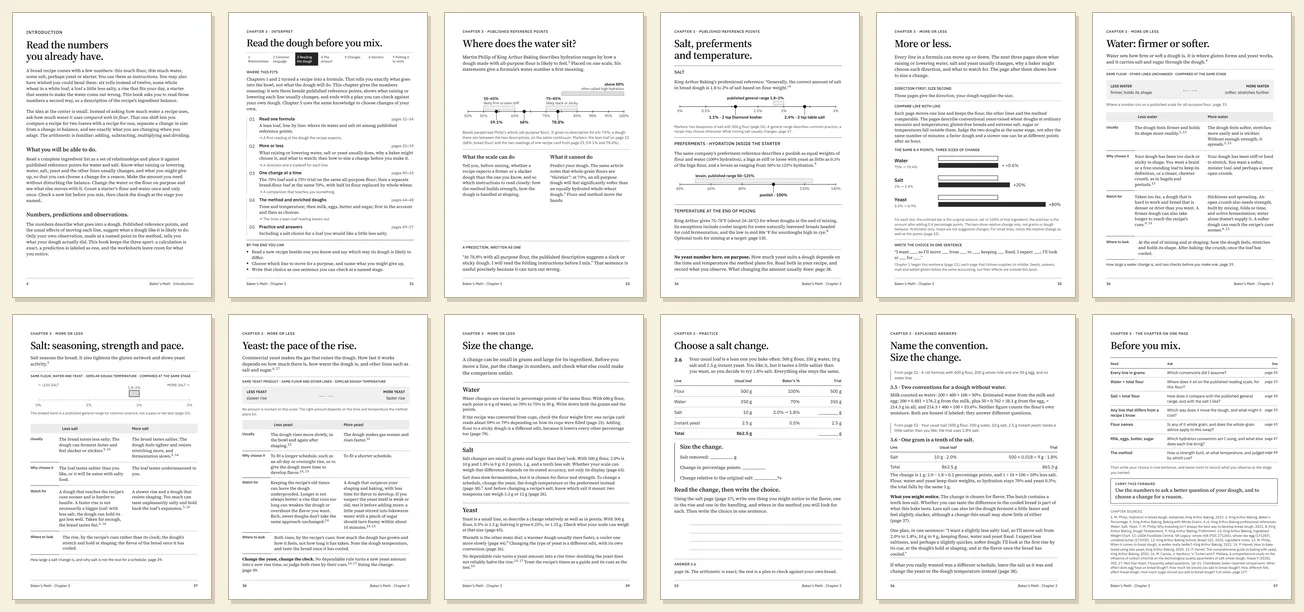
Free sample
Read a complete lesson from Chapter 3
Twelve pages in the book’s own order: the introduction, the chapter’s route, the published reference points, the more-or-less pages for water, salt and yeast, how to size a change, the salt exercise with its complete answer, and the chapter summary with its sources. Page numbers match the printed book.
Read in order, or turn to the question you have today. Each chapter opens with its route and ends with practice and explained answers.
One habit runs through every chapter: read, interpret, choose, calculate, check.
Also inside: three worksheets (a formula, a starter and a change log), a flour reference, ingredient choices at a glance, a calculation reference, a glossary, a practical index, and sources with reading notes.
01
Read a recipe differently
Is this a bigger batch, or a different dough?
pp. 7–15
02
Give ingredients a common language
What is every percentage a percentage of?
pp. 16–30
03
Read the dough before you mix
What might more or less of an ingredient change?
pp. 31–57
04
Make the amount you need
How do you change the batch and keep the balance?
pp. 58–72
05
Change a formula on purpose
Which line moves, and what stays fixed?
pp. 73–87
06
Follow the flour through your starter
Where are the flour and water already counted?
pp. 88–113
07
Put the method to work
How do you turn a familiar recipe into a checked plan?
pp. 114–134
The details
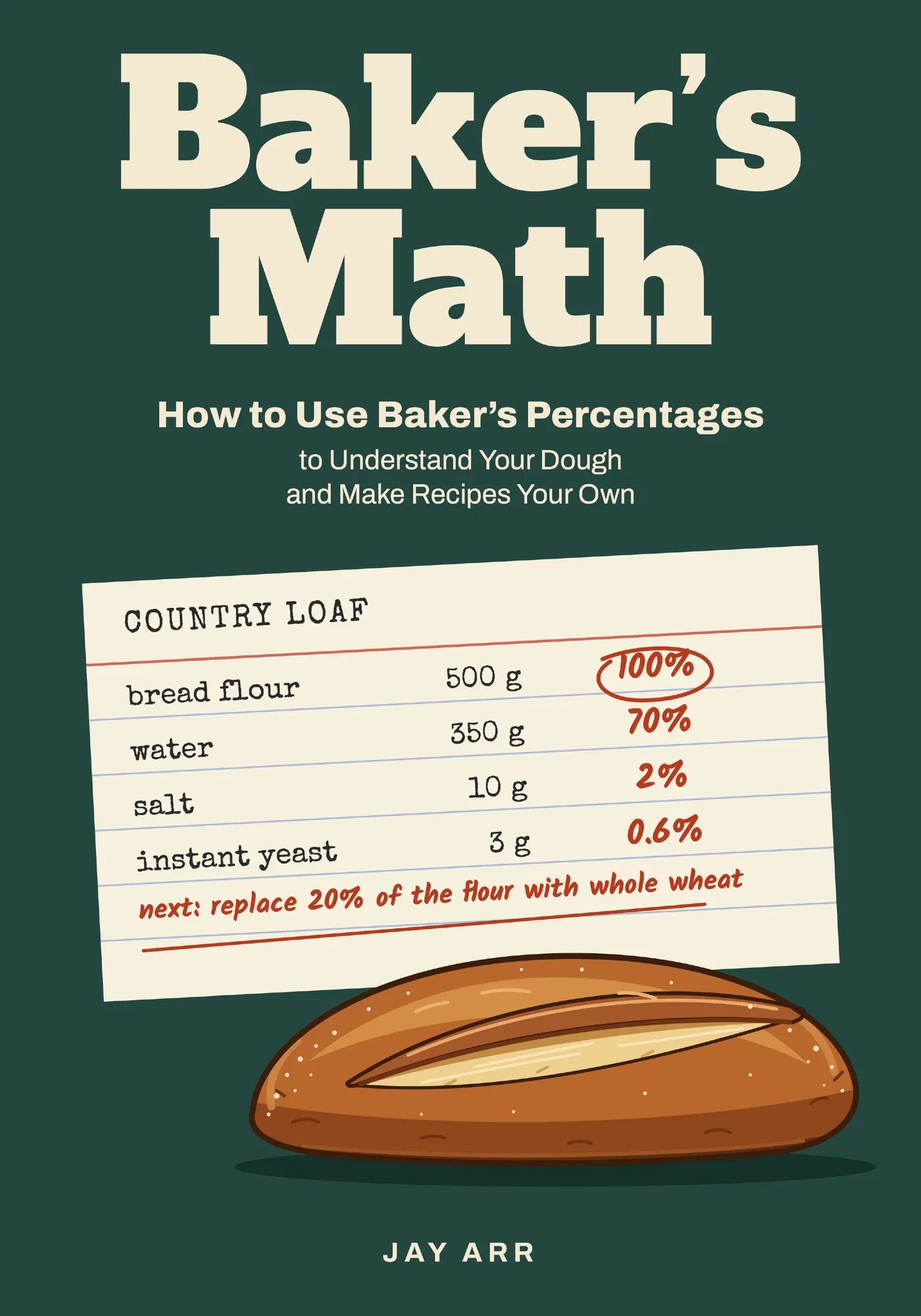
Baker's Math
How to Use Baker’s Percentages to Understand Your Dough and Make Recipes Your Own
No. Bring a complete bread recipe you trust. Baker’s Math helps you read, resize and deliberately change its ingredient quantities; your recipe supplies the method and the cues for judging the dough.
Do I need to be good at math?
The arithmetic is adding, subtracting, multiplying and dividing. Keep a calculator beside you. The worked examples show every step, and the practice has explained answers.
How does it relate to the free articles and tools?
The articles and tools on this site answer one question at a time. The book develops the ideas as one connected learning path, from reading a formula to adapting a whole recipe, with its own worked choices, practice with explained answers, and reference pages to keep at the bench.
It’s a teaching and reference guide built from published baking sources, which the book cites chapter by chapter. The worked examples and practice cases are original teaching cases, not kitchen-tested recipes.
As the introduction puts it: “a calculation is exact, a prediction is labeled as one, and the worksheets leave room for what you notice.”