Fougasse and epi de ble are two traditional French decorative bread shapes made from the same lean dough family. Fougasse is a Provencal flatbread cut with a bench scraper into a leaf or wheat-sheaf pattern with diagonal openings; epi is a baguette cut with scissors at a 30-45 degree angle into 6-8 alternating kernels along a spine. Both bake at 475F (246C) on a preheated stone -- fougasse for 12-15 minutes, epi for 18-22 minutes with steam. The shapes are decorative but also functional: each forces the cuts open before the bake so the final loaf cannot be replicated by slicing a finished loaf.
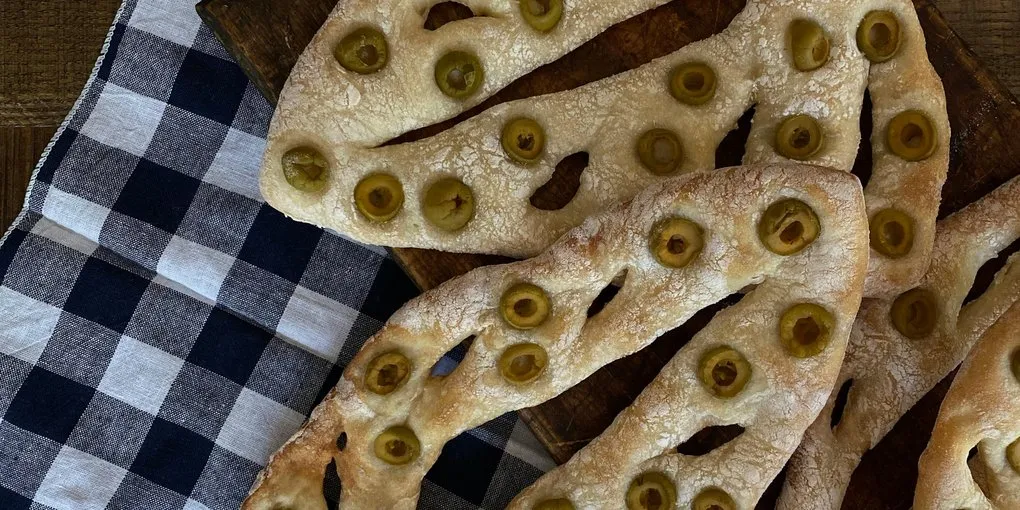
Most breads are loaves — a round, an oval, a cylinder, or a braid sitting on a cooling rack waiting to be sliced. Fougasse and epi de ble are not that. They are sculptural — bread that has been cut or snipped during proofing so that the final baked product has a shape you could not possibly produce by slicing a loaf after baking. A fougasse looks like a flat leaf with veined openings cut all the way through. An epi de ble (literally “wheat ear”) looks like a stalk of wheat itself, with alternating segments fanned out in two rows, connected by a thin backbone. Both are traditional French shapes. Both are fast to execute once you understand the technique. And both turn an otherwise ordinary dinner table into something that looks like you know what you are doing.
This is a visual tutorial, which means the shaping and cutting sequence is the entire point. The doughs are simple — both are essentially baguette dough or a lean wheat dough — so the flavor and crumb will be determined by your fermentation, not by anything exotic in the formula. What matters is where and how you cut, how far you stretch the dough during the cut, and how you proof so that the cuts stay open through the bake. Done right, you get two breads that are as much decorative centerpieces as they are dinner breads.
Fougasse: the Provencal Leaf Bread
Fougasse is a flatbread from Provence in southern France, descended from the same Roman ancestor as Italian focaccia. Both names trace back through Late Latin focacium — bread baked on the focus, or hearth — which is why their names rhyme but their shapes do not. The French and Italian breads diverged over centuries: focaccia became thicker and more olive-oil-saturated, while fougasse became thinner and took on a characteristic leaf or wheat-sheaf shape created by cutting slits through the dough before baking. The classic Provencal fougasse is flavored with olive oil, sometimes with herbes de Provence, olives, anchovies, or bacon (fougasse aux lardons), and baked at high heat until the edges blister and char.
Historically, fougasse served a practical function in the wood-fired bakery. It was the loaf a baker made first each day — small, thin, fast-baking — to test whether the oven had reached working temperature. If the fougasse came out cleanly with good color, the oven was ready for the larger pain de campagne loaves. The shape — flat, full of holes — meant the fougasse cooked through in 12 to 15 minutes, compared to 45 minutes for a full hearth loaf. There is even a French saying tied to this practice — il ne faut pas bruler la fougasse, “do not burn the fougasse.” It was utilitarian before it was decorative, and it became decorative because bakers realized that the same shape that let the oven’s heat penetrate fast also looked beautiful on the table.
The shape is the signature. A traditional fougasse is shaped like a leaf or a tree, with a central “stem” cut straight through the dough and angled side cuts radiating outward, each opening into a diamond or oval hole when the dough is stretched apart. The technique is simple in concept: cut with a bench knife or sharp pastry wheel, then pull the two sides of each cut apart to open a gap that will not close during proofing or baking. If you do not stretch the cuts open, they will heal closed during the rise and you will end up with a scored but unopened flatbread.
Epi de Ble: the Wheat-Stalk Baguette
Epi de ble — literally “ear of wheat” — is a baguette-based decorative shape that mimics an actual stalk of wheat, with alternating kernels fanning out in two rows along a thin central spine. It is a traditional French baker’s showpiece, often baked for harvest festivals, for rustic dinner settings, or simply as a way for a bakery to demonstrate technique. Visually it is one of the most striking shapes a home baker can produce. Practically it is a brilliant tear-bread — each “kernel” is a perfect dinner-roll-sized pull-apart portion, so one epi serves six to eight people and never requires a knife at the table.
The dough is standard baguette — lean, water plus flour plus salt plus yeast, typically at 65 to 68 percent hydration. What makes the epi is the cutting. After shaping a baguette and placing it seam-side down on a floured couche or parchment, you take a pair of sharp kitchen scissors and make angled cuts along the length of the loaf, alternating sides and fanning each cut section outward. The cuts go roughly three-quarters of the way through the dough — deep enough to separate the kernels but shallow enough that the spine stays intact and the shape holds together as one piece.
Bakers often turn epi into a second-day production — a freshly made baguette that came out with less-than-ideal oven spring gets repurposed as epi, because the shape forgives minor proofing issues. For a home baker starting fresh, use a standard baguette formula at slightly lower hydration (65 percent) to keep the cuts clean. Wetter doughs spread too much and the kernels merge during the bake.
Try It Yourself
The Baker's Bench
Use the Baker's Bench to scale a baguette formula up or down before shaping epi -- a single 350g baguette piece produces a six-kernel epi that serves six.
Open ToolShaping and Cutting Fougasse: Step by Step
Fougasse is a flatbread, but the cuts are what separate it from focaccia. The cuts have to be made cleanly, and they have to be opened wide before proof so the proofing gas widens them rather than letting the dough heal them shut.
1. Dough selection. A lean dough at 70 to 75 percent hydration with 3 to 4 percent olive oil built in. If you already make focaccia or ciabatta at home, use that formula. Skip the stretch-and-fold structure-building if your recipe calls for it — fougasse benefits from a looser crumb and an easier-to-cut dough.
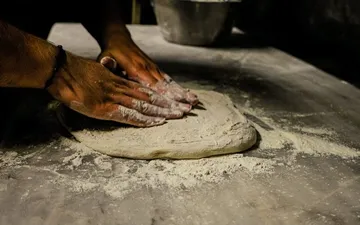
2. Pre-shape to a rectangle. After bulk fermentation, divide the dough into 250 to 400 gram pieces. Gently flatten each piece into a rough oval and bench rest 15 minutes covered. Then press each piece into a long oval or leaf-shape rectangle roughly 10 inches long by 6 inches wide on a lightly floured work surface or directly on parchment paper.
3. Cut the shape. Using a bench scraper or sharp pastry wheel (not a knife — you want a clean chop, not a drag), make one long straight cut down the center of the oval, leaving 1 inch of uncut dough at each end. Then cut 3 or 4 diagonal cuts on each side, angled toward the top of the leaf, each one 3 to 4 inches long. Each cut should go completely through the dough but stop about 1/2 inch from the outer edge of the oval.
4. Open the cuts. This is the critical step. Using your fingers, gently pull the dough on either side of each cut away from the cut to open it into a diamond or oval window. The cuts will want to heal closed during proof — you need to stretch them open now so that the proofing gas expansion widens rather than shrinks them. Each opening should be at least 1 inch wide before proofing.
5. Proof. Cover loosely with a damp towel or oiled plastic wrap. Proof 45 minutes to 1 hour at room temperature. The cuts should remain clearly open. If they start to close, gently stretch them again before baking.
6. Bake hot. Preheat oven with a stone or steel to 475F (246C). Transfer the fougasse on parchment to the stone. Bake 12 to 15 minutes until deeply golden with charred edges at the tips. Brush hot from the oven with olive oil and sprinkle with coarse salt and optional herbs. Eat warm.
Shaping and Cutting Epi: Step by Step
Epi is a finishing technique on top of standard baguette technique. Most of the work happens in the baguette itself — the cut is the last 30 seconds before the bread goes in the oven.
1. Shape a baguette. Use any standard baguette formula — poolish-based, straight dough, or old-dough method — at 65 to 68 percent hydration. Shape the loaf into a standard baguette at 14 to 16 inches long. Place seam-side down on a well-floured couche or parchment paper.
2. Proof to roughly 80 percent. Proof the baguette to slightly under fully proofed — enough that a poke-tested indent springs back partway, not all the way. This leaves room for the kernels to spring open dramatically in the oven. A fully proofed baguette will produce an epi with soft, less-defined kernels, because there’s no oven spring left to fan them out.
3. Cut with scissors. Using sharp kitchen scissors held at a 30 to 45 degree angle to the dough (blade nearly flat to the surface, not vertical), make a cut about 3/4 of the way through the dough, starting 2 inches from one end. As you make the cut, pull the cut piece away to one side — left for the first cut.
4. Alternate sides. Move the scissors 1.5 to 2 inches down the baguette and make the next cut at the same 30 to 45 degree angle, this time pulling the cut section to the right side. Continue alternating left-right all the way down the loaf, with each kernel fanned out in its direction. You should end up with 6 to 8 kernels alternating in two rows along a central spine.
5. Transfer and bake. Slide the epi (still on parchment, or peel it off the couche) onto a preheated stone or steel at 475F (246C). Add steam — a preheated cast-iron pan with hot water poured in, an ice-cube method, or a lid for the first 10 minutes. (See our baking with steam guide for the home-oven options.) Bake 18 to 22 minutes until the kernels are deep golden brown. Vent steam for the last 5 minutes for a crisp crust.
6. Serve. The epi presents spectacularly as a tear-bread — diners pull off kernels by hand at the table. Serve with butter, olive oil, or simply alongside a rustic meal.
Fougasse and Epi: The Cut Is the Bread
Two parallel processes that share a dough family but differ at the moment of cutting
- 01
Pre-shape
BothFougasse: divide dough into 250-400g pieces, bench rest 15 min, press into 10x6 inch ovals. Epi: shape a 14-16 inch baguette, place seam-down on a floured couche.
Lean doughs both. Fougasse 70-75% hydration with olive oil; epi 65-68% straight baguette. - 02
Set the proof clock
BothFougasse cuts the dough first, then proofs 45-60 minutes. Epi proofs the baguette to about 80 percent of full first, then cuts immediately before the oven.
Order matters. Fougasse cuts pre-proof so the gas opens them; epi cuts post-proof so the spring fans the kernels. - 03
Cut the shape
The signature momentFougasse: bench scraper or pastry wheel makes one center cut plus 3-4 diagonal side cuts, all the way through, stopping 1/2 inch from the edge. Epi: kitchen scissors at 30-45 degrees, 3/4 through, alternating sides every 1.5-2 inches.
Fougasse demands a chop-cut. Epi demands a low-angle scissor snip. - 04
Open or fan
Mechanical commitmentFougasse cuts must be pulled open with fingers to 1+ inch wide. Epi kernels must be tilted out to alternate sides as the cut is made -- not after.
Fougasse failure mode: cuts heal closed during proof. Epi failure mode: kernels merge during bake. - 05
Final proof or load
Where they divergeFougasse: 45-60 min covered proof, re-stretch any cuts that close. Epi: load directly to the oven within 60 seconds of cutting -- the kernels are already in their final position.
Both shapes go onto a preheated stone at 475F. Both want steam. - 06
Bake hot
475F (246C)Fougasse 12-15 min until edges char. Epi 18-22 min with steam, vented in the last 5 minutes for crust crispness.
Brush fougasse with olive oil + flaky salt out of the oven. Epi serves as tear-bread; no carving knife required.
Fougasse signal
- Cuts stay clearly open during proof
- Edges blister and char in the oven
- Final shape unmistakably leaf or sheaf
- Crumb soft, slightly oily, dimpled with herbs
Epi signal
- Six to eight cleanly separated kernels
- Visible thin spine connecting all of them
- Each kernel tears off without ripping its neighbor
- Crust deep golden, kernels golden-brown on every face
Same oven temperature, same dough family, two completely different sculptural outcomes. The cut is the bread.
jayarrbread.comCommon Mistakes for Both Shapes
Cuts heal closed during proof (fougasse). The number one fougasse failure. Remedy: stretch the cuts wider before proofing than you think necessary. Stretch again halfway through proof if they look like they are closing. Lightly oiling your fingers with olive oil when stretching helps the cut edges resist re-sticking.
Kernels merge during bake (epi). Too wet a dough or too-full a proof. Use lower hydration (65 percent) and slightly under-proof the epi. Also make sure your scissor cuts go deep enough — 3/4 through the dough, not just scored on top.
Flat, dense result (both). Under-proofed or insufficient oven heat. Both breads benefit from a high-heat oven (475F minimum) and a preheated stone for bottom heat. A cold oven or a baking sheet at 400F will produce a pale, dense product regardless of how well you shaped.
Uneven bake, one side dark. Your oven has hot spots. Rotate the bread 180 degrees at the 10-minute mark of baking. Both shapes are thin enough that they finish fast but they also bake unevenly if the oven heat source is asymmetric.
Scissors drag through the dough (epi). Dull blades. Sharp kitchen shears that close cleanly to the tip cut without smearing. If the scissors stick or smudge dough, wipe between cuts and consider sharpening or replacing them.
Why These Shapes Are Worth Learning
Both fougasse and epi take a standard lean dough and, with 30 to 60 seconds of cutting work, produce something visually extraordinary. They are what a professional baker calls “show-off breads” — technically simple, visually dramatic, and almost impossible to replicate with a purchased loaf because they require you to cut the dough before baking. Nobody sells fougasse frozen. Nobody ships epi across town. They are, by the physics of their shape, necessarily home-baked or bakery-fresh.
They also teach you something about bread that straight-loaf shaping does not — that the final form of a loaf is a function of what you do with the dough in the last 5 minutes before it goes into the oven, not just how you fermented it, mixed it, or shaped the pre-form. A fougasse made from a mediocre dough with brilliant cutting technique still looks beautiful. A perfect baguette dough with sloppy epi scissors produces a limp, sad tear-bread. Once you see this, you understand why the French — who arguably take bread shape more seriously than any other bread culture — treat shaping and finishing as the professional-defining skills of a baker, above even mixing and fermentation. The dough is the raw material. The shape is the author’s signature on top.
If you have already learned boule and batard and you are looking for the next visible upgrade to your dinner-party bread game, fougasse and epi are the right place to spend a Saturday. They take an afternoon to practice, twenty minutes a piece thereafter, and the skill sticks the first time you nail one.
Frequently Asked Questions
- What is the difference between fougasse and focaccia?
- Both breads share the same Latin root -- panis focacius, meaning hearth bread -- and both descend from the same Roman flatbread tradition. The split happened regionally. Italian focaccia evolved into a thicker, olive-oil-saturated bread, typically 1 to 1.5 inches tall, dimpled on top with oil pooling in the wells, and often unshaped beyond the rectangular pan it is baked in. French fougasse evolved thinner, is cut with slits that open through the dough into a leaf or wheat-sheaf pattern, and is never baked in a pan -- always free-form on a stone. In flavor they are cousins; in shape they are distinct.
- Do I need special scissors for epi de ble?
- Any sharp kitchen scissors work. What matters is that the blades close cleanly all the way to the tip and are not dull -- a dull scissor will drag through the dough instead of cutting cleanly, and the kernels will tear rather than separate. Some bakers use dedicated baker's shears or pastry scissors, but a good pair of kitchen shears (Wuesthof or Victorinox kitchen shears, for example) produces excellent results. Keep the blades clean and lightly oiled between cuts if dough is sticking.
- Can I make fougasse with sourdough?
- Yes -- a sourdough fougasse works beautifully. Use a 20-percent levain inoculation and the same 70 to 75 percent hydration target, with a longer bulk ferment (4 to 6 hours at room temperature or overnight cold retard). The tangy flavor of sourdough pairs well with olive oil and Provencal herbs. Shape and cut exactly the same way as yeasted fougasse. The one adjustment: proof slightly less (30 to 40 minutes after cutting vs 45 to 60 for yeasted) because sourdough continues to ferment aggressively once shaped.
- How do I keep the cuts open during proofing?
- This is the most common fougasse problem. Three tactics. First, cut the dough cleanly with a bench scraper or pastry wheel, not a knife -- a drag-cut creates a narrow slit that heals faster than a clean chop-cut. Second, stretch each cut open with your fingers immediately after cutting so that the gap is at least 1 inch wide, not just a thin slit. Third, check the cuts 20 to 30 minutes into proof and gently re-stretch any that have started to close. Lightly oiling your fingers with olive oil when stretching keeps the cut edges from re-sticking to each other.
- What temperature should I bake fougasse and epi?
- Both benefit from high heat -- 475F (246C) on a preheated stone or steel is the standard home-oven target, well within the 460-480F range Hamelman recommends for lean French doughs. Fougasse bakes fast (12 to 15 minutes) because it is thin; epi bakes slightly longer (18 to 22 minutes) because the spine is thicker than fougasse dough. Steam helps both -- a preheated cast-iron pan with a cup of boiling water poured in at loading, vented in the last 5 minutes of bake for crisp crust. If your oven will not go to 475F, bake at the highest temperature available but expect a slightly paler, less-blistered crust. Lower temperatures (400F or below) will produce a dense, under-developed result for both shapes.
- How does epi differ from a standard baguette in technique?
- Same dough, same shaping for the body of the loaf -- the only differences come at the end. Epi is proofed slightly under (about 80 percent of full proof) instead of fully, so the kernels still have spring left when they hit the oven. And instead of scoring with a lame, you cut with kitchen scissors at a 30-45 degree angle, alternating sides to fan the kernels into two rows. Everything else -- mixing, bulk fermentation, pre-shape, final shape, oven temperature, steam -- is identical to a standard baguette.
If you found this useful, see our guides on how to score bread for the broader pattern vocabulary, olive rosemary bread for a fougasse-adjacent flavored loaf, and focaccia for the Italian cousin that shares fougasse’s Roman ancestor.