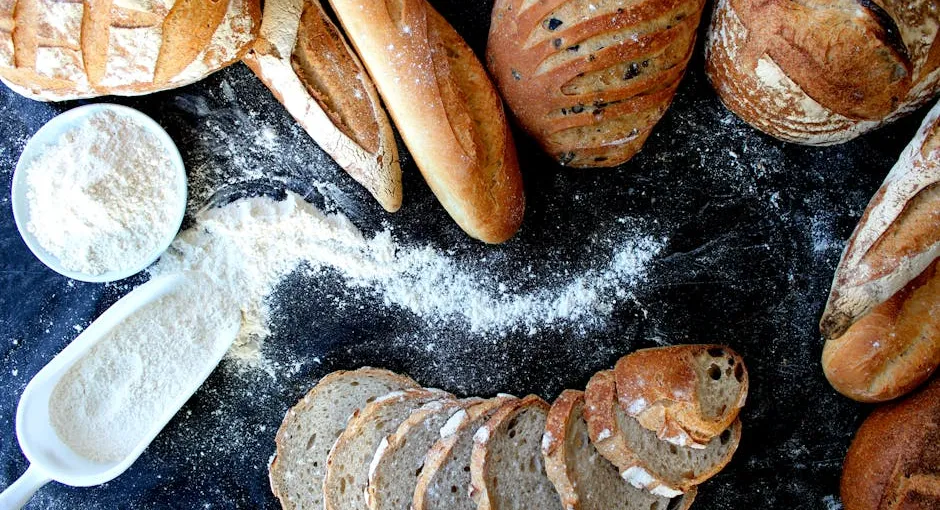
Flour is the single largest ingredient in bread by weight. It is also the ingredient most bakers think the least about. A bag is a bag, right? It is not. The wheat class, protein content, extraction rate, and milling method all change how your dough behaves, how your crumb develops, and how your bread tastes. Switching from one brand to another without adjusting hydration is one of the most common reasons a recipe that “always works” suddenly fails.
Here is what the science says, followed by how seven popular bread flour brands actually performed in the same recipe.
What Makes Bread Flour Different from All-Purpose
Bread flour has higher protein content than all-purpose flour, typically 11.5-13.5% compared to 10-11.5% for all-purpose. That extra protein means more glutenin and gliadin — the two protein classes that hydrate and cross-link to form gluten.
Glutenin provides elasticity (the spring-back). Gliadin provides extensibility (the stretch). Bread flour is selected for a balance that produces strong, gas-retaining dough. All-purpose flour has less of both, which means weaker gluten, less oven spring, and a tighter crumb.
Higher protein flour also absorbs more water. Jeffrey Hamelman notes that switching from 11.5% protein flour to 12.5% protein flour at the same hydration percentage produces a noticeably stiffer dough. When you change flour brands, adjust hydration based on how the dough feels, not the number in the recipe. For a deeper dive, see Bread Flour vs All-Purpose: What Actually Changes.
What to Look For in Bread Flour
Protein content (11.5-13%). This is listed on the nutrition panel. Divide protein grams by the serving size grams to get the percentage. Higher protein is not always better — 14%+ flour (like high-gluten or some spring wheat flours) can produce tough, chewy bread unless you increase hydration significantly.
Unbleached. Bleaching uses chemical agents (chlorine gas, benzoyl peroxide) to whiten flour and artificially age it. Unbleached flour retains more of its natural carotenoid pigments, which contribute to a creamier crumb color and better flavor. Every serious bread author uses unbleached flour exclusively.
Wheat class. The best bread flour comes from hard red winter, hard red spring, or hard white winter wheat. Hard red spring wheat (grown in northern states like North Dakota) has the highest protein and is the backbone of most premium bread flours. Soft wheat is for pastry, not bread.
Consistency. The most important quality in a flour brand is that it performs the same way bag after bag. Artisan bakers choose brands they can rely on, then build their formulas around that flour’s specific absorption and behavior.
The 7 Brands We Tested
We baked the same lean white bread formula with each flour: 75% hydration, 2% salt, 0.4% instant yeast, 5-hour bulk fermentation at 76°F, cold retard overnight, baked in a Dutch oven at 475°F. Same water, same salt, same yeast, same schedule. Only the flour changed.
1. King Arthur Bread Flour — Best Overall
King Arthur Bread FlourProtein: 12.7%. Wheat: Blend of hard red winter and spring. Milled: Domestically.
King Arthur is America’s oldest flour company and the benchmark against which other bread flours are measured. The 12.7% protein consistently produces strong, extensible dough that handles high hydration well. Crumb was open and even, crust was deeply colored, and flavor was clean with a subtle nuttiness.
Why it wins: Unmatched consistency. Bag after bag, year after year, King Arthur delivers the same performance. This matters more than any other quality. When your recipe works, you want it to work every time.
The one catch: At $6-8 for a 5-pound bag, it costs roughly twice as much as grocery store brands. Worth it if you bake regularly. Hard to justify if you bake twice a year.
2. Central Milling Organic Artisan Bakers Craft — Best for Artisan Baking
Central Milling Artisan Bakers CraftProtein: 11.5%. Wheat: Hard red winter. Milled: Petaluma, California.
Central Milling supplies some of the best bakeries in the country, including Tartine. Their Artisan Bakers Craft is a lower-protein bread flour that produces extensible, easy-to-shape dough with a creamy, open crumb. The slightly lower protein makes it more forgiving during shaping — less spring-back, more stretch.
Why it stands out: The flavor. Central Milling’s careful sourcing and milling produce flour with noticeably more character than mass-market brands. The crumb has a sweet, wheaty complexity that higher-protein flours sometimes lack.
The one catch: Lower protein means it is less forgiving at very high hydrations (80%+). The gluten network is adequate but not as robust as King Arthur’s. Also harder to find — primarily available online or at specialty stores.
3. Bob’s Red Mill Artisan Bread Flour — Best Widely Available
Bob’s Red Mill Artisan Bread FlourProtein: 12.5-13%. Wheat: Hard red spring and winter blend. Milled: Milwaukie, Oregon.
Bob’s Red Mill is available at nearly every grocery chain in America. Their Artisan Bread Flour is unbleached, unbromated, and milled from a solid blend of hard wheat. Performance in our test was good — strong gluten development, decent oven spring, acceptable crumb structure.
Why it works: Availability and price. You can buy it on a regular grocery run and pay less than King Arthur in most markets. The quality is genuinely good.
The one catch: We noticed slightly more variability between bags compared to King Arthur and Central Milling. One bag produced dough that felt perceptibly different from the next, suggesting less tightly controlled blending. Experienced bakers adjust; beginners get confused.
4. Gold Medal Better for Bread — Best Budget
Gold Medal Better for Bread FlourProtein: 12%. Wheat: Hard red winter. Milled: General Mills facilities nationwide.
Gold Medal’s “Better for Bread” line is available everywhere and costs about $4 for a 5-pound bag. It is bromated in some markets (check the label — avoid bromated flour if possible, as potassium bromate is a potential health concern and banned in the EU). Where available unbromated, it is a perfectly serviceable bread flour.
Why it works: Price and availability. If you are baking your first loaf and do not want to order specialty flour online, Gold Medal gets the job done.
The one catch: Noticeably less complex flavor than King Arthur or Central Milling. The crumb was fine but unremarkable. Crust color was slightly paler at the same bake time, suggesting fewer natural sugars and amino acids available for Maillard browning. Also: check for bromate on the label.
5. Cairnspring Mills Trailblazer — Best Regional/Craft
Cairnspring Mills TrailblazerProtein: 12-12.5%. Wheat: Pacific Northwest-grown Edison wheat. Milled: Burlington, Washington.
Cairnspring is a small craft mill producing flour from regionally adapted wheat varieties. Trailblazer is their bread flour, milled from Edison hard white winter wheat. The dough had a distinctive silkiness during mixing, shaped beautifully, and produced bread with the most complex flavor of any flour in our test.
Why it stands out: Flavor, full stop. The bread tasted like wheat, not like flour. There is a richness and depth that mass-produced flour simply does not achieve. This is what “terroir in grain” tastes like.
The one catch: Expensive ($8-12 per 5 pounds, plus shipping). Only available online or at Pacific Northwest retailers. Not practical as an everyday flour for most bakers, but worth trying at least once to understand what flour can be.
6. Giusto’s Baker’s Choice — Best for High-Hydration
Giusto’s Baker’s ChoiceProtein: 12.5%. Wheat: Hard red spring/winter blend. Milled: South San Francisco, California.
Giusto’s has been milling for Northern California bakeries since 1940. Their Baker’s Choice is a reliable, slightly thirsty flour that absorbs water well and produces dough that stays workable at 78-80% hydration where other flours get slack.
Why it works: It handles water beautifully. If you bake high-hydration sourdough (Robertson-style country bread at 75%+), Giusto’s gives you a dough that stays shapeable. The crumb was open and airy, with good cell structure.
The one catch: Limited regional availability. Hard to find outside of the western United States. Online ordering is possible but shipping flour across the country is expensive and somewhat absurd.
7. Great River Organic Bread Flour — Best Organic Value
Great River Organic Bread FlourProtein: 13-14%. Wheat: Hard red spring. Milled: Fountain City, Wisconsin.
Great River mills certified organic flour from spring wheat grown in the upper Midwest. The protein is high — sometimes too high. Dough was noticeably stiffer at 75% hydration than other flours, requiring 78-80% to reach a comparable consistency.
Why it works: Organic certification at a reasonable price ($6-7 per 5 pounds). High protein makes it forgiving for beginners who tend to under-hydrate. Strong oven spring.
The one catch: The high protein can produce a slightly chewy, tight crumb if you do not increase hydration. Flavor was good but less nuanced than Central Milling or Cairnspring. You need to adjust your recipe for this flour — do not use it as a drop-in replacement at your usual hydration.
The Ranking
| Rank | Flour | Protein | Best For | Price (5 lb) |
|---|---|---|---|---|
| 1 | King Arthur Bread Flour | 12.7% | Overall consistency | $6-8 |
| 2 | Central Milling Artisan Bakers Craft | 11.5% | Flavor and artisan baking | $7-10 |
| 3 | Bob’s Red Mill Artisan Bread Flour | 12.5-13% | Availability | $5-7 |
| 4 | Cairnspring Mills Trailblazer | 12-12.5% | Best flavor experience | $8-12 |
| 5 | Giusto’s Baker’s Choice | 12.5% | High-hydration doughs | $6-9 |
| 6 | Great River Organic | 13-14% | Organic value | $6-7 |
| 7 | Gold Medal Better for Bread | 12% | Budget/beginner | $3-5 |
What to Actually Buy
If you bake weekly: King Arthur Bread Flour. Consistency is worth the premium. You will learn faster when your flour is not a variable.
If you want the best flavor: Central Milling Artisan Bakers Craft or Cairnspring Trailblazer. These are craft-milled flours that taste different — better — than mass-market brands.
If you are just starting out: Bob’s Red Mill or King Arthur. Both are widely available and perform reliably. Pick whichever your grocery store carries.
If budget matters most: Gold Medal Better for Bread (check that it is unbromated) or store-brand bread flour with at least 12% protein.
Understanding Protein Content on the Label
The protein percentage listed on a flour bag is derived from the nutrition panel, not printed directly. Here is how to calculate it.
Look at the serving size (usually 30g) and the protein per serving (usually 3-4g). Divide protein by serving size and multiply by 100:
- 4g protein per 30g serving = 13.3% protein
- 3g protein per 30g serving = 10% protein
This is a rough method — it rounds to the nearest gram, so two flours could both show 4g protein per serving while one is actually 12% and the other is 13.5%. For precise comparisons, check the brand’s technical data sheet (usually available on their website) or contact their customer service.
The Damaged Starch Factor
One flour quality that never appears on the label is damaged starch. During milling, some starch granules are physically broken. Hamelman explains that damaged starch absorbs water excessively during mixing but releases it during baking. Symptoms of high damaged starch: slack dough, sticky bulk fermentation, flattened loaves, poor oven spring, excess crust color, and soft crust.
US flour typically has 8-9% damaged starch; European flour runs about 7%. This is one reason American flours absorb more water than European flours (Forkish notes that “a wet dough in France would probably contain about 5 percent less water than an American high-hydration dough”). You cannot control damaged starch, but knowing it exists helps explain why two flours with the same protein content can behave differently.
Flour Storage Tips
Bread flour should be stored in an airtight container at room temperature. In a sealed container, white bread flour keeps for 6-12 months. Whole wheat flour goes rancid much faster because the germ contains oils — buy it in smaller quantities and use it within 1-3 months, or store it in the freezer.
When you open a new bag from a new brand, reduce your hydration by 2-3% on the first bake and adjust from there. Different flours absorb water differently, and even the same brand can vary slightly between harvests. As Hamelman says: adjust hydration based on the feel of the dough, not the recipe number.
Stone-ground flour has a shorter shelf life than roller-milled flour because the stone-grinding process retains more of the germ and its oils. If you buy specialty stone-ground flour, use it within 2-3 months or refrigerate/freeze it.
For more on the science behind flour selection, see How Gluten Actually Works in Bread and our Baker’s Shelf flour reference tool. For the full equipment guide, see what else you need.
Frequently Asked Questions
- Does bread flour make a noticeable difference over all-purpose?
- Yes. Bread flour's higher protein (12-13% vs 10-11.5%) produces more gluten, which traps more gas during fermentation. The result is noticeably better oven spring, a more open crumb, and a chewier texture. You can make bread with all-purpose flour, and many bakers do, but the loaf will be denser and flatter. The difference is most obvious in lean doughs with no enrichments.
- Should I use bleached or unbleached flour for bread?
- Always unbleached. Bleaching destroys carotenoid pigments that contribute to flavor and color. Unbleached flour produces a creamier crumb and a more complex taste. Every major bread author — Hamelman, Robertson, Forkish, Reinhart — uses unbleached flour exclusively. Bleached flour also behaves differently during fermentation and may produce weaker gluten.
- Why does my dough feel different with a new bag of flour?
- Even within the same brand, flour varies between harvests. Wheat grown in a dry year absorbs more water than wheat from a wet year. Protein content can shift by half a percentage point between batches. This is normal. Adjust hydration by feel — add water gradually until the dough reaches the consistency you know works, rather than trusting the number in the recipe.
- Is organic flour better for bread baking?
- Organic flour is not inherently better or worse for baking performance. The organic label refers to farming practices (no synthetic pesticides or fertilizers), not milling quality or protein content. Some organic flours are excellent (Great River, Central Milling Organic); others are mediocre. Judge flour by its protein content, consistency, and how it performs in your recipe, not by whether it is organic.
- Can I mix two different flour brands in one recipe?
- Absolutely. Many professional bakers blend flours to hit a specific protein target or flavor profile. If your bread flour is too strong (tight crumb, chewy texture), blend it 80/20 with all-purpose to bring the protein down. If you want more flavor complexity, replace 10-20% of your bread flour with a whole wheat or high-extraction flour. Just remember that changing the blend changes the hydration requirement.