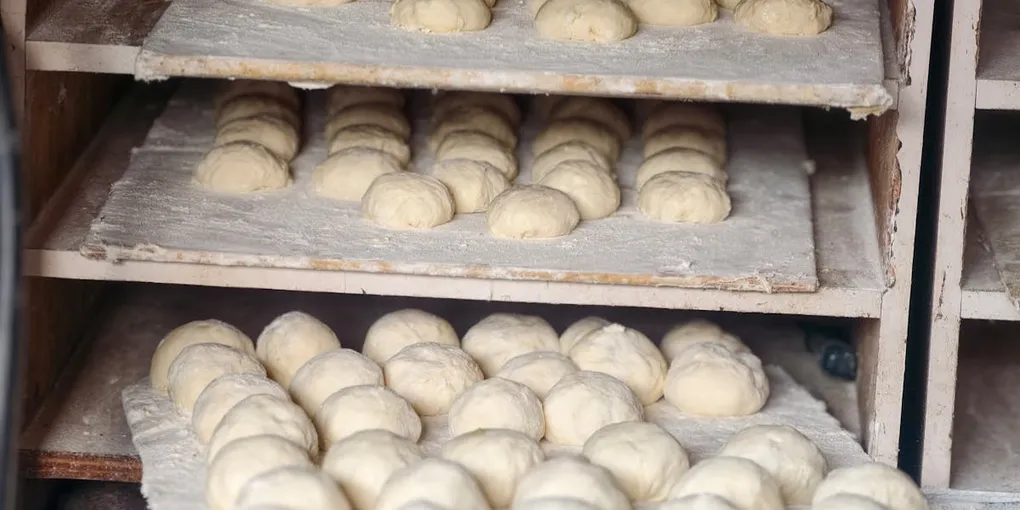
Bulk fermentation is the first rise — the period after mixing when the entire mass of dough ferments together in a single container before being divided and shaped. It’s where flavor develops, the crumb structure is established, and the dough transforms from a shaggy lump into something alive.
This is the stage where most bread is won or lost. Too short and the bread is dense. Too long and it collapses. The difference between a mediocre loaf and a great one usually comes down to what happens during bulk.
What Happens During Bulk Fermentation
Four processes run simultaneously:
1. CO2 production. Yeast consumes sugars and produces carbon dioxide. An important detail from Buehler: CO2 does not create new bubbles. It inflates bubbles that were incorporated during mixing. This is why proper mixing matters for crumb structure.
2. Flavor compound accumulation. Organic acids, esters, and alcohols build up as yeast and bacteria metabolize sugars. Longer fermentation produces more complex flavor.
3. Gluten relaxation. Protease enzymes gradually snip peptide bonds in the gluten network, making the dough more extensible. This is beneficial up to a point. Too much protease activity degrades gluten to the point where the dough can’t hold gas.
4. Enzyme activity. Amylase continues breaking damaged starch into maltose, providing ongoing food for yeast. This is why bulk fermentation can sustain itself for hours — the dough generates its own fuel.
Folding During Bulk
Folding during bulk fermentation is the modern replacement for extended kneading. It strengthens the gluten network without oxidizing the dough (which destroys flavor and color).
Why Fold
Every major baker agrees on the reasons:
- Strengthens gluten without the oxidation that extended mixing causes
- Redistributes yeast, food, and temperature throughout the dough mass
- Subdivides large gas bubbles into smaller ones (producing finer, more even crumb)
- Counteracts the gluten relaxation from protease activity
Folding Schedules by Author
| Author | Method | Schedule |
|---|---|---|
| Robertson | Stretch-and-fold (4 sides = 1 turn) | Every 30 min for first 2 hours, then undisturbed 1-2 hours |
| Forkish | Stretch-and-fold + flip | 2-4 folds in first 1.5 hours; never in last hour |
| Hamelman | Bench fold or bucket fold | 1-3 folds during first half of bulk |
| Reinhart | Stretch-and-fold for wet doughs | Every 20-30 min during fermentation |
The common pattern across all methods: fold during the first half of bulk fermentation, then leave the dough alone.
When NOT to Fold
Hamelman identifies three situations where folding is unnecessary or harmful:
- Doughs with more than 35% pre-fermented flour. The acid from the preferment has already strengthened the gluten.
- Short bulk fermentation doughs (like sourdough rye). Rye has no gluten to develop, so folding does nothing.
- Naturally stiff doughs (like challah). These develop adequate strength from mixing alone.
And Forkish’s universal rule: never fold during the last hour of bulk fermentation. At that point, the dough has accumulated significant gas. Folding deflates it, and there isn’t enough time to re-inflate before shaping.
Volume Targets: How Much Should It Rise?
The difference isn’t a disagreement about technique — it reflects different fermentation philosophies. Robertson uses wild leaven with a relatively short, warm bulk. The dough gets most of its rise during the proofing stage. Forkish uses commercial yeast with a longer fermentation, pushing the dough further during bulk.
Both produce excellent bread. The key is to follow the volume target that matches your method.
How to Track Volume
Use a clear, straight-sided container (Forkish specifically recommends a 12-quart Cambro). Mark the starting level with tape or a rubber band. Check against the mark at intervals.
In a round mixing bowl, volume change is harder to judge. The dough expands outward as well as upward, and the visual cue is less reliable.
Temperature: The Master Variable
Temperature controls everything in bulk fermentation. A 5 degrees F difference in dough temperature can shift the bulk by an hour or more.
Yeast approximately doubles its fermentation rate with every 17 degrees F (8 degrees C) increase in temperature. A dough that rises in 2 hours at 70 degrees F will rise in about 1 hour at 87 degrees F and take about 4 hours at 53 degrees F.
This rule is why desired dough temperature (DDT) matters. Standard lean bread targets 75-78 degrees F (24-26 degrees C) — warm enough for active fermentation but not so warm that it races out of control.
What to Do When Your Kitchen Is Cold
If your kitchen is below 70 degrees F:
- Use warmer water (up to 95 degrees F) to hit your DDT
- Place the dough in the oven with just the light on (typically adds 5-10 degrees F)
- Set the container on a heating pad on low, wrapped in a towel
- Extend your bulk time and go by volume/feel, not the clock
What to Do When Your Kitchen Is Hot
If your kitchen is above 80 degrees F:
- Use colder water (even refrigerator-cold) to bring the DDT down
- Shorten your bulk time
- Monitor closely — warm dough ferments fast and the window between ready and over-fermented narrows
When Is Bulk Done?
Judge bulk fermentation completion by:
1. Volume increase. Has the dough hit the target for your recipe?
2. Dough feel. Well-fermented dough feels airy, jiggly, and alive. Poke the surface — it should feel gassy and pillowy, not dense and stiff.
3. Surface appearance. Look for a domed, slightly convex surface with visible bubbles just under the skin. If the surface is flat or concave, the dough has passed its peak.
4. Edge pull. Gently pull the dough away from the container wall. Well-fermented dough has visible gas bubbles along the edges — a honeycomb pattern.
For the full poke test technique during proofing (after shaping), see our proofing guide.
Bulk Fermentation for Rye
Rye plays by entirely different rules. Rye contains no gluten-forming proteins — its structure comes from pentosans. Higher percentages of rye mean shorter bulk fermentation, not longer.
| Rye Percentage | Bulk Fermentation |
|---|---|
| Up to 40% | 60 minutes |
| 40-60% | 45-60 minutes |
| 60-80% | 30 minutes |
| 90-100% | 10-20 minutes |
High-rye doughs that bulk too long become slack and acidic. The pentosan gel that provides structure breaks down with excessive fermentation. Shape quickly and proof on a short timeline.
Flavor and Fermentation Length
One of the few universal principles in bread baking: longer fermentation produces more complex flavor. The flavor comes from multiple sources that accumulate over time:
Organic acids (lactic and acetic) from bacterial fermentation provide tang and depth.
Ethanol from yeast fermentation is a flavor precursor. It evaporates during baking at 172 degrees F, but its breakdown products contribute to crust flavor.
Amino acids released by protease activity become Maillard reaction substrates during baking. More amino acids = more complex crust flavor.
This is why Forkish’s Overnight White — with its 12-14 hour bulk at near-zero yeast (0.08%) — produces “extraordinary flavor complexity.”
Cold Retarding: The Overnight Option
After bulk fermentation, shaped dough can be refrigerated overnight at 37-40 degrees F. This isn’t technically part of bulk fermentation — it’s cold proofing — but it’s closely related. Benefits include slowed fermentation, extended flavor development, firmer dough for cleaner scoring, and scheduling flexibility.
Forkish confirms: “The chilled loaves don’t need to be warmed to room temperature before baking.” Load straight from the fridge into a screaming-hot Dutch oven.
For more on cold fermentation, see our cold fermentation guide.
Common Bulk Fermentation Mistakes
Ending too early. Dense bread with tiny uniform holes. The dough didn’t produce enough gas. Give it more time or a warmer environment.
Ending too late. The dough has passed peak gas retention. It feels slack, the surface is flat or concave, and it may smell overly acidic. Shape immediately and bake as soon as possible.
Folding too aggressively. Gentle folds, not violent stretching. The goal is to strengthen, not degas.
Folding too late. Folds in the last hour deflate accumulated gas. Front-load your folds.
Ignoring temperature. A recipe that says “bulk 4 hours” assumes a specific dough temperature. If your kitchen is 10 degrees F cooler, your bulk needs to be significantly longer. Go by dough behavior, not the clock.
Frequently Asked Questions
- How do I know when bulk fermentation is done?
- Look for three signs together: the dough has hit the volume target for your recipe (20-30% for Robertson-style, tripled for Forkish-style), it feels airy and jiggly when you poke it, and the surface is slightly domed with visible bubbles just under the skin. A flat or concave surface means the dough has passed its peak.
- Does bulk fermentation time change with temperature?
- Significantly. Yeast roughly doubles its activity with every 17 degrees F (8 degrees C) increase. A dough that ferments in 4 hours at 75 degrees F might need only 2.5 hours at 82 degrees F or 6+ hours below 70 degrees F. Always go by dough behavior rather than following a recipe timer in a different-temperature kitchen.
- Should I fold during the entire bulk fermentation?
- No. Fold during the first half of bulk, then leave the dough alone. Forkish's rule is absolute: never fold during the last hour. By that point, the dough has accumulated significant CO2 — folding deflates it, and there isn't enough time to re-inflate before shaping.
- Can I do bulk fermentation in the fridge overnight?
- You can, but it's less common than cold-retarding shaped loaves. The professional technique called pointage en bac holds bulk dough at 46-50 degrees F for up to 18 hours. For most home bakers, it's more practical to complete bulk at room temperature, shape, then refrigerate the shaped loaves overnight.
- Why is my dough sticky after bulk fermentation?
- Some stickiness after bulk is normal for high-hydration doughs (72%+). If the dough is excessively slack and sticky, the bulk may have gone too long — protease enzymes break down gluten over extended fermentation. Salt inhibits protease activity, so verify that salt was added at mixing.