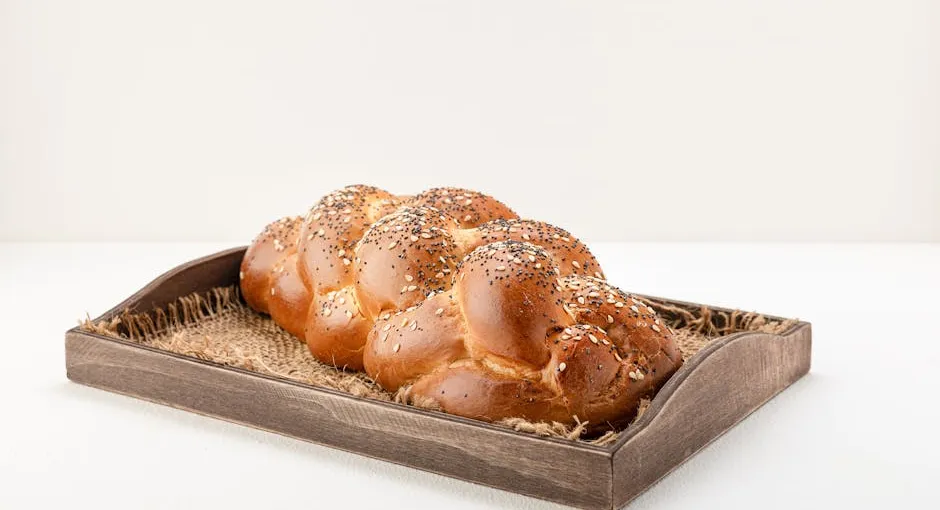
Challah is a braided enriched bread with a golden egg-washed crust and a soft, slightly sweet interior. It’s traditionally prepared for Shabbat and Jewish holidays, and its distinctive braided shape makes it one of the most visually striking breads you can bake. Unlike brioche, which pushes enrichment to its structural limits, challah is moderate — enriched enough to be tender and flavorful, but lean enough to braid by hand without specialized equipment.
The Formula
Hamelman’s challah formula:
- Flour: 100%
- Water: 40%
- Eggs: 20%
- Oil: 8% (vegetable or light olive)
- Honey: 8%
- Salt: 2%
- Yeast: 2% (instant)
For a home batch of 500g flour: 200g water, 100g eggs (about 2 large), 40g oil, 40g honey, 10g salt, 10g instant yeast.
This formula produces a straightforward enriched dough — richer than standard white bread but much leaner than brioche. The use of oil instead of butter keeps challah dairy-free, which is essential for its traditional role in kosher meals.
Mixing
Challah mixing is standard and does not require a stand mixer. You can absolutely mix and knead this dough by hand — it’s firm enough to work on a countertop without sticking everywhere.
Stand mixer method: Combine all ingredients. Mix on low speed 3-4 minutes until incorporated, then medium speed 5-7 minutes until smooth and elastic.
Hand method: Combine all ingredients in a large bowl, stir until shaggy, then turn out onto a lightly floured surface. Knead 8-10 minutes until smooth and supple.
Unlike brioche, challah doesn’t need phased ingredient additions. Everything goes in at once. The relatively modest enrichment (8% oil vs. brioche’s 50% butter) means the fat doesn’t catastrophically interfere with gluten development.
Bulk Fermentation
Cover the dough and let it rise at room temperature (75-78 degrees F) for 1-1.5 hours until roughly doubled. The relatively high yeast percentage (2%) drives a vigorous rise.
Challah has enough structure from the mixing that folding during bulk is unnecessary.
Braiding: The Heart of Challah
6-Strand Braid
The traditional showpiece that produces a higher, rounder loaf with a more complex visual pattern. Divide dough into 6 ropes, pinch together at one end, and follow the weaving sequence. The key principle: the outermost strands always move inward, crossing over their neighbors.
Braiding Tips
- Even ropes: Spend time rolling to uniform thickness. Uneven strands create an uneven braid.
- Tapered ends: Slightly thinner at the tips produces a loaf that narrows gracefully.
- Consistent tension: Not too tight (tears), not too loose (flattens). Moderate, even tension throughout.
- Tuck the ends: Pinch and fold under the loaf at both ends for a clean finish.
- Let the dough rest if it resists. If the ropes keep springing back, cover them and rest 5 minutes. The gluten will relax.
Egg Wash
Egg wash is essential for challah’s signature appearance: a deep golden, glossy, lacquered crust.
Beat 1 egg with 1 tablespoon of water. Brush the entire surface gently. Apply one coat before the final proof begins and a second coat just before baking for maximum gloss.
Variations:
- Egg yolk only + water: Deepest golden color, most shine
- Whole egg + water: Standard — good color and shine
- Whole egg + cream: Richest color, slightly glossier
Sprinkle sesame seeds or poppy seeds onto the wet egg wash if desired.
Proofing
After braiding, place on a parchment-lined sheet pan. Cover loosely. Proof at room temperature for 45-60 minutes until the braid has expanded noticeably.
Watch carefully — challah over-proofs easily. The enrichment accelerates fermentation, and the braided structure is more fragile than a solid boule. If the braid starts to separate at the junctions, bake immediately.
Baking
Challah bakes at 375-380 degrees F for 30-35 minutes. Like brioche, the sugar and egg wash brown quickly.
Done when internal temperature reaches 185-190 degrees F and the crust is deep golden brown. If the top browns too quickly, tent with aluminum foil for the last 10 minutes.
No steam. Enriched breads don’t need steam. The egg wash provides the crust character.
Let cool on a wire rack for at least 20 minutes before slicing.
Challah Variations
Raisin Challah: Add 15-20% raisins during the final minutes of mixing. Soak in warm water 20 minutes first.
Chocolate Challah: Replace 10% of flour with cocoa powder, increase honey to 12-15%, add chocolate chips (10% of flour weight).
Round Challah (Rosh Hashanah): Roll into a single long rope and coil into a spiral. Reduce temperature by 10 degrees F or tent with foil since the center takes longer.
Whole Wheat Challah: Substitute up to 40% whole wheat flour, increase water by 5%. Above 40% whole wheat, the bran cuts through gluten strands and makes braiding difficult.
Common Challah Mistakes
Under-braiding tension. A loosely braided challah spreads flat during proofing instead of rising upward.
Skipping the egg wash. Without it, challah bakes to a matte, pale crust. The egg wash is fundamental.
Over-proofing. Enriched doughs have a narrower proofing window. The braided structure is weaker than a solid loaf.
Too much flour during braiding. Heavy flour prevents the strands from adhering. Use a light dusting only.
Where Challah Fits
Challah is the ideal first enriched bread. It’s forgiving to mix (by hand or machine), straightforward to shape (the 3-strand braid takes minutes to learn), and bakes reliably. If brioche intimidates you, start here.
Challah also produces outstanding French toast, bread pudding, and sandwiches the day after baking. The enriched crumb absorbs custard beautifully and toasts evenly. For more on keeping enriched breads fresh, see the bread storage guide.
For formula scaling and baker’s percentage calculations, the Baker’s Bench tool handles enriched doughs and will calculate egg counts based on your flour weight. Browse the best bread books for Hamelman’s complete challah formulas.
Frequently Asked Questions
- Can I make challah by hand without a stand mixer?
- Yes. Unlike brioche, challah has moderate enrichment (8% oil, 20% eggs) that doesn't prevent hand kneading. Combine all ingredients in a bowl, turn out onto a lightly floured surface, and knead 8-10 minutes until smooth and supple.
- How do I keep my challah braid from spreading flat?
- Braiding tension is the main factor. The braid should be snug -- firm enough that the strands hold their positions, but not so tight that the dough tears during proofing. Even rope thickness matters too: uneven strands create an asymmetric braid.
- What's the difference between 3-strand and 6-strand braids?
- A 3-strand braid is the standard braid -- simple, elegant, and easy to learn. A 6-strand braid produces a taller, rounder loaf with a more complex woven pattern. The 6-strand is the traditional showpiece for Shabbat and holidays. Both taste identical.
- Why does challah use oil instead of butter?
- Challah is traditionally a kosher bread. In kosher dietary law (kashrut), dairy products and meat cannot be eaten together. Using oil instead of butter keeps challah pareve (neither dairy nor meat), so it can be served alongside any meal. You can substitute butter if you don't keep kosher.
- How do I get that deep golden challah crust?
- Egg wash, applied twice. Beat 1 egg with 1 tablespoon of water, brush gently over the braided loaf before the final proof, then apply a second coat just before baking. For the deepest golden color, use egg yolk only (no white) mixed with water. Bake at 375-380 degrees F.