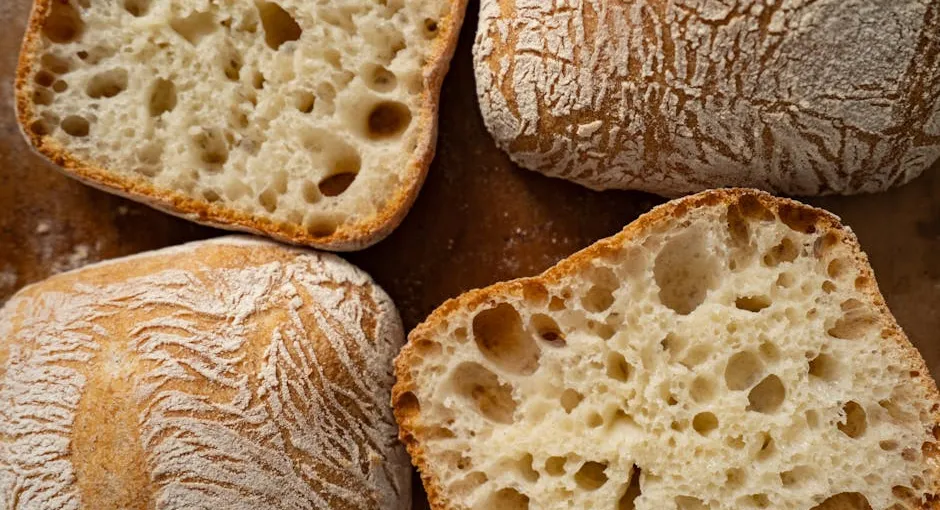
Ciabatta means “slipper” in Italian — a flat, wide loaf shaped like an old house shoe. The name undersells what the bread actually is: one of the most dramatic expressions of hydration in the bread world. A good ciabatta has a thin, crisp crust and an interior that’s almost entirely holes, with translucent walls of gluten stretched to their structural limit. It’s the bread that teaches you what water can do.
Ciabatta is also the bread that humbles experienced bakers. The dough at 73-80% hydration is slack, sticky, and uncooperative. You can’t shape it in any traditional sense — you divide it, stretch it gently, and then leave it alone. The restraint is the technique.
Two Approaches: Biga vs. Overnight Autolyse
Hamelman presents two distinct ciabatta formulas, each producing a different character of bread.
Ciabatta with Stiff Biga
The biga version uses a 60% hydration pre-ferment containing 20% of the total flour, fermented 12-16 hours at 60-65 degrees F. The final dough comes together at 73% hydration — high, but manageable compared to the alternative.
The stiff biga contributes a wheaty, complex flavor and some structural strength from its overnight fermentation. The relatively lower hydration (73% is “high” for most bread but moderate for ciabatta) makes this version more handleable. The crumb is open and irregular but not as dramatically holey as the overnight autolyse version.
This is the version to start with if ciabatta is new to you.
Ciabatta with Overnight Autolyse
The overnight autolyse version pushes to 80% hydration and uses no pre-ferment at all. Instead, the flour and water are mixed and left for 12-16 hours at room temperature. During this extended autolyse, enzymes begin breaking down starch and protein, the flour fully hydrates, and gluten develops spontaneously without any mechanical energy.
The result is a dough that’s already extensible and partially fermented before you add the remaining yeast and salt. The crumb from this method is more open — large, irregular holes with a slightly more sour character from the extended rest.
Bassinage: The Key Technique
Both ciabatta methods require bassinage — the technique of holding back water during initial mixing and adding it gradually later.
Hold back about 10% of the total water at the start. Mix the main dough with the remaining 90% until it comes together and develops some initial gluten structure. Then add the reserved water in small additions on second speed (or by hand, incorporating with folding), allowing each addition to absorb before adding more.
Why this matters: at 73-80% hydration, dumping all the water in at once makes the dough a loose batter that can’t form any gluten structure. By building the gluten network first at a lower effective hydration, then gradually introducing the remaining water, the gluten can absorb and hold the additional water within its existing structure.
Hamelman is explicit about this technique for ciabatta. Without bassinage, the dough will never come together properly at these hydration levels.
Understanding High Hydration
Ciabatta lives at the top of the hydration spectrum. For context:
| Hydration | Dough Character | Typical Bread |
|---|---|---|
| 55-65% | Stiff, smooth, easy to shape | Bagels, sandwich bread |
| 65-72% | Medium, slightly tacky | French bread, most artisan loaves |
| 72-80% | Slack, sticky, needs folding | Sourdough country bread, ciabatta |
| 80%+ | Very wet, cannot be shaped traditionally | High-hydration ciabatta, focaccia |
At 73% (biga version), the dough is sticky but manageable with wet hands and a bench scraper. At 80% (overnight autolyse version), the dough is essentially a thick batter that flows and spreads. Traditional shaping is impossible — you divide it, stretch it gently into rough rectangles, and let the oven do the rest.
This is the critical insight about ciabatta: you’re not shaping the bread. You’re managing a very wet dough and keeping it from spreading too thin before it gets into the oven. Every touch should be gentle and purposeful. Aggressive handling degasses the dough and destroys the open crumb structure you’re after.
The Formula: Biga Version
Biga (mix evening before):
- Bread flour: 100%
- Water: 60%
- Instant yeast: a pinch (0.08%)
- Ferment 12-16 hours at 60-65 degrees F
Final dough:
- Remaining flour: 80% (of total formula flour)
- Water: 73% total hydration (using bassinage — hold back 10%)
- Salt: 2%
- Instant yeast: 0.5-0.7%
- Biga: all of it
Method:
- Combine final flour, 90% of water, and torn pieces of biga. Mix on first speed 3 minutes.
- Add salt and yeast. Mix on second speed 3-4 minutes.
- Gradually add reserved water on second speed. Mix until dough is smooth and very extensible.
- Bulk ferment 2.5-3 hours at 75-78 degrees F with 2-3 folds in the first half.
- Turn out onto a well-floured surface. Divide into rectangles (do NOT round or pre-shape).
- Transfer to parchment or a floured couche. Proof 45-60 minutes.
- Bake at 460 degrees F with steam, 25-30 minutes.
The Formula: Overnight Autolyse Version
Overnight autolyse:
- Bread flour: 100%
- Water: 80% total hydration (hold back 10% for bassinage)
- Mix flour and 70% of water. Cover. Rest 12-16 hours at room temperature.
Final mix:
- Salt: 2%
- Instant yeast: 0.5-0.7%
- Reserved water: 10%
Method:
- Add salt and yeast to the autolysed dough. Mix on first speed 2 minutes.
- Gradually add reserved water on second speed. Mix 4-5 minutes until smooth.
- Bulk ferment 2-2.5 hours with 2 folds in the first hour.
- Divide and transfer gently to parchment. Proof 30-45 minutes.
- Bake at 460 degrees F with steam, 25-30 minutes.
The Flour Question
Ciabatta demands strong flour. The gluten network has to hold its structure under extreme hydration — 73-80% water stretching every protein strand to its limit. All-purpose flour at 10-11% protein doesn’t have enough glutenin and gliadin to build a network that survives this kind of hydraulic stress.
Use bread flour with 12-13% protein. King Arthur Bread Flour, Gold Medal Better for Bread, or any strong bread flour with protein content listed on the label. The difference is not subtle — AP flour ciabatta spreads flat and bakes dense. Bread flour ciabatta holds its shape and develops the dramatic hole structure.
If you have access to strong Italian flour (Tipo 0 at W280-320), it works beautifully. The higher protein Italian flours were developed for exactly this kind of bread. But domestic bread flour is perfectly adequate. The protein content matters more than the origin.
For a deeper look at flour differences and how protein content affects dough behavior, the comparison article covers the science.
Autolyse and Timing
Both ciabatta methods benefit from understanding what’s happening during the extended rest periods.
In the biga version, the biga itself undergoes 12-16 hours of slow fermentation. The stiff consistency (60% hydration) means enzyme activity is restrained and the flour develops slowly. The biga contributes pre-fermented flavor and some structural strength to the final dough.
In the overnight autolyse version, the flour-water mixture isn’t just sitting there. During those 12-16 hours, several processes run simultaneously. Flour proteins fully hydrate and begin cross-linking spontaneously. Amylase enzymes break starch into sugars. Protease enzymes soften the gluten network, making it more extensible. By morning, the dough is partially fermented, highly extensible, and ready for the final salt-and-yeast addition with minimal mixing.
The overnight autolyse is related to, but more extreme than, the standard autolyse used in everyday bread baking. The standard autolyse runs 20-60 minutes. At 12-16 hours, the enzymatic changes are far more profound — hence the different crumb character.
Handling: Less Is Everything
Ciabatta dough punishes over-handling. Every unnecessary touch deflates gas cells and reduces the open crumb you’re after.
During bulk fermentation: Fold gently — stretch-and-fold, not aggressive punching or degassing. 2-3 folds in the first half of bulk, then leave the dough completely alone. The gas structure developing in the second half of bulk is what creates the characteristic ciabatta holes.
During dividing: Use a well-floured bench scraper. Cut decisively — don’t saw through the dough. Flour generously. Each piece should be a rough rectangle, not a round.
Do NOT flip ciabatta during proofing. Hamelman is explicit about this. The side that was on top when you divided stays on top. The gas structure is fragile and directional; flipping collapses it.
During transfer to the oven: Slide the parchment onto a preheated baking stone or steel. If you’re brave, you can invert the proofed ciabatta directly onto the hot surface (the flour-dusted bottom becomes the top). Speed matters — get the dough from bench to oven in seconds, not minutes.
Baking
Bake at 460 degrees F with steam for the first 10-15 minutes. The steam phase is critical for ciabatta because the thin crust needs to stay pliable during the dramatic oven spring. Without steam, the crust sets early and restricts expansion, producing a denser loaf.
After venting the steam, bake another 15-20 minutes until the crust is deep golden and the loaf sounds hollow when tapped. Ciabatta crust should be thin and crisp, not thick and chewy. If your crust is thick, you may need more steam in the first phase.
Total bake time: 25-30 minutes. Internal temperature should reach 200-210 degrees F.
Let the loaf cool on a wire rack for at least 30 minutes before cutting. The crumb continues setting as it cools, and cutting too early compresses the still-soft interior.
Why Your Ciabatta Might Not Have Holes
The dream is a crumb that’s mostly air with thin, translucent walls. Here’s what goes wrong when that doesn’t happen:
Not enough hydration. If your dough isn’t genuinely wet and sticky, you won’t get ciabatta-level openness. Ciabatta at 65% hydration is just a flat country bread. The holes come from the water.
Too much handling. Every fold, turn, and touch after the first hour of bulk fermentation deflates gas cells. The discipline of ciabatta is doing less, not more.
Weak fermentation. If the dough hasn’t risen significantly during bulk, there isn’t enough gas trapped in the structure to create holes. The dough should be noticeably expanded, bubbly, and jiggly at the end of bulk.
Skipped bassinage. Adding all the water at once prevents proper gluten development. The dough becomes a batter that can’t hold gas. Build the structure first, then add the water.
Wrong flour. Ciabatta needs strong bread flour (12-13% protein). The gluten network has to hold up under extreme hydration. All-purpose flour (10-11% protein) can’t do this. See the flour comparison for specifics.
Ciabatta as Teacher
Ciabatta is worth making even if it’s not your favorite eating bread. The techniques it teaches — bassinage, restraint during bulk, high-hydration handling, and the relationship between water and crumb structure — apply directly to every other bread you’ll make.
Understanding hydration at the ciabatta level changes how you think about all bread formulas. You start to see hydration as a tool, not just a number. And once you’ve successfully handled an 80% hydration dough, a 72% country loaf feels almost stiff.
For formula scaling, the Baker’s Bench tool will calculate the bassinage split and adjust the pre-ferment ratios based on your desired batch size.
A good bench scraper is essential for handling ciabatta dough without degassing it.
Frequently Asked Questions
- What hydration should ciabatta be?
- Ciabatta typically ranges from 73% to 80%+ hydration. Hamelman's biga version uses 73% -- high for most breads but manageable for ciabatta. His overnight autolyse version pushes to 80%, producing a wetter dough and more dramatically open crumb. Below 72%, you won't get the characteristic hole structure. The water is what makes ciabatta ciabatta.
- What is bassinage and why does ciabatta need it?
- Bassinage is the technique of holding back 10% of the water during initial mixing and adding it gradually later on second speed. Ciabatta needs it because at 73-80% hydration, adding all the water at once creates a batter that can't develop any gluten structure. By building the gluten network first at lower effective hydration, then incorporating the remaining water, the existing gluten absorbs and holds the additional water without losing structure.
- Why is my ciabatta dense instead of full of holes?
- The most common causes are insufficient hydration, too much handling during bulk fermentation and dividing, or weak fermentation. Ciabatta requires genuinely wet, sticky dough -- if it's not hard to handle, it's probably not wet enough. After the first hour of bulk, every touch deflates gas cells. Divide with a floured bench scraper using decisive cuts, and never flip ciabatta during proofing.
- Can I make ciabatta with all-purpose flour?
- All-purpose flour (10-11% protein) produces significantly worse results than bread flour (12-13% protein) for ciabatta. The gluten network needs to hold structure under extreme hydration, and all-purpose flour simply doesn't have enough protein to do that. The result will be a flat, spread-out loaf without the dramatic hole structure. Use bread flour for ciabatta.
- What's the difference between the biga and overnight autolyse versions?
- The biga version uses a stiff pre-ferment (60% hydration, 12-16 hours) and a 73% final hydration. It's more manageable and produces a wheaty, complex flavor. The overnight autolyse version skips the pre-ferment entirely, instead resting the flour and water 12-16 hours, and pushes hydration to 80%. It produces a more open crumb and slightly tangier flavor. Start with the biga version if ciabatta is new to you.