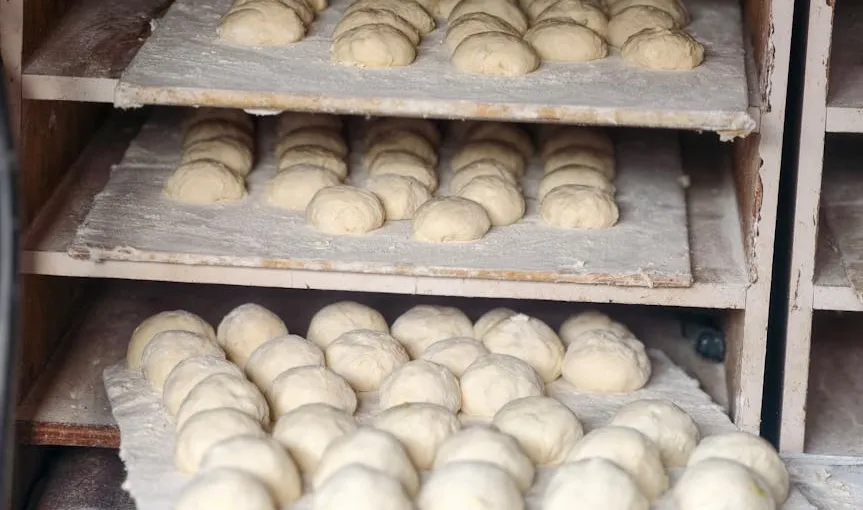
Fermentation is where bread becomes bread. Mixing gives you structure. Baking gives you crust. But fermentation gives you flavor, rise, and the open crumb that defines good bread. Every minute your dough sits in a warm container, billions of single-celled organisms are eating sugar, producing gas, generating alcohol, and excreting organic acids that transform bland flour paste into something worth eating.
Understanding fermentation science doesn’t require a biochemistry degree. It requires knowing what’s eating what, what they’re producing, and how temperature controls the entire process.
The Core Equation
Alcoholic fermentation, also called glycolysis, is the central chemical reaction in bread dough. In plain language: one molecule of glucose yields two molecules of ethanol and two molecules of carbon dioxide.
Each glucose molecule produces:
- 2 molecules of CO2 — the gas that makes bread rise
- 2 molecules of ethanol — a flavor precursor that evaporates during baking at 172 degrees F (78 degrees C)
- Heat — fermentation is exothermic, which means dough temperature rises during bulk fermentation even without external warming
This equation drives everything. The CO2 inflates gas cells that were incorporated during mixing. The ethanol contributes to flavor complexity. The heat accelerates further fermentation in a positive feedback loop — which is why runaway over-fermentation happens faster than you’d expect.
Where the Sugar Comes From
Yeast needs sugar to ferment. But bread formulas for lean doughs don’t contain added sugar. So where does it come from?
Flour itself contains free sugars: sucrose, maltose, and glucose. These are available immediately when the dough is mixed. But they’re consumed quickly — within the first 1-2 hours of fermentation.
The ongoing sugar supply comes from enzymes breaking down starch.
The Sugar Utilization Pathway
- Free sugars in flour — sucrose, maltose, glucose — are available immediately
- Yeast enzyme invertase breaks sucrose into glucose + fructose
- Yeast preferentially ferments glucose and fructose first
- Once free sugars are depleted, amylase enzymes break down damaged starch into maltose
- Maltose becomes the ongoing yeast food source throughout the rest of fermentation
This is why fermentation rate changes over time. The first hour or two may seem fast (abundant free sugars), then it slows (transitioning to enzyme-derived maltose), then finds a steady state. It’s also why flour with more damaged starch (common in American flour at 8-9% versus 7% in European flour) produces slightly faster fermentation — there’s more substrate for amylase to work on.
The Enzymes
Enzymes are proteins that catalyze specific biochemical reactions without being consumed themselves. Three enzyme families matter in bread dough.
Alpha-Amylase
Cleaves starch chains at random internal points, producing dextrins (short starch fragments). Alpha-amylase works throughout bulk fermentation and into the early stages of baking, deactivating around 176 degrees F (80 degrees C).
High alpha-amylase activity is a double-edged sword. Moderate activity: good crust color, good flavor, adequate sugar supply for yeast. Excessive activity: sticky dough, gummy crumb (too many dextrins interfere with starch setting during baking).
Beta-Amylase
Works from the ends of starch chains, cleaving off maltose units two at a time. Beta-amylase is the primary producer of ongoing yeast food — it converts damaged starch into the maltose that sustains fermentation after free sugars are consumed. Also inactivated at approximately 176 degrees F (80 degrees C).
Proteases
Flour contains endogenous proteases that snip peptide bonds in glutenin chains. At low levels, this is beneficial: it softens tight gluten, improves extensibility, and releases amino acids that become flavor compounds and Maillard reaction substrates during baking. At high levels or over very long fermentations, proteases degrade gluten to the point where dough can’t hold gas. Salt inhibits protease activity — one of several reasons salt is essential at approximately 2% of flour weight.
Diastatic malt (Reinhart) contains live amylase enzymes. Adding 0.5% of flour weight boosts crust color and flavor by providing additional sugar for both fermentation and the Maillard reaction.
Commercial Yeast: Types and Behavior
Commercial yeast is Saccharomyces cerevisiae, bred for vigor and reliability.
| Type | Moisture | Conversion from Fresh | Notes |
|---|---|---|---|
| Fresh (compressed) yeast | ~70% | 100% (baseline) | Professional standard; perishable |
| Active dry yeast | 5-7% | Multiply fresh x 0.4 | Must dissolve in warm water first |
| Instant dry yeast | 5-7% | Multiply fresh x 0.33 | Can be added directly to flour |
| Osmotolerant yeast | — | Same as instant | For doughs with more than 10% sugar |
Temperature and Yeast Activity
Temperature is the master control for fermentation speed.
- 32-50 degrees F (0-10 degrees C): Activity greatly reduced. This is the cold retarding zone — fermentation slows nearly to zero.
- 86-95 degrees F: Optimal activity for commercial yeast. Maximum gas production.
- 116-140 degrees F (47-60 degrees C): Thermal death point — yeast dies permanently.
The doubling rule (Reinhart): Yeast approximately doubles its fermentation rate with every 17 degrees F (8 degrees C) increase in temperature. A dough that rises in 2 hours at 70 degrees F will rise in about 1 hour at 87 degrees F and take about 4 hours at 53 degrees F.
This rule explains why desired dough temperature matters so much. A 5 degree F difference in final mix temperature can shift your bulk fermentation timing by an hour or more.
Yeast Quantity and Time
The amount of yeast in the formula determines fermentation length:
Sourdough Fermentation: A Different System
Sourdough starters contain both wild yeast and lactic acid bacteria (LAB), creating a more complex fermentation than commercial yeast alone.
The Key Organisms
- Fructilactobacillus sanfranciscensis: The most common LAB in traditional sourdoughs. Prefers maltose as a food source.
- Kazachstania exigua / K. humilis: Wild yeasts that also prefer maltose.
- Saccharomyces cerevisiae: When present, prefers glucose, leaving maltose available for the other organisms.
This metabolic division of labor is elegant: the bacteria and wild yeasts partition the available sugars rather than competing head-to-head. The result is a stable ecosystem where multiple organisms coexist.
The organisms are NOT tied to geography. Despite the popular myth about San Francisco sourdough, the specific microbes in a culture are determined by the baker’s maintenance practices, the flour used, and the ambient environment — not the city.
Lactic vs. Acetic Acid
Sourdough’s flavor comes from organic acids produced by LAB. The balance between two acids defines the character of the bread.
Practical translation: if you want milder sourdough, keep your starter warm and liquid and don’t over-ferment. If you want tangier sourdough, use a stiffer starter, ferment longer, and consider a cold retard.
Fermentation Is Exothermic
A detail that catches new bakers off guard: fermentation generates heat. The glycolysis equation is exothermic — every glucose molecule that converts to ethanol and CO2 releases energy as thermal output. During a 4-5 hour bulk fermentation, dough temperature can rise 2-4 degrees F from fermentation alone, independent of ambient temperature.
This matters for timing. If you mixed your dough to a perfect 76 degrees F DDT, it may be 78-80 degrees F by the end of bulk. The warmer temperature accelerates the very fermentation producing the heat, creating a positive feedback loop.
What Gas Actually Does
CO2 doesn’t create new bubbles in dough. This is a common misconception. The gas inflates bubbles that already exist — bubbles that were incorporated during mixing.
This is why mixing and kneading matter for crumb structure. A well-mixed dough has more small, evenly distributed gas nuclei. Stretch-and-fold turns during bulk fermentation subdivide large bubbles into smaller ones, promoting a finer, more even crumb.
Fermentation and Flavor
The connection between fermentation length and flavor depth is the most universal principle in bread science. Every author states it. Long fermentation = more flavor. No exceptions.
During fermentation, enzymes produce organic acids, amino acids, esters, and alcohols — all flavor compounds. A bread that bulk-fermented for 12 hours contains measurably more of every flavor compound than a bread that fermented for 2 hours with 4x the yeast.
This is why pre-ferments exist. A poolish, biga, or levain pre-ferments a portion of the flour for 12-16 hours before the final mix. That pre-fermented flour carries accumulated flavor compounds into the final dough, even if the final bulk fermentation is relatively short.
Forkish’s shelf life observation reinforces this: straight doughs (commercial yeast only) keep 2-3 days. Pre-ferment breads keep 4-5 days. Levain breads keep 5-6 days. Longer fermentation produces bread that tastes better and lasts longer.
Bulk Fermentation Completion Indicators
How do you know when bulk fermentation is done?
Volume increase. Forkish targets a triple for his Saturday White (~5 hours at 77-78 degrees F) and 2.5-3x for his Overnight White (12-14 hours). Robertson targets only 20-30% for his country loaf (3-4 hours at 78-82 degrees F). The targets differ because their formulas and methods differ.
Dome and bubbles. The surface of well-fermented dough is slightly domed, with visible gas bubbles just beneath the surface.
The jiggle test. Robertson describes well-fermented dough as having a “delicate, airy quality.” Shake the container — the dough should jiggle like a water balloon rather than sitting rigidly.
Understanding fermentation turns bread baking from recipe-following into process management. When you know what’s happening inside the dough, you can adjust timing, temperature, and yeast quantity to hit any flavor and texture target you want.
Frequently Asked Questions
- What temperature is best for bread fermentation?
- For most lean breads with commercial yeast, a dough temperature of 75-78 degrees F (24-26 degrees C) produces the best balance of rise and flavor development. Yeast is most active at 86-95 degrees F, but faster isn't better -- lower temperatures extend fermentation time, which produces more complex flavor. Temperatures above 82 degrees F risk over-fermentation and excessive protease enzyme activity that degrades gluten.
- Why does bread dough rise faster on warm days?
- Yeast approximately doubles its fermentation rate with every 17 degrees F (8 degrees C) increase in temperature. On a warm day (80 degrees F kitchen versus a typical 70 degrees F), your dough may ferment 40-60% faster than expected. This is why desired dough temperature calculations exist -- by adjusting water temperature, you can hit a consistent final mix temperature regardless of ambient conditions.
- Is longer fermentation always better for bread flavor?
- Longer fermentation produces more flavor compounds, which is why all five major bread authors agree that extended fermentation improves flavor. However, there's a limit. Extremely long fermentation (24+ hours at room temperature) can degrade gluten past usefulness and produce excessive sourness. The sweet spot depends on the formula: 12-14 hours for Forkish's low-yeast overnight doughs, 3-4 hours for Robertson's active sourdough bulk.
- What's the difference between active dry yeast and instant yeast?
- Both are dried forms of Saccharomyces cerevisiae at 5-7% moisture. Active dry yeast must be dissolved in warm water before use. Instant dry yeast can be added directly to flour without pre-dissolving. Instant yeast is also more concentrated: use 33% of the fresh yeast amount versus 40% for active dry. For a recipe calling for 10g fresh yeast, use 3.3g instant or 4g active dry.
- Why does sourdough bread keep longer than yeasted bread?
- Sourdough's lower pH from organic acids (lactic and acetic) inhibits mold growth and slows starch retrogradation (the process that causes staling). Straight yeasted doughs keep 2-3 days, pre-ferment breads keep 4-5 days, and levain breads keep 5-6 days. The acids produced during sourdough fermentation are essentially natural preservatives.