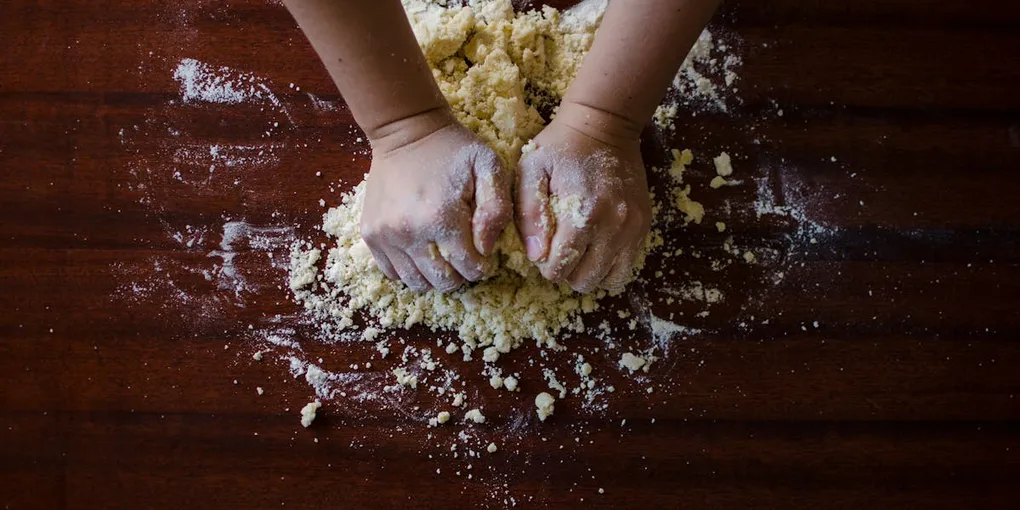
Kneading is the most iconic step in bread baking and also the most misunderstood. Beginners either under-knead (stopping when their arms get tired) or over-knead in a stand mixer (running it until the motor overheats). Both produce mediocre bread for different reasons.
The real question isn’t just how to knead — it’s why you’re kneading, what’s happening to the dough at a molecular level, and when kneading is actually counterproductive. Some of the best bread in the world — including most high-hydration sourdoughs — involves zero traditional kneading.
What Kneading Actually Does
Kneading develops gluten. That’s the single-sentence answer, but it hides a lot of physics.
Wheat flour contains two protein classes: glutenin and gliadin. Glutenin molecules are large polymers linked by disulfide bonds — they provide elasticity, the tendency to spring back. Gliadin molecules are smaller and act as a molecular lubricant within the glutenin network, providing extensibility — the ability to stretch without tearing.
When you knead, three things happen simultaneously. First, you’re forcing these proteins into contact with water, accelerating hydration. Second, mechanical energy rearranges disulfide bonds, building a stronger, more organized gluten network. Third, you’re incorporating air bubbles into the dough — and these bubbles matter more than you’d think. During fermentation, CO2 doesn’t create new bubbles. It inflates bubbles that already exist from mixing. The bubbles you knead in become the crumb structure of your final loaf.
Well-kneaded dough is smooth, elastic, and slightly tacky. It pulls away from the bowl or counter cleanly, holds its shape when rounded, and passes the windowpane test.
The Windowpane Test
This is your go-to indicator for gluten development, regardless of kneading method. Tear off a small piece of dough (golf-ball sized) and gently stretch it between your fingers and thumbs. If the gluten is well-developed, you can stretch it thin enough to see light through without it tearing.
Hamelman describes it precisely: “When it is sheeting fully, you will be able to coax it out into a thin, almost transparent, sheet.”
If the dough tears immediately, it needs more development. If it stretches partway and then tears with ragged edges, you’re getting close — give it a few more minutes. The windowpane test works for hand-kneaded dough, machine-mixed dough, and even dough developed through stretch and fold.
Hand Kneading: The Pincer Method
Ken Forkish’s pincer method is the most efficient hand-mixing technique in any of the major bread books. It’s faster and less tiring than traditional push-fold-rotate kneading.
Phase 1 — Incorporation. Reach under the dough mass in your tub or bowl, stretch a portion up, and fold it over the top. Rotate the tub 90 degrees and repeat. Continue until all dry flour is incorporated. This takes 1-2 minutes.
Phase 2 — The Pincer. Make a pincer grip with your thumb and forefinger and squeeze through the center of the dough, cutting it almost in half. Then fold the dough over itself. Rotate the tub, pincer again, fold again. Repeat this cycle for 2-6 minutes total.
The pincer works because it shears the dough internally, promoting gluten alignment without the repetitive motion stress of traditional kneading. It’s particularly effective for wet doughs (72%+ hydration) where conventional kneading turns into a sticky wrestling match.
After the pincer method, the dough rests during bulk fermentation with periodic folds. The combination of initial pincer mixing plus folds over 3-5 hours develops gluten comparable to 8-10 minutes of machine kneading.
Stand Mixer Kneading
Planetary Mixer (KitchenAid-Style)
For home bakers using a stand mixer with a dough hook:
- First speed (low): 2-3 minutes. Combine all ingredients until no dry flour remains.
- Second speed (medium): 4-10 minutes depending on the dough. Watch for the dough to pull cleanly away from the bowl sides and wrap around the hook.
Friction factor matters here. A planetary mixer adds 24-28 degrees F of heat to the dough during mixing. If your kitchen is 72 degrees F and your flour is 68 degrees F, you need cold water to hit your desired dough temperature of 75-78 degrees F.
Reinhart’s guidance: “Low speed paddle 1 min to combine, then dough hook medium 6-12 min.” Enriched doughs with butter and eggs need the full 12 minutes. Lean doughs with an autolyse might need only 4-6 minutes.
When to Stop
Over-mixing in a stand mixer is a real risk. Excessive mechanical energy breaks the very bonds you’re trying to build. The dough goes from smooth and elastic to slack, shiny, and sticky — a sign that gluten is degrading.
Beyond structural damage, over-mixing destroys carotenoid pigments in the flour. These pigments contribute to cream-colored crumb and wheaty aroma. Raymond Calvel identified this overoxidation problem as the central cause of French bread quality decline in the post-WWII era.
Signs of over-mixing: dough becomes very sticky and slack after initially coming together; the surface looks shiny and wet rather than smooth and slightly matte; the dough tears easily rather than stretching. If you reach this point, you can’t fix it — the gluten is permanently damaged.
Hamelman’s Unkneaded Six-Fold Method
Jeffrey Hamelman demonstrated that gentle folding can replace intensive mechanical mixing entirely. His method: mix the dough shaggy (just until incorporated, no kneading), then perform 6 folds at 10-minute intervals during early bulk fermentation.
Each fold involves lifting one side of the dough, stretching it up, and folding it over the center. Rotate 90 degrees and repeat for all four sides. The dough transforms from rough and shaggy to smooth and strong over the course of an hour without any kneading at all.
This works because gluten develops spontaneously through hydration and time (the principle behind autolyse), and gentle folds organize that developing network without the oxidation damage that comes from extended mixing.
Autolyse: Letting Water Do the Work
Before you knead at all, consider whether an autolyse step can reduce the amount of mechanical energy your dough needs. Mix flour and water only — no salt, no yeast, no starter — and let it rest for 20-60 minutes.
After a 20-minute autolyse, Reinhart needs only 2-4 additional minutes of mixing. Every author in the major bread canon agrees that autolyse improves bread quality. Never add salt during the autolyse — salt inhibits water absorption.
Bassinage: The Two-Stage Water Trick
For very high-hydration doughs — ciabatta at 80%+, for example — adding all the water at once makes the dough impossible to mix properly. Hamelman’s solution is bassinage: hold back 10% of the water at the start of mixing.
Mix the main dough with 90% of the water first. Develop the gluten partially. Then add the reserved water gradually on second speed. The already-formed gluten network can absorb the additional water without falling apart.
Kneading Times by Dough Type
| Dough Type | Hand (Pincer) | Stand Mixer | Autolyse + Folds |
|---|---|---|---|
| Lean white (65-70% hyd) | 4-6 min + folds | Low 2 min, Med 6-8 min | 20-40 min autolyse + 4-6 folds |
| High-hydration (75%+) | 2-4 min + folds | Not recommended (too wet) | 30-60 min autolyse + 4-6 folds |
| Whole wheat | 6-8 min + folds | Low 2 min, Med 8-10 min | 40-60 min autolyse + 4-6 folds |
| Enriched (brioche) | Not practical | Low 3 min, Med 12-15 min | N/A |
| 100% rye | 10-12 min first speed only | Low 10-12 min only | N/A (no gluten to develop) |
Rye is a special case. Rye flour contains almost no gluten-forming proteins. Structure comes from pentosans. Second speed will shear the pentosan gel apart. First speed only, and only until homogeneous.
When NOT to Knead
Some of the best breads in the world involve no kneading at all.
High-hydration sourdoughs. Robertson’s Tartine Country Bread uses no kneading. The dough is developed entirely through stretch-and-fold turns during bulk fermentation.
No-knead breads. The entire no-knead method relies on time replacing mechanical energy. Long fermentation (12-18 hours) with minimal yeast allows gluten to develop through hydration and slow enzymatic action.
Doughs with heavy pre-fermented flour. When more than 35% of the flour has been pre-fermented, the acid has already strengthened the gluten. Additional mechanical development can be detrimental.
Common Kneading Mistakes
Adding too much flour. Sticky dough tempts you to add flour. Resist. The stickiness decreases as gluten develops. Adding flour changes your hydration percentage and produces denser bread.
Stopping too soon. If you’re hand kneading and stop because you’re tired at 4 minutes, the dough probably isn’t developed enough. Take a 5-minute rest, then continue.
Running the stand mixer unattended. Stand mixers can over-develop dough in under a minute past the sweet spot. Stay with the mixer and check frequently.
Kneading is a skill that improves with feel. After a few dozen loaves, you’ll recognize the transition from shaggy to smooth to elastic without needing the windowpane test every time. But while you’re learning, test early and test often.
Frequently Asked Questions
- How long should I knead bread dough by hand?
- Most lean bread doughs need 8-12 minutes of traditional hand kneading, or 4-6 minutes using Forkish's pincer method followed by stretch-and-fold turns during bulk fermentation. Rather than watching the clock, use the windowpane test — stretch a small piece thin enough to see light through. If it tears, keep going.
- Can you over-knead bread dough by hand?
- It's extremely rare to over-knead by hand — most people's arms give out long before the gluten degrades. Over-kneading is primarily a stand mixer problem. A planetary mixer generates enough mechanical energy to break down gluten structure in 12-15 minutes on medium speed.
- What speed should I use on my stand mixer for bread?
- Start on first speed (low) for 2-3 minutes to combine ingredients, then switch to second speed (medium) for 4-10 minutes to develop gluten. Never use the highest speed for bread dough — it generates excessive heat and can damage both the gluten and the mixer motor.
- Do I need to knead sourdough bread?
- Most sourdough recipes don't require traditional kneading. The combination of high hydration, autolyse, and stretch-and-fold turns during bulk fermentation develops the gluten network gently over several hours. Robertson's Tartine method uses no kneading at all.