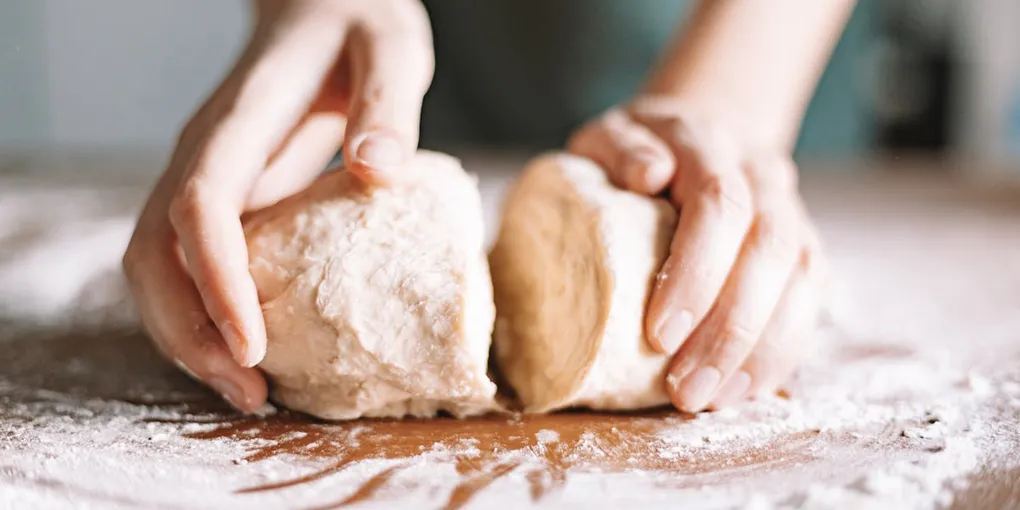
Shaping is the step where a loose mass of fermented dough becomes a loaf with structure. The goal is surface tension — a taut outer skin that holds the loaf’s shape during proofing, contributes to oven spring, and prevents the dough from spreading flat.
Every shape works by the same principle: friction between the dough and the work surface stretches the outer layer tight while the interior remains soft and gas-filled. The dough is not rolled but pushed. Buehler describes the physics: “The friction of the table stretches the outer layer of the dough taut.”
If your loaves spread sideways during proofing, collapse in the oven, or bake into flat discs, the fix is almost always better shaping.
Before You Shape: Pre-Shaping
Pre-shaping is the often-skipped step that makes final shaping dramatically easier.
After bulk fermentation is complete, turn the dough out onto a lightly floured surface and divide it (if making multiple loaves). Then gently round each piece into a rough ball by tucking the edges underneath. The goal isn’t precision — it’s to create initial surface tension and organize the dough into a coherent mass.
Bench rest: Cover the pre-shaped pieces and let them rest for 20-30 minutes. During this rest, the gluten relaxes. If you skip the bench rest and try to final-shape immediately, the dough fights back — it’s too elastic, tears at the seams, and won’t hold its shape.
How long to rest depends on how tight the pre-shape is:
- Gentle pre-shape (barely rounded): 15-20 minutes is enough
- Firm pre-shape (well-rounded): 25-30 minutes to let the tension release
Surface Tension: The Core Concept
Surface tension is what separates a loaf that holds its shape from one that pancakes. When you shape correctly, the outer layer of the dough stretches smooth and tight — like a balloon’s skin — while the interior stays soft and full of gas.
Three factors create surface tension:
- Friction with the work surface stretches the bottom of the dough tight as you drag it
- Folding and tucking pulls the surface layers taut from multiple directions
- Sealing the bottom traps the tension so it doesn’t release
If the surface tears during shaping, the tension escapes and the loaf will spread. Shape firmly but not so aggressively that the outer layer rips.
Shaping a Boule (Round)
The boule is the most forgiving shape and the best one to learn first.
- Flip the pre-shaped round seam-side up on a lightly floured surface.
- Fold the edges to center. Pull the far edge toward you and press to seal. Pull the left side over, then the right side, then the near edge. You’ve created a package.
- Flip seam-side down onto an unfloured area of the counter.
- Cup your hands around the dough, fingertips touching the counter behind the loaf.
- Drag toward you in short, firm strokes. The counter friction tightens the skin. Rotate slightly between drags.
- Stop when the surface is smooth and taut. The seam should be sealed on the bottom.
The key moment is step 5. You’re not rolling the dough — you’re pulling it toward you so the bottom catches on the counter and the top stretches tight.
Robertson’s Unfloured Surface
Robertson shapes on an unfloured surface. The dough’s natural stickiness provides the friction needed to build tension. This is more effective for high-hydration doughs but requires confidence handling sticky dough.
After shaping, transfer the boule seam-side up into a floured banneton (proofing basket).
Shaping a Batard (Oval)
The batard is an elongated oval — wider than a baguette, shorter than a boule.
- Flip the pre-shaped piece seam-side up on a lightly floured surface.
- Press gently into a rectangle — don’t degas aggressively.
- Letter fold: Fold the top third down toward the center. Press the seam with the heel of your hand. Fold the bottom third up over the first fold. Press to seal.
- Seal the center seam by pressing with the heel of your hand along the entire length.
- Rock gently back and forth with both hands to elongate slightly and taper the ends.
- Place seam-side up in an oval banneton or seam-side down on a couche.
The letter fold is the core technique. Pressing with the heel of your hand is important — fingertips don’t apply enough pressure to seal the seam.
Shaping a Baguette
The baguette is the most technically demanding bread shape. Hamelman devotes more pages to baguette shaping than to any other topic in his 500-page book.
- Pre-shape into an oval (not a round). Rest 20-30 minutes.
- Flip seam-side up. Fold the top edge down to the center. Press to seal.
- Rotate 180 degrees. Fold the new top edge down to meet the seam. Press to seal.
- Seaming: Fold the dough over your thumb, press with the heel of your hand to seal. Move your hand down the length, repeating this fold-and-seal.
- Roll to elongate. Place both hands on the center and roll while moving hands outward toward the ends.
Expect your first 10-20 baguettes to be imperfect. For a comprehensive guide, see baguettes at home.
Shaping High-Rye Dough
Rye dough plays by completely different rules. You cannot build surface tension the way you do with wheat dough.
Shape with wet hands, never flour. Flour sticks to the dough surface and creates a dry barrier.
For rye over 70%: Shape seam-side UP, then invert into a heavily floured banneton.
Minimal handling. Rye dough degasses easily. Shape quickly and decisively. Two or three moves maximum.
Proofing After Shaping
Once shaped, the dough needs a final proof before baking. Two options:
Room Temperature Proof
Robertson: 3-4 hours at room temperature for his country bread. Use the poke test to judge readiness.
Cold Retard (Overnight in Fridge)
Place the shaped, banneton-held loaf directly in the refrigerator. The cold slows fermentation while flavor continues to develop and the dough firms for easier scoring.
Bake straight from the fridge — Forkish confirms the loaves don’t need to come to room temperature first. Cold dough actually scores more cleanly because the surface is firm.
Banneton Prep and Flour Choice
Flour the banneton generously. The first time you use a new banneton, flour it heavily — more than you think is necessary.
Best flour for bannetons: Robertson uses a 50/50 blend of rice flour and wheat flour. Rice flour doesn’t absorb water the way wheat flour does, so it creates a better non-stick barrier.
Do not wash your banneton with water. Brush out excess flour with a dry brush after each use.
Orientation: Most loaves go into the banneton seam-side up. When you turn the loaf out, the smooth, flour-patterned surface faces up for scoring.
Troubleshooting Shaping Problems
Dough springs back and won’t hold shape
The gluten is too tight. Give it a longer bench rest (add 10-15 minutes). If it still resists, the bulk fermentation may have been too short.
Dough tears during shaping
Either the gluten is underdeveloped (needed more folds during bulk) or you’re handling it too aggressively. Ease up on the tension.
Loaf spreads flat during proofing
The shaping didn’t create enough surface tension. Try shaping again (you can gently re-shape once without major damage). Or the dough is over-proofed.
Dough sticks to everything
For sticky dough, wet your hands and bench scraper rather than adding flour to the dough. Rice flour in the banneton prevents sticking better than wheat flour.
Seam opens during baking
The seam wasn’t sealed tightly enough. Press harder with the heel of your hand.
Practice Over Perfection
Shaping is a physical skill. The muscle memory comes from repetition — the feel of when the surface is taut enough, the pressure needed to seal a seam, the drag angle that builds tension without tearing.
Shape five loaves and the fifth will be noticeably better than the first. Shape fifty and you’ll barely think about it.
Frequently Asked Questions
- Should I flour the surface when shaping bread?
- It depends on your dough. For standard hydration wheat doughs (65-72%), a lightly floured surface works fine. For high-hydration doughs (75%+), Robertson's technique of shaping on an unfloured surface actually works better. For rye dough, use wet hands instead of flour.
- How do I know when I have enough surface tension?
- The surface of the dough should look smooth, taut, and slightly translucent — like a balloon. When you poke it gently, it should feel springy and resist without tearing. If the surface is rough, wrinkled, or the dough slumps sideways immediately, it needs more tension.
- Why does my dough keep springing back when I try to shape it?
- The gluten is too elastic and needs more time to relax. Give the pre-shaped dough a longer bench rest — try 25-30 minutes instead of 15-20. If shaping a batard or baguette and the dough won't elongate, stop, cover it, wait 5-10 minutes, and try again.
- Can I reshape bread dough if I mess up?
- Yes, once. Gently flatten the dough, let it rest covered for 15-20 minutes, then reshape. Each reshaping degasses the dough slightly, so avoid doing it more than once.
- What's the difference between a boule and a batard?
- A boule is round; a batard is an elongated oval. Boules use cupping and dragging, while batards use letter folds and seam-sealing. Boules are more forgiving for beginners because the round shape distributes tension evenly.