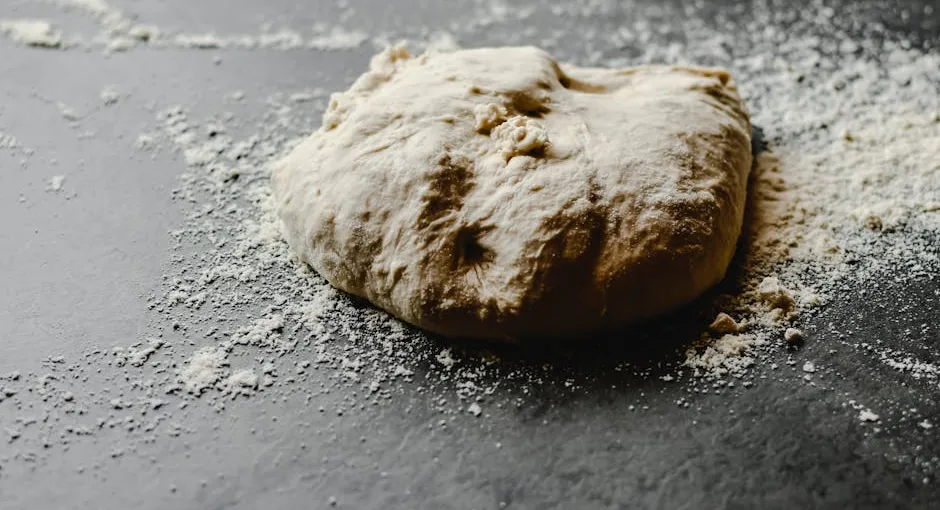
No-knead bread works because time does what a stand mixer does — it develops gluten. Mix flour and water together, leave them alone for hours, and the protein molecules hydrate, uncoil, and cross-link into a gluten network without anyone touching the dough. Add a few gentle folds and you get structure that rivals a kneaded loaf, with more flavor and less effort.
This isn’t a gimmick or a shortcut. Jeffrey Hamelman — one of the most respected professional bakers in the US — demonstrated that his unkneaded six-fold method produces bread with excellent crumb structure. The physics is sound: glutenin and gliadin molecules need water and time to form disulfide bonds. Kneading accelerates the process but isn’t the only path to get there.
Why Kneading Exists (and Why You Can Skip It)
When you knead bread dough, you’re doing three things at the molecular level:
- Hydrating proteins. Kneading forces flour and water together, ensuring every protein molecule contacts water.
- Unfolding glutenin chains. Mechanical energy stretches and aligns the large glutenin polymers.
- Promoting disulfide bond formation. As glutenin chains align, their cysteine residues come into proximity and form covalent cross-links (S-S bonds). These bonds are the structural backbone of gluten.
Time accomplishes all three, just more slowly. During a long rest, water gradually penetrates flour particles. Glutenin chains unfold as they hydrate. Bonds form as the molecules find each other through random thermal motion rather than mechanical force.
The autolyse step — mixing flour and water and resting before adding other ingredients — proves this principle every time a baker uses it. A 30-minute autolyse can reduce mixing time by 50% because the flour has already begun developing gluten on its own.
The Formula
| Ingredient | Weight | Baker’s % |
|---|---|---|
| Bread flour | 500g | 100% |
| Water (80-85°F / 27-29°C) | 375g | 75% |
| Fine sea salt | 10g | 2% |
| Instant dried yeast | 1.0g | 0.2% |
Yield: One large loaf (about 870g baked).
The 0.2% yeast gives you a 10-12 hour fermentation window at room temperature — enough time for significant flavor development without the risk of over-fermenting overnight. If you want the full overnight schedule (mix at 7 PM, bake at 9 AM), drop to 0.8g yeast (0.16%) as in the Overnight White.
The Timeline
| Time | Step | Active Time |
|---|---|---|
| 8:00 PM | Mix | 3 min |
| 8:10 PM | Fold 1 | 30 sec |
| 8:20 PM | Fold 2 | 30 sec |
| 8:30 PM | Fold 3 | 30 sec |
| 8:40 PM | Fold 4 | 30 sec |
| 8:50 PM | Fold 5 | 30 sec |
| 9:00 PM | Fold 6 | 30 sec |
| 9:00 PM - 7:00 AM | Bulk fermentation (sleep) | 0 min |
| 7:00 AM | Shape | 5 min |
| 7:15 AM | Proof | — |
| 7:30 AM | Preheat oven + Dutch oven | — |
| 8:30 AM | Score and bake | 2 min |
| 9:15 AM | Cool | — |
Total hands-on time: about 12 minutes.
Step 1: Mix (Evening)
Pour 375g water into a large bowl or clear container. Add 1.0g instant yeast. Add 500g bread flour and 10g salt. Mix with a wooden spoon or your hand until no dry flour remains — 2-3 minutes. The dough will look shaggy and rough. That’s correct.
Step 2: Six Folds (Next Hour)
Starting 10 minutes after mixing, perform one stretch-and-fold every 10 minutes, six times total:
- Wet your hand.
- Grab one side of the dough, stretch it up, fold it over to the other side.
- Rotate the bowl 180 degrees. Repeat on the other side.
- That’s one fold.
This takes 30 seconds each time. After the sixth fold, cover the container and leave it alone until morning.
Step 3: Overnight Bulk Fermentation
While you sleep, three things happen simultaneously:
Fermentation. The yeast slowly converts sugars to CO2 and ethanol. The ethanol evaporates during baking but contributes to flavor complexity through intermediate reactions.
Enzyme activity. Amylase breaks starch into maltose (yeast food). Protease softens gluten, improving extensibility. Both enzymes have hours to accumulate their products, which is why long-fermented bread has more flavor.
Continued gluten development. Even without folds, the gluten network continues to form and mature throughout the rest.
Temperature and timing: At 70°F, expect 10-12 hours. At 75°F, more like 8-10 hours. At 65°F, you might need 14-16 hours. The dough should be 2-2.5 times its original volume and bubbly when ready.
Step 4: Shape (Morning)
Flour your counter lightly. Ease the dough out of the container. Shape a boule:
- Stretch the bottom edge away from you, fold up to center.
- Fold left side to center, then right side.
- Fold the top edge toward you and over everything.
- Flip seam-side down. Drag toward you gently to tighten the surface.
Place seam-side up into a floured banneton or a bowl lined with a well-floured towel.
Step 5: Proof and Preheat
Cover the dough and let it proof at room temperature while the oven heats. Place your Dutch oven in the oven and preheat to 475°F for at least 45 minutes.
The proof here is short — 60-75 minutes — because the dough has already done most of its rising during the overnight bulk.
Step 6: Score and Bake
Remove the hot Dutch oven. Turn the loaf out onto parchment or directly in. Score with a razor blade or lame — a single slash or a cross pattern both work. Keep the blade at a 30-degree angle for the best ear.
Lid on: 30 minutes at 475°F. Lid off: 15-20 minutes at 450°F until dark brown.
The Dutch oven method creates a sealed steam environment during the first phase. The moisture from the dough itself keeps the surface extensible, allowing maximum oven spring. When the lid comes off, the surface dries and the Maillard reaction kicks in for crust development.
Step 7: Cool
Wire rack. 45-60 minutes minimum. The crust will crackle as it cools — that’s normal and desirable. Cutting too early gives you a gummy interior because the crumb is still setting as starches continue to gel during cooling.
Lodge Combo Cooker — the easiest way to load dough into a hot Dutch oven.
Variations
Higher hydration (80-85%). Increase water to 400-425g. The dough will be much stickier and harder to shape, but the crumb will be more open and irregular.
With whole wheat. Replace 50-100g of the bread flour with whole wheat. Add 10-15g extra water — whole wheat absorbs more due to bran.
All-purpose flour. Works fine at 75% hydration. The crumb will be slightly more tender and less chewy. Reduce water by 10-15g — all-purpose absorbs less water than bread flour.
Common Problems
Huge tunnels on top, dense bottom. Over-proofed. Shape earlier or reduce yeast.
Dense, flat loaf. Under-fermented. Check volume — it should at least double overnight.
Crust is great, interior is gummy. Under-baked or cut too soon. Give it 5 more minutes with the lid off, and wait a full hour before slicing.
Dough is impossibly sticky and won’t shape. Too much water for your flour. Try reducing hydration to 70% on your next attempt.
Frequently Asked Questions
- Does no-knead bread taste different from kneaded bread?
- Yes, and most people prefer it. No-knead bread uses long fermentation (10-14 hours) instead of mechanical kneading, which gives enzymes time to break starch into sugars and proteins into amino acids. These compounds are the building blocks for Maillard reaction flavors in the crust and complex fermentation flavors in the crumb.
- Can I make no-knead bread with all-purpose flour?
- Yes. All-purpose flour at 10-12% protein has enough gluten-forming protein for no-knead bread, especially with folds to support the structure. Reduce hydration by about 2-5% (use 350-365g water per 500g flour instead of 375g) because all-purpose absorbs less water than bread flour.
- Why do I need to fold no-knead bread if it is no knead?
- Folds are not kneading. Kneading involves sustained, repetitive mechanical force for 5-15 minutes to develop gluten. Folds are 30-second interventions that redistribute yeast, equalize temperature, and gently strengthen the gluten network. You can skip them entirely, but 4-6 folds in the first hour produce a noticeably better crumb structure.
- How do I adjust no-knead bread for a warmer or cooler kitchen?
- Temperature and yeast are the two dials. In a warm kitchen (78°F+), use less yeast (0.6-0.8g instead of 1.0g per 500g flour) or mix with cooler water. In a cool kitchen (below 68°F), use slightly more yeast (1.2-1.5g) or use warmer water (90°F). The goal is the same endpoint — 2-2.5 times volume expansion.