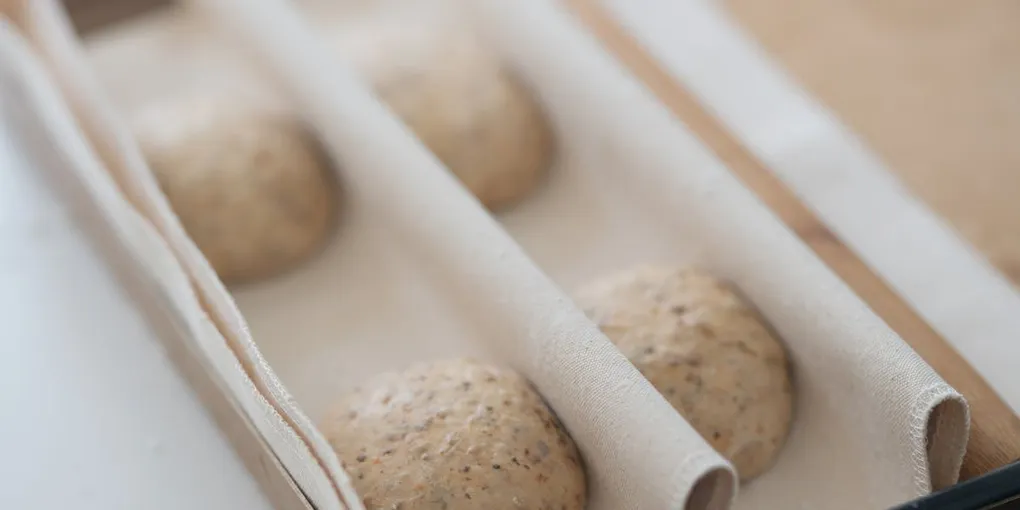
A pre-ferment is a portion of a bread formula’s flour, water, and yeast that’s mixed and fermented before the final dough. The idea is simple: give part of the flour a head start. That extra time — usually 12-16 hours — develops flavor compounds, organic acids, and fermentation byproducts that a straight dough mixed and baked in a single day cannot produce.
Every major bread author uses pre-ferments, and all agree they improve bread. The disagreement is about which pre-ferment to use for which bread. This guide covers the three most common commercial-yeast pre-ferments and explains when each one makes sense.
The Three Pre-ferments
Poolish
A poolish is the simplest pre-ferment: equal weights of flour and water (100% hydration) with a tiny amount of commercial yeast, fermented at room temperature for 12-16 hours.
Character: Liquid, bubbly, sweet-smelling when ripe. The high hydration encourages enzyme activity, producing a mild, sweet, nutty flavor. The crumb of poolish-based bread tends to be open and irregular — the wet pre-ferment contributes extensibility that translates to larger, more uneven holes.
Readiness signs (Hamelman): The surface domes and just begins to recede at the center. Using it before the dome forms means it’s under-fermented. Using it after the dome has fully collapsed means it’s over-fermented — expect flat, overly acidic bread. The window between these states is about 2-3 hours, so timing matters but isn’t razor-thin.
Typical use: French baguettes, pain de campagne, rustic white breads. Any bread where you want open crumb and mild fermentation flavor.
Details:
- Hydration: 100% (equal flour and water by weight)
- Contains: flour + water + yeast (no salt)
- Fermentation: 12-16 hours at 68-72 degrees F
- Yeast: 0.08-0.25% of the poolish flour
- PFF: typically 30-50% of total flour
- Refrigeration: up to 24 hours if you need to delay
Biga
A biga is a stiff Italian pre-ferment: 60% hydration (or 60-70%, per Forkish) with a small amount of yeast, fermented at cooler temperatures for 12-16 hours.
Character: Dense, firm, dough-like. The lower hydration and cooler fermentation produce a different acid profile than poolish — more moderate acid development, with a wheaty, firm flavor. Biga-based bread has a tighter, more even crumb than poolish-based bread, with a pronounced wheat flavor.
Typical use: Ciabatta (Hamelman’s stiff biga version), Italian country bread, rustic loaves where you want wheat flavor without aggressive openness.
Details:
- Hydration: 60% (sometimes 60-70%)
- Contains: flour + water + yeast (no salt)
- Fermentation: 12-16 hours at 60-65 degrees F (cooler than poolish)
- Yeast: 0.08-0.25% of the biga flour
- PFF: typically 20-30% of total flour
- Refrigeration: up to 24 hours
Forkish’s definition: “A somewhat stiff dough (60 to 70 percent water) made up of just flour, water, and a very small amount of yeast, fermented for six to twelve hours.”
Pate Fermentee
Pate fermentee — literally “fermented dough” or “old dough” — is a piece of previously made bread dough reserved and used as a pre-ferment for the next batch. It’s the most practical pre-ferment because you don’t make it separately; you simply set aside a portion of today’s dough for tomorrow’s bread.
Character: Because it includes salt (about 2%), the fermentation is more restrained than poolish or biga. The flavor is complex — slightly sour, with depth that comes from having gone through a full mixing and initial fermentation. The crumb is complex and even.
Typical use: Baguettes (Hamelman’s pate fermentee version), any bread where you want enhanced flavor with minimal extra work.
Details:
- Hydration: about 65% (same as the bread it came from)
- Contains: flour + water + salt + yeast (the only pre-ferment that includes salt)
- Fermentation: 12-16 hours at 65-70 degrees F
- PFF: typically 20-30% of total flour
- Refrigeration: 2-3 days
- Freezing: up to 3 months (Reinhart)
The freezability makes pate fermentee uniquely convenient. Make a batch of bread, freeze a portion, and pull it out weeks later for instant pre-ferment. No planning required.
Head-to-Head Comparison
| Feature | Poolish | Biga | Pate Fermentee |
|---|---|---|---|
| Hydration | 100% | 60% | ~65% |
| Salt | No | No | Yes (2%) |
| Consistency | Liquid, bubbly | Firm, dough-like | Standard dough |
| Ferment temp | 68-72 degrees F | 60-65 degrees F | 65-70 degrees F |
| Ferment time | 12-16 hours | 12-16 hours | 12-16 hours |
| Acid profile | Low (mild, sweet) | Moderate (wheaty) | Moderate (complex) |
| Crumb effect | Open, irregular | Tight, wheaty | Complex, even |
| Flavor | Sweet, nutty | Wheaty, firm | Complex, slight sour |
| Fridge life | 24 hours | 24 hours | 2-3 days |
| Can freeze | No | No | Up to 3 months |
How Pre-ferments Improve Bread
The benefits of pre-ferments aren’t mysterious. They’re the predictable result of giving flour more time to ferment.
Flavor complexity: During 12-16 hours of fermentation, yeast produces dozens of flavor compounds — esters, alcohols, aldehydes, organic acids — that don’t exist in a straight dough mixed and baked in 4-5 hours. These compounds survive baking and contribute the “interesting” flavor that distinguishes artisan bread from same-day loaves.
Improved dough handling: The acids from pre-fermentation strengthen the gluten network, making the dough more extensible and easier to shape. This is especially noticeable in baguettes and other breads that require careful handling.
Better keeping quality: Pre-fermented flour produces bread that stales more slowly. Hamelman attributes this to the organic acids, which inhibit mold growth and slow retrogradation. Forkish confirms: breads made with pre-ferments keep 4-5 days versus 2-3 days for straight dough. For more on this, see the bread storage guide.
Extended shelf life:
| Bread Type | Shelf Life (Forkish) |
|---|---|
| Straight dough (commercial yeast only) | 2-3 days |
| Pre-ferment bread (poolish, biga, pate fermentee) | 4-5 days |
| Levain bread (sourdough) | 5-6 days |
Sourdough Levains: The Fourth Category
Sourdough levains are pre-ferments too — but they use wild yeast and lactic acid bacteria instead of commercial yeast. There are two main types:
Liquid levain: 100-125% hydration. Similar consistency to poolish. Favors lactic acid production (mild, creamy flavor) due to the warm, wet environment. Used at 70-75 degrees F, 12-16 hours.
Stiff levain: 60% hydration. Similar consistency to biga. Favors acetic acid production (sharp, tangy flavor) due to the drier, cooler environment. Used at 65-70 degrees F, 10-16 hours.
The parallel to poolish and biga is not coincidental. The same hydration-and-temperature principles that affect commercial yeast pre-ferments also affect sourdough levains.
Robertson’s distinctive contribution is his young leaven concept: use the levain before it reaches peak acidity. He seeds with just 1 tablespoon of mature starter into 200g flour and 200g water, then uses it when it passes the float test — typically 8-12 hours later. The result is bread with fermentation complexity but without aggressive sour flavor. Learn more in the beginner sourdough guide.
Robertson’s Hybrid Approach
Robertson does something unusual: he uses both natural leaven and poolish in the same bread. His baguettes and enriched breads combine a sourdough levain (for complexity) with a poolish (for overnight fermentation without acidity).
His rationale: natural leaven alone produces too much acidity for baguettes and brioche. Poolish adds fermentation complexity without bacterial sourness. Commercial yeast in the poolish ensures reliable oven spring in doughs where wild yeast might not provide enough lift.
This hybrid approach is worth experimenting with once you’re comfortable making pre-ferments individually.
The Detmolder Method: Rye’s Three-Phase Build
For rye bread, Hamelman describes the Detmolder three-phase method — a German technique that sequences three sourdough builds to optimize flavor:
- Freshening (Anfrischsauer): 150% hydration, 77-79 degrees F, 5-6 hours — activates organisms
- Basic Sour (Grundsauer): 60-65% hydration, 73-80 degrees F, 15-24 hours — develops acetic backbone
- Full Sour (Vollsauer): 100% hydration, 85 degrees F, 3-4 hours — rounds flavor with lactic acid
Total: 24-30 hours. This is the gold standard for rye pre-ferments and produces the most complex rye bread flavor achievable.
Pointage en Bac: The Anti-Pre-ferment
Not every complex bread needs a pre-ferment. Hamelman’s Pointage en Bac method — “bulk fermentation in a bucket” — retards the entire straight dough at 46-50 degrees F for up to 18 hours. The cold temperature slows fermentation to a crawl while enzymes remain active, developing a sweet, complex flavor without any sourness.
The result is a distinctly different baguette: sweet and purely wheaty, without the fermented character of poolish or the complexity of pate fermentee. It proves that time, not pre-ferments, is the real flavor builder. Pre-ferments are simply the most practical way to get time into a formula.
Choosing Your Pre-ferment
Choose poolish when:
- You want the most open, irregular crumb
- You’re making French-style bread (baguettes, pain de campagne)
- You want mild, sweet fermentation flavor
Choose biga when:
- You want wheat-forward flavor
- You’re making Italian bread (ciabatta, rustic loaves)
- You want a tighter, more even crumb
Choose pate fermentee when:
- You want convenience (no separate pre-ferment to mix)
- You bake regularly (always have leftover dough)
- You want complex flavor with minimal effort
- You want to freeze pre-ferment for later use
Choose levain when:
- You want the deepest flavor complexity
- You don’t mind longer timelines (8-16 hours for the levain, then 3-12 hours for the dough)
- You want the best keeping quality (5-6 days)
- You have a healthy sourdough starter
For formula calculations involving pre-ferments — including PFF percentages, flour and water accounting, and scaling — the Baker’s Bench tool handles all pre-ferment types and will show you the total formula percentages including what’s in the pre-ferment.
The baker’s percentages guide explains how to account for pre-ferment flour and water in total formula calculations. The bulk fermentation guide covers how PFF affects final dough fermentation timing. And for understanding how desired dough temperature interacts with pre-ferment temperature, the DDT guide walks through the calculation.
Frequently Asked Questions
- What's the difference between poolish and biga?
- Poolish is a wet pre-ferment (100% hydration — equal flour and water), while biga is a stiff pre-ferment (60% hydration). Poolish produces bread with a more open, irregular crumb and mild, sweet flavor. Biga produces a tighter, more even crumb with pronounced wheat flavor. Both ferment 12-16 hours, but poolish ferments warmer (68-72 degrees F) while biga ferments cooler (60-65 degrees F). Choose poolish for French breads, biga for Italian breads.
- Can I use pate fermentee from any bread dough?
- Yes, as long as it's a yeasted dough with salt. Simply set aside 20-30% of any bread dough after mixing. Refrigerate for up to 3 days or freeze for up to 3 months (Reinhart). Bring to room temperature before using in your next batch. The salt in pate fermentee slows fermentation, giving it the widest usability window of any pre-ferment.
- How do I know when my poolish is ready?
- Watch the surface. A ripe poolish has domed and is just beginning to recede at the center. Before the dome: under-fermented (not enough flavor or fermentation activity). After the dome has fully collapsed: over-fermented (flat bread, overly acidic). The window between under and over is about 2-3 hours at room temperature, so timing is forgiving but not unlimited.
- Do pre-ferments actually make bread taste better?
- Yes, and all five major bread authors agree on this. During 12-16 hours of fermentation, yeast produces dozens of flavor compounds — esters, alcohols, and organic acids — that simply don't develop in a 4-5 hour straight dough. Pre-fermented bread also stales more slowly: Forkish reports 4-5 day shelf life for pre-ferment breads versus 2-3 days for straight doughs.
- Is sourdough starter the same as a pre-ferment?
- A sourdough levain is a type of pre-ferment, but it uses wild yeast and lactic acid bacteria instead of commercial yeast. The principles are the same — ferment a portion of flour in advance for flavor, texture, and keeping quality. Liquid levain (100%+ hydration) functions similarly to poolish; stiff levain (60% hydration) functions similarly to biga. The acid profile and flavor are different because of the bacterial fermentation.