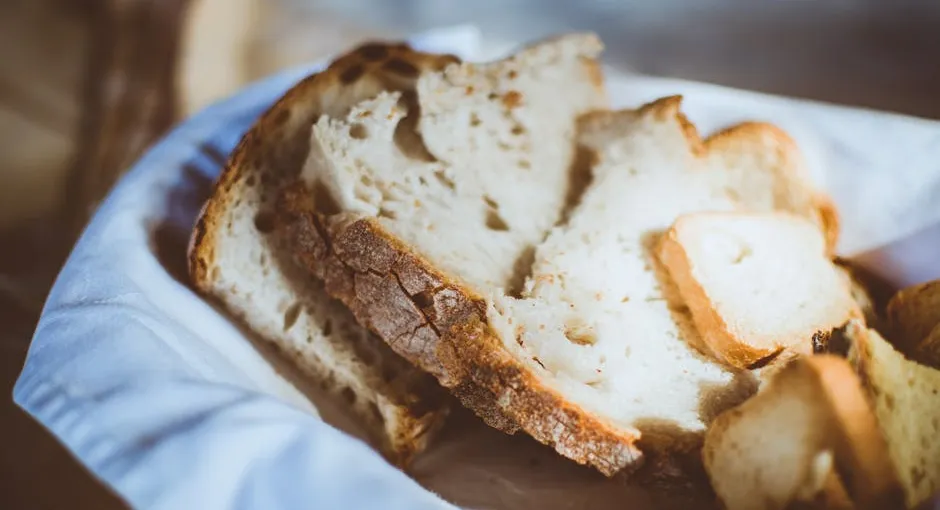
Ask most people why bread goes stale and they’ll say it dries out. It seems obvious — stale bread feels dry, it crumbles, it’s lost its soft chew. But the conventional explanation is wrong. Stale bread hasn’t lost its water. The water is still there. It’s just in the wrong place.
Staling is caused by retrogradation — a molecular process where starch chains that gelatinized during baking slowly re-crystallize as the bread cools and sits. These new crystals exclude water from the crumb structure, pushing moisture from the interior toward the crust. The bread feels dry and firm because of internal water redistribution, not evaporation.
This distinction matters because it changes everything about how you store bread, why the refrigerator is the worst place for it, and why a few minutes in the oven can reverse staling completely.
What Retrogradation Actually Is
During baking, starch granules in the dough absorb water and swell. Above about 140 degrees F (60 degrees C) for wheat starch, the granules burst open in a process called gelatinization — the starch molecules uncoil and disperse through the surrounding water. This is what creates the soft, moist crumb of fresh bread.
As the bread cools after baking, those starch molecules begin to re-associate. They slowly realign into more ordered, crystalline structures. This is retrogradation — the starch reverting from its gelatinized (amorphous) state back toward its native (crystalline) state.
As the crystals form, they squeeze water out of the starch matrix. That water migrates from the crumb toward the crust, which is why stale bread has a soggy, leathery crust and a dry, crumbly interior. The total moisture content of the loaf hasn’t changed much. The distribution has changed entirely.
The Temperature Rule
Retrogradation rate is temperature-dependent, and the relationship is counterintuitive.
| Temperature | Retrogradation Rate | Storage Recommendation |
|---|---|---|
| Below 32 degrees F (0 degrees C) | Stopped completely | Freeze for long-term storage |
| 35-40 degrees F (refrigerator) | Maximum — the worst temperature | Never store bread in the refrigerator |
| 68-77 degrees F (room temperature) | Moderate-slow | Best for short-term storage |
| 140 degrees F+ (60 degrees C+) | Crystals melt (reversal) | Reheat to restore freshness |
The critical fact: bread goes stale faster in the refrigerator than at room temperature.
The refrigerator temperature range (35-40 degrees F) is precisely where starch retrogradation proceeds at its maximum rate. Emily Buehler is unequivocal: “Do not put bread in the refrigerator.” Every major bread author agrees.
Why Freezing Works (and Refrigerating Doesn’t)
Below 32 degrees F (0 degrees C), retrogradation stops completely. Frozen bread is in a state of suspended animation.
This creates a clean binary rule:
- Short-term (1-3 days): Store at room temperature
- Long-term (anything beyond 3 days): Freeze
The refrigerator occupies the worst of both worlds. It’s too warm to stop retrogradation (like a freezer would) and too cold to keep the rate slow (like room temperature would).
Why Sourdough Stays Fresh Longer
Sourdough bread has a measurably longer shelf life than straight yeasted bread. The numbers from Forkish:
| Bread Type | Shelf Life |
|---|---|
| Straight doughs (commercial yeast only) | 2-3 days |
| Pre-ferment breads (poolish, biga) | 4-5 days |
| Levain breads (sourdough) | 5-6 days |
Two mechanisms explain this. First, the lower pH from organic acids (lactic and acetic) produced during sourdough fermentation inhibits mold growth. Second, the acids and the longer fermentation process produce modifications to the starch structure that slow retrogradation.
The Reversibility Trick
Here’s the good news: retrogradation is reversible.
Heating bread to 140 degrees F (60 degrees C) melts the starch crystals, returning them to their amorphous, gelatinized state. The bread regains its soft, moist character.
Methods for revival:
- Toasting: Works for slices. The Maillard browning is a bonus.
- Oven warming: 300 degrees F (150 degrees C) for 10 minutes directly on the rack. Best for whole or half loaves.
- Steam re-heating: Run the loaf under water briefly, then bake at 350 degrees F for 10-12 minutes. The steam re-gelatinizes the crust while the oven heat melts interior crystals.
One caveat: bread will stale faster after a second heating cycle. Revive only what you’ll eat immediately.
How to Store Bread Properly
Room Temperature (1-3 Days)
Paper bag: Crust stays crispy but the crumb dries out faster. Best for same-day or next-day consumption of crusty loaves.
Plastic bag: Crumb stays moist longer but the crust softens. Forkish has made peace with this: “I got over my aversion to storing bread in plastic bags many years ago… nothing else keeps the bread as well.”
Cut side down on a cutting board: The simplest approach for a loaf you’re eating over 1-2 days.
Freezing (Beyond 3 Days)
- Let the bread cool completely after baking
- Wrap tightly in plastic wrap
- Wrap again in aluminum foil (double barrier against freezer burn)
- Freeze flat if possible
To revive: Defrost at room temperature (still wrapped), then heat at 300 degrees F for 10 minutes. You can also slice before freezing and toast individual slices directly from frozen.
Stale Bread Is an Ingredient
Robertson dedicates an entire chapter to using days-old bread. In many culinary traditions, stale bread is the preferred ingredient: panzanella, ribollita, bruschetta, croutons, French toast, and breadcrumbs all call for stale bread specifically.
Robertson frames this as a matter of principle: “The large country loaves are designed to be eaten over several days… wasting it is a modern failure.”
If you bake large country loaves, plan for the lifecycle. Day one: fresh slices with butter. Day two: toast and sandwiches. Day three: bruschetta or croutons. Day four: breadcrumbs or freezer.
Cooling: The First Storage Decision
After baking, the crumb is still gelling. Cutting before cooling compresses the still-setting starch, producing a gummy texture.
Minimum cooling times before cutting:
- Forkish: 20 minutes minimum
- Robertson: 2-4 hours for country loaves
- Hamelman: 24-48 hours for sourdough; 12-24 hours for high-rye breads
The Complete Storage Decision Tree
- Will you eat it within 3 days? Store at room temperature in a plastic bag or cut-side down on a board.
- Will you eat it within a week? Slice, freeze, and toast from frozen as needed.
- Will you eat it eventually? Freeze whole, tightly wrapped in plastic + foil.
- Is it already stale? Toast it, oven-warm it, or cook with it.
- Should you refrigerate it? No. Never. Not ever.
Staling is inevitable. Understanding that it’s a molecular process — not a moisture loss problem — gives you the tools to slow it, reverse it, and plan for it. Bake good bread, store it correctly, and use every last crumb.
Frequently Asked Questions
- Why should you never put bread in the refrigerator?
- The refrigerator temperature (35-40 degrees F) is precisely where starch retrogradation -- the molecular process that causes staling -- proceeds at its maximum rate. Bread goes stale faster in the refrigerator than at room temperature. Below freezing, retrogradation stops completely. At room temperature, it proceeds slowly. The refrigerator is the worst of both worlds.
- Can you reverse stale bread?
- Yes. Starch retrogradation is reversible. Heating bread to 140 degrees F (60 degrees C) melts the starch crystals and restores the soft, moist crumb. Toast individual slices, or warm a whole loaf at 300 degrees F for 10 minutes on the oven rack. One caveat: bread will stale faster after reheating, so only revive what you'll eat right away.
- Why does sourdough bread stay fresh longer than regular bread?
- Two reasons. First, the organic acids from sourdough fermentation lower the bread's pH, which inhibits mold growth. Second, the longer fermentation process modifies starch structure in ways that slow retrogradation. Forkish quantifies the difference: straight yeasted doughs last 2-3 days, pre-ferment breads last 4-5 days, and levain breads last 5-6 days.
- Is stale bread actually dry?
- No -- that's the central misconception. Stale bread hasn't lost significant moisture through evaporation. The total water content is nearly the same. What's changed is water distribution: as starch molecules re-crystallize, they squeeze water out of the crumb structure. The moisture migrates from the interior toward the crust.
- How long should I wait before cutting fresh bread?
- At minimum, 20 minutes (Forkish), though 2-4 hours is better for large country loaves (Robertson). The crumb is still setting as bread cools -- cutting too soon compresses the gelling starch and produces gummy texture even from a perfectly baked loaf. Rye breads need even longer: 24-48 hours for high-rye, and up to 72 hours for 100% rye breads.