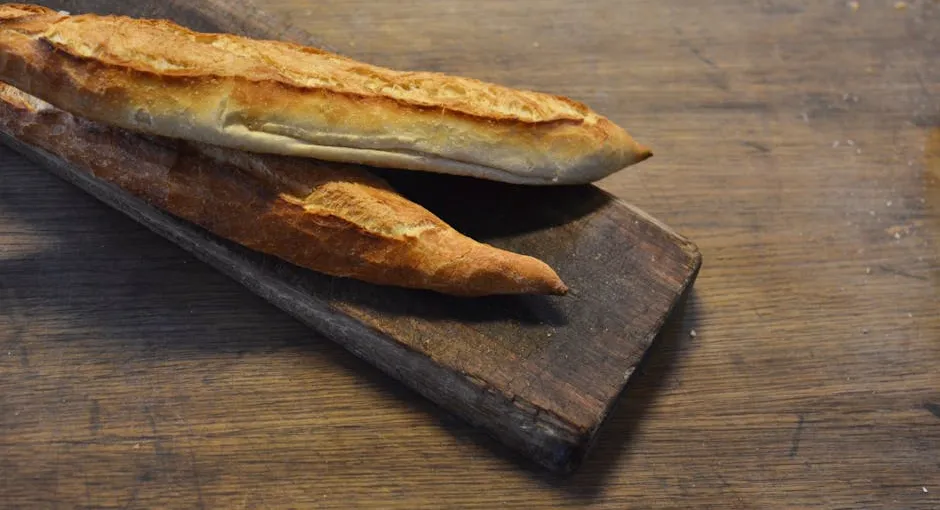
A great baguette has thin, shattering crust, an open and irregular crumb, and a flavor that’s sweet, wheaty, and slightly nutty. It’s also the single hardest bread to make at home. The shape demands precise handling, the crust demands proper steam, and the crumb demands a fermentation approach that balances gas production with flavor development.
The good news: there are multiple proven paths to a good home baguette, and they suit different schedules and skill levels. This guide covers three methods side by side — poolish, pate fermentee, and the cold-retard tradition style — so you can pick the one that fits how you bake.
What Makes a Baguette a Baguette
A baguette is a lean French bread: flour, water, salt, yeast. No fat, no sugar, no enrichments. The standard formulation runs 65-76% hydration depending on the method, with 1.8-2% salt. Baking temperature is 460-480 degrees F with aggressive steam in the first phase.
The shape is specific: 22-26 inches long, tapered ends, scored with 5-7 overlapping cuts at a 30-degree angle using a curved lame. The highest point of the baguette should be at its center, with a graceful, symmetrical taper toward each end.
Shaping is the most technically demanding part. Hamelman describes a detailed seaming technique: the right hand folds dough over the left thumb, the heel of the hand presses to seal, and the motion repeats down the entire length. Each seam must be tight and even. The finished baguette should have consistent diameter from end to end.
Scoring requires a curved lame held at approximately 30 degrees to the surface. Each cut should be 5-7 inches long, with successive cuts overlapping by 25-30%. This overlap creates the signature “ears” — the thin flaps of crust that lift during baking and become the crispiest part of the loaf.
Method 1: Poolish Baguette
The poolish method is the classic French approach and produces the most open, irregular crumb of the three methods.
The Poolish
A poolish is a wet pre-ferment: equal parts flour and water by weight (100% hydration) with a tiny amount of commercial yeast, fermented 12-16 hours at 68-72 degrees F. Hamelman uses 50% of total flour in the poolish — a high pre-fermented flour percentage that drives significant flavor development.
The poolish is ready when the surface has domed and just begun to recede at the center. This timing is critical. A poolish used before doming hasn’t developed enough flavor or fermentation products. A poolish used well after the dome collapses has over-fermented — the bread will be flat, overly acidic, and lacking oven spring.
Formula Overview
- Hydration: 68%
- Pre-fermented flour: 50% (in the poolish)
- Flavor profile: Sweet, nutty, with an open and irregular crumb
- Schedule: Mix poolish the evening before. Final mix the next morning. Bulk 1.5-2 hours. Shape, proof 45-75 minutes, bake.
What to Expect
This is the baguette that most closely matches the French bakery ideal: crisp and shattering crust, highly irregular holes, mild and wheaty flavor with the subtle sweetness that a long poolish fermentation develops. The 50% PFF means the final dough ferments quickly — bulk is short, just 1.5-2 hours with 1-2 folds.
Method 2: Pate Fermentee Baguette
Pate fermentee — literally “old dough” — uses a piece of previously made bread dough as the pre-ferment. It’s the most practical method for bakers who make bread regularly, because you simply reserve a portion of today’s dough for tomorrow’s baguettes.
The Pate Fermentee
Unlike poolish, pate fermentee includes salt (about 2%) and is stiffer (approximately 65% hydration). It contains the full complement of bread dough ingredients: flour, water, salt, yeast. Fermentation happens at 65-70 degrees F for 12-16 hours, or you can refrigerate it for up to 3 days. Reinhart notes that pate fermentee can even be frozen for up to 3 months, making it the most schedule-flexible pre-ferment.
Hamelman uses 25% pre-fermented flour in this version — less than the poolish method. The salt in the pate fermentee slows fermentation and preserves gluten strength, so even at a lower PFF the flavor contribution is significant.
Formula Overview
- Hydration: 68%
- Pre-fermented flour: 25% (in the pate fermentee)
- Flavor profile: More complex than poolish, slightly more assertive, tighter crumb
- Schedule: Make or reserve pate fermentee 1-3 days ahead. Final mix, bulk 1.5-2 hours, shape, proof, bake.
What to Expect
The crumb is tighter and more even than the poolish version — still open, but without the extreme irregularity. The flavor is more complex: the combination of salt-regulated fermentation and the slightly sour character from the longer ferment produces a baguette with more depth. Many professional bakers prefer this method because the pate fermentee is forgiving (works across a wide timing window) and produces consistent results.
Method 3: Cold-Retard Tradition (Pointage en Bac)
This is the Parisian boulangerie method, and it produces a distinctly different baguette from either of the pre-ferment approaches.
How It Works
Pointage en Bac means “bulk fermentation in a bucket.” It’s a straight dough — no pre-ferment at all. Instead, the entire batch of mixed dough is retarded at 46-50 degrees F for up to 18 hours. The dough is then divided and shaped directly from cold, without warming.
Hamelman’s Baguettes de Tradition take the minimalism further: hydration rises to 76%, and mixing is strictly first-speed only — about 600-700 revolutions in a spiral mixer (or the equivalent of slow mixing only in a stand mixer). No second-speed development at all. The long cold rest and high hydration provide all the structure and extensibility the dough needs.
Formula Overview
- Hydration: 70-76% (higher than pre-ferment methods)
- Pre-fermented flour: 0% (straight dough)
- Flavor profile: Sweet, complex, zero sourness — the purest wheat expression
- Schedule: Mix in the afternoon, retard overnight at 46-50 degrees F. Shape from cold the next morning, proof 1-2 hours, bake.
What to Expect
The flavor is distinctive: sweet and complex without any sourness or acidity. Where poolish baguettes have a nutty fermented character and pate fermentee versions have depth, the Pointage en Bac baguette tastes purely of wheat, with a sweetness that develops from the long, slow enzyme activity at cold temperatures. The crumb is open and custardy. No folds are performed during the cold bulk.
This method rewards patience and minimal handling. The dough will feel slack and uncooperative when you first shape it from cold, but it firms up quickly during the proof as it warms.
Side-by-Side Comparison
| Feature | Poolish | Pate Fermentee | Pointage en Bac |
|---|---|---|---|
| Pre-ferment type | Wet (100% hydration) | Old dough (65% hydration, salted) | None — straight dough |
| PFF | 50% | 25% | 0% |
| Final dough hydration | 68% | 68% | 70-76% |
| Mixing intensity | Standard (first + second speed) | Standard | First speed only |
| Bulk ferment | 1.5-2 hours, room temp | 1.5-2 hours, room temp | 18 hours at 46-50 degrees F |
| Folds | 1-2 | 1-2 | None |
| Flavor | Sweet, nutty, open crumb | Complex, slightly assertive | Sweet, pure wheat, no sourness |
| Crumb | Most irregular/open | Even, open | Open, custardy |
| Schedule flexibility | Moderate (poolish timing matters) | High (old dough keeps 3 days) | High (cold retard is flexible) |
Shaping: The Critical Skill
All three methods converge at shaping. The technique is identical regardless of which fermentation path you took.
Pre-shape: After dividing, gently elongate each piece into a rough rectangle. Don’t degas aggressively — you want to preserve the gas structure from bulk fermentation. Cover and bench rest 15-20 minutes. This rest is essential; without it, the gluten is too tight to shape without tearing.
Final shape: Hamelman’s seaming technique is the benchmark. Working on a lightly floured surface, fold the top third of the rectangle down and press the seam with the heel of your hand. Fold again, seal again. Repeat until you have a tight cylinder. Then roll gently with both hands, applying slightly more pressure at the ends to create the taper. Target length: 22-26 inches for a standard home oven (shorter if your baking stone or steel limits you).
Transfer: Proof seam-side up on a floured couche (linen cloth). The couche’s pleats hold the baguettes’ shape during proofing. Transfer to a peel or parchment for loading — a quick flip so the seam is now on the bottom.
The shaping guide covers the full technique with the batard and boule shapes as well.
Scoring Baguettes
Scoring a baguette is the final skill test. Hold a curved bread lame at approximately 30 degrees to the horizontal surface of the dough. Each cut should be swift and decisive — one motion, not a sawing back-and-forth.
Make 5-7 cuts along the length, with each cut overlapping the previous one by 25-30%. The overlap ensures even expansion: if the cuts don’t overlap enough, the baguette will burst unpredictably between the scores.
The cuts should be slightly off-center — not directly on the midline. This asymmetry is what creates ears. When the bread expands in the oven, the thinner lip of dough on the shallow side lifts up and crisps, forming the iconic baguette ear.
Scoring technique in full depth, including the relationship between proof level and cut depth.
Baking
All three methods bake the same way: 460-480 degrees F with aggressive steam for the first 10-15 minutes, then vented for the remaining bake time.
The steam phase is critical for baguettes. Steam keeps the crust surface pliable during the initial oven spring, allowing the scores to open fully and the ears to lift. Without adequate steam, the crust sets too early, oven spring is compromised, and the ears stay flat.
At home, the best steam options are:
- A cast iron pan on the bottom rack with boiling water poured in at loading
- A spray bottle misting the oven walls (less effective but simple)
- A covered baking vessel like a Dutch oven for the first phase (works but limits you to one baguette per bake)
After 10-15 minutes, vent the steam by cracking the oven door or removing the water pan. The remaining 10-15 minutes of dry heat develops the deep golden crust and Maillard flavor compounds. Total bake: 22-28 minutes.
Target color: deep gold to light amber. Don’t pull them when they look “done” — go darker than your instinct says.
The Flour Factor
Baguettes are lean bread — flour, water, salt, yeast. With so few ingredients, flour quality determines everything.
For poolish and pate fermentee methods at 68% hydration, standard bread flour (12-12.7% protein) works well. King Arthur Bread Flour is a reliable choice. The moderate protein provides enough gluten strength for shaping without making the dough too elastic to stretch into baguette length.
For the high-hydration Pointage en Bac method (76%), slightly lower protein flour (11-12%) can actually perform better. The extended cold rest develops gluten slowly, and excessively strong flour can produce a dough that resists shaping. French-style flour (Type 55 equivalent) or a blend of bread flour and all-purpose is worth experimenting with.
If you have access to French flour or a high-quality domestic equivalent, baguettes are where the difference shows most. The simpler the formula, the more the flour’s inherent flavor and performance matter. See the flour comparison for specifics on protein content and baking behavior.
Common Baguette Problems
Baguettes are too short. The dough springs back during shaping because the gluten is too tight. Solution: longer bench rest (20-30 minutes) between pre-shape and final shape. The gluten needs time to relax.
Uneven thickness. The middle is fat, the ends are thin (or vice versa). Apply even, light pressure during rolling, using both hands simultaneously. Let gravity help at the ends rather than squeezing.
Scores don’t open. Usually a steam problem, not a scoring problem. Without enough steam in the first 10-15 minutes, the crust sets before the scores can expand. Also check proof level — over-proofed dough has exhausted its expansion capacity.
Flat profile, no spring. Either over-proofed, or the shaping didn’t create enough surface tension. Tighter seams during shaping and a shorter proof can fix this. The baguette should feel firm and springy when you poke it, not soft and pillowy.
Pale crust despite long bake. Your oven may not reach the temperature it claims. Use an oven thermometer. Also check that you’re venting steam at the right time — steam left in the oven throughout the bake can prevent proper browning.
Which Method Should You Try First?
If you want the easiest path: Pate fermentee. Reserve a chunk of any bread dough you make. The old dough is forgiving on timing and produces reliably good results.
If you want the best crumb: Poolish. The 50% PFF and wet pre-ferment produce the most dramatic open crumb.
If you want the best flavor: Pointage en Bac. The cold retard develops a sweetness and complexity that the other methods can’t match. But the high hydration and minimal mixing require more confidence with wet dough.
If you want to try all three: Make them in the order listed. Each one teaches something the previous one didn’t, and by the time you’ve made all three, you’ll understand what baguette flavor and texture are really about.
For pre-ferment details and the science behind each approach, the reference article covers poolish, biga, and pate fermentee in depth. The bulk fermentation guide explains why the cold-retard method works without any folds.
Frequently Asked Questions
- What's the best baguette method for beginners?
- The pate fermentee method is the most forgiving starting point. You simply reserve a piece of any bread dough you've already made, refrigerate it for 1-3 days, and use it as the pre-ferment. The old dough has a wide usability window and produces consistent results. The poolish method requires more precise timing (the poolish must be used at peak dome), and the cold-retard method uses higher hydration dough that's harder to handle without experience.
- Why don't my baguettes have ears?
- Ears form when three conditions are met: the lame is held at a shallow angle (about 30 degrees to the surface), the cuts are slightly off-center, and the oven has adequate steam during the first 10-15 minutes. The angle creates a thin lip of dough on the shallow side that lifts and crisps during oven spring. Without steam, the crust sets before the scores can open fully. Without the correct angle, the cuts open symmetrically instead of forming a flap.
- Can I make baguettes without a baking stone or steel?
- A baking stone or steel dramatically improves bottom crust and oven spring, but you can use an inverted sheet pan preheated in the oven as a substitute. The key is thermal mass -- any heavy, preheated surface that delivers heat directly to the bottom of the dough. Without it, the baguettes will bake from top-down only, producing pale bottoms and reduced spring.
- How do I get steam in a home oven for baguettes?
- The most reliable home method is a cast iron pan placed on the bottom rack during preheating. At loading time, pour about 1 cup of boiling water into the hot pan and close the door quickly. The water flash-steams and fills the oven. After 10-15 minutes, remove the pan or crack the door to vent. Lava rocks in the pan increase surface area and produce more steam. A Dutch oven works too, but limits you to one baguette per bake.
- What hydration should I use for home baguettes?
- It depends on your method. Poolish and pate fermentee baguettes use 68% hydration -- a medium-wet dough that's workable for shaping. The cold-retard tradition style runs higher at 70-76%, producing a slacker dough with more open crumb. If you're new to baguette shaping, start at 68% to learn the handling, then increase hydration as your technique improves.