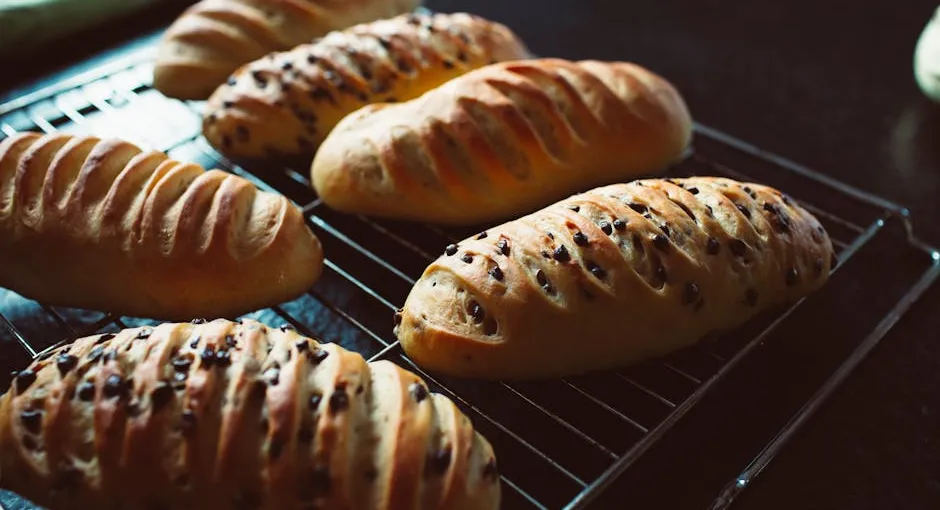
Sourdough bread is flour, water, salt, and a living culture. No commercial yeast. No dough conditioners. The wild yeast and lactic acid bacteria in your starter do all the leavening, and that slow biological process produces flavors that no other bread can match.
This recipe is a stripped-down version of the Tartine-style country loaf — one of the most reproduced sourdough formulas in the world. We’ve simplified the timeline, reduced the variables, and given you a clear schedule so your first bake isn’t an anxiety spiral. The goal is a single loaf with a crackling crust, an open crumb, and enough success to make you want to bake a second one.
If you don’t have an active starter yet, start with our starter guide. You need a culture that reliably doubles in 6-8 hours after feeding before you attempt this recipe.
What You Need
Ingredients
| Ingredient | Weight | Baker’s % |
|---|---|---|
| Bread flour | 450g | 90% |
| Whole wheat flour | 50g | 10% |
| Water | 375g | 75% |
| Salt | 10g | 2% |
| Active sourdough starter (levain) | 100g | 20% |
Total flour: 500g. This makes one loaf, approximately 900g baked weight.
The 90/10 flour split gives you the structure of white flour with a touch of whole wheat flavor and fermentation activity. The 75% hydration is moderate — sticky enough to develop an open crumb but not so wet that it’s unmanageable for a first attempt. Once you’re comfortable, you can push to 80% for a more open crumb.
Equipment
- Kitchen scale (grams, mandatory)
- Large mixing bowl or 6-quart container
- Bench scraper
- Proofing basket (banneton) or a bowl lined with a floured kitchen towel
- Dutch oven, 4-quart minimum
- Razor blade or bread lame
- Probe thermometer (helpful, not mandatory)
Build the Levain (Night Before)
The night before you bake — around 9-10 PM — build a fresh levain. This is a small off-shoot of your starter, built specifically for this bake.
In a clean jar, combine:
- 1 tablespoon (about 20g) of your active, recently-fed starter
- 100g bread flour
- 100g water at 78-80 degrees F (25-27 degrees C)
Mix until no dry flour remains. Cover loosely and leave at room temperature (ideally 72-78 degrees F). By morning — 8 to 12 hours later — it should be bubbly, domed, and smell pleasantly yeasty.
The float test: Drop a small spoonful into a glass of water. If it floats, the levain has produced enough CO2 and is ready. If it sinks, wait another hour and test again. Do not proceed with a levain that sinks — it won’t have enough leavening power.
Robertson calls this a “young leaven” — caught before peak acidity, when yeast activity is high but acid hasn’t accumulated. This produces bread with complex wheat flavor and subtle fermentation character, not aggressive sourness.
The Timeline
Here’s what your bake day looks like. Times assume a 75 degrees F kitchen.
| Time | Step |
|---|---|
| 9:00 AM | Autolyse — mix flour and water |
| 9:30 AM | Add levain and salt |
| 9:45 AM - 1:30 PM | Bulk fermentation with folds |
| 1:30 PM | Pre-shape |
| 1:50 PM | Final shape |
| 2:00 PM - overnight | Cold proof in refrigerator |
| Next morning | Preheat oven, score, bake |
Cold-proofing overnight makes this a two-day process but gives you scheduling flexibility and firms the dough for easier scoring. You can also proof at room temperature for 3-4 hours and bake same-day if you prefer.
Step 1: Autolyse (9:00 AM)
Combine 450g bread flour and 50g whole wheat flour in your bowl. Add 350g of the water (hold back 25g for later). Mix by hand until no dry flour remains — about 1 minute.
Cover and rest for 30 minutes.
During autolyse, the flour fully hydrates and gluten begins forming spontaneously without any mechanical energy. This single step reduces your total mixing time, improves crumb openness, and develops better aroma. Every serious sourdough baker uses it.
Step 2: Add Levain and Salt (9:30 AM)
Spread 100g of your ripe levain over the dough surface. Sprinkle 10g salt on top. Pour the remaining 25g water over everything.
Now mix it in. Use the pincer method: squeeze through the dough with your thumb and forefinger, cutting it into pieces, then fold it back on itself. Rotate the bowl and repeat. Continue for 3-5 minutes until the levain and salt are fully incorporated and the dough feels cohesive.
The dough will be shaggy and rough at this point. That’s normal. The folds during bulk fermentation will develop the gluten.
Step 3: Bulk Fermentation with Stretch-and-Folds (9:45 AM - 1:30 PM)
Bulk fermentation is where the magic happens. Over the next 3.5 to 4 hours, the wild yeast in your levain will produce CO2 (leavening) and the bacteria will produce organic acids (flavor).
Folding schedule:
Every 30 minutes for the first 2 hours (4 sets of folds total), perform one round of stretch-and-folds:
- Wet your hand. Grab one side of the dough.
- Stretch it up as far as it will go without tearing.
- Fold it over to the opposite side.
- Rotate the bowl 90 degrees and repeat.
- Do all 4 sides. This is one “turn.”
After the 4th set of folds (about 2 hours in), leave the dough undisturbed for the remaining 1.5-2 hours. Do not fold during the last hour — you’ll deflate the gas you’ve been building.
What to look for at the end of bulk:
- The dough has increased in volume by 20-30% (not doubled — that’s overproofed for sourdough)
- It feels airy and jiggly when you tilt the container
- You can see small bubbles on the surface and around the edges
- It pulls away from the sides of the bowl slightly
If your kitchen is below 72 degrees F, bulk may take 5-6 hours. If it’s above 80 degrees F, it could finish in 3 hours. Watch the dough, not the clock.
Step 4: Pre-shape (1:30 PM)
Flour your work surface lightly. Turn the dough out onto it. Using your bench scraper and one hand, gently shape the dough into a rough round by tucking the edges underneath. Don’t degas aggressively — you want to keep the bubbles.
Cover with a towel and rest 20 minutes. This bench rest lets the gluten relax, making final shaping much easier.
Step 5: Final Shape (1:50 PM)
Dust your banneton generously with a 50/50 mix of rice flour and bread flour. (Rice flour prevents sticking far better than wheat flour alone.)
Lightly flour the top of your rested dough. Flip it over so the floured side is down. Now shape a boule:
- Stretch the bottom edge away from you, fold it up to the center.
- Stretch the left side out, fold to center.
- Stretch the right side out, fold to center.
- Stretch the top edge toward you, fold to center.
- Flip the whole package over so the seams are underneath.
- Cup your hands around the dough and drag it toward you across the unfloured surface. The friction of the counter tightens the outer skin. Repeat 2-3 times until the surface feels taut.
Place the dough seam-side up into your banneton.
If the dough feels too slack to hold its shape, you may have over-fermented during bulk, or your hydration is too high for your flour. Next time, shorten bulk by 30 minutes or reduce water by 10-15g.
Step 6: Cold Proof (Overnight)
Cover the banneton tightly with plastic wrap or a shower cap. Place in the refrigerator (37-40 degrees F).
The cold slows fermentation nearly to zero while continuing to develop flavor — acetic acid bacteria remain slightly active at fridge temps, adding complexity. The cold also firms the dough, making it easier to score in the morning.
You can bake anytime between 12 and 36 hours later. The sweet spot is 12-18 hours. This flexibility is one of the best things about cold-proofing — bake when you’re ready.
Step 7: Preheat (Next Morning)
Place your Dutch oven (lid on) in the oven. Set the oven to 500 degrees F (260 degrees C). Let it preheat for at least 30 minutes — 45 is better. The Dutch oven must be screaming hot.
The Dutch oven is the home baker’s substitute for a professional steam-injection oven. The sealed lid traps moisture from the dough itself, creating a miniature steam chamber that keeps the surface extensible during oven spring and gelatinizes the surface starch for a glossy, crackly crust.
Step 8: Score and Bake
Remove the Dutch oven from the oven (carefully — it’s 500 degrees F). Remove the lid. Turn your loaf out of the banneton onto a piece of parchment paper, or directly into the Dutch oven.
Score the loaf. Hold a razor blade or lame at a 30-degree angle and make one confident slash about 3-4 inches long and half an inch deep. Don’t saw — one smooth motion. The score creates a controlled weak point where the loaf can expand, rather than ripping unpredictably.
Lower the loaf into the Dutch oven. Put the lid on. Return to the oven.
Bake schedule:
- Lid on: 20 minutes at 500 degrees F (steam phase — oven spring happens here)
- Lid off: Reduce heat to 450 degrees F. Bake 20-25 minutes more until deep mahogany brown.
When the lid comes off, you’ll see how much your loaf has risen. This is the moment of truth. Even a modest oven spring means you’re on the right track.
How dark? Darker than you think. The most common beginner mistake is pulling the loaf when it “looks done.” It’s not done. The caramelization and Maillard reaction that create complex crust flavor happen at the dark end of the spectrum. Go for deep amber to mahogany — not pale gold.
Lodge Combo Cooker — makes loading dough into the hot pot dramatically easier.
Step 9: Cool (The Hard Part)
Place the loaf on a wire rack. Listen — it should crackle and sing as the crust contracts. This is a sign of a good bake.
Now wait. Two hours minimum. Three to four is better. The crumb is still setting as the loaf cools. Cutting too soon compresses the still-gelling starch, producing a gummy interior even if the bake was perfect.
What Your First Loaf Will (Probably) Look Like
Honest expectations: your first sourdough loaf will likely not look like the ones on Instagram. Here’s what’s normal:
- Moderate oven spring, not dramatic ears. Ears take practice with scoring angle and proofing precision.
- A slightly tight crumb. Most first loaves are slightly under-fermented. That’s fine — it’s still delicious.
- An uneven score. Scoring is a skill that improves with repetition.
- A crust that softens overnight. This is normal for home-baked bread stored at room temperature.
Here’s what would indicate a problem:
- Dense, gummy center: Under-baked or cut too soon. Bake longer next time and wait the full cooling time.
- Completely flat loaf: Either the levain wasn’t active (failed float test) or the dough was massively over-fermented.
- Huge tunnels at the top, dense bottom: Over-proofed. Shape earlier next time.
- Ripped sides instead of clean score expansion: Under-proofed. Give it more bulk time.
For a deeper dive into what went wrong, see Why Is My Bread Dense? and Overproofed vs Underproofed.
Troubleshooting Your First Bake
“My dough was soup after bulk.” Either your kitchen was too warm (above 82 degrees F accelerates fermentation dramatically), your bulk ran too long, or your flour can’t handle 75% hydration. Next time: reduce water to 350g (70% hydration) and see if the dough is more manageable.
“My starter passed the float test but the bread didn’t rise.” The levain may have been past peak — bubbly but already collapsing. Use the levain while it’s still domed and expanding, not after it starts falling.
“The bottom of my loaf burned.” Your Dutch oven is conducting too much heat from below. Place a baking sheet on the rack below the Dutch oven next time to act as a heat shield. Or place the Dutch oven on a baking stone or steel.
“The bread tastes really sour.” Your bulk fermentation was too long, or your starter was very acidic when you built the levain. Use a younger levain (build it smaller — 1 tablespoon of starter to 100g flour and water) and shorten bulk by 30-60 minutes.
What to Bake Next
Once you’ve nailed this basic loaf a few times, you have options:
- Push the hydration to 80% for a more open crumb — Sourdough Country Bread is the full-commitment version
- Learn why each step matters with our bulk fermentation guide
- Dial in your shaping with How to Shape Bread
- Troubleshoot your crumb with Overproofed vs Underproofed
- Understand the science behind your starter with Sourdough Starter Science
Use Baker’s Bench to scale this formula to different flour weights, and Starter Clock to dial in your levain timing based on your kitchen temperature.
Frequently Asked Questions
- How long does it take to make sourdough bread from start to finish?
- About 24 hours from building the levain to slicing the bread. The active work is under 30 minutes — the rest is waiting. You build the levain the night before (10 minutes), mix and fold the dough over 4 hours the next morning (15 minutes of hands-on time), cold-proof overnight, and bake the following morning. The two-overnight schedule sounds long, but the actual effort is minimal.
- Can I make sourdough bread without a Dutch oven?
- You can, but it's significantly harder to get a good crust. The Dutch oven traps steam from the dough itself, which keeps the surface extensible during oven spring and gelatinizes the starch for a glossy crust. Without one, you need to generate steam another way — a pan of boiling water on the bottom rack, spraying the oven walls, or using an inverted roasting pan as a lid. A Dutch oven is the single most impactful equipment upgrade for home sourdough baking.
- Why is my sourdough bread so sour?
- Sourness comes from acid accumulation during fermentation, especially acetic acid. The most common causes are over-fermenting (bulk too long or too warm), using an over-ripe levain that's already acidic, or maintaining your starter with long gaps between feedings. To reduce sourness, use a young levain that's still rising (not collapsed), shorten bulk fermentation by 30-60 minutes, and keep your kitchen at 75-78 degrees F rather than above 80 degrees F.
- What hydration should a beginner use for sourdough?
- Start at 70-75%. This range produces a dough that's manageable for shaping but still wet enough for a reasonably open crumb. At 70%, the dough feels almost normal — slightly tacky but not sticky. At 75%, it's noticeably sticky and requires wet hands. Above 78%, you're in advanced territory where shaping demands practiced technique. Build your skills at 75% before pushing higher.
- Do I need to use whole wheat flour in sourdough?
- No, but a small percentage (5-15%) helps. Whole wheat flour contains bran and germ that provide extra minerals and sugars for the yeast and bacteria, creating a more active fermentation. It also adds flavor complexity — a subtle nuttiness that pure white flour lacks. The 90% white / 10% whole wheat split is a common starting point that keeps the dough manageable while adding depth.