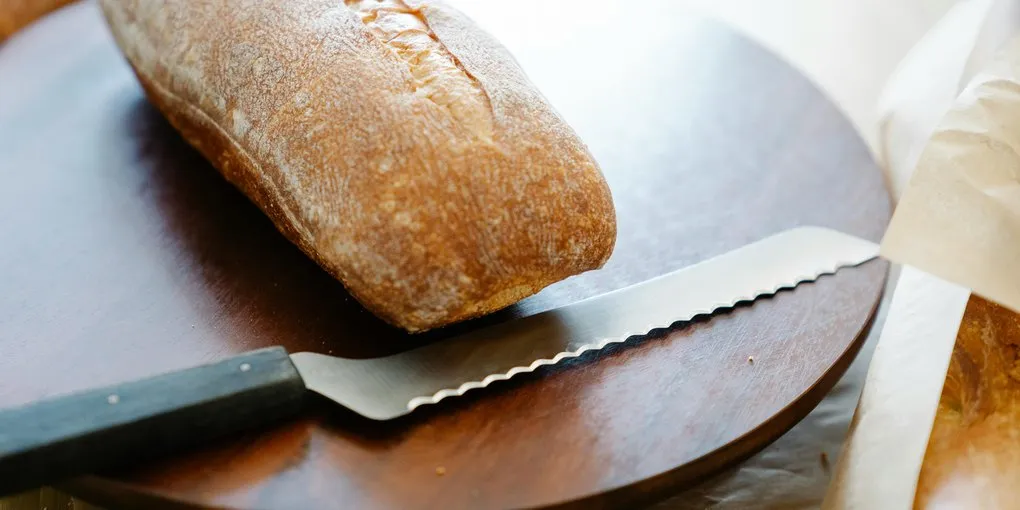
The Tojiro ITK Bread Slicer F-687 ($95-120) is the best overall serrated bread knife — molybdenum vanadium steel, 270mm scalloped blade, cleanest cuts on artisan crusts. For best value, the Mercer Culinary Millennia 10-inch ($20-30) delivers restaurant-grade slicing for under thirty dollars. Aim for at least a 10-inch blade. Avoid the dishwasher and never store loose in a drawer.
Why a Good Bread Knife Matters
A proper bread knife does one job — cut through a hard crust without crushing the crumb underneath. Every other knife in your kitchen will fail at this. Chef’s knives slide off the crust. Utility knives bounce. Electric knives tear. A serrated bread knife uses the saw-tooth principle to bite through the brittle Maillard-browned shell of a loaf and then glide through the soft, aerated interior without compression.
There is more variation between bread knives than you might expect. Blade length affects how many strokes you need to get through a batard. Tooth geometry determines whether you tear crumb or slice it cleanly. Handle balance decides whether your wrist gets tired on the tenth slice at a dinner party. And the steel — stamped versus forged, German versus Japanese — determines how long the edge stays sharp before it starts to shred instead of slice.
The good news is that the best bread knives are not expensive. You can get a professional-grade serrated blade for less than a decent chef’s knife. The one caveat: serrated blades are hard to sharpen at home, so when the teeth finally dull, most home bakers replace the knife rather than resharpen it. Factor that into the buying decision.
What to Look For
A bread knife buying decision comes down to five factors that matter and a dozen that do not.
Blade length. Aim for at least 9 inches, ideally 10. A short bread knife (the 6-inch varieties) forces a sawing motion that tears rather than slices. Artisan country loaves, oval batards, and pan loaves all cut best with a blade that spans the loaf in one full draw.
Tooth geometry. Scalloped teeth (curved depressions ground into the blade, the Tojiro style) bite cleanly into hard crusts and stay sharp longer than wavy or pointed serrations. Wavy teeth (the Mercer and Victorinox style) are gentler and produce clean slices on tender crumb. Double-serrated edges (the Wusthof Classic style) have an additional micro-serration between the main teeth and slice soft loaves with very few crumbs.
Offset versus straight handle. An offset handle (angled so the blade sits below your knuckles) lets you slice all the way through without banging the cutting board. Straight-handle knives are cheaper and easier to store, but you lose that last clean push at the end of a slice.
Blade material. High-carbon stainless steel holds an edge longer than softer stainless. Japanese steels like AUS-8 and molybdenum vanadium tend to be harder and sharper out of the box; German steels like X50CrMoV15 are tougher and more forgiving of abuse.
Weight and balance. A bread knife should feel light enough to saw through twenty slices without fatigue. Heavier forged knives look premium but can tire the wrist on long slicing sessions.
Top Picks
Tojiro ITK Bread Slicer F-687 — Editor’s Choice
Tojiro ITK Bread Slicer F-687The Tojiro ITK Bread Slicer is what working bakers actually use. The blade is 270mm (about 10.6 inches), the steel is molybdenum vanadium stainless, and the tooth pattern is a fine reverse-scalloped serration that bites into hard crusts without ripping. It slices a sourdough batard in three clean strokes, not ten, and the finish of the cut face — the way the crumb looks when you open up the loaf — is noticeably cleaner than with stamped wavy-edge knives. Triple-riveted pakkawood handle, made in Sanjo City, Japan, weighs about 5.8 ounces.
Who it is for: anyone who bakes artisan bread regularly and wants the sliced face of the loaf to look as good as the bake. At roughly $95-120 it is the most expensive knife on this list, but it is the only one that is a pleasure to use rather than just a tool that does the job.
Bottom line: The best bread knife you can buy under $150 — and probably the last one you will buy.
Mercer Culinary Millennia 10” Wide Wavy Edge — Best Value
Mercer Culinary Millennia Bread KnifeMercer is a workhorse brand in culinary-school kitchens, and the Millennia 10-inch wide bread knife shows why. One-piece stamped high-carbon Japanese steel ground at a 15-degree edge angle, hardness in the HRC 53-54 range, NSF-certified, a textured Santoprene/polypropylene handle that grips even with wet hands, and a wavy edge that plows through crust without tearing crumb. The price — usually $20-30 — is astonishing for the build quality. Culinary students buy them, use them hard for two years, then hand them down to the next class still sharp. Mercer backs them with a limited lifetime warranty.
Who it is for: the practical baker who wants a knife that works for ten years without fuss. The handle is not luxurious. The aesthetics are industrial. But the cutting performance rivals knives four times the price.
Bottom line: The knife I recommend when someone asks for “a bread knife that just works.”
Wusthof Classic 10” Double-Serrated Bread Knife — Best Forged
Wusthof Classic Double-Serrated Bread KnifeThe Wusthof Classic is the heirloom-quality option. Precision-forged from a single piece of X50CrMoV15 high-carbon stainless steel, hardened to HRC 58, full-tang construction, a triple-riveted polyoxymethylene (POM) synthetic handle, and a double-serrated edge that makes unusually clean cuts on soft bread. This is the knife your grandparents probably owned if they took cooking seriously — and it is still the benchmark in most German-made kitchen sets. At $150-200 it is the priciest option here, but the forged construction, the Trident logo, and the manufacturer’s lifetime warranty mean it will outlast every other knife in your kitchen.
Who it is for: the cook who wants one serrated knife for life and values lifetime warranty support. The forged build is heavier than the Tojiro or Mercer — Wusthof’s 9-inch double-serrated weighs 6.7 ounces, the 10-inch is heavier still — which some bakers love and others find fatiguing on long slicing sessions.
Pros: Precision-forged construction. Lifetime warranty. Double-serrated edge slices soft bread beautifully. German build quality.
Cons: Heavier than the stamped competition. Expensive for the actual cutting performance, which the Tojiro matches. The double-serration can chew through very crispy crusts less efficiently than fine scalloped teeth.
Bottom line: Buy it if you want a forged heirloom knife. Buy the Tojiro if you want better slicing.
Victorinox Fibrox Pro 10.25” Wavy Edge — Best Stamped
Victorinox Fibrox Pro Bread KnifeThe Victorinox Fibrox Pro (sometimes still sold under the Forschner name) is the knife that restaurant cooks buy in bulk and throw in communal drawers because nobody worries when they disappear. Swiss-made high-carbon stainless blade at HRC 56, Fibrox slip-resistant handle, wavy edge, NSF approved, and the entire knife weighs just 4.5 ounces. It has been the America’s Test Kitchen top pick for budget bread knives more than once. Price is usually $35-50 depending on the retailer.
Who it is for: anyone who wants a knife that performs near the top of the field at about a third of the price of the Wusthof. The Fibrox handle is practical rather than pretty — textured black plastic that grips well and washes easily.
Pros: Excellent slicing performance for the price. NSF approved. Lightweight at 4.5 ounces. Proven in commercial kitchens worldwide. Swiss manufacturing with a lifetime warranty.
Cons: The stamped blade does not hold an edge as long as a fully forged option like the Wusthof. Handle is utilitarian rather than attractive.
Bottom line: The smart-money pick for anyone who wants performance without the forged-knife price tag.
Dalstrong Phantom Series 9” — Best Looking
Dalstrong Phantom Series Bread KnifeDalstrong’s Phantom Series bread knife is the aesthetic choice. Precision-forged AUS-8 Japanese steel hardened to HRC 58, hand-polished spine, traditional D-shaped pakkawood handle imported from Spain, hand-finished to a 13-15 degree edge angle. Cutting performance is good — not Tojiro-tier, but better than most knives in the $80-100 range — and the build quality is higher than the price suggests.
Who it is for: the baker who cares how the knife looks on the counter and when posted to Instagram. The Dalstrong is often 20-30% cheaper than comparable Japanese-brand knives because Dalstrong manufactures to its own spec rather than sourcing from established Japanese forges, while using similar steels.
Pros: Beautiful to look at. AUS-8 steel at 58 HRC holds an edge reasonably well. Pakkawood handle feels good in the hand. Often on sale.
Cons: The 9-inch blade is shorter than ideal for large artisan loaves. Dalstrong’s marketing oversells the performance — this is a good knife, not a great one. Long-term edge retention is behind the Tojiro.
Bottom line: Pretty, capable, and a reasonable buy on sale; skip it at full price.
Honest Comparison
Five good knives, five different reasons to choose one. The Tojiro wins on pure cutting performance. The Mercer wins on price. The Wusthof wins on heirloom build. The Victorinox wins on smart-money value. The Dalstrong wins on aesthetics.
Serrated Bread Knives Compared
| Feature | 01Tojiro 10.6" | 02Mercer Millennia 10" | 03Wusthof Classic 10" | 04Victorinox Fibrox 10.25" | 05Dalstrong Phantom 9" |
|---|---|---|---|---|---|
| Price | $95-120 | $20-30 | $150-200 | $35-50 | $60-90 |
| Blade Length | 270mm (10.6") | 254mm (10") | 254mm (10") | 260mm (10.25") | 229mm (9") |
| Steel | Molybdenum vanadium | High-carbon Japanese, HRC 53-54 | X50CrMoV15, HRC 58 | High-carbon stainless, HRC 56 | AUS-8, HRC 58 |
| Construction | Stamped | Stamped | Forged | Stamped | Forged |
| Tooth Style | Scalloped | Wavy | Double serrated | Wavy | Serrated |
| Handle | Pakkawood | Santoprene | POM synthetic | Fibrox textured | Pakkawood D-shape |
| Weight | 5.8 oz | 5 oz | 8 oz | 4.5 oz | 6 oz |
| Best For | Artisan sourdough | Everyday value | Heirloom buy | Smart-money pick | Aesthetic buyer |
One truth cuts across all of them: a serrated knife in the $30-120 range will outlast the bread you bake in the next five years. Do not agonize. Pick the one that matches how you cook.
Care and Maintenance
Hand-washing extends a serrated edge by years. Do not put a bread knife in the dishwasher. The detergent damages the handle material over time, and the blade rattling against other utensils chips the serrations. Hand-wash, dry immediately, and store in a block, a sleeve, or on a magnetic strip — not loose in a drawer.
Serrated blades are not home-sharpenable the way chef’s knives are. Professional serrated sharpening services exist (expect $15-25 per knife, done maybe every 3-5 years for a home baker), but most people just replace the knife when the teeth finally dull. Brands like Wusthof and Dalstrong offer lifetime warranties that sometimes cover serrated edge degradation — worth registering the knife when you buy it.
For the rest of your bread-baking toolkit, see our bread baking equipment guide. Pair your knife with a kitchen scale for dough formulation and a bread lame for scoring. After slicing a fresh loaf, the right bread storage method keeps the rest of the loaf at its best.
This article contains affiliate links. If you buy through them, we earn a small commission at no extra cost to you. We only recommend tools we have personally used or have tested through consistent bakery and home-kitchen feedback.
Frequently Asked Questions
- Is the Tojiro worth the price over the Mercer Millennia?
- Yes — but only if you bake regularly. The Tojiro ($95-120) cuts cleaner, holds its edge longer, and produces a nicer sliced face on artisan loaves than the Mercer ($20-30). If you bake sourdough every week, the Tojiro pays back in cutting pleasure and edge retention over five years. If you slice a grocery-store baguette once a week, the Mercer is all the knife you need. The performance gap is real but small; the price gap is large.
- How long should a bread knife last?
- A precision-forged knife like the Wusthof Classic will outlast you if you hand-wash it and store it properly — these are heirloom tools backed by a lifetime warranty. Stamped knives (Mercer, Victorinox) typically stay sharp enough for five to ten years of weekly home use before the serrations start to drag. The Tojiro falls between, with molybdenum vanadium steel holding its edge several times longer than basic stamped stainless. Dishwasher abuse will shorten any of these lifespans dramatically.
- How do I sharpen a serrated bread knife at home?
- You mostly do not. The toothed edge cannot be sharpened on standard whetstones or pull-through sharpeners without destroying the geometry. Some brands sell specialty serrated sharpeners (small rods that fit between teeth), and they work for extending life by a season or two. For a real sharpening, send the knife to a professional service ($15-25 per knife). Most home bakers simply replace a serrated knife when it genuinely dulls — typically every five to ten years for stamped blades.
- Do I need an electric bread knife?
- No. Electric knives tear softer crumb and are clumsy on hard crusts. Every baker on this list recommends a standard serrated blade. Electric knives have their place (carving turkey, for example), but bread slicing is not one of them.
- Will a serrated paring knife work for small loaves?
- For rolls and small items, a 5-6 inch serrated utility knife is fine. For anything larger than a dinner roll, you want the full 9-10 inch blade. Short serrated knives force a sawing motion that compresses the crumb on larger loaves.
- Pointed serrations versus wavy edge — which cuts better?
- Scalloped or pointed teeth (the Tojiro and Dalstrong style) are more aggressive on hard crusts and tend to hold their edge longer. Wavy edges (the Mercer and Victorinox style) are gentler and produce cleaner slices on tender or enriched bread. Wusthof's double-serrated edge is the cleanest cutter on soft loaves. For pure artisan-sourdough use, scalloped teeth win; for mixed bread types, a wavy or double-serrated edge is more forgiving.