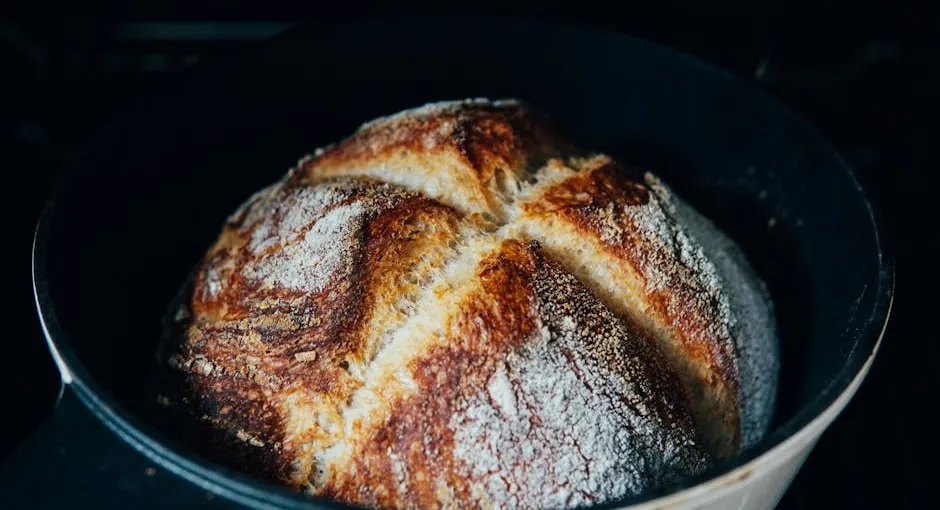
A Dutch oven is the single most important piece of equipment for home bread baking. It solves the biggest problem home bakers face: steam. Professional bakeries inject steam directly into the oven during the first minutes of baking, which delays crust formation, extends oven spring, and gelatinizes surface starch into a glossy, crackly shell. Your home oven cannot do this. A Dutch oven does it automatically by trapping the moisture that escapes from the dough itself.
Both Chad Robertson (Tartine Bread) and Ken Forkish (Flour Water Salt Yeast) build their entire home baking methods around Dutch ovens. Robertson preheats his at 500°F for at least 20 minutes, bakes with the lid on for 20 minutes, then removes the lid for 20-25 more minutes at 450-500°F. Forkish preheats at 475°F for a full 45 minutes, bakes lidded for 30 minutes, then finishes with the lid off for 15-20 minutes. Both approaches produce extraordinary bread. The Dutch oven is not optional — it is the method.
What Actually Matters in a Bread Dutch Oven
Not every Dutch oven is a good bread Dutch oven. Here is what separates the ones that work from the ones that frustrate.
Thermal mass. Heavy walls store more heat. When you open the oven door and drop in cold dough, a lightweight vessel loses temperature fast. A heavy cast-iron or enameled cast-iron pot recovers quickly and delivers consistent radiant heat to the dough surface. This is the physics that drives oven spring — those first 10 minutes of explosive rise that happen when CO2 comes out of solution, ethanol vaporizes, and gas cells expand.
Lid seal. The lid does not need to be airtight. It needs to be close-fitting enough to trap steam during the first phase of baking. A loose lid lets moisture escape before it can do its job: condensing on the cool dough surface, releasing latent heat, and keeping surface enzymes active long enough to accumulate Maillard substrates for a deeply caramelized crust.
Shape and size. Round Dutch ovens (5-7 quart) work for boules. Oval Dutch ovens (6-7 quart) accommodate batards. The Challenger Bread Pan handles both. If you only bake round loaves, a round 5-quart is the sweet spot — big enough for a 900g dough piece without the loaf pressing against the walls, small enough to preheat efficiently.
Handles. You are gripping this thing at 475-500°F. Short, stubby knobs on the lid are a burn hazard. Wide loop handles on both the pot and the lid make loading dough safer, especially when you are working with a hot, heavy vessel and floppy dough at the same time.
Knob rating. Many enameled Dutch ovens ship with phenolic (plastic) knobs rated to only 375-400°F. That is not hot enough for bread. Staub’s metal knobs are rated to 500°F out of the box. Le Creuset now ships stainless steel knobs rated to 500°F on most models, but verify before you buy. Lodge’s enameled line uses stainless knobs. If your knob is plastic, replace it with a stainless steel aftermarket knob before you preheat to 475°F.
The Best Dutch Ovens for Bread
Lodge Cast Iron Dutch Oven — Best Value
Lodge 5-Quart Cast Iron Dutch OvenThe Lodge 5-quart bare cast-iron Dutch oven is the workhorse of home bread baking. It is heavy (about 12 pounds), retains heat extremely well, and costs under $50. No enamel to chip. No plastic knobs to worry about. Pre-seasoned out of the box and ready to bake at any temperature your oven can produce.
Pros: Exceptional value. Bombproof durability — this will outlast you. Excellent heat retention and thermal mass. No temperature limits. The flat lid doubles as a griddle.
Cons: Bare cast iron requires seasoning maintenance. The black interior makes it hard to judge crust color without lifting the lid. Heavier than enameled options at the same size. Slightly rougher interior surface.
The Lodge is the Dutch oven to buy if you are starting out and want to spend your budget on good flour instead. It performs within 5% of pots costing five times as much.
Lodge Combo Cooker — Best for Loading Dough
Lodge Cast Iron Combo CookerThe Lodge Combo Cooker is a 3.2-quart deep skillet with a shallow pot that serves as the lid. For bread baking, you invert the setup: bake on the shallow skillet base, cover with the deep portion as the dome. This makes loading dough dramatically easier because you are sliding dough onto a flat surface rather than dropping it into a deep, scorching-hot pot.
Pros: Easiest dough loading of any option. Low sides mean less burn risk. About $45. Made in the USA. The pieces also work independently as a skillet and a small Dutch oven.
Cons: The 3.2-quart capacity is tight for larger loaves. Only works for boules — batards do not fit. The seal between the two pieces is loose, which lets some steam escape earlier than a traditional Dutch oven. You may notice slightly less oven spring compared to a tighter-sealing vessel.
For bakers who dread the “drop the dough into the hot pot” maneuver, the Combo Cooker is a revelation.
Staub Round Cocotte (5.5 Qt) — Best Premium Round
Staub 5.5-Quart Round CocotteStaub’s 5.5-quart round cocotte has the thickest walls (4mm) of any enameled Dutch oven on the market. That extra thermal mass translates to more heat stored, faster recovery after opening, and more aggressive oven spring. The flat black enamel interior is more heat-resistant than Le Creuset’s cream interior, and Staub’s brass knob is rated to 500°F without replacement.
Pros: Superior heat retention. Self-basting lid with spikes that redistribute condensation. Metal knob rated to 500°F. Heavy (11.2 pounds), dense construction. Available in matte black, which hides bread baking wear well.
Cons: Expensive (typically $300-400). The black interior makes monitoring crust color difficult. Heavier than Le Creuset at the same size. The self-basting spikes are designed for braising, not bread — they don’t hurt, but they don’t help either.
Staub is the choice for bakers who want a premium vessel that does double duty for bread and cooking.
Le Creuset Round Dutch Oven (5.5 Qt) — Best All-Around Premium
Le Creuset 5.5-Quart SignatureLe Creuset’s Signature 5.5-quart round Dutch oven is the most popular premium Dutch oven in the world. The cream-colored interior makes it easy to see crust color development through the glass or by lifting the lid. Current models ship with stainless steel knobs rated to 500°F. The enamel is smooth, durable, and easy to clean.
Pros: Lighter than Staub (11.4 pounds vs 11.2 — marginal, but the balance feels lighter). Cream interior aids crust monitoring. Wide handle openings for safer gripping. Enormous color selection. Excellent resale value.
Cons: Expensive ($300-380). The cream interior stains over time with high-heat bread baking. Slightly thinner walls than Staub, though the practical difference in bread quality is negligible. Older models may have plastic knobs — check before buying used.
Le Creuset is the “buy it for life” option that works as well for Sunday braises as Saturday bakes.
Challenger Bread Pan — Best Purpose-Built Option
Challenger Bread PanThe Challenger Bread Pan is the only vessel on this list designed exclusively for bread. It is a heavy cast-iron base (like a shallow griddle) with a domed cast-iron lid. The wide, flat base accommodates both boules and batards. The low base height makes loading easy. The tight-fitting dome traps steam efficiently. America’s Test Kitchen named it their top bread oven.
Pros: Purpose-built for bread — no compromises. Fits both round and oval loaves. Easy loading like the Combo Cooker but with better steam retention. Consistently produces excellent crust with fine blistering. Made in the USA.
Cons: Expensive (about $275-295). Weighs 22 pounds — uncomfortably heavy to handle at 500°F. Only useful for bread (no braising, no soups). The weight alone is a serious consideration; you need good oven mitts and confident grip strength.
The Challenger is for dedicated bread bakers who want the best possible tool for the job and do not mind that it does nothing else.
What to Actually Buy
If you are baking bread for the first time, buy the Lodge 5-quart cast-iron Dutch oven. It costs under $50, performs beautifully, and if you decide bread baking is not for you, it is still one of the most useful pots in any kitchen.
If loading dough into a deep hot pot makes you nervous, get the Lodge Combo Cooker. The shallow base solves the problem elegantly for $45.
If you want one premium vessel for bread and everyday cooking, pick between Staub (better heat retention, metal knob, black interior) and Le Creuset (lighter feel, cream interior for visibility, wider handles). Both make outstanding bread. The differences are real but small.
If you bake multiple times a week and bread is your primary hobby, the Challenger Bread Pan is the best tool for the job. It is expensive, heavy, and single-purpose — and it is better at baking bread than anything else here.
Dutch Oven Bread Baking Tips
Always preheat with the lid on. Both the pot and the lid need to be at full temperature before the dough goes in. Robertson recommends at least 20 minutes of preheating at 500°F. Forkish recommends 45 minutes at 475°F. Longer preheating means more stored thermal energy.
Use parchment for loading. Cut a round of parchment paper, place your scored loaf on it, and use the parchment as a sling to lower the dough into the pot. This prevents sticking, eliminates the need for cornmeal, and makes extraction easier. The parchment will darken but will not burn at bread-baking temperatures.
Remove the lid at the right time. The lidded phase creates steam for oven spring. The open phase drives Maillard browning and crust development. Robertson removes the lid after 20 minutes. Forkish waits 30 minutes. If your crust is pale, leave the lid on longer. If your crust is burning before the interior is done, reduce oven temperature after removing the lid.
Go darker than you think. Both Robertson and Forkish insist on this. Robertson wants “deep mahogany all over.” Forkish suggests baking “just shy of the point of burning.” The most common home-baker error is pulling the loaf when it looks done. It is not done. The difference between pale gold and deep amber is the difference between soft, forgettable crust and the shattering, caramelized crust that makes homemade bread worth the effort.
Let it cool completely. After baking, the interior crumb continues setting as starch gels firm up. Cutting too early compresses the still-gelling structure, producing a gummy texture even if the bake was perfect. Give your loaf at least 1-2 hours for standard white bread, longer for whole grain or sourdough.
The Science: Why a Dutch Oven Works
The Dutch oven replicates the two-phase baking cycle used in professional bakeries.
Phase 1 — Steam (lid on). When cold dough enters the hot pot, moisture from the dough surface evaporates and is trapped by the lid. This steam condenses on the cooler dough surface, releasing latent heat (about 2,260 joules per gram of water) and keeping the surface warm but not rigid. The surface remains extensible, which allows maximum oven spring. Simultaneously, the steam keeps surface enzymes active longer, producing more amino acids and reducing sugars — the Maillard substrates that will create deep crust flavor in Phase 2.
Phase 2 — Browning (lid off). Once the lid is removed, the trapped moisture escapes. The dough surface dries rapidly. As the surface temperature rises above 250°F (121°C), the Maillard reaction accelerates — amino acids react with reducing sugars to produce hundreds of flavor compounds and the brown melanoidin pigments that give bread its color. Above 330°F (165°C), caramelization begins as sugars thermally decompose, adding additional complexity. The longer you bake in this phase, the more deeply caramelized the crust becomes.
This two-phase system is why Dutch oven bread has better crust than bread baked on a stone with a pan of water. The enclosed environment concentrates steam far more effectively than open-oven steam methods. The seal does not need to be airtight — close-fitting is enough.
Frequently Overlooked: Enamel vs Bare Cast Iron for Bread
Both work well for bread, but there are practical differences worth knowing.
Bare cast iron (Lodge, Challenger): No temperature limits. Develops seasoning that improves nonstick properties over time. Requires seasoning maintenance (light oil coat, avoid soap). Can rust if stored wet. The black surface means you cannot see what is happening inside without lifting the lid.
Enameled cast iron (Staub, Le Creuset): Smooth, easy-to-clean surface. Cream-colored interior (Le Creuset) makes crust monitoring easier. No seasoning required. But enamel can chip from thermal shock or drops, and repeated empty preheating at 500°F causes gradual discoloration. Enamel is cosmetic — it does not affect heat transfer or bread quality.
For bread baking specifically, bare cast iron has a slight edge because you never worry about temperature limits or enamel damage. But enameled Dutch ovens double as cooking vessels for braises, soups, and stews, which makes them more versatile. Most home bakers who own a Le Creuset or Staub already have everything they need.
For a complete list of what you need to get started, see our Complete Bread Baking Equipment Guide. And if you want to explore baking without a Dutch oven, read Baking Stone vs Steel for Bread. For the technique behind scoring your loaves before they go into the pot, see our scoring guide. Understanding hydration will also help you choose the right Dutch oven size for your dough.
Frequently Asked Questions
- Can I use a regular pot instead of a Dutch oven for bread?
- You need a vessel with a tight-fitting lid that can withstand at least 475°F. A heavy stainless steel pot with an oven-safe lid can work in a pinch, but it lacks the thermal mass of cast iron. The bread will still bake, but oven spring will be weaker and the crust will be thinner. Cast iron stores and radiates far more heat per pound than stainless steel, which is why every serious bread author recommends it.
- Do I need to grease my Dutch oven before baking bread?
- No. The dough's natural moisture and the parchment paper (if you use one) prevent sticking. Greasing a preheated Dutch oven at 475-500°F will smoke and can produce off-flavors. If you bake without parchment directly on bare cast iron, a light dusting of cornmeal or semolina on the bottom of the pot is enough to prevent sticking.
- What size Dutch oven is best for a single loaf of bread?
- A 5 to 5.5-quart round Dutch oven is the sweet spot for a standard boule made from about 900-1,000g of dough. Smaller than 4 quarts and the dough presses against the walls, restricting oven spring. Larger than 7 quarts and the extra air space dilutes the steam concentration, reducing crust quality. For batards (oval loaves), an oval 6-7 quart Dutch oven or the Challenger Bread Pan is a better fit.
- Can I bake two loaves in a Dutch oven at the same time?
- Not in the same vessel. Each loaf needs its own enclosed environment for proper steam concentration. If you want to bake two loaves in one session, either use two Dutch ovens side by side, or bake sequentially — the second loaf can proof in the refrigerator while the first one bakes. Cold retarded dough goes straight from the fridge into the hot pot with no warmup needed.
- Will bread baking ruin my Le Creuset or Staub enamel?
- Repeated preheating at 475-500°F while empty can cause enamel discoloration over time, especially on Le Creuset's cream interior. This is cosmetic — it does not affect performance. Staub's black enamel hides this discoloration better. Neither manufacturer considers bread-baking-temperature preheating to be outside normal use, and both rate their products to 500°F.