Industrial bread in America began with Wonder Bread, launched May 1921 by the Taggart Baking Company of Indianapolis (later acquired by Continental Baking in 1925). Pre-sliced bread followed in 1928 when Otto Rohwedder's slicer was first installed at the Chillicothe Baking Company in Missouri. Britain's industrial turn came in 1961 with the Chorleywood Bread Process, developed by Bill Collins, George Elton, and Norman Chamberlain at the British Baking Industries Research Association — it now produces over 80% of UK commercial bread. The artisan counter-revolution rose through Elizabeth David's English Bread and Yeast Cookery (1977), Nancy Silverton's La Brea Bakery (1989) and her 1996 book, and Chad Robertson's Tartine Bakery (2002) and Tartine Bread (2010). The 2020 pandemic produced the largest sourdough surge in history — King Arthur Baking Company's online flour sales rose more than 2,000% year over year in March 2020, and the company finished the year with flour sales up 58% on 2019 — and home baking did not fall back to its pre-2020 niche once lockdowns ended.
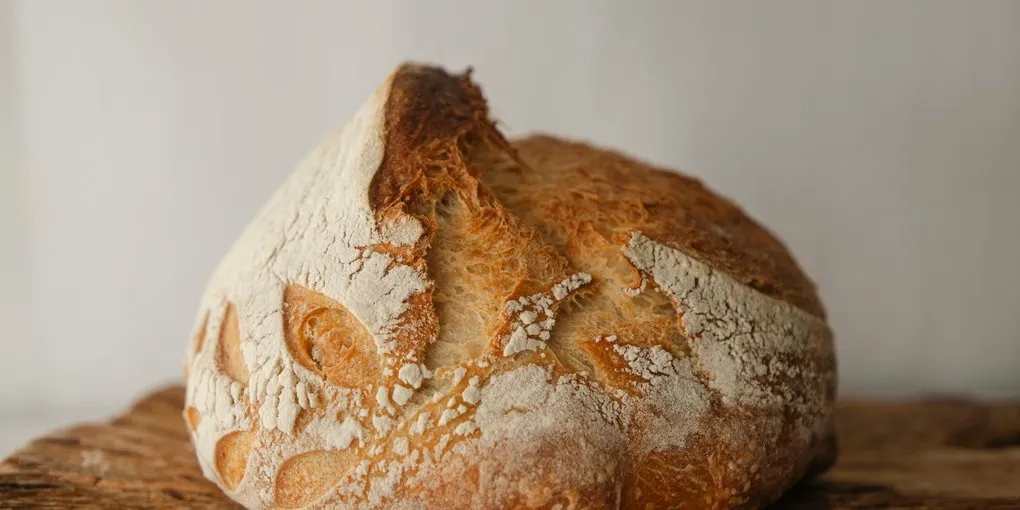
There are two Americas in the bread aisle. The first is a plastic bag of soft, sliced, white, week-stable, industrially fortified sandwich bread that costs roughly three dollars, lasts ten days, and has a mouthfeel somewhere between a marshmallow and a piece of upholstery. The second is a rough, hand-scored, flour-dusted country loaf that costs eight to twelve dollars, keeps three to five days, and tastes noticeably different on day one versus day three.
These two Americas are not just different products. They are the outputs of two opposite theories of what bread is for. The industrial theory (1921-present) says bread is a delivery vehicle for cheap calories, produced as quickly as possible, stabilized as long as possible, and standardized for national distribution. The artisan theory (1977-present) says bread is a fermented whole food, time-consuming to make, shaped by the baker’s hand, and local to the bakery that produced it. The conflict between these two theories is the single most important story in twentieth-century Western bread — and the artisan side has been slowly, unexpectedly, winning.
Wonder Bread launched in 1921 and defined American industrial bread
The Taggart Baking Company of Indianapolis introduced Wonder Bread on May 21, 1921, with the first loaves reaching grocers’ shelves on May 24 in the now-iconic red, blue, and yellow balloon wrapper. The brand name came from vice-president Elmer Cline, who had been struck with “wonder” at the International Balloon Race held at the Indianapolis Motor Speedway. Continental Baking Company purchased Taggart in 1925 and turned Wonder Bread into a national brand over the following decade. Marketing leaned heavily on industrial cleanliness — photographs of workers in white aprons and sanitary tile — as a deliberate contrast to the perceived dirtiness of neighborhood bakeries and household hand-baking.
Technically, early Wonder Bread was not yet the ultra-soft loaf of the postwar era. Mandatory commercial enrichment (thiamine, riboflavin, niacin, iron) did not arrive until the 1943 War Food Order, which mandated bread enrichment under the Roosevelt administration’s wartime nutrition program after volunteer enrichment had already brought roughly 75% of US white bread into compliance by mid-1942. The dough-improver chemistry that produces modern soft white bread — added mono- and diglycerides, calcium propionate mold inhibitor, dough conditioners, high-fructose corn syrup — was developed and adopted incrementally through the 1940s, 1950s, and 1960s.
Pre-sliced bread was first sold commercially on July 7, 1928, when baker Frank Bench installed Otto Rohwedder’s bread-slicing machine at the Chillicothe Baking Company in Chillicothe, Missouri. Bench’s “Kleen Maid Sliced Bread” was advertised as “the greatest forward step in the baking industry since bread was wrapped” — a phrase that traveled through subsequent newspaper coverage and is the historical seed of the modern idiom “the greatest thing since sliced bread” (the idiom itself is generally dated to the mid-twentieth century). Wonder Bread itself did not begin national distribution of pre-sliced loaves until 1930. By 1933, an estimated 80% of American bread was pre-sliced.
The 1961 Chorleywood Process changed British bread forever
In Britain, the turning point was not Wonder Bread but the Chorleywood Bread Process (CBP), developed in 1961 at the British Baking Industries Research Association in Chorleywood, Hertfordshire. The team responsible — Bill Collins, George Elton, and Norman Chamberlain — designed the process to enable bakeries to produce a finished one-pound loaf from flour in roughly three to four hours, versus the 12-to-24 hours that traditional bulk-fermented bread required. The work was funded jointly by the post-war UK government and the three baking giants of the era — Allied Bakeries, Spillers, and Joseph Rank Ltd (which merged into Rank Hovis McDougall the following year) — and was driven in part by the desire to make lower-protein British wheat usable at scale, reducing reliance on expensive imported Canadian hard wheat.
The Chorleywood method combines three innovations. First, intense high-speed mechanical mixing develops the gluten network in three to five minutes rather than the traditional fifteen-plus. Second, added ascorbic acid (vitamin C) acts as a dough oxidizer, strengthening gluten without long rest times. Third, added fat (typically a hard fat at roughly 0.7% of flour weight), high-dosage commercial yeast (roughly double traditional levels), and added emulsifiers produce a soft, uniformly crumbed loaf in a single continuous production run.
Within a decade of its 1961 introduction, Chorleywood-process bread accounted for the majority of UK commercial bread; by 2009 the figure was about 80% of UK factory bread. British bread consumers adapted to the soft, long-shelf-life, aerated loaf so thoroughly that traditional long-fermentation British bakeries nearly disappeared — a generation of working bakers were trained exclusively on the Chorleywood method and had no first-hand experience of long bulk fermentation.
The health controversy around Chorleywood bread is ongoing. Critics — including the Real Bread Campaign, co-founded in 2008 by Andrew Whitley of Bread Matters and the food-and-farming alliance Sustain — argue that the process’s short fermentation time does not allow the phytic acid reduction, FODMAP breakdown, or partial gluten predigestion that occur in longer-fermented breads, and that the resulting bread may contribute to reported gluten intolerance and digestive symptoms in populations consuming largely CBP bread. The scientific evidence is contested but the cultural critique is substantial. Worth adding for any reader recognising their own symptoms in that description: trading a Chorleywood loaf for a long-fermented one changes the bread, not the diagnosis — see is gluten-free healthier?, and the note below before you change what you eat. The mechanism behind the longer-ferment effect is documented in our sourdough fermentation, phytic acid, and bioavailability post.
Before you buy or bake
- Get tested before you eliminate gluten
- Celiac testing only works while you are still eating gluten — serology and biopsy both normalize once it is removed, which can produce a false negative and delay a diagnosis by months or years. If you suspect a problem, talk to a doctor while still eating gluten rather than after cutting it out.
The artisan counter-revolution began with Elizabeth David in England
The British reaction against Chorleywood bread began almost immediately. Elizabeth David, the dominant British food writer of the twentieth century, published English Bread and Yeast Cookery in 1977 — a book detailing traditional British bread techniques from medieval cottage loaves through Victorian baking through her contemporary baker interviews. David won the Glenfiddich Writer of the Year Award for it. The book was widely read as an indictment of the Chorleywood loaf — Hilary Spurling in The Observer called it “a scathing indictment of the British bread industry” — though David framed it as a historical and technical document.
David’s book did not trigger a revolution in commercial bakeries. It triggered one in British home kitchens. Home bread baking in the UK, which had largely retreated under post-war commercial consolidation, began to creep back through the 1980s, particularly in households that owned or bought stand mixers (the Kenwood Chef dominated the UK market, as the KitchenAid did in the US). By the mid-1990s, specialty artisan bakeries — Poilâne-style country loaves, French-influenced baguettes, Italian-style ciabatta — were opening in Britain’s larger cities.
The Real Bread Campaign, launched on November 26, 2008, later articulated the specific technical objection to Chorleywood bread in a publishable standard: “real bread” is defined as bread made without artificial additives, processing aids, or added enzymes, using base ingredients (flour, water, yeast, and salt) with optional fats, milk, seeds, grains, and sugars. The campaign certifies bakeries that meet this definition.
Nancy Silverton and La Brea Bakery defined American artisan bread
The American artisan bread movement has a specific origin point. In 1989, Nancy Silverton opened La Brea Bakery on La Brea Avenue in Los Angeles, six months before the adjacent restaurant Campanile opened — Silverton co-founded both with her then-husband Mark Peel and partner Manfred Krankl. Silverton had been working as pastry chef at Wolfgang Puck’s Spago and had become obsessed with French country bread after eating at Poilâne in Paris and reading about Acme Bread Company in Berkeley. La Brea opened with a wild-yeast sourdough starter she had cultivated herself, and a menu of country loaves, baguettes, and ciabatta that was genuinely different from anything then on sale in an American supermarket. Within weeks, La Brea was doing roughly $1,000 in daily bread sales.
Silverton’s 1996 book Nancy Silverton’s Breads from the La Brea Bakery: Recipes for the Connoisseur — over 300 pages of technique, starter care, and recipes — is one of the two foundational texts of the modern American artisan bread movement. It taught a generation of American home bakers and professional bakers that long-fermented, wild-leavened, hand-shaped bread was a reproducible kitchen practice rather than a museum piece.
La Brea Bakery itself grew from a single Los Angeles storefront into a major wholesale producer. In 2001, the Irish food group IAWS — which merged with Switzerland’s Hiestand Holding in 2008 to form ARYZTA AG — acquired an 80% stake for around $56 million, in a deal valuing the business at up to $68.5 million. The acquisition — which moved La Brea breads into national frozen-dough distribution — was sometimes criticized as a softening of the artisan mission, but the bakery’s technical standard remained well above mass-market bread through the 2000s. ARYZTA later divested its North American holdings to Lindsay Goldberg in 2021.
Chad Robertson and Tartine rewrote what home sourdough could be
The second foundational text of American artisan bread is Chad Robertson’s Tartine Bread, published by Chronicle Books in 2010 with photographs by Eric Wolfinger. Robertson and his wife Elisabeth Prueitt had opened Tartine Bakery on Guerrero and 18th Street in San Francisco’s Mission District in 2002, after earlier work at Bay Village Breads in Mill Valley and a Point Reyes wood-fired bakery. By 2008, Robertson and Prueitt had won the James Beard Foundation’s Outstanding Pastry Chef award.
Tartine Bread did three things. First, it documented a specific country-loaf formula — roughly 75% hydration, overnight bulk fermentation at room temperature, cold retard in the fridge, hot Dutch oven bake — that was genuinely achievable in a home kitchen without commercial equipment. Second, it included a specific photographic argument for what “great bread” looks like: open crumb, burnt-dark crust, blistered ear. Wolfinger’s photographs became the iconic visual template for a decade of Instagram sourdough. Third, it normalized the 24-to-36-hour bread timeline — the patience of long fermentation was framed not as a barrier but as the entire point. The book is now in its 32nd printing across six languages and was later named by The New York Times Style Magazine as one of the 25 most influential cookbooks of the past century. For the home implementation, see our sourdough country bread and no-knead bread guides — both descend technically from Tartine and from Jim Lahey’s no-knead method, which Mark Bittman popularized in a New York Times column in November 2006.
Most major American artisan bakeries that opened between 2010 and 2020 have at least some technical lineage to Tartine — sometimes through Robertson’s actual apprentices, sometimes through the book itself as a training document.
The 2020 pandemic produced the largest sourdough surge in history
When COVID-19 lockdowns began in March 2020, something unexpected happened in Western home kitchens. Home baking, which had been a slow-growing minor trend through the 2010s, exploded into a mass cultural phenomenon. Google searches for “sourdough” rose roughly 384% globally in March 2020, and “sourdough starter” searches spiked even higher. King Arthur Baking Company’s online flour sales rose more than 2,000% year over year in March 2020 alone, and the company finished 2020 with flour sales up 58% on 2019. Commercial flour supply chains were overwhelmed for roughly six weeks as retail bread flour and specialty flour demand outstripped available milling capacity.
The pandemic sourdough surge was driven by a confluence of factors: sudden household time availability, supply-chain anxiety that made home-baked bread feel more secure than commercial, social-media reinforcement (every platform had its bread-photo trend through spring and summer 2020), and the fact that many people who had always meant to try sourdough finally had no excuse.
What followed was genuinely unusual. Most pandemic hobbies faded. Sourdough did not — five years on it is still a visible mass activity rather than the niche it was in 2019. How much of the surge persists is not something anyone can put a number on: no survey or index tracks home baking volume across those years, and figures claiming a specific multiple of a 2019 baseline are not supported by any published dataset. What is visible is qualitative and consistent — the artisan movement has moved from coastal cities into the national interior in a way it had never done before. For a longer historical view, see our history of sourdough from ancient Egypt to modern.
From Wonder Bread to Tartine: 100 Years of Bread
Eight turning points in the industrial-to-artisan bread story, from 1921 through the 2020 sourdough surge.
1921 — Wonder Bread
Taggart Baking Company launches Wonder Bread in Indianapolis. Continental Baking acquires Taggart in 1925 and takes it national.
1928 — Sliced Bread
Otto Rohwedder's slicer debuts at the Chillicothe Baking Co. in Missouri. By 1933, ~80% of US bread sales are pre-sliced.
1961 — Chorleywood Process
Collins, Elton, and Chamberlain at the BBIRA produce a loaf from flour in under 4 hours. Now ~80% of UK commercial bread.
1977 — Elizabeth David
English Bread and Yeast Cookery documents traditional British bread. Reads as a quiet polemic against Chorleywood.
1989 — La Brea Bakery
Nancy Silverton opens La Brea on La Brea Ave in Los Angeles. 1996 book becomes the first American artisan bread canon.
2002 — Tartine Bakery
Chad Robertson and Elisabeth Prueitt open Tartine on Guerrero and 18th in SF Mission District.
2010 — Tartine Bread
Robertson's book with Wolfinger's photos. Now 32nd printing in 6 languages. Trains a generation on 75% hydration overnight bulk.
2020 — Pandemic Surge
Google sourdough searches up ~384% globally in March; King Arthur online flour sales over 2,000% YoY in March, flour sales up 58% for the year.
Sources: Indiana Historical Bureau (Wonder Bread); Sliced Bread Wikipedia and Chillicothe Baking Co. records; Wikipedia and Campden BRI on Chorleywood; English Bread and Yeast Cookery (Allen Lane 1977); La Brea Bakery and Wikipedia; Tartine Bakery and Chronicle Books; King Arthur Baking Company financial disclosures.
jayarrbread.comIndustrial bread is not going away, and that may be the point
The artisan movement has not displaced industrial bread. Wonder Bread is still nationally distributed, owned by Flowers Foods since a $355 million acquisition from Hostess in 2013. The Chorleywood process still dominates UK commercial bread. Pepperidge Farm, Oroweat, Sara Lee, Dave’s Killer Bread, and Nature’s Own remain the dominant American shelf brands.
What has changed is the cultural position of industrial bread. In 1995, industrial white bread was the default American bread and artisan bread was an exotic specialty. In 2025, artisan bread is the aspirational default and industrial bread is the convenience product — what you buy when you need a sandwich tomorrow and do not have time for a bakery visit. The market has bifurcated: industrial bread holds the convenience-and-price end, and artisan bread holds the flavor-and-prestige end. Middle-ground commercial “premium” bread — the Arnold Country, Pepperidge Farm Farmhouse, Dave’s Killer tier — exists precisely to span the gap.
The deeper pattern here is that industrial bread solved a 1930s-to-1970s problem (cheap, reliable calories for urbanizing populations) and then outstayed its welcome. The artisan movement solved the resulting 1990s-to-2020s problem (flavor, texture, and nutrition as core consumer values) and is now the dominant influence on new bakery openings and on home baking trends. Whether industrial bread continues to shrink or reaches a stable floor is one of the open questions in the twenty-first-century food system. For readers who want to participate, our beginner sourdough bread and sourdough starter science posts are the gateway.
What is clear is that the artisan resurgence has already won the cultural argument. A well-baked country loaf is now the aspirational American bread. The soft white sliced loaf, which in 1960 was modernity itself, has become the food of hurried mornings and childhood nostalgia. That is a remarkable reversal for sixty years of cultural work.
Frequently Asked Questions
- What is the Chorleywood Bread Process and why is it controversial?
- The Chorleywood Bread Process (CBP) is a British industrial bread-making method developed in 1961 by Bill Collins, George Elton, and Norman Chamberlain at the British Baking Industries Research Association. It produces a finished loaf from flour in roughly three to four hours, versus the 12-to-24 hours traditional bulk-fermented bread requires. It uses intense high-speed mechanical mixing, added ascorbic acid as a dough oxidizer, added fat, high commercial yeast doses, and emulsifiers. By 2009, around 80% of UK factory bread used the process. Critics argue the short fermentation time skips phytic acid reduction, FODMAP breakdown, and partial gluten predigestion that occur in longer-fermented breads, which may contribute to reported digestive issues. The scientific evidence is contested.
- Who invented sliced bread?
- Sliced bread was invented by Otto Frederick Rohwedder, a jeweler-turned-inventor from Davenport, Iowa. The first commercial sale of pre-sliced bread happened on July 7, 1928, when Rohwedder's slicing machine was installed at the Chillicothe Baking Company in Chillicothe, Missouri. The product was called 'Kleen Maid Sliced Bread.' Within two weeks, sales at Bench's Bakery had risen 2,000%, and by 1933 roughly 80% of American bread was sold pre-sliced. The Chillicothe Baking Company's marketing copy from 1928 — 'the greatest forward step in the baking industry since bread was wrapped' — is the historical seed of the modern idiom 'the greatest thing since sliced bread,' which is generally dated to the mid-twentieth century.
- What is the difference between artisan bread and 'real bread'?
- 'Artisan bread' is a marketing term with no legal definition in most countries. It generally implies hand-shaped, long-fermented, produced by a small bakery without industrial shortcuts — but there is no certification. 'Real bread' is a specific technical standard developed by the UK's Real Bread Campaign, launched in November 2008 by Andrew Whitley of Bread Matters and the food-and-farming alliance Sustain. Real bread is bread made from flour, water, yeast, and salt (plus optional fats, milk, seeds, grains, and sugars) without artificial additives, processing aids, or added enzymes. The Real Bread Campaign certifies bakeries that meet this standard.
- Did pandemic sourdough baking actually last?
- The March-April 2020 surge was initially treated as a temporary pandemic hobby, and unlike most pandemic hobbies it did not collapse when lockdowns ended — sourdough baking is still a visible mass activity rather than the niche it was in 2019. The size of the original spike is documented: Google searches for 'sourdough' rose roughly 384% globally in March 2020, and King Arthur Baking Company's online flour sales rose more than 2,000% year over year that month, with the company finishing 2020 with flour sales up 58% on 2019. How much of that persists is not measurable from published data — no survey or index tracks home baking volume across those years, so any specific multiple of a 2019 baseline should be treated as an estimate rather than a finding.
- Is industrial bread going away?
- Not in the near term. Industrial bread remains the default supermarket product in the United States — Pepperidge Farm, Oroweat, Sara Lee, Dave's Killer Bread, and Nature's Own dominate American shelves — and the Chorleywood process still dominates UK commercial bread. What has changed is cultural position: industrial bread has moved from 'default American bread' to 'convenience product,' while artisan bread now occupies the aspirational flavor-and-prestige end of the market. Middle-ground commercial premium brands (Arnold Country, Pepperidge Farm Farmhouse, Dave's Killer) exist to span the bifurcation.
- Who actually invented Wonder Bread?
- Wonder Bread was launched on May 21, 1921 by the Taggart Baking Company of Indianapolis, Indiana. The brand name and the iconic red-yellow-blue balloon wrapper came from Taggart vice-president Elmer Cline, who had been struck with 'wonder' at the International Balloon Race held at the Indianapolis Motor Speedway. Continental Baking Company purchased Taggart in 1925 and turned Wonder Bread into a national brand. Wonder Bread did not begin national distribution of pre-sliced loaves until 1930 — sliced bread had already been pioneered by the smaller Chillicothe Baking Company in Missouri in 1928.
Historical claims in this article are sourced from the Indiana Historical Bureau and Encyclopedia of Indianapolis (Wonder Bread / Taggart Baking Company); Wikipedia, Chillicothe Baking Company records, and the Lemelson-MIT Program (Otto Rohwedder and sliced bread); Wikipedia, Campden BRI, and the British Baker obituary of Bill Collins (Chorleywood Bread Process); Allen Lane’s 1977 publication of Elizabeth David’s English Bread and Yeast Cookery; the published work of Nancy Silverton (La Brea Bakery, 1996) and Chad Robertson (Tartine Bread, Chronicle Books, 2010); and King Arthur Baking Company’s published financial disclosures and press coverage of the 2020 pandemic surge. The Bread Knowledge Synthesis is a technical reference and does not cover twentieth-century bread industry history.