When the Western Roman Empire collapsed in the late fifth century, the commercial bakeries that had supplied Rome scattered or shut down, and bread-making knowledge survived primarily inside monasteries. Saint Benedict's Rule (composed around 530 CE at Monte Cassino) wrote a daily ration of bread — roughly one Roman pound, about 327 grams — into the structure of every Benedictine house, and for the next thousand years Benedictine, Cluniac (founded 910 at Cluny), and Cistercian (founded 1098 at Cîteaux) monasteries kept the practices of milling, leavening, and oven-tending alive. The Plan of Saint Gall, drawn between roughly 820 and 830 CE, is the earliest surviving blueprint of a medieval monastic bakery and brewery. From this monastic core came the bread hierarchy that shaped medieval European class, the water-powered mill that the Cistercians proliferated across the twelfth and thirteenth centuries, and the continuous sourdough cultures that home bakers still inherit today.
When the Western Roman Empire collapsed in the late fifth century, the commercial bakeries that had fed the city of Rome went with it. The pistores — the professional bakers organized into the corporations that had supplied Rome’s grain dole to roughly 200,000 citizens under Augustus — scattered, retired, or died with the disrupted urban food economy. For most of post-Roman Europe, bread knowledge retreated into the only institutions still writing things down: the monasteries.
For the next thousand years, what the West knew about bread — the milling of grain, the care of leavens, the construction of ovens, the timing of bakes — was kept alive behind cloister walls. Monks baked daily because their Rule demanded it, and because bread was the body of their faith. The continuity of medieval baking, from roughly 500 to 1500 CE, is inseparable from the continuity of the monastic orders that preserved it.
This is the story of how the Benedictines, the Cluniacs, and the Cistercians kept Europe fed — and how the hierarchy of breads they produced, from the abbot’s fine white loaves to the peasants’ dark coarse rye, shaped a class system that lasted into the Industrial Revolution.
The Benedictine Rule codified bread into daily monastic life
Saint Benedict of Nursia (c. 480–547 CE) composed his Rule around 530 CE, most probably at Monte Cassino in central Italy, and in doing so he wrote bread into the structure of every Benedictine monastery for the next millennium. Chapter 39 of the Rule specifies a daily ration of one libra of bread — a Roman pound, modern estimates of which run from about 322 to 329 grams — per monk per day, distributed across the two daily meals (and a third reserved for supper if both meals were taken).
This was a generous allowance by medieval standards. A peasant laborer might get less, especially in lean years; a Roman legionary’s grain ration had been roughly similar. What made the Rule revolutionary was not the quantity but the reliability. A monk who kept his vows could count on daily bread for the rest of his life. The entire social economy of the monastery — the ploughing, the harvesting, the threshing, the milling, the baking — was organized to make that promise true.
The Rule assumes a bakery exists and places it under the cellarer’s oversight: chapter 31 extends the cellarer’s responsibility to what happens “whether in the kitchen, in the cellar, in a shop, in the bakery, in the garden.” It does not name a baker as an office. What carries the weight here is Benedict’s general principle that physical labour and prayer are inseparable. The phrase later attached to that idea — ora et labora, “pray and work” — does not actually appear in the Rule itself and is a nineteenth-century coinage, but the underlying principle that physical labor and prayer are inseparable runs through the entire text. A well-baked loaf was, in the Benedictine understanding, an act of worship.
The Plan of Saint Gall preserved the blueprint of a medieval bakery
We know what a ninth-century monastic bakery looked like because one survives, on parchment. The Plan of Saint Gall (Cod. Sang. 1092), drawn between roughly 820 and 830 CE and still kept at the Stiftsbibliothek of Saint Gall Abbey in Switzerland, is an idealized architectural blueprint for a Benedictine monastery — the only surviving major architectural drawing from the entire period between the fall of Rome and the thirteenth century. It includes a detailed bakery and brewery complex, with labeled rooms, ovens, grain storage, and mill works.
The plan shows bake houses with bread ovens, kneading troughs, flour bins, and adjacent granaries. The mill — often water-powered — was placed near the bakery to minimize flour transport. The bakeries shared space with the brewhouses, because spent grain from brewing fed the bread, and spent grain from bread-making fed the brewers; the airborne yeasts and shared warmth made the proximity efficient. Separate brewhouses were planned for monks, distinguished guests, and pilgrims and the poor.
Monks at houses like Saint Gall baked multiple bread types simultaneously. The abbot and visiting dignitaries ate panis dominicus, the lord’s bread — fine-sifted white wheat. Choir monks ate panis conventualis, a coarser wheat loaf. Lay brothers and servants got a coarser loaf, often barley or rye. The poor who came to the monastery gate received the darkest and coarsest bread of all, sometimes stretched with ground peas or acorns in years of famine. (Monastic almsgiving of coarse bread at the gate is well attested; the tidy Latin names for each grade that circulate online mostly are not, so this article does not use them.)
Trenchers turned stale bread into plates before the poor ate them
Medieval monks and nobility did not use ceramic plates at most meals. They ate off trenchers — thick slabs of stale bread, typically three or four days old, cut into rough squares about four inches across and half an inch thick. The trencher was placed in front of each diner, meat and sauce were heaped on top, and the bread absorbed the juices over the course of the meal.
At the end of the meal, the wealthy threw their trenchers to the dogs or gave them to the servants. At monasteries, the sodden trenchers were collected and distributed at the gate to the poor who waited there for alms. A trencher that had absorbed a rich man’s meat juices was, for a hungry peasant, a complete and nutritious dinner in itself.
This practice meant that the monastery bakery had to produce trencher-grade bread on a regular schedule. The bread needed to be dense enough to hold up under wet food, coarse enough to absorb without dissolving, and baked in large flat loaves that could be sliced cleanly. Trencher bread was typically a coarse wholewheat or a wheat-and-rye mix, well-baked, and deliberately allowed to stale before use. The staling retrogradation of the starch made the slab structurally sound — exactly the same process that, when accidental, makes stale modern bread feel dry and unpleasant.
The Medieval Bread Hierarchy
Who ate what, and why
Panis Dominicus
The lord's bread — fine-sifted white wheat; served to abbots, bishops, nobility, and visiting dignitaries.
Manchet / Pain de Chapitre
Fine white wheat bread (English manchet, French pain de chapitre) — the status loaf of the wealthy. The name pain demesne / paindemain traces to Latin panum dominicum, the lord's bread.
Panis Conventualis
The choir monks' bread — coarser wheat than the abbot's, but still wheat-based and lightly sifted.
Cheat / Pain Bis
The burghers' and merchants' bread — less-sifted wheat, tan-colored, middle-class staple.
Coarse bread
Barley or rye, given to lay brothers, servants, and working men.
Tourte / Maslin
Mixed-grain peasant bread — typically wheat and rye sown together (the original maslin), sometimes with barley or oats added; dark, dense, and nutritionally rich.
Alms bread
Distributed at the monastery gate; coarsest rye, often stretched with peas or acorns.
Famine bread
Ground acorns, tree bark, beans, and bran stretched to keep people alive in bad years.
Ironically, the coarse dark bread at the bottom of the hierarchy retained the bran, germ, and most of the grain's minerals — making the peasant's daily bread more nutritious, gram for gram, than his lord's white loaves.
jayarrbread.comThe bread hierarchy was a visible class system
Medieval European society was stratified, and the bread each person ate made that stratification visible at every meal. The hierarchy was remarkably consistent from England to Italy to Germany, with local variations in which grains were locally available.
At the top, the nobility and senior clergy ate manchet (in England) or pain de chapitre (in France) — very fine white bread made from sifted wheat flour, the bran and germ removed. Manchet and the older form paindemain both trace etymologically to the Latin panum dominicum — the lord’s bread. The bread was soft, light-colored, and expensive. Wheat required good soil, careful cultivation, and skilled milling. The bolting cloths needed to sift the flour white were themselves luxury items.
The middle classes — burghers, merchants, prosperous tradesmen — ate cheat or pain bis, a bread of less-sifted wheat flour. It was darker than manchet but still mostly wheat. In English towns, guild regulations dictated the price and weight of each grade, enforced by the Assize of Bread and Ale, codified in the thirteenth century (1266 under Henry III) and one of the longest-running consumer-protection laws in English history — it survived in London until the Bread Act of 1822.
The laboring poor ate tourte or simply “black bread” — wholemeal wheat mixed with rye, or pure rye, or a “maslin” of wheat and rye co-sown in the same field (sometimes with barley or oats added). The word maslin derives from Old French miscelin, meaning “mixture.” This bread was dense, dark, and long-keeping. It was also more nutritious than the white bread eaten by their betters, because the bran and germ were intact. The medieval peasant’s daily bread, gram for gram, was nutritionally richer than his lord’s — a fact medical historians have made for more than a century.
At the bottom, in famine years, bread was stretched with whatever was available: ground acorns, tree bark, ground peas, ground beans, bran. Contemporary chroniclers describe the bread of the Great Famine of 1315–1317, which killed an estimated ten to fifteen percent of the population of northern Europe (substantially more in worst-hit cities), as barely recognizable as bread at all.
Monasteries proliferated reliable milling through water and wind
The monasteries’ longest-lived contribution to bread-making was not a recipe. It was the water mill. Romans had built water mills; the post-Roman West kept some and lost others through the disruption of central infrastructure. From the twelfth century onward, monastic orders — and the Cistercians especially — rebuilt, refined, and proliferated water-powered milling across Europe.
The Cistercian Order, founded in 1098 at Cîteaux Abbey in Burgundy by Saint Robert of Molesme (later joined by Alberic and Stephen Harding as co-founders), located its abbeys along rivers for a reason: running water was infrastructure. A Cistercian grange typically included a water-driven grain mill, a water-driven fulling mill for cloth, and a water-driven forge. Their monasteries were built around state-of-the-art hydraulic systems — a single channel running through the mill, the workshops, the refectory, and the latrines, doing several jobs as it flowed.
The Domesday Book of 1086 recorded roughly six thousand mills in England — most of them water-driven. By the mid-thirteenth century, that count had swollen substantially through monastic and manorial construction. The Cistercians had something close to 742 houses across Europe at the order’s peak, and their grange system spread water-power technology along with monastic discipline.
The consistency of monastic milling had a quiet but enormous consequence for bread quality. Before reliable mills, bread flour was often ground on hand-driven querns, inconsistent in particle size and frequently contaminated with stone dust. Monastic mills used matched millstones, water-regulated feed rates, and bolting cloths to separate the bran. The result was more uniform flour, more predictable dough behavior, and more consistent bread. The skill required to set millstones — the precise spacing, the texture of the dressing, the angle of the feed — became a guarded trade in the monasteries and later among the lay millers who succeeded them.
The monastery oven was communal infrastructure
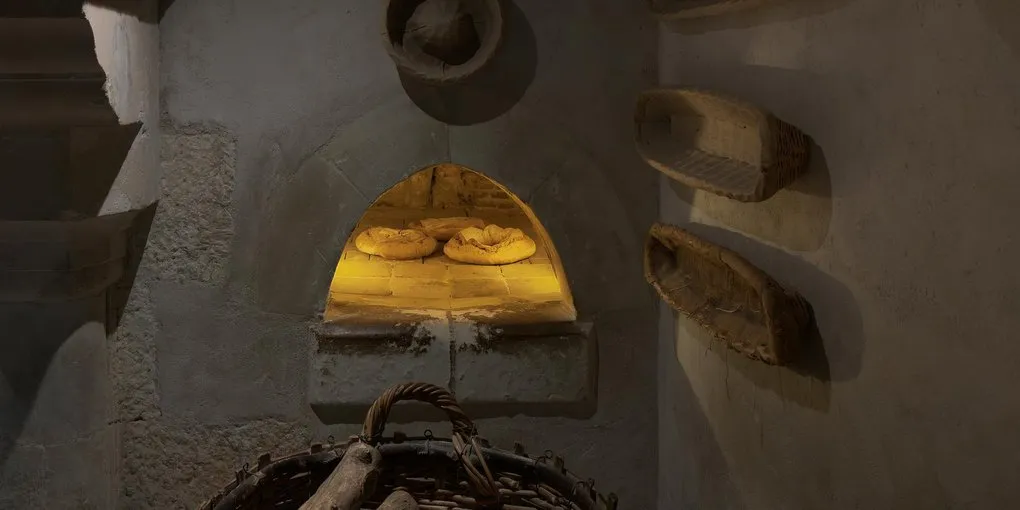
A medieval monastery oven was a large, domed, wood-fired masonry structure, often six feet or more in interior diameter. It took hours to heat — a fire was built inside, allowed to burn down, and the ashes were swept out. The retained heat in the masonry was then used to bake in what bakers still call a “falling oven,” with the chamber temperature dropping over several hours from a peak above 500°F down to warm enough for drying fruit or finishing a slow-cooked dish at the end.
Medieval bakers exploited this falling heat curve by sequencing bakes: breads with the hottest tolerance first (dense dark loaves, which benefited from aggressive initial heat), then finer white breads, then enriched breads and tarts, then drying applications. Nothing was wasted. Even the ashes had uses — as fertilizer, as laundry lye, as ingredients in primitive soap.
The lord of a medieval manor, secular or monastic, usually owned the oven. Peasants brought their own raw dough to the four banal — the lord’s oven — and paid a fee, often a fraction of the baked bread itself, for use of it. This was one of three classic seigneurial monopolies known as the banalités, alongside the mill (moulin banal) and the wine press (pressoir banal). The system formally survived in France until the Revolution abolished feudal rights on the night of August 4, 1789. Monastery ovens served a similar function for pilgrims and travelers, who often brought grain as payment for bread baked on-site.
The physics of these ovens is something modern home bakers rediscover when they buy a bread cloche or Dutch oven. The combination of trapped steam for the early bake and retained radiant heat for the later bake is exactly what a masonry hearth does — and exactly what oven spring in bread requires. Medieval bakers, working entirely by eye and feel, understood this intuitively.
Leavens were kept alive for decades inside monastic communities
Long before the word sourdough entered English, medieval monastic bakeries kept continuous wild-yeast leavens. A portion of each batch’s dough — called the chef or the mère (mother) in later French bakery tradition, but variously named in Latin sources — was reserved to leaven the next day’s bake. The same culture could persist, fed daily, for years or decades. Some modern abbeys still bake from cultures they claim trace back centuries. The biological reality is that the wild yeasts and lactic acid bacteria in any culture replace themselves continuously, so what persists is the continuous practice, not any specific original organism — but the practice is genuinely ancient.
The mechanics are the same as in any modern natural starter: the lactic acid bacteria and wild yeasts build up acidity in the culture, the acidity inhibits spoilage organisms, and the dough predictably rises within eight to twelve hours of inoculation. The medieval baker did not know the biochemistry, but he knew the behavior — and he trained his apprentices to recognize the smell, the bubble structure, and the feel of a healthy culture. The practice of seeding each new batch from a piece of the old, carried from monastery to monastery as monks moved between houses, spread the bread culture of Europe along the network of religious communities. For the longer story of how this leaven lineage runs from ancient Egypt through monastic Europe to the modern revival, see our history of sourdough from ancient Egypt to modern guide.
For home bakers today, this continuity is recoverable. A culture built from scratch with flour and water, fed and matured over a week or two, is biologically equivalent to the cultures medieval monks maintained. The same principles — warmth, regular feeding, hydration balance — that appear in any modern sourdough starter guide are the principles the monks worked by.
Cluny and Cîteaux marked the two great monastic models — and both shaped bread
By 1100, two distinct flavors of Benedictine practice dominated. Cluny Abbey, founded in 910 in Burgundy by Duke William I of Aquitaine and its first abbot Berno (previously of Baume), grew into the most powerful monastic network of the High Middle Ages — at one point governing close to a thousand dependent houses. Cluny’s church, completed in stages and rebuilt repeatedly, was the largest building in Christendom for several centuries, until the new Saint Peter’s Basilica in Rome was completed in 1626. Cluniac monasteries practiced an elaborate, ornate liturgy and operated as large agricultural and economic centers; their bakeries fed monks, servants, pilgrims, the poor at the gate, and a steady flow of travelers.
The Cistercian Order, founded in 1098 at Cîteaux, was a deliberate reform of what its founders saw as Cluniac drift away from austerity. Cistercians emphasized manual labor, isolation, and self-sufficiency — and they did the actual baking, milling, and farming themselves, supported by conversi, the lay brothers who handled much of the physical work of the granges. The contrast with Cluny was about who did the work: Cluniac houses relied heavily on hired labour and dependants for manual tasks, while Cistercian houses did it in-house through their lay brothers.
Both models — Cluniac patronage and Cistercian self-sufficiency — kept the daily bread of medieval Europe baking. They simply did it differently.
Monasteries declined, but bread knowledge survived
The Black Death of 1347–1351 killed perhaps a third of Europe’s population — modern estimates run from 30 to 60 percent — and a comparable proportion of its monks. The monastic orders never fully recovered. The Protestant Reformation in the sixteenth century dissolved monasteries across northern Europe — Henry VIII’s Dissolution of the Monasteries closed more than eight hundred religious houses in England, Wales, and Ireland between 1536 and 1541. By 1700, the monastic bread economy of the High Middle Ages was gone.
But the knowledge had already migrated. Guild bakers in cities, trained in the monastic tradition, had been taking over urban baking since the twelfth century. The Paris bakers were among the oldest of the Parisian corporations, with their statutes codified in 1268 in Étienne de Boileau’s Livre des métiers under Louis IX. The London Worshipful Company of Bakers — split historically into the White Bakers and the Brown Bakers — received its first recorded royal charter under Henry VII in 1486. When the monasteries fell, the guild bakers kept going. The bread hierarchy persisted in slightly secularized form — pain blanc for the rich, pain bis for the middle class, pain noir for the poor — right through to the French Revolution, when the price of bread became a political fuse.
The trace of the monastic tradition is still visible in how we bake today. The idea that bread is a daily food, baked in quantity and shared across a community, comes from the Benedictine Rule. The practice of maintaining a continuous starter culture comes from the monastic bakeries. The instinct that bread is the baker’s prayer — that there is something sacred in the simple transformation of flour, water, salt, and time — is, whatever else it is, the monastic inheritance of every modern home baker who has ever stayed up past midnight waiting for a dough to rise. If the long arc from industrial loaf back to hand-shaped artisan loaf interests you, see our companion piece on industrial bread vs. the artisan resurgence.
Frequently Asked Questions
- What was the daily bread ration for a Benedictine monk?
- Chapter 39 of the Rule of Saint Benedict, composed around 530 CE, specifies one libra of bread per monk per day, distributed across the two daily meals. A libra is the Roman pound, modern estimates of which run from about 322 to 329 grams. The ration was generous by medieval standards — comparable to a Roman legionary's grain ration — and crucially, it was reliable. A monk who kept his vows could count on daily bread for the rest of his life, which was one of the reasons monastic life was so attractive in a continent where peasant famine was always one bad harvest away.
- What is a trencher, and did people really eat off bread?
- A trencher was a thick slab of stale bread, typically three or four days old and roughly four inches square by half an inch thick, used as an edible plate at medieval meals. Meat and sauce were heaped on top, and the bread absorbed the juices. At the end of the meal, the trencher — now soaked with the meal's richest flavors — was either given to dogs, to servants, or, at monasteries, collected and distributed at the gate to the waiting poor. Trencher bread was deliberately baked dense, coarse, and allowed to stale so it could hold up under wet food without dissolving. The practice persisted until pewter and ceramic plates replaced wooden and bread trenchers in the seventeenth century.
- Did medieval monks really eat better bread than peasants?
- They ate whiter bread, but not necessarily better bread. The fine sifted wheat breads eaten by senior clergy and nobles (manchet in England, pain de chapitre in France) had the bran and germ removed, which stripped out fiber and most of the minerals. The coarse dark breads eaten by peasants — whole wheat, rye, or mixed-grain maslin — retained all of the grain's nutrition. Modern nutritionists have pointed out for more than a century that the medieval peasant's diet, bread included, was nutritionally richer than his lord's. The hierarchy was social, not nutritional.
- How long could a medieval sourdough culture survive?
- Indefinitely, as long as it was fed. Medieval monastic bakeries maintained continuous cultures by reserving a portion of each batch's dough for the next day's bake — a practice that could and did persist for decades. Some modern abbeys claim cultures that trace back centuries, though biologically the wild yeasts and lactic acid bacteria in any culture replace themselves continuously. What genuinely persists is the practice, not any specific original organism. The same is true of any modern sourdough starter kept in regular use.
- Why were monasteries so important to bread milling?
- After the Roman Empire's collapse, the commercial water mills and state-subsidized bakeries of the ancient world largely disappeared or fragmented. From the twelfth century onward — and especially with the Cistercian Order's founding in 1098 — monastic builders rebuilt and proliferated water-powered milling across medieval Europe. The Domesday Book of 1086 already records about six thousand mills in England, and that count had swollen substantially by the mid-thirteenth century, with a large proportion of new construction tied to monastic granges. Monastic mills produced more uniform flour and more consistent bread than the hand-driven querns peasants had used before them, which meant a measurable step-change in bread quality across monastic territories.
- What is the four banal?
- The four banal (literally 'the banned oven,' from Old French ban meaning a feudal proclamation) was the seigneurial oven that medieval peasants were required to use for their baking, paying a fee — often a portion of the baked bread — to the lord who owned it. It was one of three classic banalités, alongside the lord's mill (moulin banal) and the lord's wine press (pressoir banal). Monastery ovens often served the same role for the surrounding lay community. The system formally ended in France on the night of August 4, 1789, when the National Constituent Assembly abolished feudal rights.
- What is the Plan of Saint Gall?
- The Plan of Saint Gall (manuscript Cod. Sang. 1092, kept at the Stiftsbibliothek of Saint Gall Abbey in Switzerland) is an idealized architectural blueprint for a Benedictine monastery, drawn between roughly 820 and 830 CE. It is the only surviving major architectural drawing from the entire period between the fall of Rome and the thirteenth century, and it includes a detailed bakery and brewery complex with labeled rooms, ovens, grain storage, and mill works — the earliest extant document showing what a medieval monastic bakery actually looked like.
Sources: Rule of Saint Benedict, c. 530 CE, Chapter 39; Plan of Saint Gall, c. 820–830 CE, Stiftsbibliothek Sankt Gallen, Cod. Sang. 1092; Bridget Ann Henisch, Fast and Feast: Food in Medieval Society (Penn State Press, 1976); Françoise Desportes, Le pain au Moyen Âge (Olivier Orban, 1987); William Chester Jordan, The Great Famine: Northern Europe in the Early Fourteenth Century (Princeton University Press, 1996); Steven L. Kaplan, The Bakers of Paris and the Bread Question, 1700–1775 (Duke University Press, 1996).