Indian bread is a family of regional flatbreads built from grain geography, not from a single oven. North India's wheat belt produces chapati, paratha, and tandoor-baked naan; the millet zones of Maharashtra and Karnataka make jowar and bajra bhakri; the rice-and-lentil south makes dosa and idli, with Kerala's coiled Malabar parotta as a wheat exception whose origin is debated between West Asian maritime contact and overland spread from the north. The clay tandoor is ancient — tandoor-style ovens appear in Indus Valley sites at Kalibangan and Harappa from roughly 2600 BCE — but the loanword 'tandoor' is Persian (from Akkadian tinūru). The earliest documented references to tandoor-baked naan come from the Delhi Sultanate poet Amir Khusrau around 1300 CE, and naan is mentioned in the Ain-i-Akbari, the late-16th-century Mughal administrative chronicle compiled by Akbar's vizier Abu'l-Fazl, while paratha-type layered breads are documented far earlier, in the twelfth-century Manasollasa.
India bakes more bread per day than almost any other civilization, and almost none of it looks like what a Western baker recognizes as bread. There is no oven in a traditional Indian home kitchen. There is a tava, a griddle, a live flame, and sometimes a clay-lined pit cylinder fired in the corner of a courtyard. The dough is unleavened more often than not. It is rolled thin, slapped hot, and eaten within minutes of being made.
This is not bread as a preserved foodstuff. This is bread as a daily ritual, produced fresh for every meal, shaped by a specific hand in a specific household. The techniques stretch back thousands of years, and the regional variation across the subcontinent is so deep that no single category called “Indian bread” really holds together. Punjabi bread and Tamil bread and Gujarati bread share common ancestors but have grown into distinct species.
What follows is a history of how wheat, millet, and chickpea flour became the roti, naan, paratha, and puri that now define Indian cuisine — and why naan, the dish most Western diners associate with Indian food, has roots that are older, more pan-regional, and more linguistically Persian than the modern restaurant menu suggests.
Wheat came to India through the Indus Valley
Wheat cultivation in South Asia traces to the Indus Valley region, where the early Neolithic site of Mehrgarh in modern Balochistan has yielded domesticated wheat and barley alongside grinding stones and storage pits. The original excavation team, led by French archaeologists Jean-François and Catherine Jarrige between 1974 and 1986, dated the earliest occupation (Period I) to before 7000 BCE on stratigraphic grounds. A 2025 radiocarbon study published in Scientific Reports (Nature) revised those dates substantially later, placing Period I at roughly 5250–4650 cal BCE — still pre-Indus, but several millennia younger than the original estimate. Domesticated wheat and barley reached South Asia from the Fertile Crescent as part of the spread of farming itself rather than through any organised grain trade, arriving on the Indus plain well before the Mature Harappan period (c. 2600–1900 BCE) — though at Mehrgarh the early crop assemblage is more than 90% barley, and some researchers argue for local domestication there.
Early Indian bread was almost certainly unleavened. Harappan grain was ground on a saddle quern — a flat lower stone worked back and forth with a handstone — producing a whole-grain meal that retained bran and germ. The rotary chakki that defines modern atta milling, two stacked circular stones with the upper one turned by hand, is a much later technology: rotary querns do not appear in South Asia until roughly the middle of the first millennium BCE, some two thousand years after the Harappans.
Roti descends from that early tradition, but the continuity is an inference rather than a find. No Harappan bread survives, and the earliest direct evidence of a flatbread-type preparation in South Asia is considerably later. What the ingredients and the tools point to — hulled wheat, a grinding stone, a hot surface over a fire — is a flatbread much like the one still made in a Haryana village kitchen today. For the modern home version, see our roti and chapati recipe.
Roti is the everyday bread of the subcontinent
Roti — also called chapati, with the two words used largely interchangeably across most of North India — is the baseline bread of the wheat belt. The formula is austere: whole-wheat atta flour, water, a pinch of salt, occasionally a film of ghee or oil on the surface after cooking. No yeast. No sourdough. No shortening laminated into the dough. Just flour, water, and heat.
The dough is kneaded until smooth, rested for roughly 20 minutes to allow gluten relaxation and full bran hydration, then divided into small portions called peda. Each peda is rolled flat into a circle roughly six to seven inches across, then cooked on a tava — a flat or slightly concave iron griddle — over a medium-high flame. The roti is flipped on the tava, then transferred directly to the open flame for the dramatic final step: puffing. Steam trapped between the dough’s two thin layers expands violently and inflates the roti into a pillow within two or three seconds. A successful puff (called the phulka) is the signal that the dough hydration, the rolling, and the cook have all hit their marks.
Atta is not interchangeable with Western whole-wheat flour. Indian atta is milled from harder, high-protein common wheat (Triticum aestivum) — not durum, which in India goes mainly to sooji and semolina — and ground to a finer particle size on stone chakkis. The resulting flour rolls thinner, stretches without tearing, and produces a softer finished bread than a Western whole-wheat flour will. For a primer on whole-grain flour selection, see our whole-wheat flour guide.
The chapati’s role in many rural Indian households goes beyond the meal itself. Appetite is often quantified in chapatis — “two-chapati meal” is a common shorthand for hunger level — and family flour consumption is calculated in chapatis per day rather than in grams or cups.
The tandoor is older than its Persian name
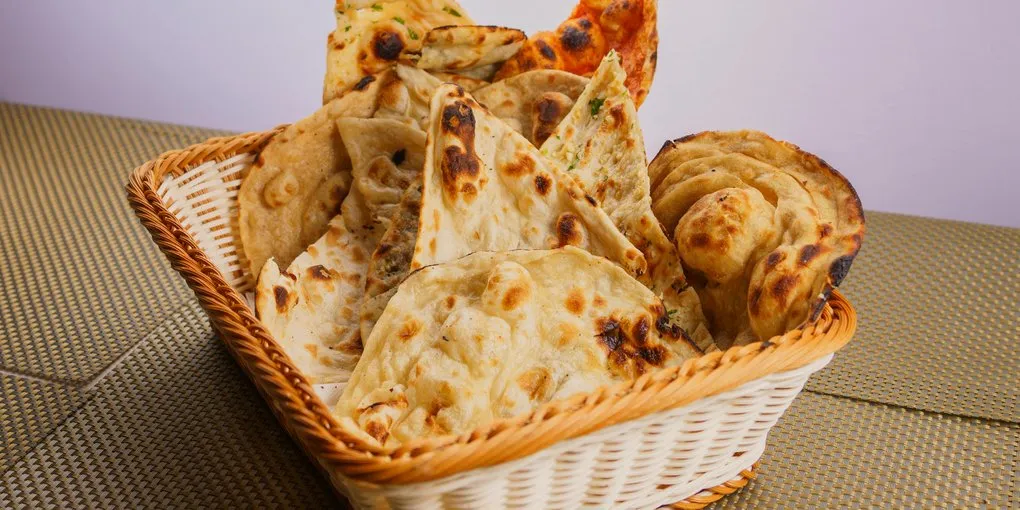
The iconic Indian restaurant bread — the teardrop-shaped, blistered, chewy naan — is baked in a tandoor, a cylindrical clay oven lined with refractory clay and heated by a charcoal or wood fire at its base. Interior temperatures in a working tandoor commonly run between 400 and 480 °C (roughly 750–900 °F), with the lower part of the chamber hotter than the top. Bread is cooked by slapping the flattened dough directly onto the near-vertical interior wall, where it adheres by moisture and cooks in 60–90 seconds.
A common claim — that the tandoor “arrived in India with the Mughals” in the 16th century — is misleading. The clay-cylinder oven type is in fact ancient on the subcontinent. Excavations at the Indus Valley sites of Kalibangan (in modern Rajasthan) and Harappa (in modern Pakistan) have uncovered both underground and overground mud ovens dating to roughly 2600 BCE that closely resemble the tandoors of present-day Punjab and Rajasthan. The Indus Valley residents were predominantly wheat eaters; the ovens were almost certainly used for baking bread. The technology is not Mughal. It is Harappan, or older.
What is Persian is the word. The English “tandoor” descends from Hindustani tandūr, from Persian tanūr, and ultimately from Akkadian tinūru (𒋾𒂟) — a compound of tin (mud) and nuro (fire) — one of the oldest documented terms for a bread oven and attested as early as the Epic of Gilgamesh. Cognates include Arabic tannūr, Hebrew tanúr, Armenian t’onir, Georgian tone, Turkish tandır, and Uzbek tandir. The word, like the technology, predates any modern political boundary by millennia.
The earliest documented mention of tandoor-baked naan in the Indian subcontinent comes not from the Mughals but from the Delhi Sultanate poet Amir Khusrau (1253–1325), an Indo-Persian Sufi musician and court scholar who wrote in the imperial circles of multiple sultans in the late 13th and early 14th centuries. Khusrau distinguished two breads: naan-e-tunuk, a thin, gossamer flatbread, and naan-e-tanuri, a thicker bread baked in a tandoor. By the late 16th century, the Ain-i-Akbari — the administrative chronicle of Akbar’s empire compiled by his vizier Abu’l-Fazl ibn Mubarak between 1589 and 1596 — records naan at the imperial table, eaten with kebab or kheema. It is a passing mention rather than the catalogue of named varieties it is sometimes described as.
So the timeline is: clay-cylinder ovens at Kalibangan and Harappa around 2600 BCE; the Persian loanword tandoor and the Persian-style enriched, leavened bread naan circulating in Delhi Sultanate court cuisine by 1300 CE; the technique refined and codified in Mughal imperial kitchens through the 16th century; and the tandoor as a commercial restaurant fixture as a 20th-century development. After the 1947 Partition, Punjabi refugee restaurateurs popularized the tandoor in Delhi and beyond — most famously at Moti Mahal, opened in Daryaganj in 1947 by three Peshawar refugees — Kundan Lal Gujral, Kundan Lal Jaggi and Thakur Das Magu — who had run a restaurant of the same name in Peshawar. Moti Mahal is widely credited with popularising the technique of skewering yogurt-marinated chicken in a bread tandoor, which produced tandoori chicken (and, indirectly, butter chicken). For most of Indian history, however, most Indian households have had no tandoor at all. For a deep dive on home-baked naan technique, see our naan bread recipe.
Naan itself is a leavened bread. Traditional recipes use yogurt and a touch of yeast or natural starter; modern restaurant formulas often use baking powder plus yogurt for faster production. The yogurt serves two functions: lactic acid weakens gluten bonds for tenderness, and the live cultures contribute flavor depth. Naan is typically enriched with milk, egg, or ghee — closer in character to a brioche or challah than to a plain chapati.
Paratha is India’s laminated bread
Paratha is where Indian bread meets a technique a French pastry chef would recognize. The dough starts similar to chapati — atta flour, water, salt, sometimes a small amount of ghee in the mix — but once rolled, it is brushed with ghee or oil, folded, rolled again, brushed again, and folded again. The laminated disc is then cooked on the tava with additional ghee, producing a flaky, layered bread that can be several times thicker than a plain roti.
The lamination technique in paratha developed independently of European puff pastry, and the physics are similar: fat separates dough layers, steam trapped between layers expands them apart on the hot griddle, and the result is flakiness. Paratha’s documented history runs earlier than the Mughal court, not through it. Food historian K. T. Achaya traces paratha-type layered breads to the twelfth-century Sanskrit Manasollasa, where breads such as manda and vestika are described. They later became common among nobility in Punjab and the Delhi Sultanate, and were popularised under the Mughals through period cookbooks. The name is usually explained as parat (layer) plus atta (flour), though that reading is popular rather than documented — the reference dictionaries trace the word no further back than Hindustani.
Paratha ranges from the plain triangular lachha paratha of Punjab to the coiled Malabar parotta of Kerala. The Kerala version is so thoroughly laminated that individual layers separate into ribbons when torn. Its origin in the south is contested — culinary anthropologist Kurush Dalal attributes it to traders and sailors arriving from West Asia and Central Asia, citing the fact that wheat is not widely grown in Kerala and that the layering method is foreign to older Indian dough techniques. (He is not on record fixing a century to it, and maritime contact with the Malabar Coast long predates the Islamic era.) An alternative theory traces it from Punjab southward overland. The truth is likely a combination — a wheat-based, fat-laminated bread tradition arriving with West Asian traders and absorbing North Indian influences over centuries of cultural exchange.
Stuffed parathas are a category of their own: aloo paratha (potato), gobi paratha (cauliflower), mooli paratha (radish), paneer paratha (cheese), keema paratha (spiced meat). The dough is wrapped around a filling, sealed, gently rolled, and cooked with ghee. A good aloo paratha cooked on a village tava is one of the great breads of the world and almost never served outside the home. For the home recipe with both triangular and spiral coil shaping, see our paratha guide.
Puri, bhatura, and the fried-bread tradition
Not all Indian breads are griddle-cooked. Puri is a small disc of atta dough that is rolled thin, then deep-fried in hot oil. It puffs dramatically in the oil, producing a hollow sphere with a crisp shell and steamy interior. Puri is breakfast food, festival food, temple offering food, and the carbohydrate component of chaat street foods like pani puri.
Bhatura is the Punjabi cousin: leavened with yogurt or yeast, made with all-purpose maida flour instead of whole-wheat atta, rolled larger than a puri, and deep-fried. It is the bread of chole bhature, a North Indian dish of chickpea curry with leavened fried bread. Bhatura is plate-sized, chewy, and significantly richer than its unleavened counterparts.
Kulcha is the yeast-leavened cousin of naan, particularly associated with Amritsar. Kulcha can be cooked on a tava or in a tandoor, is often stuffed with potatoes or onions, and is traditionally served with chole.
The regional grain map explains the variation
The dividing line that most shapes Indian bread is wheat versus rice versus millet. Wheat dominates the North — Punjab, Haryana, Uttar Pradesh, Madhya Pradesh, and the wetter parts of Rajasthan and Gujarat, whose drier districts lean on millet instead — where the climate and Indo-Gangetic alluvial soils support wheat cultivation. Bread is the staple; rice is a side dish. This is chapati, paratha, naan, puri country.
South India is rice country. Bread still appears, but in different forms — dosas and idlis are technically fermented rice-and-lentil preparations rather than wheat breads, occupying the same meal-structural role that chapati plays in the North. Wheat chapatis are less prominent outside urban restaurants. The Malabar parotta is the notable Kerala wheat exception, traced to Arab maritime trade with the Malabar Coast.
Millet bread dominates in the drier regions of western and central India. Bajra roti (pearl millet) is staple in Rajasthan and Gujarat; jowar bhakri (sorghum) is common across Maharashtra and northern Karnataka; ragi roti (finger millet) is widespread in Karnataka. Millet doughs contain no gluten and are harder to roll — they require a different technique, often pressed flat by hand on a wet cloth rather than rolled with a pin, and cooked on the tava at lower heat to prevent cracking. Archaeological evidence from Iron Age sites in the southern Deccan (such as Kadebakele) suggests millet-based flatbreads and doughs in the region by roughly 800 BCE. The nutritional profile of millet bread is superior to refined wheat in several respects — higher fiber, more minerals, lower glycemic impact — and millet breads are seeing a revival as India’s contemporary health discourse moves toward traditional grains. For more on these grains in a global bread context, see our ancient grains bread guide.
The Indian Bread Map
One subcontinent, six bread cultures — each shaped by its dominant grain
Punjab / North Wheat Belt
Wheat (atta and refined maida); home of the tandoor as restaurant fixture after 1947.
Gangetic Plain
Wheat-dominant Indo-Gangetic alluvial soils; the daily-bread heartland.
Rajasthan / Gujarat
Drier climate favors pearl millet alongside wheat; long-keeping snack flatbreads.
Maharashtra / N. Karnataka
Deccan plateau sorghum and finger-millet country; coarser, hand-pressed flatbreads.
South India (Tamil Nadu / Kerala / Andhra)
Rice-and-lentil belt; fermented batter preparations replace wheat bread in the same meal role.
Bengal
Rice-dominant with some wheat; deep-fried maida flatbreads at festival meals.
Wheat dominates the north. Millet fills the dry west and central plateau. Rice rules the south. Bread culture follows grain geography.
jayarrbread.comThe hand that makes the bread
One last thing worth naming: in a traditional Indian kitchen, bread is made by hand, by a specific person, for each meal. The skill of making perfect round rotis is a point of pride and a measure of household competence. It is learned by watching and by doing, not by recipe. The subtle adjustments — more water on a dry day, less flour on a humid one, a harder push with the rolling pin on a stubborn dough — are tacit knowledge passed across generations.
Industrial roti-making machines exist, and packaged chapatis can be bought in urban Indian supermarkets. But for most Indians, bread is still what comes off a tava that was heating while someone stood nearby rolling the next peda. That immediacy — bread as a real-time, person-to-plate transaction — is the through-line from the Harappan hearth to the modern Punjabi kitchen. Everything else is regional variation on top of that foundation.
A note on fermentation and the idli-dosa question
One detail worth addressing for non-Indian readers: South Indian dosa and idli, though often grouped with Indian “breads” in Western discussions, are technically fermented rice-and-lentil batter preparations rather than wheat breads. The batter — typically a 2:1 or 3:1 ratio of parboiled rice to urad dal (split black gram) — is soaked, ground, and fermented overnight with wild yeast and lactic acid bacteria. The result is then either poured thin and griddle-crisped (dosa) or steamed in cups (idli). The fermentation chemistry is closer to a sourdough than to a chapati — same wild yeast and lactobacilli, different grain substrate.
The historical importance of idli and dosa is that they provide a way to make a fermented, more digestible, protein-complete staple from rice — the dominant grain of the South — in the same meal-structural role that bread occupies in the North. A Tamil breakfast of idli with sambar and chutney is functionally equivalent to a Punjabi breakfast of paratha with achar. Both are fermented or laminated grain preparations eaten with savory accompaniments. The form differs because the grain differs. That underlying pattern — grain geography producing bread-role foods that vary in form but not in function — is the single most useful framework for understanding the full breadth of what Indian “bread” actually means.
For other deep-history bread traditions that follow the same grain-determines-form logic, see our writeups on the pita bread of the Levant and Ethiopia’s teff-based injera.
Frequently Asked Questions
- What is the difference between roti and chapati?
- The terms are largely regional rather than technical. Chapati is more common in Hindi-speaking North India; roti is more widespread across the broader subcontinent and in diaspora English. Both refer to a thin, unleavened, whole-wheat atta flour bread cooked on a tava and finished over an open flame. In Punjabi, roti can also serve as a general word for 'meal' or 'bread in any form,' which adds to the ambiguity. If a recipe specifies one or the other, assume they mean the same thing unless the context indicates otherwise.
- Why does naan have a teardrop shape and roti is round?
- Naan is baked by slapping the dough onto the near-vertical interior wall of a tandoor. Gravity pulls the bottom of the dough downward as it cooks, stretching the originally round disc into an elongated teardrop. Chapati is rolled flat on a board before cooking on a horizontal tava, so it holds its circular shape. The teardrop is a consequence of the tandoor geometry, not a deliberate design choice.
- Is naan actually Indian?
- Naan as a bread style is pan-regional across Central Asia, Iran, and South Asia — the word naan itself is Persian and simply means 'bread.' The clay tandoor in which naan is traditionally baked is older still: tandoor-style ovens appear at Indus Valley sites like Kalibangan and Harappa around 2600 BCE, well before the loanword tandoor (from Akkadian tinuru via Persian) entered Hindustani. The earliest documented mention of tandoor-baked naan in the subcontinent is from the Delhi Sultanate poet Amir Khusrau around 1300 CE, more than two centuries before the Mughals arrived. Naan is genuinely part of Indian food culture, but its roots are pan-regional and its commercial-restaurant prominence is largely a 20th-century post-Partition development.
- Why is atta flour different from all-purpose flour?
- Atta is milled from the whole wheat kernel — bran, germ, and endosperm — and traditionally ground on stone chakkis that produce a fine but unbleached flour. All-purpose maida is highly refined white flour, made from endosperm only. Atta has higher fiber, more protein in absolute terms, and a nuttier flavor. Chapati made with all-purpose flour will be paler, less flavorful, and will not puff in the same way. The phulka puff comes from steam trapped inside a continuous gluten sheet -- bran does not generate steam, and sharp bran particles actually puncture that film, which is exactly why atta dough is rested so the bran softens and flexes with the gluten instead of cutting through it.
- Can I make naan without a tandoor?
- Yes. Home cooks often use a cast-iron skillet preheated over high heat for 5+ minutes, or place naan dough directly on the heated surface of an inverted wok or the underside of a pizza stone under the broiler. None of these reproduce true tandoor texture — the tandoor's near-vertical orientation, very high radiant heat, and charcoal smoke are difficult to replicate at home — but they produce a respectable leavened flatbread. Focus on a very hot surface (cast iron at 500°F or hotter), a slightly sticky yogurt-leavened dough, and a fast cook of 90 seconds per side.
- Did naan really come from the Mughals?
- Not exactly. Tandoor-baked naan is documented in the Delhi Sultanate, more than two centuries before the Mughal Empire — the earliest reference is in the writings of the Indo-Persian poet Amir Khusrau (1253–1325), who described naan-e-tunuk (a thin flatbread) and naan-e-tanuri (a tandoor-baked thicker bread). The Mughals, beginning with Babur in the early 16th century and especially under Akbar later in the 16th century, refined and codified imperial naan varieties — the Ain-i-Akbari (c. 1590) mentions naan at Akbar's table, though as a passing reference rather than the catalogue of varieties it is often said to contain. But the Mughals popularized and refined a tradition that already existed; they did not introduce it.