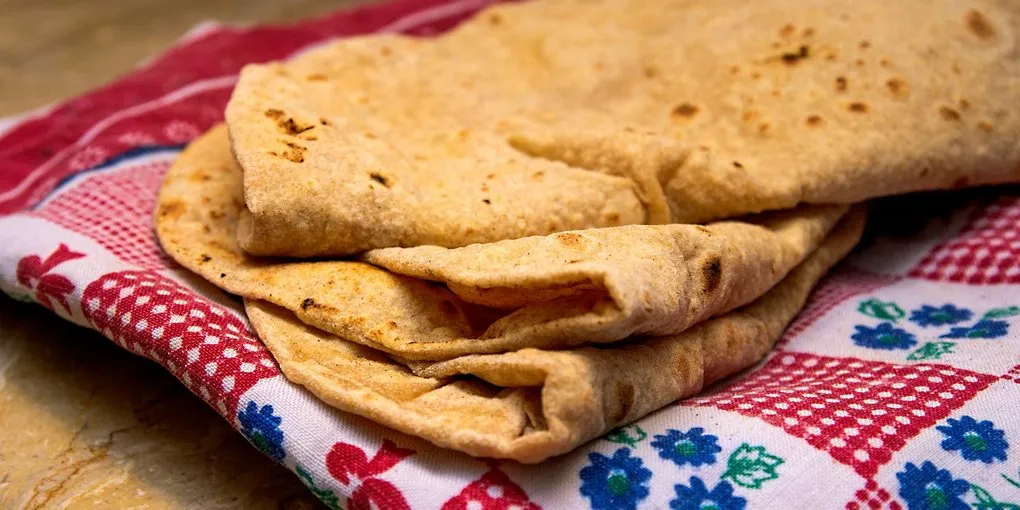
Authentic chapati uses atta (Indian stoneground whole-wheat flour) at 65% hydration with salt only. Knead 4-5 minutes, rest 20 minutes, divide into 66g balls, roll thin (2 mm), and cook in two stages: 20-30 seconds on a 220-240C tava, flip for another 30-45 seconds, then lift onto a direct gas flame for 5-6 seconds where the chapati puffs into a sphere from internal steam. Total time: about 45 minutes for 10 chapatis.
If there is one bread that earns the word staple more honestly than any other on earth, it is the North Indian chapati. Roughly 700 million people eat some form of roti or chapati every day, many of them twice a day, and most of them hand-roll and cook that bread themselves. It is whole-wheat, thin, soft, pliable, and dry. No lamination, no fat, no yeast, no shortcuts. Four ingredients on the shopping list, three minutes to cook each round, and a complete daily staple that has fed a continent for thousands of years.
The skill everyone watches for in a competent Indian home cook is the phulka. The moment when a chapati, moved from the hot tava to a direct flame, puffs up into a taut sphere of bread pillow as steam forms between its two layers and inflates them apart. A chapati that does not puff on the flame is still edible; a chapati that does puff is the signal that the dough, the rolling, and the cook all hit their marks. This guide walks through the dough, the rolling technique, and the two-stage cook that produces that puff reliably.
Before we get into method: the words roti and chapati mean essentially the same thing, and this confuses everyone. Roti is a catch-all North Indian term meaning “bread.” Any unleavened flatbread can be called roti. Chapati refers specifically to the thin, soft, whole-wheat version cooked on a tava. Every chapati is a roti; not every roti is a chapati. Most home cooks use the words interchangeably, and this recipe covers both.
Cultural Context
Chapati descends from a very old tradition, but the continuity is an inference rather than a find. No Harappan bread survives, and the earliest direct evidence of a flatbread-type preparation in South Asia is considerably later than the Indus Valley cities. What the ingredients and the tools point to — hulled wheat, a grinding stone, a hot surface over a fire — is a flatbread much like the one still made in a Haryana village kitchen today. What is documented is that wheat was a staple grain alongside barley in the Indo-Gangetic plain well before the word chapati, which is later, enters the record.
The tava is the flat, slightly concave cast-iron griddle used to cook chapatis. Traditional tavas are un-seasoned cast iron, heated in direct contact with a flame (wood or gas), and are one of the few cooking vessels in Indian home kitchens that goes generations without replacement. Modern home cooks often use heavy cast-iron skillets, which work identically.
The two-stage cook (tava then open flame) is not universal across India but is the standard in North India and Pakistan. In the south, where coconut is the ambient fat, rotis are more often cooked entirely on the tava and sometimes brushed with oil after. In the east and Bangladesh, a coarser wheat called lal atta or red wheat is common, producing a darker, nuttier chapati. The recipe here represents the North Indian standard, which is the most widely practiced version.
The chapati’s role in the meal is structural. In a traditional thali, the chapati is the utensil. You tear a small piece with your right hand, fold it around a bite of dal or vegetable, and use it to deliver food to your mouth. This is why texture matters so much: a stiff, dry chapati cannot scoop, and a gummy chapati cannot release the food. Soft, pliable, slightly stretchy is the target, and that target is achieved by hydration and the 20-minute rest, not by adding fat to the dough.
Ingredients
Recipe yields 10 chapatis, approximately 18 cm (7 inches) each.
| Ingredient | Grams | US Measure | Baker’s % |
|---|---|---|---|
| Atta (Indian whole-wheat flour) | 400 g | about 3 1/3 cups | 100% |
| Fine sea salt | 4 g | 3/4 tsp | 1% |
| Warm water (100-105F / 38-40C) | 260 g | about 1 cup + 2 Tbsp | 65% |
| Atta for dusting | As needed | — | — |
Atta note: Chapatis require atta specifically. Atta is the fine, stoneground whole-wheat flour used throughout the Indian subcontinent, milled from harder, high-protein common wheat (Triticum aestivum) — not durum, which in India goes mainly to sooji and semolina — and ground to a finer particle size than standard Western whole-wheat flour. The difference shows up instantly in rolling: an atta dough rolls thin and stretches without tearing, while a Western whole-wheat dough fights back. Common brands at South Asian grocers include Aashirvaad, Pillsbury India, Sujata, and Golden Temple. Bleached “chapati flour” at mainstream supermarkets is typically a blend of maida (refined white) and whole-wheat and is not authentic. Avoid. For a primer on whole-grain flour selection, see our whole-wheat flour guide.
No fat, no sugar, no yeast. This is deliberate. A chapati is meant to cook almost dry, puff on a direct flame from its own moisture, and stay soft because of proper hydration, not because of added fat. Fat in the dough (as in paratha) suppresses the puff. The role of salt in bread here is purely seasoning: 1% baker’s percentage is enough to season without affecting hydration or gluten behavior at this scale.
Hydration: 65% is the target for atta. If you are using a Western whole-wheat flour blend, try 67-70% because the coarser bran absorbs more slowly but eventually demands more water to produce a pliable dough. Whole-wheat flour absorbs significantly more water than white flour due to bran content, which is why pushing past the standard 60-65% lean-flatbread range is necessary here. For more on dialing dough consistency by feel, see our hydration guide. Under-hydrated dough is the single most common chapati mistake.
Chapati Timeline
Four stages to a puffed, pliable roti
1. Mix + 20-min Rest
- Atta flour
- 400g
- Hydration
- 65% (warm water)
- Rest
- 20 min minimum, covered
- Dough feels soft, slightly tacky (not stiff)
- Finger press should slowly spring back halfway
- Rest lets gluten relax + bran hydrate fully
2. Divide + Preheat Tava
- Portions
- 10 balls of 66g
- Tava temp
- 220-240C (medium-high)
- Preheat
- 5 min minimum
- Roll each ball tight and smooth
- Water droplet test: should sizzle off in 1 second
- Dry tava — no oil
3. Roll Thin
- Thickness
- 2 mm
- Diameter
- 18 cm (7 inches)
- Edges
- Thin, even
- Rotate quarter-turn every 2-3 strokes
- Dust lightly with atta; brush off excess before cooking
- Thin rolling is required for the puff in stage 4
4. Two-Stage Cook
- Tava side 1
- 20-30 sec
- Tava side 2
- 30-45 sec
- Open flame
- 5-6 sec both sides
- Flip to tava, then lift with tongs over gas flame
- Chapati puffs into sphere = success signal
- No flame? Press with cloth on tava to force puff
The puff is the test. A chapati that puffs is properly hydrated, rolled evenly, and cooked on hot enough heat.
jayarrbread.comMethod
Step 1 — Make the dough (5 minutes active)
In a large bowl, whisk the atta and salt together. Pour the warm water in slowly while stirring with a wooden spoon. Once a shaggy mass forms, switch to your hand and bring the dough together. Turn out onto a lightly floured surface.
Knead for 4 to 5 minutes. The dough should become smooth, soft, and slightly tacky. Significantly softer than a bread dough. Press a finger into the center; the indentation should spring back halfway, slowly. If the dough feels stiff, wet your hand with water and continue kneading. A tablespoon or two of extra water is easy to work in.
Step 2 — Rest (20 minutes, non-negotiable)
Cover the bowl with a damp towel or plastic wrap and let the dough rest for at least 20 minutes. This rest does three things:
- The gluten network relaxes so the chapati will roll thin without snapping back. For more on the physics of gluten, the same elastic-extensible balance that matters in bread dough also matters here.
- The bran hydrates fully, which makes the finished chapati soft rather than gritty
- The dough reaches a uniform hydration throughout — the surface stops feeling tacky
A chapati rolled from un-rested dough is always disappointing. It tears, it snaps back, it refuses to thin out, and it cooks up stiff. Do not skip.
Step 3 — Divide (3 minutes)
After the rest, weigh the dough (it should be around 664 g) and divide into 10 equal pieces of about 66 g each. Roll each piece between your palms into a tight, smooth ball. Cover with a damp towel.
Step 4 — Preheat the tava (5 minutes, during divide)
Set a heavy cast-iron tava, skillet, or griddle over medium-high heat. Preheat for at least 5 minutes. Target surface temperature is 220-240C (430-465F); a water droplet flicked on the surface should sizzle and evaporate within 1 second.
If you plan to puff the chapati over direct flame (see Step 6), turn a second gas burner to medium and have tongs nearby.
Do not oil the tava. Chapatis cook on a dry surface.
Step 5 — Roll each chapati (1-2 minutes per round)
Dust a ball generously with atta. Press flat with your palm, then roll with a wooden rolling pin (a thin Indian belan works best; a Western dowel pin is fine). Roll from the center outward, rotating the chapati a quarter-turn after every two or three strokes, dusting with atta as needed to prevent sticking. Flip the chapati once partway through rolling.
Target: approximately 18 cm (7 inches) across, 2 mm thick, with an even thickness edge to edge. Thin is essential for the puff. A thick chapati will not form the two-layer steam pocket that makes it inflate.
If the chapati resists and snaps back, set it aside for another minute of rest and roll a different one. The gluten tightens when you work it; let it relax.
Step 6 — The two-stage cook (90 seconds per chapati)
Stage 1: Tava. Shake excess flour off the rolled chapati and lay it on the hot tava. Cook for 20-30 seconds until small bubbles begin appearing on the surface and the bottom is lightly spotted (it should not be deeply browned yet).
Flip. Cook the second side for 30-45 seconds, pressing gently around the edges with the back of a spatula or a wadded cloth. You will see the chapati begin to inflate in small patches. This is the steam starting to push the layers apart.
Stage 2: Direct flame (the phulka technique). Using tongs, lift the chapati off the tava and hold it directly over a medium gas flame, first-cooked side down. Within 2-3 seconds, the chapati should balloon up into a taut sphere as trapped steam inflates both layers. Flip and hold the other side over the flame for another 2-3 seconds. Total flame time: 5-6 seconds. Do not leave it on the flame longer or it will scorch.
If you do not have a gas stove, the tava-only technique works: cook each side on the tava for 45-60 seconds, pressing the chapati all over with a wadded cloth to encourage the puff. The chapati will still inflate, just less dramatically.
Step 7 — Store hot
Transfer each cooked chapati immediately to an insulated container or a plate lined with a clean kitchen towel, and cover. The steam inside the chapati softens it as it cools slightly. This is how you get the pliable, tearable texture. Chapatis left uncovered stiffen within three minutes.
Brush the top with a thin film of ghee if desired (North Indian tradition at home) or leave plain.
How Chapati Compares to Other Flatbreads
Chapati sits at the lean, unleavened end of the flatbread family. Knowing where it falls helps you adapt technique when you make its richer cousins.
Chapati / Roti: Unleavened (just atta, water, salt), no enrichment, cooked on a dry tava at 220-240C and finished on direct flame. Thin (2 mm), pliable, no browning from fat or sugar. The simplest flatbread.
Naan: Leavened with yeast and baking powder, enriched with yogurt and oil/ghee, made from refined all-purpose flour, and cooked on a 500F+ skillet. Soft, charred, dramatically puffed.
Pita: Leavened with yeast only, lean (no enrichment), made from bread flour, baked in a 500-550F oven. Forms a single large pocket as the top and bottom layers separate from steam.
The unifying physics is the steam puff. All three breads inflate from internal water turning to steam at high heat, but each one stages that puff differently: chapati on direct flame after a tava cook, naan on a screaming-hot skillet, pita inside a hot oven.
Troubleshooting
Chapati will not puff. Three usual causes. Dough too dry (add 15-20 g more water next batch). Chapati rolled too thick (target 2 mm, edges thin). Tava not hot enough (water droplet should sizzle off in 1 second).
Chapati stiff and dry. Under-hydrated dough, or over-cooked. Push hydration to 67-70% with atta, or 70-73% with Western whole-wheat. Cook only until spotted, not browned. Our bread troubleshooting guide covers more general dryness fixes.
Chapati gummy in the middle. Under-cooked, or tava temperature too low. Preheat 5+ minutes and cook both stages fully.
Chapati tears during rolling. Dough under-rested or under-hydrated. Rest a full 20 minutes and test hydration by pressing a finger. It should spring back slowly, not stiffly.
Dark black spots burning through. Tava too hot, or dough sat too long on the griddle. Reduce to medium, cook 20-30 seconds first side only.
Chapati snapping back during rolling. Gluten over-tightened, needs more rest. Set this ball aside for 2-3 minutes and roll the next one instead.
Storage
Cooked chapatis keep wrapped in a zip-top bag at room temperature for 1 day, refrigerated for 3 days, or frozen for 2 months with parchment between each. Reheat on a dry tava for 15-20 seconds per side, or wrap in a damp paper towel and microwave for 20 seconds. Microwaving is acceptable for chapati (unlike many richer flatbreads) because the whole-wheat dough is thinner and steams evenly. For best pliability, always store covered, never loose on a plate. For more on keeping bread fresh, see our bread storage guide.
Frequently Asked Questions
- What is the difference between roti and chapati?
- In most Indian kitchens, the words are used interchangeably, and that is fine. Technically, roti is a North Indian umbrella term meaning bread. It covers any unleavened flatbread, including chapati, paratha, phulka, and tandoori roti. Chapati is the specific name for a thin, soft, whole-wheat roti cooked on a tava. Every chapati is a roti; not every roti is a chapati. When someone in North India says they will have two rotis with the dal, they usually mean chapatis, and the context makes it clear.
- Can I make chapati without a gas stove for the puff?
- Yes, and plenty of home cooks do. The two-stage cook (tava then flame) is the traditional method, but a tava-only chapati still puffs, just less dramatically. With an electric or induction cooktop, cook each side on the tava for 45-60 seconds, pressing gently all over the surface with a folded cloth. The pressure helps trap steam between the two dough layers and inflates them. Some modern Indian home cooks use a dedicated wire roti-puffer (a perforated disc on a handle) held over the cooktop element to achieve the same puff. Available at most South Asian grocers.
- Why is my chapati stiff instead of soft and pliable?
- Almost always a hydration issue. 65% is the starting target for genuine atta; Western whole-wheat requires 67-73% to achieve the same pliability because the coarser bran drinks water slowly. If your chapatis are stiff, try adding 20-30 g more water to the next batch. The dough should feel genuinely soft, noticeably softer than a bread dough, and a finger press should leave a slow-recovering dent. The 20-minute rest after mixing is the second most common failure point; without it, the bran never fully hydrates.
- Is atta the same as whole-wheat flour?
- Similar but not identical. Atta is stoneground whole-wheat flour milled from harder, high-protein common wheat (Triticum aestivum) — not durum, which in India goes mainly to sooji and semolina — at a finer particle size than Western whole-wheat. The finer grind gives atta a smoother texture and higher water-absorption consistency, and the wheat composition contributes a slightly different gluten structure. Western whole-wheat flour will work in this recipe but requires more water (67-73% hydration instead of 65%) and tends to produce a coarser, stiffer chapati. If you can source atta, do. The difference is noticeable. Common brands at South Asian grocers include Aashirvaad (most popular in India), Pillsbury India, Sujata, and Golden Temple.
- How many chapatis should one person eat in a meal?
- Varies enormously by region, diet, and how active the eater is, but a typical North Indian lunch or dinner for an adult includes 2-4 chapatis alongside dal, vegetable curry, rice, and yogurt. At around 100-110 calories per chapati (from whole-wheat flour and water only), they are a nutrient-dense calorie source with fiber from the whole grain and no added fat. Modern urban households sometimes substitute half the chapatis with rice, especially in Bengal and the south; rural and agricultural households traditionally eat more chapatis and fewer grains overall.
- Why does my chapati not puff on the flame?
- Three usual causes, in order of likelihood. First, the dough is under-hydrated, so there is not enough free water to vaporize and inflate the bread. Push hydration up by 15-20g per 400g of flour. Second, the chapati is rolled too thick or unevenly. The two layers cannot separate and trap steam if the dough is more than about 2 mm thick. Third, the tava is not hot enough. The flick-water test (sizzles off in 1 second) is the easiest check. Most failures are the first cause.
Chapati is the everyday bread of the Indian flatbread family, and it is the cleanest expression of how far four ingredients can go when the technique is dialed in. Master the dough hydration, the 20-minute rest, the thin even roll, and the two-stage cook, and the puff becomes routine. Once the rolling-and-griddle rhythm is second nature, the same technique makes classic flour tortillas, or excellent sourdough discard tortillas if you keep a starter. The corn-based arepa is a close cousin from the Americas — same griddle rhythm, a completely different grain.