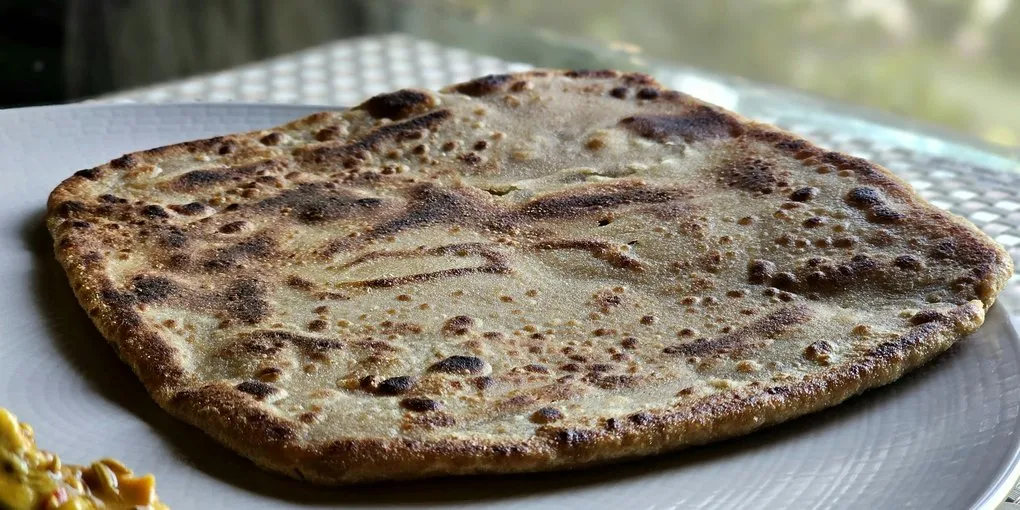
Paratha is laminated whole-wheat Indian flatbread. Make a 60% hydration atta dough, rest 20 minutes, divide into 8 balls of 83g. For each, roll into a 12 cm disc, brush with ghee, fold into a triangular quarter (6 layers) or spiral coil (20-30 layers), then roll out to 18 cm and 2-3 mm thick. Cook on a 220-240C cast-iron tava for 30 seconds, flip and brush with ghee, cook another 45 seconds per side until golden-brown spotted and the layers visibly separate. Total time: about 55 minutes for 8 parathas.
The plain paratha is the laminated cousin of the chapati — same whole-wheat atta dough, same tava, same five-minute cooking window — but a completely different bread on the plate. Where a chapati is thin, dry, and disciplined, a paratha is flaky, buttery, and luxurious, built from layers of ghee that separate as they cook and produce a bread with visible strata you can peel apart. This is the bread of the Sunday breakfast table, not the weekday lunchbox. In Punjab, where paratha is arguably the state’s defining food, a proper aloo paratha (stuffed with spiced potato) alongside a glass of lassi is the canonical morning meal.
The technique is conceptually similar to French pastry lamination, scaled down and simplified. Indian home cooks achieve a layered structure by rolling the dough flat, smearing it with ghee, folding it on itself in a specific geometric pattern, and rolling it out again. Each fold multiplies the layer count: a triangular three-fold produces 6 layers, a spiral coil technique can produce 20-30 layers. The ghee between the layers vaporizes and expands in the hot tava, puffing each layer away from its neighbors and giving the finished paratha its signature flakiness — the same physics that powers a croissant, just with ghee instead of a butter block and a hot griddle instead of an oven.
This recipe covers the plain butter paratha with two traditional shaping techniques — the triangular fold and the spiral coil — using a gram-weight atta dough. For the stuffed versions, see the variations at the end.
Cultural Context
Paratha’s documented history runs earlier than the Mughal court, not through it. Food historian K. T. Achaya traces paratha-type layered breads to the twelfth-century Sanskrit Manasollasa, which describes breads such as manda and vestika. They later became common among nobility in Punjab and the Delhi Sultanate, and were popularised under the Mughals. The name is usually explained as parat (layer) plus atta (flour), though that reading is popular rather than documented — the reference dictionaries trace the word no further back than Hindustani. The technique is old; the modern North Indian home version is its most widely cooked form. For the fuller regional picture, see our Indian bread traditions guide.
By the nineteenth century, paratha had become firmly regional. In Punjab and across North India, the stuffed versions dominate: aloo (potato), gobi (cauliflower), mooli (radish), paneer (cheese), methi (fenugreek leaves). Each is eaten with yogurt, butter, and pickles for breakfast. In Bengal, a lighter, flakier version called Bengali paratha or porota uses maida (refined white flour) rather than atta and is sometimes deep-fried rather than pan-cooked, producing a bread closer to a flaky pastry. In the south, Kerala’s parotta (spelled with the double-t) takes lamination to its theatrical extreme — the dough is repeatedly slapped and stretched paper-thin, layered with oil, coiled into a spiral, and griddled until crisp.
This recipe focuses on the North Indian whole-wheat atta paratha — the most common and most forgiving style, and the one most home cooks outside India encounter first. Kerala parotta and Bengali porotta both use different doughs and different finishing techniques. But once you have the atta paratha down, the variations are accessible.
The one non-negotiable ingredient is ghee. Ghee is clarified butter cooked further until the milk solids brown and caramelize — it has a nutty, intensely buttery flavor that ordinary clarified butter and plain melted butter cannot reproduce. It also has a high smoke point of around 250C (485F), so it does not burn in the laminated layers during cooking. Indian home cooks make it weekly from cream or buy it in jars; Western supermarkets now stock it reliably in the international aisle.
Paratha Lamination Techniques
Two folds, two layer counts, same flaky result
1. Dough + Rest
- Atta flour
- 400g
- Hydration
- 60%
- Rest
- 20 minutes covered
- Whole-wheat atta, 5% ghee in dough
- Knead 4-5 min until smooth
- 20-min rest lets gluten relax before folding
2. Triangular Fold
- Layers
- ~6 layers
- Technique
- Fold semi then quarter
- Difficulty
- Beginner
- Roll disc, ghee surface, fold semicircle
- Ghee new surface, fold again into triangle
- Most common home-cook fold — easy to master
3. Spiral Coil Fold
- Layers
- 20-30 layers
- Technique
- Radial cut, roll into cone
- Difficulty
- Intermediate
- Roll thinner disc, ghee, one radial cut
- Roll from cut edge into tight cone
- Flatten cone — much flakier result
4. Tava Cook
- Temp
- Med-high (~230C)
- Per side
- 30-45 seconds
- Ghee coat
- 1 tsp per side after flip
- Dry tava for first 30s, then brush ghee on flip
- Press gently with spatula to encourage puff
- Done when layers visibly separate and steam escapes
More folds = more layers. Triangular is reliable. Spiral is worth learning once the triangular fold feels automatic.
jayarrbread.comIngredients
Recipe yields 8 plain butter parathas, approximately 18 cm (7 inches) each.
Dough
| Ingredient | Grams | US Measure | Baker’s % |
|---|---|---|---|
| Atta (Indian whole-wheat flour) | 400 g | about 3 1/3 cups | 100% |
| Fine sea salt | 6 g | 1 tsp | 1.5% |
| Ghee (for dough) | 20 g | 1 1/2 Tbsp | 5% |
| Warm water (100-105F / 38-40C) | 240 g | 1 cup | 60% |
For lamination and cooking
| Ingredient | Grams | US Measure |
|---|---|---|
| Ghee (for lamination and cooking) | 80-100 g | 6-8 Tbsp |
| Atta for dusting | As needed | — |
Atta note: Atta is stoneground Indian whole-wheat flour, milled differently from Western whole wheat. The grain is harder, high-protein common wheat (Triticum aestivum) — not durum, which in India goes mainly to sooji and semolina — the mill is slower, and the result is a fine, slightly yellow flour that absorbs more water and rolls thinner than Western whole-wheat. Major brands (Aashirvaad, Pillsbury India, Sujata, Golden Temple) are sold in South Asian grocery stores. If you cannot find atta, a 50/50 blend of whole-wheat pastry flour and regular whole-wheat flour approximates it; straight Western whole-wheat produces a stiffer, more stubborn dough. For more, see our whole-wheat flour guide.
Ghee note: Store-bought (Amul, Pure Indian Foods, Ancient Organics) works well. Buy unsalted. Melted ghee is what you want for lamination — you are spreading it thin over rolled dough. The role of fat in dough is also covered in our butter in bread dough guide.
Hydration note: 60% is the right starting point for atta. If you are using a Western whole-wheat blend, push to 62-65% — whole-wheat bran absorbs water aggressively, and drier doughs roll thinner but crack more easily. For more on dialing dough consistency by feel, see our hydration guide.
Method
Step 1 — Make the dough (5 minutes active, 20 minutes rest)
In a large bowl, whisk the atta and salt together. Drizzle in the 20g of ghee and rub it into the flour with your fingertips until the mixture looks like fine cornmeal. Pour in the warm water and stir with a wooden spoon until a shaggy dough forms. Turn out onto a lightly floured surface and knead for 4 to 5 minutes — just until the dough is smooth, soft, and slightly tacky.
The dough should feel softer than bread dough but firm enough to hold its shape. Press a finger into it; the indentation should spring back slowly.
Cover the bowl with a damp towel and rest for at least 20 minutes. This rest is non-negotiable: it lets the gluten network relax and the bran hydrate fully. A paratha rolled from un-rested dough fights you at every stage and tears during the lamination fold.
Step 2 — Divide and pre-shape (5 minutes)
After the rest, weigh the dough (it should be around 666 g) and divide into 8 equal pieces of about 83 g each. Roll each piece between your palms into a tight, smooth ball. Cover with a damp towel to prevent drying.
Step 3 — Roll and laminate (triangular fold technique)
Dust a ball generously with atta. Roll it into a disc about 12 cm (5 inches) in diameter and 2-3 mm thick. Brush the entire surface with melted ghee — about 1 teaspoon, spread evenly to the edges.
The triangular fold (the most common home-cook technique):
- Fold the disc in half to form a semicircle. Brush the top surface of the semicircle with ghee.
- Fold the semicircle in half again, crossing the first fold, to form a triangular quarter-disc.
- Dust generously with atta.
- Roll the triangle outward from the center, maintaining the triangular shape as best you can, until the paratha is approximately 18 cm (7 inches) across and 2-3 mm thick.
The fold creates six layers of dough separated by ghee. When it cooks, those layers puff apart.
Step 4 — Alternative: spiral coil technique (for extra flakiness)
The spiral technique produces 20 to 30 micro-layers and a visibly flakier paratha, but requires more practice.
- Roll a ball into a disc about 14 cm (5 1/2 inches), thinner than for the triangular fold.
- Brush the entire surface with ghee.
- Make one radial cut from the center to the edge.
- Starting at the cut, roll the disc into a tight cone — the cut edge becomes the base of the cone, the spiral wraps around and around to the opposite point.
- Press the cone down onto the work surface with your palm to flatten it into a thick disc. The ghee is now sealed in concentric spirals throughout.
- Dust with atta and roll the coiled disc back out to 18 cm (7 inches) and 2-3 mm thick.
Step 5 — Cook on the tava (2-3 minutes per paratha)
Heat a dry cast-iron tava, griddle, or heavy skillet over medium-high heat for 3 to 4 minutes. A proper tava temperature is 220-240C (430-465F) — test by flicking a drop of water on the surface; it should sizzle and evaporate within 1 second.
Lay the rolled paratha on the hot tava. Cook for 30 seconds until small bubbles appear on the surface. Flip.
Brush the now-up-facing side with about 1 teaspoon of ghee, using a silicone brush or a wadded paper towel. Cook for 45 seconds, pressing gently with the back of a spatula to encourage the layers to separate and puff.
Flip again, brush the second side with ghee, and cook for another 45 seconds, pressing occasionally. The paratha is done when both sides have golden-brown blistered spots from the Maillard reaction, the layers have visibly separated, and you can see steam escaping between the strata.
Transfer the cooked paratha to a plate lined with a clean kitchen towel and loosely cover. Repeat with remaining balls.
Step 6 — Serve
Eat immediately, within 10 minutes of cooking. Traditional accompaniments include a pat of butter melting on top, a spoonful of plain yogurt or raita, mango pickle, and a strong cup of chai. Parathas firm up as they cool; they are best hot.
How Paratha Compares to Other Indian Flatbreads
Paratha sits at the rich, laminated end of the Indian flatbread family. Knowing where it falls helps you adapt technique and pick the right bread for the meal.
Roti / Chapati: Unleavened, lean (atta + water + salt only), no fat in the dough, cooked on a dry tava and finished over open flame. Thin, soft, pliable. The everyday utensil-bread of North India.
Paratha (this recipe): Unleavened but laminated. Same atta dough plus ghee in the dough and ghee between folded layers, cooked on a tava with more ghee. Flaky, buttery, holiday-and-Sunday-breakfast bread. About 60-100 extra kcal per piece from the lamination fat.
Naan: Yeast-leavened, enriched with yogurt and oil, made from refined all-purpose flour, traditionally tandoor-baked at 700F+ or a 500-550F skillet at home. Soft, charred, dramatically puffed.
Pita: Yeast-leavened, lean, made from bread flour, baked in a 500-550F oven. Forms a single large pocket as the top and bottom layers separate from steam. Middle Eastern rather than Indian.
The unifying physics in chapati, paratha, naan, and pita is steam puff — internal water vaporizing and inflating the dough at high heat. Each bread stages that puff differently: chapati on direct flame, paratha between ghee-laminated layers, naan on a screaming-hot skillet, pita inside a hot oven.
Troubleshooting
Layers not separating, paratha solid like a roti: Too little ghee during lamination, or fold not fully sealed. Use a full teaspoon of ghee on each fold surface and ensure the folds are pressed firmly.
Ghee leaking out during cooking: Too much ghee during lamination, or tava not hot enough. Reduce to a thin even film, and preheat the tava 3-4 minutes.
Paratha tough or stiff: Dough under-rested, or rolled too many times (over-worked gluten). Rest the dough a full 20 minutes and roll each paratha in a single pass per fold. Our bread troubleshooting guide covers more general toughness fixes.
Paratha burns before it cooks through: Tava too hot. Reduce to medium.
Paratha pale, no golden spots: Tava too cool. Raise to medium-high; water droplet should sizzle off in 1 second.
Paratha tears during fold: Dough too dry, or not rested enough. Add 10-15 g more water to next batch; rest the full 20 minutes.
Variations
Aloo paratha (potato-stuffed): Make the dough slightly softer (65% hydration). For each paratha, place 40-50 g of spiced mashed potato (cumin, turmeric, chili, cilantro, salt) in the center of a rolled disc, pleat the edges up and over the filling to seal, and roll back out to 18 cm. Cook as above.
Methi paratha (fenugreek): Knead 30 g of fresh chopped fenugreek leaves into the dough along with a teaspoon each of cumin, turmeric, and chili powder. No lamination needed; cook as a thick single-layer paratha with ghee on each side.
Bengali-style flaky porotta: Substitute maida (refined flour) for the atta. Use the spiral coil technique. Some Bengali cooks deep-fry at 180C (360F) for 1-2 minutes per side instead of pan-cooking.
Storage
Cooked parathas keep wrapped in a zip-top bag for 1 day at room temperature, 3 days refrigerated, or 2 months frozen with parchment between each. Reheat on a dry tava for 30-45 seconds per side. Microwaving produces a gummy texture — do not. For more on bread freshness, see our bread storage guide.
Frequently Asked Questions
- Can I use regular whole-wheat flour instead of atta?
- It works, but produces a stiffer paratha that cracks more easily during the lamination fold. Atta is stoneground from harder, high-protein common wheat (Triticum aestivum) — not durum, which in India goes mainly to sooji and semolina — and milled to a finer, slightly yellow powder that rolls thinner and absorbs water differently than Western whole-wheat. If you cannot source atta (look in South Asian grocery stores — brands Aashirvaad, Pillsbury India, Sujata, and Golden Temple are common), a 50/50 blend of whole-wheat pastry flour and regular whole-wheat flour approximates it. You may also need to push hydration to 62-65% because Western whole-wheat bran absorbs more water.
- What is the difference between paratha, parotta, and porotta?
- All three are names for closely related layered flatbreads — the usual explanation of the name is parat (layer) plus atta (flour), though that reading is popular rather than documented — and they evolved into different breads in different regions. Paratha (North Indian) is whole-wheat atta, triangular or spiral-folded with ghee, pan-cooked on a tava. Parotta (Kerala, South Indian) is a maida-based bread stretched dramatically thin, layered with oil, coiled, and pan-cooked with firm pressure — flakier and crispier than the North Indian version. Porotta (Bengali) is maida-based, sometimes deep-fried instead of griddled, and produces an almost pastry-like result. This recipe covers the North Indian paratha, which is the most forgiving and most common internationally.
- Why does my paratha not puff and separate into layers?
- Three usual causes, in order of likelihood: not enough ghee in the lamination fold (use a full teaspoon per fold surface, spread evenly), tava not hot enough (the paratha needs hard, fast heat to vaporize the ghee between layers before the dough sets), or the fold did not seal properly (press each fold firmly before rolling out). The spiral coil technique produces more layers than the triangular fold; if you are consistently missing lamination on triangular folds, try spiral.
- Can I make paratha ahead for meal prep?
- Yes, with some technique adjustments. Cook the parathas to about 90% done — golden but not deeply browned — cool, then stack with parchment between and freeze. Reheat directly from frozen on a hot dry tava for 45 seconds per side; the final browning happens during reheating, so the paratha tastes freshly made. Refrigerated parathas keep 3 days but lose flakiness fast; freezer storage preserves texture much better.
- Is paratha healthier than naan or roti?
- It depends on what you care about. Compared to a chapati (same atta dough, no fat), a paratha has significantly more calories from the ghee used in lamination and cooking — about 60-100 kcal per paratha from fat alone. Compared to naan (which is traditionally a refined-flour bread with dairy and oil), a whole-wheat atta paratha has more fiber and nutrients. Whole-wheat atta is a complete carbohydrate with the bran and germ intact, so it has a slower glycemic profile than refined-flour breads. If you are watching calories, a chapati is the leanest Indian flatbread; if you are optimizing nutrition and don't mind the fat, whole-wheat paratha is a solid choice.
- What kind of pan should I use if I do not have a tava?
- A heavy cast-iron skillet is the closest stand-in and works essentially identically. Carbon steel works well too. Avoid nonstick pans for paratha — they cap out at lower temperatures than cast iron, and the high heat needed to puff the layers is hard to reach without warning labels going off. A traditional tava is a flat or slightly concave un-seasoned cast-iron disc, heated directly on a flame; modern home cooks in India and abroad most often substitute a 10-12 inch cast-iron skillet with no real loss in result.
Paratha is the laminated, indulgent member of the Indian flatbread family — the Sunday-breakfast counterpart to the everyday chapati, and a richer cousin to the yogurt-leavened naan and the lean, oven-puffed pita. Master the dough hydration, the 20-minute rest, the lamination fold, and the ghee-on-tava cook, and you have the central technique behind a whole family of stuffed and regional variants.