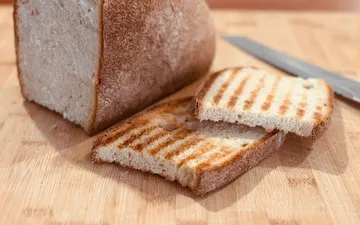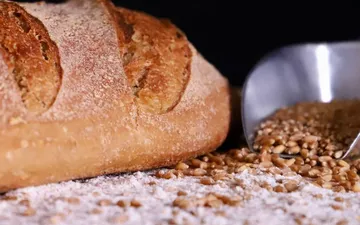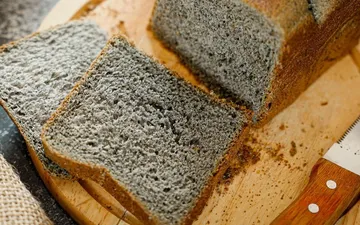
Wheat is a significant source of fructans, one of the fermentable carbohydrates grouped under the FODMAP acronym, and fructans are water-soluble so milling does not remove them. Fermentation can degrade fructans -- by lactic acid bacteria in a sourdough culture and also by baker's yeast, whose invertase activity can be a major determinant. What the research does not support is a clock rule. The extent of reduction depends on grain, microbial strain, temperature, hydration, and the specific process, so elapsed hours are not an interchangeable dose and no home schedule can be assumed to produce a low-FODMAP loaf. Monash testing shows the variability directly: some traditionally fermented wheat and rye sourdoughs remain high FODMAP, while certain tested sourdoughs qualify only at a defined serving size. Only a specific tested product at a tested serving can be called low-FODMAP with confidence. And this is about FODMAPs, not gluten -- fermentation never makes bread appropriate for celiac disease.
Before you buy or bake
- A gluten-free claim is not a wheat-free claim
- These are two different questions and they need two different label checks. Under US rules a food may carry a compliant gluten-free claim and still contain processed wheat starch, provided the finished gluten level is below the regulatory limit and wheat is declared as an allergen. If you are managing a wheat allergy, read the allergen declaration for wheat and follow your allergist’s guidance — a gluten-free claim, certified or not, is not evidence that wheat is absent.
- Get tested before you eliminate gluten
- Celiac testing only works while you are still eating gluten — serology and biopsy both normalize once it is removed, which can produce a false negative and delay a diagnosis by months or years. If you suspect a problem, talk to a doctor while still eating gluten rather than after cutting it out.
Not medical advice. This article explains food science and published research. FODMAP tolerance is highly individual, and dietary management of irritable bowel syndrome should be guided by a qualified healthcare provider or an accredited FODMAP-trained dietitian. Self-diagnosis of digestive symptoms is unreliable.
Bread has an awkward relationship with the low-FODMAP diet. The protocol, developed at Monash University by Sue Shepherd and Peter Gibson, identifies fermentable carbohydrates that commonly trigger symptoms in people with irritable bowel syndrome. Wheat is a meaningful source of fructans — and because fructans are water-soluble, they do not wash out during milling.
So the question bakers get from friends with IBS is reasonable: is any bread workable? There is a real answer here, and it is narrower and less tidy than the version that circulates in baking circles. The short form: fermentation can reduce fructans, but “long-fermented sourdough is low-FODMAP” is not a rule you can apply by the clock.
FODMAPs Are a Class of Carbohydrates, Not a Diet Theory
FODMAP stands for Fermentable Oligosaccharides, Disaccharides, Monosaccharides, and Polyols — short-chain carbohydrates poorly absorbed in the small intestine and then rapidly fermented by bacteria in the large intestine. For most people this is harmless. For people with IBS it can produce gas distension, osmotic water shifts, and significant symptoms.
The Monash low-FODMAP diet is among the most thoroughly studied dietary interventions for IBS. A meta-analysis by Marsh et al. in the European Journal of Nutrition (2016) and subsequent reviews report clinically meaningful symptom reduction in a majority of IBS patients who follow it. The protocol is explicitly not permanent: it runs a restriction phase, a structured reintroduction phase, and a personalization phase built around the individual’s own tolerances.
Wheat’s contribution is primarily fructans — chains of fructose units humans lack the enzymes to digest. They are the “O” in the acronym, and they also occur in rye, barley, onions, and garlic.
What Fermentation Does to Fructans — and What Governs It
Fructans can be metabolized during fermentation. Two corrections to the usual telling matter here.
It is not only lactic acid bacteria. The common claim is that fructan degradation is the work of the lactic acid bacteria in a sourdough culture and that commercial yeast is irrelevant or counterproductive. That is not what the literature shows. Baker’s yeast also degrades wheat fructans, and strain-level invertase activity can be a major determinant of how much is degraded (Laurent et al.; Ispiryan et al.). A yeasted bread is not automatically excluded from fructan reduction, and a sourdough is not automatically included.
Time alone is not a threshold. Time genuinely matters — enzymes and microbes need hours to act, and within any one defined process a longer ferment will generally degrade more fructan than a shorter one. What time does not do is function as a portable dose you can carry between formulas. Targeted sourdough cultures can produce large fructan reductions (Ziegler et al.), but those results come from particular combinations of flour, strain, temperature, hydration, and schedule, and the reduction belongs to that whole system rather than to the clock reading. So the same number of hours in two different kitchens, with two different starters and two different flours, can produce very different results — which is why “ferment it for N hours” cannot be turned into a guarantee, even though fermenting longer is still the right direction within your own process.
This is why this article no longer offers a “24-hour threshold,” a percentage range you can expect, or a home schedule presented as producing a low-FODMAP loaf. Earlier versions of this page did all three. They implied a precision and portability the research does not support, and a reader following a strict protocol could be misled by them.
Monash Testing Shows How Variable the Result Is
The most useful corrective comes from Monash’s own product testing, which measures finished breads rather than inferring from process.
Their guidance makes two points that cut against the folk rule directly. First, some traditionally fermented wheat and rye sourdoughs still test high FODMAP — long fermentation and a traditional method are not sufficient. Second, several sourdoughs that do test acceptably are suitable only at a defined serving size, which means the answer is not “this bread is low-FODMAP” but “this bread, at this portion.”
That is the practical shape of the evidence: a property of a specific tested product at a specific serving, not a property of a category or a technique.
What Can and Cannot Be Concluded About Sourdough and FODMAPs
Where the food chemistry ends and the assumptions begin
| 01Supported | 02Not supported | |
|---|---|---|
| Fructan degradation | Fermentation can degrade wheat fructans | That any long ferment reliably does so |
| Which organisms | Lactic acid bacteria and baker's yeast both degrade fructans; strain invertase activity matters | That commercial yeast works against fructan reduction |
| What governs the result | Grain, strain, temperature, hydration, and process | Elapsed hours as an interchangeable dose |
| A time threshold | Targeted processes have achieved large reductions | A 24-hour rule that reliably produces a low-FODMAP loaf |
| Traditional sourdough | Some tested sourdoughs qualify at a defined serving | That traditional fermentation guarantees it -- some wheat and rye sourdoughs still test high FODMAP |
| Home baking | You can follow a process resembling a tested one | That your loaf is low-FODMAP -- you cannot verify this at home |
| Symptom benefit | Plausible for fructan-sensitive individuals | Demonstrated -- a pilot RCT of long-fermented lower-FODMAP sourdough found no symptom improvement over its comparator |
| Gluten | A separate issue entirely | Any implication of celiac safety -- fermentation never provides this |
Food chemistry and reader outcome are different claims. A measured reduction in a loaf's fructan content does not by itself establish that people feel better eating it.
jayarrbread.comFood Chemistry Is Not the Same as Feeling Better
This distinction deserves its own heading, because it is the one most often skipped.
Almost all the encouraging evidence here concerns fructan content measured in bread. That is a real outcome and the relevant one for FODMAP load. But the question a reader actually cares about is whether eating the bread improves their symptoms, and that requires a different kind of study.
Where such trials exist, they are not uniformly encouraging. A pilot randomized trial of long-fermented, lower-FODMAP sourdough did not find symptom improvement over its comparator. One pilot trial does not settle the question, and it is exactly the sort of result that gets omitted from enthusiastic write-ups. The honest position is that reduced fructans in a loaf is a plausible route to better tolerance for fructan-sensitive people, and that the clinical evidence has not confirmed it.
The Biesiekierski Trial, Read Carefully
The study most often invoked in this area is Biesiekierski et al.’s 2013 crossover trial in Gastroenterology. Self-identified gluten-sensitive patients were stabilized on a low-FODMAP background diet, then challenged with gluten, whey protein, or placebo under blinding. No reproducible, dose-dependent gluten effect emerged.
The correct reading is narrow: gluten was not a reproducible trigger in those patients under a controlled low-FODMAP background. The trial did not directly challenge fructans and therefore does not, by itself, prove fructans caused the symptoms — the popular “it was the FODMAPs, not the gluten” summary is an inference the design does not establish. What it does undercut is the confident assumption that gluten must be the culprit whenever bread causes trouble.
Grain Choice Matters
Fructan content varies across grains. Rye is higher in fructans than wheat per gram, which is one reason some IBS patients tolerate dense rye breads poorly — and, as noted above, Monash testing has found some fermented rye sourdoughs still high in FODMAPs.
Spelt is sometimes tolerated better, though published testing suggests it is only modestly lower in fructans than modern wheat. Einkorn and emmer have been hypothesized to be lower, but the data is mixed and not strong enough to support a tolerance claim. Naturally gluten-free flours such as rice, millet, and oat are generally low in fructans, though whether a given gluten-free bread is low-FODMAP depends on its other ingredients — chicory root inulin, honey, and agave are high-FODMAP additions that appear in some commercial gluten-free breads. Our gluten-free flour guide covers what those flours do structurally.
What a Home Baker Can Reasonably Do
You cannot verify FODMAP content in a home kitchen, and no schedule guarantees a result. What you can do is bake in a way that resembles processes shown to reduce fructans, while being honest that the outcome is unverified.
- Use an active, mature starter and a genuinely extended fermentation rather than a rushed one. Within a given formula, longer and well-fermented is the direction the evidence points — just not a number you can transfer from someone else’s recipe to yours, or treat as a guaranteed outcome.
- Note that adding commercial yeast does not disqualify a loaf from fructan reduction — baker’s yeast degrades fructans too. Use whichever leavening suits your baking.
- Prefer wheat over rye if fructan tolerance is marginal.
- Avoid high-FODMAP inclusions: honey, agave, chicory root fiber, large amounts of dried fruit, onion or garlic. Olive oil, butter, salt, and most seeds are generally low-FODMAP.
- For technique, our autolyse, stretch-and-fold, and shaping guides cover the mechanics, and the Dutch oven guide covers the bake.
If you are following the low-FODMAP protocol properly, none of this substitutes for the app and your dietitian. Introducing an untested home loaf during the restriction or reintroduction phase can corrupt exactly the data the protocol exists to generate.
The Honest Summary
Fermentation can reduce wheat fructans. How much depends on grain, strain, temperature, and process — not on a number of hours. Some tested sourdoughs qualify as low-FODMAP at a defined serving; others, including traditionally fermented ones, do not. Baker’s yeast degrades fructans too. And the step from “less fructan in the loaf” to “this person feels better” has not been reliably demonstrated.
For someone with diagnosed IBS following the Monash protocol, the useful conversation is with their dietitian, about tested products at tested servings and about when in the protocol any new bread belongs. Results vary — and here that is not a hedge, it is the central finding.
Frequently Asked Questions
- Is sourdough low-FODMAP?
- Not as a category. Some specific sourdoughs have tested as low-FODMAP at a defined serving size, and others -- including traditionally fermented wheat and rye sourdoughs -- have tested high. Whether a given loaf qualifies depends on grain, microbial strain, temperature, hydration, and process, none of which you can read off a label or a fermentation time. Only a specific tested product at a tested serving can be called low-FODMAP with confidence, which in practice means an applicable entry in the Monash app.
- How long does sourdough need to ferment to reduce FODMAPs?
- There is no established time threshold, and earlier versions of this article were wrong to suggest one. Fructan degradation depends on which organisms are present and their activity, the grain, temperature, hydration, and the specific process -- so elapsed hours across a levain build, bulk, and cold retard are not an interchangeable dose. Studies reporting large reductions used particular controlled processes; those results describe what a specified process achieved, not a rule you can apply by the clock at home.
- Does adding commercial yeast ruin a low-FODMAP sourdough?
- No, and this is a common misconception that this article previously repeated. Baker's yeast also degrades wheat fructans, and strain-level invertase activity can be a major determinant of how much degradation occurs. A yeasted or mixed-leaven bread is not automatically excluded from fructan reduction, just as a wild-yeast sourdough is not automatically included. The leavening choice is far less decisive than the overall process and the grain.
- Does long fermentation make bread safe for celiac disease?
- No, and this is the most important limit on everything in this article. FODMAP reduction and gluten are separate issues. Fermentation degrades fructans and partially degrades gluten, but it does not reliably bring gluten below the under-20-parts-per-million threshold required for a gluten-free claim. Anyone with celiac disease needs products carrying that claim, regardless of how long a wheat bread was fermented. This article is about digestive tolerance in IBS, not celiac safety.
- Will low-FODMAP sourdough improve my IBS symptoms?
- That has not been reliably demonstrated, and the distinction matters. Most of the encouraging evidence measures fructan content in bread rather than symptoms in people. A pilot randomized trial of long-fermented, lower-FODMAP sourdough did not find symptom improvement over its comparator. Reduced fructans is a plausible route to better tolerance for fructan-sensitive individuals, but plausible is not demonstrated, and individual variation in IBS is large.
- Should I talk to a dietitian before adding sourdough to a low-FODMAP diet?
- Yes. The Monash low-FODMAP diet is a structured three-phase protocol -- restriction, reintroduction, personalization -- and introducing an untested bread mid-phase can confuse the reintroduction data the protocol exists to generate. An accredited FODMAP-trained dietitian can advise whether and when to add any bread and how to test your own tolerance systematically, which matters because IBS shows substantial individual variation.