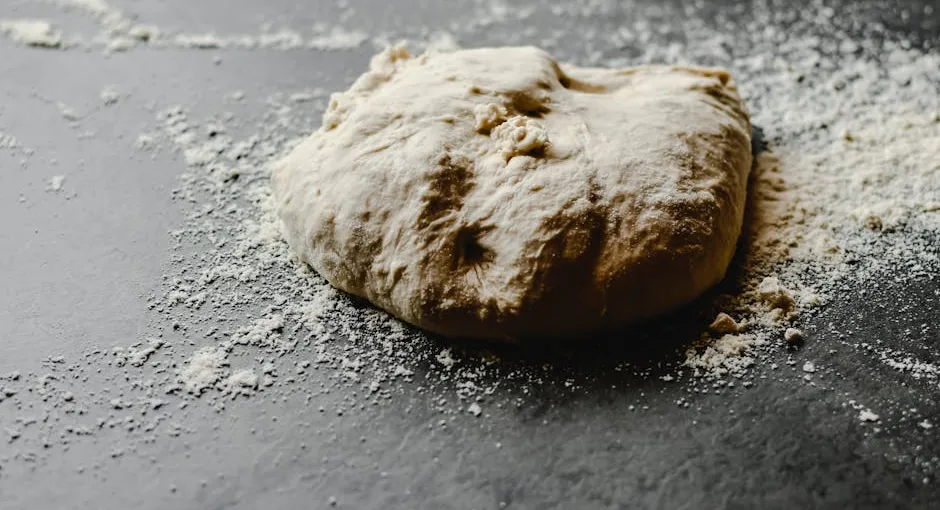
Ken Forkish’s Overnight White Bread is one of the most elegant bread formulas ever published. Four ingredients. No pre-ferment. No sourdough starter. Just flour, water, salt, and a vanishingly small amount of instant yeast — 0.8 grams for a full kilogram of flour. You mix it in the evening, go to sleep, and bake it in the morning.
The trick is the yeast-to-time ratio. Where most yeasted recipes use 1-2% yeast and ferment for 1-3 hours, Forkish uses 0.08% yeast and lets the dough ferment for 12-14 hours at room temperature. That long, slow fermentation produces flavor complexity that rivals sourdough — nutty, wheaty, slightly sweet, with a depth that fast-risen bread can never match.
This recipe is adapted from Flour Water Salt Yeast. If you own one bread book, that should probably be it — check our bread book guide for the full recommendation.
The Formula
| Ingredient | Weight | Baker’s % |
|---|---|---|
| White bread flour | 1,000g | 100% |
| Water (90-95 degrees F / 32-35 degrees C) | 780g | 78% |
| Fine sea salt | 22g | 2.2% |
| Instant dried yeast | 0.8g | 0.08% |
Yield: Two loaves, approximately 900g each.
Why the warm water: Forkish consistently uses warmer water than other bread authors. The target is a final mix temperature of 77-78 degrees F (25-26 degrees C). Warm dough with minimal yeast — that’s the Forkish philosophy. The warmth gives the tiny yeast population a running start, and the long overnight rest gives them time to do their work.
Why 2.2% salt: Forkish runs slightly higher salt than the professional standard of 2%. The extra salt slows fermentation marginally and adds flavor. In a bread this simple, you taste every ingredient. Salt matters.
Why 0.08% Yeast Works
The relationship between yeast quantity and fermentation time is roughly inverse. A normal yeasted bread at 1% instant yeast ferments in about 1.5-2 hours at 75 degrees F. Cut the yeast to 0.08% — roughly 1/12th the amount — and fermentation stretches to 12-14 hours.
During those 12-14 hours, the yeast produces CO2 (leavening) but also ethanol, esters, and organic acids that are the precursors to complex bread flavor. The enzymes in the flour — amylase breaking starch into sugars, protease softening gluten — have hours to work instead of minutes. The result is bread with more Maillard reaction substrates in the crust (darker, more flavorful) and more developed crumb flavor.
Forkish puts it simply: “The only way to find the optimum combination of time and temperature that gives the best flavor and volume in a given recipe is to repeat and adjust based on what you did last time.”
The Timeline
| Time | Step |
|---|---|
| 7:00 PM | Mix dough |
| 7:20 PM | First fold |
| 7:50 PM | Second fold |
| 8:20 PM | Third fold (optional) |
| 8:20 PM - 9:00 AM | Overnight bulk fermentation (sleep) |
| 9:00 AM | Check dough, divide, shape |
| 9:20 AM | Begin proofing |
| 10:00 AM | Preheat oven with Dutch oven |
| 10:45 AM | Bake |
| 11:30 AM | Cool |
Total active time: about 20 minutes. The bread makes itself while you sleep.
Step 1: Mix (7:00 PM)
Pour 780g of warm water (90-95 degrees F) into a 12-quart container or large bowl. Add 0.8g instant yeast. Stir briefly — the yeast doesn’t need to dissolve completely.
Add 1,000g bread flour. Mix by hand using the pincer method: reach under the dough, stretch up, fold over. Rotate the container and repeat. Then squeeze through the dough with your thumb and forefinger, cutting through it 5-6 times, folding over after each pass. Total mixing: 2-4 minutes.
Once the flour is incorporated, let the dough rest for 20 minutes. Then sprinkle the 22g salt over the surface and add a small splash of water to help it dissolve. Pincer-mix again until the salt is fully incorporated — about 1 minute.
Why add salt after the initial mix: This is a short autolyse. The 20-minute rest lets the flour hydrate before salt enters and tightens the gluten. It’s brief but effective.
Step 2: Fold (7:20 - 8:20 PM)
Do 2-3 sets of stretch-and-folds, spaced 30 minutes apart:
- Wet your hand.
- Reach under one side of the dough, stretch it up, fold it over to the opposite side.
- Rotate the container 90 degrees. Repeat on all four sides.
- Flip the entire dough over so the folds are underneath.
Each fold takes about 30 seconds. After the last fold, cover the container and leave it alone. Do not fold during the last hour of bulk fermentation — and here, “the last hour” means the entire overnight rest. Your folding is done for the night.
The folds redistribute yeast and temperature, strengthen the gluten network without oxidizing the dough, and subdivide large gas bubbles into smaller ones for a more even crumb.
Step 3: Overnight Bulk (Sleep)
Leave the covered dough at room temperature. This is the least stressful part of the process.
What’s happening while you sleep: The 0.8g of yeast is slowly working through the flour’s sugars. First the free sugars (glucose, fructose, sucrose), then maltose produced by amylase enzymes breaking down damaged starch. CO2 accumulates. The dough slowly inflates. Protease enzymes gradually soften the gluten, making the dough more extensible. Organic acids develop.
Temperature matters enormously. At 70 degrees F, bulk fermentation might need 15-16 hours. At 78 degrees F, it could be done in 10-11 hours. Forkish designed this recipe for a kitchen around 70-72 degrees F. If your house is warmer, you have two options: use slightly less yeast (0.6g instead of 0.8g) or set an earlier alarm.
Step 4: Check the Dough (Morning)
When you wake up, look at the dough. It should have expanded to 2.5-3 times its original volume. The surface should be bubbly and slightly domed. The dough should feel airy, puffy, and jiggly when you tilt the container.
If it hasn’t expanded much (less than doubled): your kitchen was too cold or your yeast was old. Give it more time — check every hour. If it hasn’t moved after 18 hours, the yeast may be dead. Test your yeast by dissolving a pinch in warm water with a pinch of sugar; if it doesn’t foam in 10 minutes, buy new yeast.
If it’s already deflating (surface is concave, dough is spreading rather than domed): it over-fermented. This happens in warm kitchens. The bread will still be edible but may be slightly sour and have less oven spring. Bake it immediately — the flavor will still be good even if the structure is compromised.
Step 5: Divide and Shape (9:00 AM)
Flour your work surface moderately. Gently ease the dough out of the container — don’t punch it down or degas aggressively.
Using a bench scraper, divide the dough in half (each piece about 890-900g). For each piece:
-
Pre-shape: Using the bench scraper, gently tuck the edges underneath to form a rough round. Let rest 15 minutes under a towel.
-
Final shape (boule): Flip the dough over onto a lightly floured spot. Fold each edge to the center (bottom, left, right, top), creating a package. Flip seam-side down. Cup your hands around the dough and drag it toward you across the counter — the friction tightens the surface. Repeat 2-3 times.
-
Place in banneton: Set the dough seam-side up in a floured proofing basket. If you don’t have bannetons, use a bowl lined with a well-floured kitchen towel.
Forkish shapes seam-side up and does not score — he lets the seams split naturally during baking. This is his signature. If you prefer a more controlled expansion, flip the dough seam-side down into the banneton and score before baking.
Step 6: Proof (9:20 - 10:45 AM)
Cover the bannetons and let the loaves proof at room temperature for about 60-75 minutes. The proofing window for this bread is relatively forgiving — pure levain breads give you hours, but even with commercial yeast, the tiny amount here means the dough evolves slowly.
The poke test: Press a floured finger gently into the dough. If it springs back slowly and partially, leaving a slight indent, it’s ready. If it snaps back immediately, give it 15 more minutes.
While the loaves proof, preheat your Dutch oven inside the oven at 475 degrees F for at least 45 minutes. Forkish is adamant about a long preheat — the Dutch oven needs to be thoroughly saturated with heat.
Step 7: Bake
Carefully remove the hot Dutch oven. Turn one loaf out into it — if baking Forkish-style, seam-side up. If you’ve placed the dough seam-side down in the banneton, it will turn out seam-side up naturally.
If you prefer to score: Flip the loaf so the smooth side is up and make a single decisive slash with a razor blade or lame.
Lid on: 30 minutes at 475 degrees F. The sealed Dutch oven traps steam from the dough, keeping the surface extensible while the loaf springs upward. This is the Dutch oven method at work — the home baker’s steam injection.
Lid off: 15-20 minutes more, until the crust is dark brown. Forkish pushes dark: “I like to bake until there are spots of very dark brown for the full flavors those bits of crust have. At least once, you should try baking a loaf just shy of the point of burning it.”
Remove and cool on a wire rack for at least 20 minutes before slicing. Forkish is less conservative on cooling time than Robertson, but longer is still better — 45-60 minutes gives the crumb time to set fully.
Repeat with the second loaf, reheating the Dutch oven for 10 minutes between bakes.
Lodge 5-Quart Dutch Oven — the best value for Dutch oven bread baking.
What Makes This Bread Special
Three things separate this from a standard white bread:
The crumb. The 78% hydration produces an open, irregular crumb with a mix of small and medium holes. It’s not ciabatta-level wild, but it’s far more interesting than sandwich bread.
The crust. The long fermentation produces more Maillard substrates — amino acids from protease activity, sugars from amylase activity — which means a deeper, more complex crust flavor when baked dark.
The convenience. Mix at 7 PM, fold three times before bed, bake in the morning. No sourdough starter to maintain. No pre-ferment to build the day before. No stand mixer. This is the bread that converts people from buying to baking.
Variations
With whole wheat: Replace 100-200g of the bread flour with whole wheat flour. Increase water by 15-25g (whole wheat absorbs more). The flavor gets earthier and more complex. This is essentially Forkish’s Overnight Country Brown.
As a no-knead bread: This already qualifies — there’s no kneading, just folding. The technique overlaps significantly with the Lahey/Sullivan no-knead method, but Forkish’s version uses less yeast and longer fermentation for better flavor.
With a poolish instead: If you want even more flavor complexity, read about pre-ferments and consider building a poolish the day before. Forkish’s poolish versions are the next step up.
Common Problems
Dough over-fermented overnight. Your kitchen is too warm. Next time, reduce yeast to 0.6g or mix the dough with cooler water (80 degrees F instead of 90 degrees F). Or mix later at night and set an alarm earlier.
Dough barely rose. Your kitchen is too cold, or the yeast is dead. Verify yeast viability with the warm-water-and-sugar test. Move the dough to a warmer spot — the oven with just the light on often holds 78-80 degrees F.
Bread is flat with no oven spring. Over-proofed during the 60-75 minute proof, or the Dutch oven wasn’t hot enough. Preheat for the full 45 minutes.
Bottom of the loaf burned. Reduce oven temperature to 450 degrees F or place a baking sheet on the rack below the Dutch oven as a heat shield. You can also place the Dutch oven on a baking stone or steel.
The crumb is gummy. Either under-baked (extend baking time by 5 minutes) or you cut into it too soon. Give it a full hour on the cooling rack.
For more troubleshooting, see Why Is My Bread Dense?.
Frequently Asked Questions
- Can I use active dry yeast instead of instant for overnight bread?
- Yes, but dissolve it in the warm water first and use slightly more — multiply the instant yeast amount by 1.25 (so 1.0g active dry instead of 0.8g instant). Active dry yeast has a protective coating that needs to dissolve before it activates. Instant yeast can be mixed directly into the flour. Both produce the same result once active.
- What if my kitchen is cold — will overnight bread still work at 65°F?
- It will work, but fermentation will be slower. At 65°F, expect 16-18 hours instead of 12-14. You can compensate by using slightly warmer water (95°F) or bumping the yeast to 1.0g. Alternatively, mix earlier in the evening. The dough is forgiving — a few extra hours at a cool temperature won't hurt it, though much beyond 18 hours risks protease degradation (slack, soupy dough).
- How do I know when overnight bread dough is ready in the morning?
- Look for 2.5-3 times volume expansion, a bubbly surface that's still slightly domed (not deflating), and a jiggly, airy feel when you tilt the container. If the surface is concave and the dough is spreading rather than rising, it has over-fermented — bake immediately. If it hasn't at least doubled, give it more time and check every 30-60 minutes.
- Is overnight white bread the same as no-knead bread?
- They overlap heavily. Both use minimal yeast, long fermentation, no mechanical kneading, and a Dutch oven. Forkish's Overnight White uses 0.08% yeast at 78% hydration with 2-3 folds. The classic Lahey no-knead (popularized by Jim Lahey and Mark Bittman) uses about 0.25% yeast at 70% hydration with zero folds. Forkish's version produces a more open crumb and more complex flavor due to higher hydration and even less yeast.