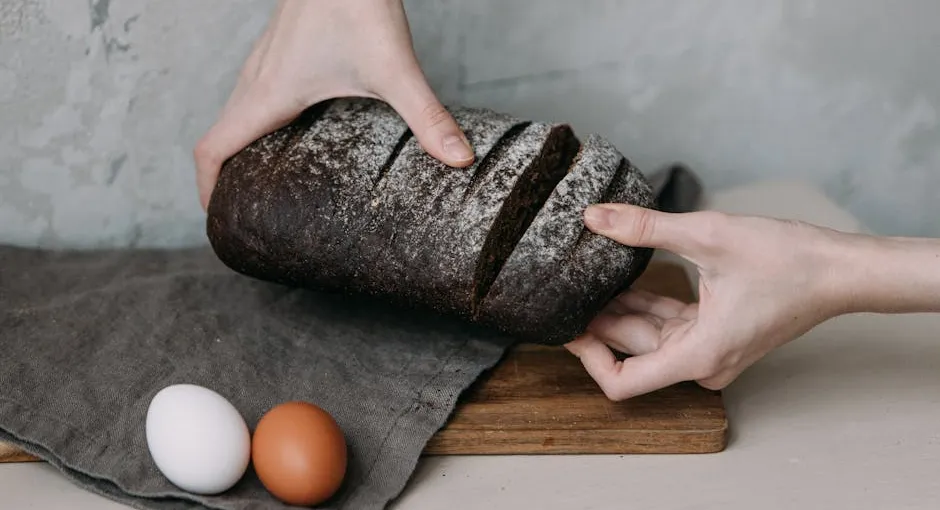
Rye is the misunderstood grain of bread baking. It plays by different rules than wheat, and most home bakers who attempt it without understanding those rules end up with a sticky, gummy disaster. The issue isn’t skill. It’s chemistry. Rye flour contains almost no gluten-forming proteins, absorbs water aggressively, and has enzyme activity that can turn your loaf into paste if left unchecked. But when you work with rye’s nature instead of against it, you get bread with a depth of flavor that wheat alone cannot touch.
Jeffrey Hamelman — the undisputed authority on rye baking in the English-speaking world — devoted more pages to rye than any other grain in Bread. This guide draws heavily from his work.
Why Rye Is Different from Wheat
Rye flour lacks the glutenin and gliadin proteins that form the elastic gluten network in wheat bread. Instead, rye’s structure comes from pentosans — water-binding carbohydrates that form a gel when hydrated. This gel gives rye dough its characteristic sticky, paste-like consistency.
Water absorption: Rye flour absorbs water aggressively and continues absorbing throughout mixing.
Amylase activity: Rye has naturally high alpha-amylase levels. Excessive amylase activity during baking converts too much starch into dextrins, producing a gummy, wet interior that never sets properly.
Gelatinization temperature: Rye starch begins gelatinizing at lower temperatures than wheat (starting around 122-140 degrees F versus 140-158 degrees F for wheat). This means rye starch is vulnerable to enzyme attack for longer during the bake.
The solution to all three problems is the same: acidification. Sourdough culture produces lactic and acetic acids that lower the pH of the dough, which inhibits amylase activity and stabilizes pentosan gels. This is why traditional rye bread is always sourdough — it’s not a flavor preference, it’s a structural necessity.
The Rye Percentage Spectrum
Sourdough for Rye: Non-Negotiable
You can make a passable 20% rye bread with commercial yeast. But once rye exceeds 30-40% of the total flour, sourdough becomes essential. The acid environment controls amylase activity and prevents the gummy crumb that plagues non-acidified rye loaves.
Hamelman maintains a rye sourdough culture with minimal effort: just 20g of whole-rye flour per day. “Rye cultures are robust.”
For most rye breads, a simple single-stage rye sour works well: mix rye flour, water, and mature culture at roughly 100% hydration, ferment at 75-80 degrees F for 12-16 hours.
The Detmolder Three-Phase Method
This is the gold standard for rye sourdough production. Three sequential builds, each optimizing a different aspect of flavor and fermentation:
Mixing Rye Dough
Forget what you know about mixing wheat dough. As rye increases, mixing time on second speed decreases. At 70-90% rye, Hamelman recommends 6-8 minutes on first speed only — no second speed at all. At 100% rye, 10-12 minutes on first speed. There’s no gluten to develop, so high-speed mixing just generates heat and breaks down the pentosan gel.
Shaping Rye
Up to 40% rye: Shape normally on a lightly floured surface.
40-70% rye: Switch to wet hands. Do not use flour on the work surface — it creates a slippery layer that prevents any surface tension from forming. Water gives you traction against the sticky dough.
70%+ rye: Shape with wet hands and place the loaf seam-up into a heavily floured banneton. When you invert it for baking, the seam is on the bottom.
For very high rye (90-100%), use a Pullman pan. The dough is too weak to hold a freestanding shape. Dock the surface — don’t try to score with a blade.
Baking Rye Bread
High-rye breads (80%+): Start at 480-535 degrees F, then reduce to 410 degrees F after the initial spring. The high initial temperature drives rapid starch gelatinization, which sets the structure before amylase can do too much damage.
Important steam exception: High-rye breads blister when exposed to heavy steam. Vent early — within the first 5-10 minutes.
The resting requirement is not optional. A 66% rye loaf needs 12 hours. An 80% rye needs at least 24 hours. A 100% Vollkornbrot needs 48-72 hours. Cutting early produces a gummy interior that has nothing to do with under-baking — the crumb simply hasn’t finished its structural transformation.
Five Rye Styles to Try
40% Rye — Marble Rye or Light Rye: The entry point. Real rye flavor with wheat-like handling.
66% Rye — German Mischbrot: The workhorse of German bakeries. Dense, moist, pronounced sour tang.
80% Rye — Schuster Laib: Peasant bread with deep, complex flavor. 24-hour rest before slicing.
90% Rye — Detmolder Landbrot: Where the three-phase method truly shines.
100% Rye — Vollkornbrot: No wheat at all. Pan bread, 60-90 minutes bake time, 48-72 hour rest. A properly made Vollkornbrot keeps for a week at room temperature and develops deeper flavor as it ages.
Common Rye Mistakes
Using commercial yeast without sourdough above 30% rye. Without acidification, amylase runs wild. The result is invariably gummy.
Treating rye like wheat. Over-mixing, over-folding, long bulk fermentation — all the things that improve wheat bread will damage rye bread.
Cutting too early. This is the most common home baker rye failure. Wait the full resting time.
Using dry flour for shaping. Flour creates a slip layer. Wet hands give you grip and traction.
If rye bread is new to you, start with the 40% formulation. It requires no special technique beyond building a rye sourdough starter. Hamelman’s Bread contains over a dozen rye formulas. For baker’s percentage conversions and formula scaling, the Baker’s Bench tool handles rye-wheat blends.
Frequently Asked Questions
- Why is my rye bread gummy inside?
- Two possible causes: you sliced it too soon, or the dough wasn't properly acidified. High-rye breads (60%+) need 12-72 hours of rest after baking before the crumb finishes setting. Without sufficient sourdough acid, rye's high amylase activity converts starch to dextrins during baking, producing a permanently gummy interior.
- Do I need sourdough for rye bread?
- For breads with more than about 30-40% rye flour, yes. Sourdough acidification is a structural necessity, not just a flavor choice. The low pH controls amylase activity that would otherwise produce a gummy crumb. Below 30% rye, the wheat flour provides enough structure that commercial yeast works fine.
- How long should I wait before slicing rye bread?
- It depends on the rye percentage. A 40% rye loaf can be sliced the same day after standard cooling. At 66% rye, wait 12 hours. At 80% rye, 24 hours minimum. At 100% rye (Vollkornbrot), Hamelman recommends 48-72 hours.
- Why do you shape rye with wet hands instead of flour?
- Rye dough is extremely sticky, and flour creates a slippery layer between your hands and the dough that prevents you from building any surface tension. Water gives you traction -- it bonds with the wet dough surface instead of sliding over it.
- What is the Detmolder method?
- The Detmolder three-phase method is a German technique for building rye sourdough that maximizes flavor complexity. Three sequential builds -- a wet, warm freshening phase (5-6 hours), a stiff basic sour (15-24 hours) that develops acetic acid tang, and a final warm, wet ripening (3-4 hours) that rounds the flavor with lactic acid. Total time is 24-30 hours.