Babka is an enriched dough (20% butter, eggs, sugar, milk) rolled thin, spread with chocolate filling, rolled into a log, cut lengthwise to expose the layers, and twisted into a braided shape. The cold dough is essential -- warm dough tears and sticks. After baking, brush with simple syrup while hot for moisture and shelf life.
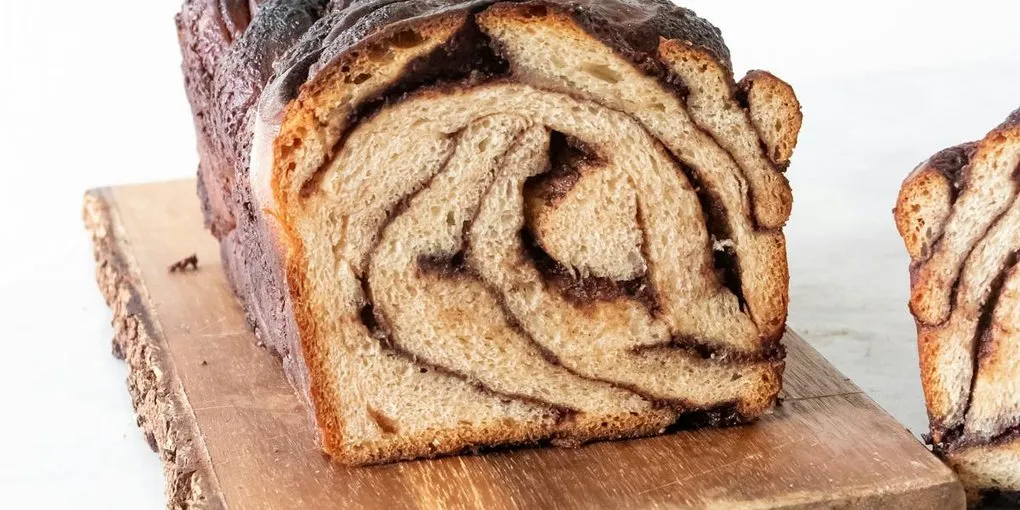
Babka is a brioche-like enriched dough filled with chocolate, rolled, sliced lengthwise, twisted, and baked in a loaf pan. When you cut into a properly made babka, you see dozens of thin, swirled layers of chocolate and butter-rich bread — it looks like a geological formation, striated and dramatic. It’s one of the most visually impressive breads you can make at home, and it tastes as good as it looks.
The technique is what makes babka special. The dough itself is a standard enriched sweet dough — eggs, butter, sugar, milk. The magic happens during shaping: rolling the dough thin, spreading a thick layer of chocolate filling, rolling it into a tight log, cutting that log in half lengthwise to expose the layers, then twisting the two halves around each other. It sounds complicated. It’s not, once you understand the steps. But it does require cold dough and a willingness to get your hands messy.
The Dough
Babka uses an enriched dough in the same family as brioche. The same principles apply: fat inhibits gluten development, so you compensate with longer mixing, cold ingredients, and a stand mixer.
Baker’s Percentages
- Bread flour: 100% (500g)
- Whole milk (cold): 30% (150g)
- Eggs (cold): 20% (2 large eggs, ~100g)
- Butter (cold): 20% (100g)
- Sugar: 15% (75g)
- Salt: 1.8% (9g)
- Instant yeast: 2% (10g)
- Vanilla extract: 1 tsp
This is moderately enriched — richer than sandwich bread, less extreme than full brioche. At 20% butter (vs. brioche’s 50%), the dough is easier to handle and develops gluten more readily. You still need a stand mixer, but the mixing time is shorter.
Mixing
-
Combine flour, milk, eggs, sugar, salt, yeast, and vanilla in a stand mixer with the dough hook. Mix on low speed for 3 minutes to incorporate.
-
Increase to medium speed (4-6 on a KitchenAid) and mix for 6-8 minutes. The dough should become smooth and elastic, pulling from the sides of the bowl. At 20% butter enrichment, gluten develops faster than brioche — you should see a reasonable windowpane within this window.
-
Add the cold butter in tablespoon-sized pieces, one at a time, on medium-low speed. Wait until each piece is mostly absorbed before adding the next. This takes 4-5 minutes.
-
Once all butter is incorporated, increase to medium speed for 2-3 minutes. The dough should be smooth, supple, and slightly sticky. It will slap against the bowl sides.
Total mixing time: approximately 15 minutes. Cold ingredients are essential — the mixer generates friction heat (a planetary mixer adds 24-28°F of friction during mixing, per Hamelman), and warm butter melts and smears rather than being mechanically dispersed through the gluten network.
Try It Yourself
The Baker's Bench
Scale the babka dough formula up or down with the Baker's Bench tool -- it handles enriched dough percentages and calculates egg and butter weights.
Open ToolBulk Fermentation and Cold Retard
Transfer the dough to a lightly oiled bowl, cover tightly with plastic wrap, and ferment at room temperature for 1-1.5 hours until about 50% larger. The sugar and fat slow fermentation compared to lean dough.
Then refrigerate for a minimum of 4 hours, preferably overnight. This cold retard is essential — it firms the butter in the dough, making it rollable and shapeable. Warm babka dough is a soft, sticky disaster that tears when you try to roll it thin. Cold babka dough handles like modeling clay.
The Chocolate Filling
Good chocolate is the difference between memorable babka and mediocre babka. Use actual chocolate — bars or chips of semisweet or bittersweet chocolate (60-70% cacao). Do not use cocoa powder as the primary filling. Cocoa powder produces a dry, grainy filling that doesn’t have the melt or richness of real chocolate.
Chocolate Filling Recipe
- Semisweet or bittersweet chocolate: 170g (6 oz), finely chopped
- Butter: 60g (4 tbsp)
- Powdered sugar: 30g (1/4 cup)
- Cocoa powder: 15g (2 tbsp) — for depth, not as the base
- Pinch of salt
Melt the chocolate and butter together in a double boiler or microwave (30-second bursts, stirring between). Remove from heat, stir in the powdered sugar, cocoa powder, and salt. Let cool until spreadable but not set — you want it thick enough to stay put when spread on the dough, but soft enough to spread evenly. Room temperature is usually right. If it firms up too much, microwave for 10 seconds.
Shaping: The Heart of Babka
This is a multi-step process. Read through all the steps before starting, and have your loaf pan greased and ready.
Babka Shaping: Roll, Fill, Cut, Twist
The 7 steps that create those dramatic chocolate layers
- 01
Roll the Dough
Roll cold dough into an 18 x 12 inch rectangle, about 1/4 inch thick. Thinner = more visible layers.
If dough springs back, rest 5 min. If it gets warm and sticky, refrigerate 15 min.
- 02
Spread Chocolate
Offset spatula, edge to edge, about 1/8 inch thick. Use nearly all the filling -- don't be stingy.
- 03
Roll Into a Log
Start from one long edge, roll tightly with even tension. Each turn compresses against the previous one.
- 04
Chill the Log
Wrap in plastic, freeze 15-20 min. Firm dough cuts cleanly. Warm dough smears.
- 05
Cut Lengthwise
Sharp chef's knife, one decisive cut from end to end. Two halves with exposed chocolate layers.
Don't saw -- one smooth motion. Sawing drags the layers.
- 06
Twist
Lay halves side by side, cut sides up. Cross one over the other 3-4 times. Keep cut sides facing up.
- 07
Pan It
Gently lift into greased 9x5 loaf pan. Tuck ends under. It'll look chaotic -- that's correct.
The cold dough is everything. If the dough warms up at any point, stop and refrigerate. You cannot shape babka with warm dough.
jayarrbread.comStep 1: Roll Out the Dough
Remove the cold dough from the refrigerator. On a lightly floured surface, roll it into a large rectangle — approximately 18 inches long by 12 inches wide, about 1/4 inch thick. Work quickly while the dough is cold. If it starts to warm up and get sticky, slide it onto a sheet pan and refrigerate for 15 minutes.
The thinness matters. Thinner dough means more visible layers in the finished babka. If the dough keeps springing back, let it rest for 5 minutes to relax the gluten, then continue rolling.
Step 2: Spread the Chocolate
Using an offset spatula, spread the chocolate filling evenly over the entire surface of the dough, edge to edge. Don’t leave borders — unlike cinnamon rolls, babka gets cut open, so you want filling everywhere. Spread it about 1/8 inch thick. You’ll use most or all of the filling.
Step 3: Roll Into a Log
Starting from one long edge, roll the dough into a tight log. Each turn should compress slightly against the previous one. Roll with even tension — if one end is tighter than the other, you’ll get uneven layers.
Step 4: Chill the Log (Optional but Recommended)
If the log feels soft or warm, wrap it in plastic and freeze for 15-20 minutes. The next step involves cutting through the log lengthwise, and this is dramatically easier when the dough is firm. This short freeze firms the chocolate and the dough without freezing them solid.
Step 5: Cut Lengthwise
Using a sharp chef’s knife (not serrated), cut the log in half lengthwise, from end to end. You now have two long halves, each with the chocolate layers exposed. This looks dramatic and messy — chocolate is everywhere. That’s correct.
Step 6: Twist
Lay the two halves side by side, cut sides facing up. Cross one over the other, then cross again, then again — twisting them into a rope-like braid with the layers exposed. Try to keep the cut sides facing up as much as possible throughout the twist. Tuck the ends under.
Step 7: Place in Pan
Gently lift the twisted babka and place it in a greased 9x5-inch loaf pan. It will look rough and chaotic. This is fine — the proof and bake smooth everything out, and the exposed chocolate layers become the babka’s signature marbled appearance.
For more detailed guidance on bread shaping techniques, that article covers the fundamentals of surface tension and working with enriched doughs.
Proofing
Cover the pan loosely and proof at room temperature (72-75°F) for 1.5-2 hours. The dough should rise to just above the rim of the pan and look puffy. The poke test applies: press gently with a floured finger. When the indent springs back slowly and partially, it’s ready.
Enriched doughs have a narrower proofing window than lean bread — the fat weakens the gluten network. Over-proofed babka collapses in the oven, and the layers smear together instead of staying distinct. When in doubt, bake sooner rather than later.
Baking
Bake at 350°F (177°C) for 35-40 minutes. Babka bakes at a lower temperature than most enriched breads (which go at 380°F per Hamelman) because the chocolate filling burns easily at higher temps, and the sugar in both the dough and filling promotes rapid browning.
The crust should be deep golden brown. If the top browns too fast, tent loosely with foil after 25 minutes. Internal temperature should reach 185-190°F — use a probe thermometer inserted into the bread portion, not the chocolate filling.
The Simple Syrup Soak
This step separates good babka from great babka. Immediately after baking, while the bread is still hot, brush the top generously with simple syrup.
Simple Syrup
- 100g sugar
- 100g water
- 1 tsp vanilla extract (optional)
Combine sugar and water in a small saucepan. Heat until the sugar dissolves. Remove from heat and add vanilla if using. Brush or spoon over the hot babka — the bread absorbs it instantly. Use all of it. Don’t be shy.
The syrup serves two purposes: it adds sweetness and moisture to the crust layer (which tends to dry out from the high baking heat), and it extends the shelf life by keeping the surface soft. Professional bakeries always soak their babka. Skip this step and your babka will taste drier and less finished.
Cooling
Let the babka cool in the pan for 20 minutes, then carefully turn it out onto a wire rack. Cool completely — at least 1 hour — before slicing. The chocolate filling is molten when it comes out of the oven and needs time to set slightly. Cutting into hot babka sends chocolate flowing everywhere and the layers collapse.
Use a sharp serrated knife. Slice about 3/4 inch thick to show off the marbled layers.
Variations
Cinnamon-Sugar Babka
Replace the chocolate filling with: 60g melted butter + 100g brown sugar + 2 tablespoons cinnamon + pinch of salt. Spread and shape exactly the same way. Cinnamon babka is arguably the classic version in Jewish bakery tradition and has a more understated sweetness.
Nutella Babka
Spread a jar of Nutella (about 250g) directly onto the rolled dough. It’s already the perfect consistency for babka filling — thick enough to stay put, spreadable enough for even coverage. This is the quickest route to chocolate babka if you don’t want to make filling from scratch. It’s sweeter and less complex than the from-scratch version, but it works.
Halva Babka
Crumble 200g of tahini halva over the chocolate-spread dough before rolling. The halva adds a nutty, sesame-rich dimension and creates pockets of crumbly sweetness within the chocolate layers. This is a contemporary Israeli variation that has gained a following for good reason.
Making Two Babkas
This recipe produces enough dough and filling for one generous loaf. If you’re making the effort (and you should — the dough needs a stand mixer and an overnight chill regardless), double everything and make two. Babka freezes beautifully: wrap the cooled, syruped loaf tightly in plastic and foil. It keeps frozen for 2-3 months. Thaw at room temperature, still wrapped, and it emerges nearly as good as fresh.
Two babkas also lets you make one chocolate and one cinnamon-sugar, which is the ideal approach for a gift, a brunch, or settling the eternal chocolate-vs-cinnamon debate.
A Note on the Stand Mixer
At 20% butter, this dough is on the manageable end of enriched bread. You could theoretically hand-mix it using an extended slap-and-fold technique, but I wouldn’t recommend it. The butter incorporation is significantly easier with a machine, and the cold temperature management during mixing matters — your hands warm the dough faster than a metal hook does. A KitchenAid Artisan or equivalent handles this dough without complaint. Watch the dough temperature and don’t let it climb above 77°F during mixing.
Why Babka Fails
Dough too warm during shaping. The single most common failure. Warm dough sticks to everything, tears when rolled thin, and loses its layers. Cold dough is non-negotiable. If at any point the dough softens, stop and refrigerate for 15-20 minutes.
Filling too thin. A stingy chocolate layer produces babka that’s mostly bread with thin veins of chocolate. Spread generously — 1/8 inch thick across the entire surface. You should use nearly all the filling recipe.
Under-twisted. If the two halves aren’t twisted enough, you get a loaf with two distinct chocolate zones instead of the swirled, marbled pattern. Aim for 3-4 full crosses during the twist.
No simple syrup. Without the soak, the crust layer is dry and the overall sweetness is off. This is a finishing step, not an optional garnish.
Over-proofed. The layers smear together and the loaf collapses. Enriched dough over-proofs easily. Watch the poke test and bake promptly.
For broader troubleshooting of enriched doughs, the bread troubleshooting guide covers most failure modes, and bread storage and freshness explains why babka should never go in the refrigerator — the 2-4°C range accelerates starch retrogradation faster than room temperature.
Frequently Asked Questions
- Can I make babka with store-bought brioche dough or pizza dough?
- Store-bought brioche dough can work in a pinch -- it has the enrichment level (butter, eggs, sugar) that babka needs. The texture won't be identical to from-scratch because commercial dough has stabilizers and preservatives, but it will produce a recognizable babka. Pizza dough is a poor substitute -- it's lean (no butter, no eggs, no sugar), which means the layers won't be tender and the flavor will be flat. If you're going to shortcut the dough, use brioche or a rich sweet dough, not lean bread dough.
- How do I store babka, and how long does it keep?
- Babka keeps well for 3-4 days at room temperature, wrapped tightly in plastic wrap. The enrichment (butter, eggs, sugar) and the simple syrup soak both slow staling. Do not refrigerate -- the refrigerator temperature accelerates starch retrogradation, which is the crystallization process that makes bread firm and stale. For longer storage, slice the babka, wrap slices individually in plastic and foil, and freeze. Thaw at room temperature or toast directly from frozen. Frozen babka keeps for 2-3 months.
- My babka layers came out blobby instead of marbled. What happened?
- Three common causes: (1) the dough wasn't rolled thin enough -- aim for 1/4 inch or thinner for visible layering; (2) the log wasn't cut cleanly in half -- use a sharp chef's knife, not serrated, and chill the log first so it cuts cleanly; (3) the twist wasn't tight enough or the cut sides weren't kept facing up during the twist. The exposed chocolate layers are what create the marbled effect when viewed in cross-section.
- Is there a dairy-free version of babka?
- Replace the butter in the dough with refined coconut oil (same weight -- 100g) and use oat milk or almond milk instead of cow's milk. For the chocolate filling, use dairy-free chocolate (many 70%+ dark chocolates are naturally dairy-free) melted with coconut oil instead of butter. The texture will be slightly different -- coconut oil is fully solid when cold and fully liquid when warm, without butter's gradual softening -- but the result is still a rich, layered babka. The simple syrup is already dairy-free.
- Can I make babka ahead and reheat it?
- Yes, and it reheats beautifully. Bake, cool, wrap tightly, and store at room temperature for up to 2 days. When ready to serve, unwrap, place on a sheet pan, and warm in a 300°F oven for 10-12 minutes. The chocolate filling re-softens slightly and the crust crisps up. You can also slice and toast individual pieces in a toaster oven -- the chocolate gets slightly melty and the edges caramelize. Avoid microwaving, which makes the bread rubbery and the chocolate unevenly hot.