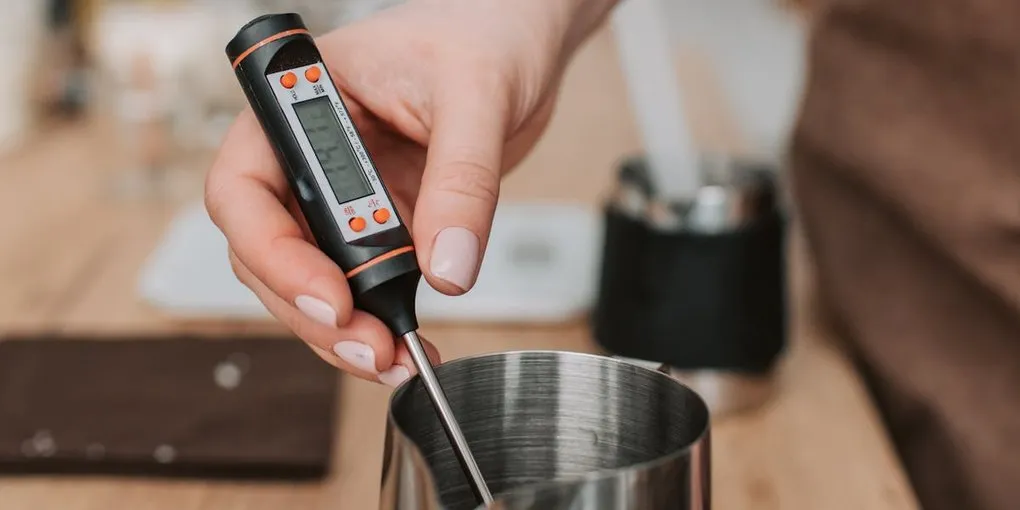
The ThermoWorks Thermapen ONE ($99-109) is the best instant-read thermometer for bread baking — 1-second read, plus or minus 0.5 degrees Fahrenheit accuracy, IP67 waterproof, 5-year warranty. For best value, the Lavatools Javelin PRO Duo ($45-65) delivers 2-3 second reads at plus or minus 0.9 degrees Fahrenheit. Aim for at least plus or minus 0.9 degrees Fahrenheit accuracy and a 4-inch or longer probe. You need it for desired dough temperature math and for internal-doneness checks at 200-210 degrees Fahrenheit on lean loaves.
Why Bread Bakers Need a Fast, Accurate Thermometer
Bread baking is chemistry, and chemistry obeys temperature. A bread thermometer does three jobs: it measures water temperature for desired dough temperature calculations, it tracks dough temperature after mixing, and it confirms doneness when you check the internal temperature of a finished loaf. In all three jobs, the tolerance is about one degree Fahrenheit — and the difference between a mediocre thermometer and a good one is whether you can measure that tolerance quickly enough to do something about it.
The desired dough temperature formula — water temp equals DDT times 3 or 4 minus the sum of air, flour, preferment, and friction factors — only works if your inputs are accurate. If your flour thermometer is off by four degrees, your dough comes out four degrees off target, and your bulk fermentation runs fast or slow enough to ruin the crumb. A good digital thermometer with plus-or-minus 0.5°F accuracy turns DDT math from guesswork into engineering.
The same thermometer tells you when the loaf is done. Standard artisan bread reaches 200-210°F internal at doneness; Robertson pulls his Tartine country loaves at 212°F for a thoroughly set crumb; enriched breads come out earlier at 185-190°F. Without the thermometer, you are guessing — and as our how to tell when bread is done guide documents, guessing is what Chad Robertson identifies as the most common home-baker error.
What to Look For
A bread thermometer buying decision comes down to five factors that matter and a few that do not.
Accuracy. Published spec should be plus-or-minus 0.9°F or better. The Thermapen ONE claims plus-or-minus 0.5°F — the gold standard. Cheap thermometers drift by 3-5 degrees, which is unacceptable for DDT work where the formula’s whole purpose is to hit a target dough temperature within 1-2 degrees.
Speed. A “one-second read” thermometer (Thermapen ONE) settles in about 1 second. The Lavatools Javelin PRO Duo settles in 2-3 seconds. The RT600C takes 5-6 seconds. Cheap generic models take 8-15. Speed matters most when you are probing a 450°F oven or a quickly-cooling loaf; the slower the read, the more the probe pulls heat out of the sample and the further your reading drifts from the true internal temperature.
Probe length. At least 4 inches. Anything shorter and you cannot safely reach the center of a tall boule or push past a hot crust without burning fingers. 4.5 inches is the practical minimum for artisan loaves.
Waterproof rating. Baking is a wet environment — sticky dough, wet hands from washing, the occasional rinse under the tap. IP65 means splash-resistant; IP67 means submersion to one meter for 30 minutes. Either is enough for kitchen use; unrated thermometers fail when battery compartments corrode.
Calibration. The ability to calibrate against ice water (32°F) and boiling water (212°F at sea level) matters. Good thermometers let you re-zero; bad ones drift and cannot be corrected.
Top Picks
ThermoWorks Thermapen ONE — Editor’s Choice
ThermoWorks Thermapen ONEThe Thermapen ONE is the professional standard. Plus-or-minus 0.5°F accuracy with a NIST-traceable calibration certificate, full reading in 1 second, 4.5-inch rotating probe, 360° auto-rotating backlit display with motion-sensing power management, IP67 waterproofing rated to 30 seconds at 39 inches, 2,000-hour battery life on a single AAA, and a 5-year warranty. Each unit is hand-crafted in Worthing, England by Electronic Temperature Instruments (ETI), with engineering and US support from ThermoWorks in American Fork, Utah.
This is the thermometer that appears on every bread baker’s toolbench from Tartine to your local sourdough hobbyist. The price — about $109 at ThermoWorks, often $115 on Amazon — is the highest on this list, but for a daily-use baking tool that lasts ten years, the math works.
Who it is for: the baker who measures water temp for every mix, checks internal doneness on every loaf, and wants the thermometer to be a non-issue. After you own one, you stop thinking about thermometry at all.
Pros: Class-leading speed and 0.5°F accuracy with NIST cert. Rotating probe and 360° auto-rotating display. IP67 waterproof, shockproof, and dustproof. Long battery life. 5-year warranty. UK-built with US support.
Cons: Expensive. The 0.5°F accuracy is more than most home bakers strictly need. No Bluetooth on the standard model — the separate Thermapen ONE Blue or ThermoWorks DOT covers that use case.
Bottom line: The last thermometer you will ever buy if you bake bread regularly.
Lavatools Javelin PRO Duo — Best Value
Lavatools Javelin PRO DuoLavatools is the upstart brand that brings Thermapen-adjacent performance to a mid-range price. The Javelin PRO Duo reads in 2-3 seconds, the published accuracy spec is plus-or-minus 0.9°F across the food-relevant range (-4°F to 302°F), the probe is 4.5 inches, and the large 2-inch ambidextrous backlit display auto-rotates regardless of how you grip it. Battery life is 4,000+ hours on a single CR2032 with motion-activated wake. IP65 splash resistance, NSF certified, 3-year warranty. Direct-from-Lavatools price is $49.99; Amazon sometimes runs $45-65 depending on color.
Who it is for: the baker who wants 90% of Thermapen performance at half the price. For most home bakers, the Javelin PRO Duo is all the thermometer you actually need.
Pros: Fast and accurate for the price. Auto-rotating display with stabilization alert. IP65 splash resistant. Excellent 4,000+ hour battery life. NSF certified. 3-year warranty.
Cons: 2-3 second read is a real step down from the Thermapen’s 1 second when you’re probing a hot oven. 0.9°F accuracy versus the Thermapen’s 0.5°F — the difference is real though small. IP65 (splash) versus IP67 (submersion) — fine for kitchen use, less rugged for outdoor BBQ duty.
Bottom line: The smart-money pick if $109 feels like too much for a thermometer.
ThermoWorks DOT — Best for Leave-In Oven Use
ThermoWorks DOTThe DOT is ThermoWorks’s leave-in, probe-on-a-cable thermometer. You insert the 4.5-inch Pro-Series probe into the loaf, thread the 47-inch silicone cable out the oven door, and watch the internal temperature rise in real time without opening the oven. The probe handles temperatures up to 572°F; the cable jacket is rated to 700°F so it survives broiling. Accuracy is plus-or-minus 1.8°F across most of the range (-4°F to 248°F), with wider tolerances at the extremes. IP65 splash-resistant housing, mountable on metal surfaces with strong magnets or via kickstand, and the alarm beeps when your target temperature is reached. Up to 5,000 hours of battery life on two AAA batteries. Price is usually $58-60 at ThermoWorks and authorized retailers.
For bread bakers this is less critical than for roasting meat — a finished loaf cools quickly enough to spot-check once at the finish — but for anyone who bakes rye or Pullman loaves where the difference between 195°F and 208°F matters, a DOT gives you early warning. It is also useful for tracking the internal-temperature curve of a new loaf style so you learn its rhythm.
Who it is for: the baker who also roasts and grills, or who wants to learn the internal temperature curve of their favorite loaves without opening the oven repeatedly.
Pros: Leave-in capability rare in this price range. Cable probe handles oven heat (silicone-insulated, rated to 700°F at the cable). Programmable temperature alarm. Excellent 5,000-hour battery life on 2 AAA cells.
Cons: Not an instant-read — you still need a probe-style thermometer for water temp and spot-checks. Cables get in the way in a tight kitchen. Plus-or-minus 1.8°F accuracy is adequate for doneness but not precision-grade for DDT.
Bottom line: A complement to an instant-read, not a replacement for one.
ThermoWorks RT600C — Best Entry-Level from a Trusted Brand
ThermoWorks RT600CThe RT600C is the budget pocket thermometer from the same company that makes the Thermapen. Plus-or-minus 0.9°F accuracy across the food-relevant 14-212°F range (drops to plus-or-minus 2.7°F outside that band), 5-6 second response time, 4.7-inch folding probe, IP65 splash-resistant housing, 5,000-hour battery life, and auto-shutoff after one hour to protect the battery. Range is -40°F to 302°F. Price is usually $19-25 — it is half the price of the Javelin PRO Duo and a quarter of the Thermapen ONE.
Who it is for: the beginning baker who wants a thermometer from a reputable brand without committing to a premium model.
Pros: ThermoWorks build quality at a low price. Plus-or-minus 0.9°F accuracy in the food range — actually better than the DOT in that band. IP65 splash resistant. 4.7-inch probe is longer than most pocket thermometers. Auto-shutoff and excellent 5,000-hour battery life.
Cons: 5-6 second read is slow enough to be noticeable when you’re rushing. Accuracy degrades to plus-or-minus 2.7°F outside the 14-212°F window — fine for kitchen use, less useful for BBQ smoking. No backlight. Warranty terms vary by retailer (1-2 years typical).
Bottom line: A respectable starter thermometer that punches above its price. Upgrade to the Javelin PRO Duo or Thermapen ONE when you decide bread is a serious hobby.
Generic Digital Instant-Read — Only If You Must
Generic Digital Instant-Read ThermometerYou can buy a digital instant-read thermometer on Amazon for $10-15. They often look identical to the name-brand options and perform like a rough approximation of one. Accuracy is typically plus-or-minus 2-3°F (they rarely publish a spec, which should tell you something), read time is 8-15 seconds, and quality varies wildly within a single product run. Some are fine for a year; some drift out of calibration after a month.
Who it is for: the beginner who wants to confirm they will actually use a thermometer before investing. Treat it as a disposable tool — replace when it starts drifting or breaking.
Pros: Cheap. Works out of the box. Lets you try before committing to $50-100.
Cons: Accuracy cannot be trusted for DDT. Drifts over time. No real warranty support. Battery compartments often corrode after a season of kitchen use.
Bottom line: Get the Javelin PRO Duo or RT600C instead. The $30-40 difference pays for itself in one ruined loaf avoided.
Honest Comparison
Five thermometers, five different reasons to choose one. The Thermapen ONE wins on pure accuracy and speed. The Javelin PRO Duo wins on price-to-performance. The DOT wins on leave-in tracking. The RT600C wins on budget. The generic exists, but you should not buy it.
Bread Thermometers Compared
Web-verified specs, current 2026 prices
| 01Thermapen ONE | 02Javelin PRO Duo | 03ThermoWorks DOT | 04RT600C | 05Generic Digital | |
|---|---|---|---|---|---|
| Price (USD) | $99-115 | $45-65 | $58-60 | $19-25 | $10-15 |
| Accuracy | +/- 0.5F | +/- 0.9F | +/- 1.8F | +/- 0.9F (food range) | +/- 2-3F typical |
| Read Speed | 1 sec | 2-3 sec | Leave-in | 5-6 sec | 8-15 sec |
| Probe Length | 4.5 in (rotating) | 4.5 in | 4.5 in (cabled) | 4.7 in (folding) | 4 in typical |
| Waterproof | IP67 | IP65 | IP65 | IP65 | Unrated |
| Battery Life | 2,000 hr (AAA) | 4,000+ hr (CR2032) | 5,000 hr (2 AAA) | 5,000 hr | Varies |
| Warranty | 5 years | 3 years | Limited (varies) | 1-2 years | None |
| Origin | UK (ETI/Worthing) | Designed USA | Designed USA | Designed USA | Various |
| Best Use | Daily instant-read | Best value | Leave-in oven | Backup/beginner | Trial only |
The Thermapen ONE is the only IP67-submersion-rated thermometer on this list. Everyone else is IP65 (splash) or unrated.
jayarrbread.comFor the baker who is serious about DDT math and internal-temperature doneness checks, the Thermapen ONE or Javelin PRO Duo is the answer. For leave-in tracking, add a DOT. For beginners sizing up whether they will use a thermometer at all, the RT600C is the smart starter. The generic only earns its place if you are absolutely not sure whether the thermometer habit will stick.
Internal Temperature Targets — What You Are Measuring
The whole point of buying a thermometer is to read the right number. Here are the numbers, by bread type, drawn from Hamelman, Reinhart, Robertson, and Buehler — verified against our how to tell when bread is done pillar guide.
Internal Done Temperatures by Bread Type
Always measure at the center of the loaf, through the bottom or side
Enriched Breads
Brioche, challah, stollen — fats and sugars brown crust early
Sandwich Bread
White pan loaf, milk bread, pain de mie
Baguette
French lean baguette — short bake at high heat
Country Bread / Sourdough
Lean hearth loaves — Hamelman, Reinhart, Buehler standard
Robertson's Target
Tartine country loaf — fully set crumb at the boiling point
The discrepancy between Robertson (212F) and Buehler/Reinhart (180-200F lower bound) is not a disagreement — Robertson simply bakes darker and more thoroughly than typical recommendations. Either approach produces excellent bread; pick a target and bake to it consistently.
jayarrbread.comThe key practical fact: enriched doughs brown the crust before the interior finishes. Brioche and challah will look done from the outside long before the center reaches 185°F, which is why a thermometer matters more on enriched loaves than on lean ones. Lean artisan bread can be checked by the thump test as confirmation, but you cannot reliably check brioche by sound — the dense, fat-laden crumb dampens the resonance.
DDT Math — Why a Thermometer Pays for Itself
The reason every serious bread author insists on a thermometer is the desired dough temperature calculation. Hamelman’s formula for a stand mixer:
Water temp = (DDT × 4) − air temp − flour temp − preferment temp − friction factor
Each input you cannot measure precisely degrades the calculation by the size of the error. A flour thermometer that reads 4°F low produces water 4°F too warm, which produces dough 1°F too warm (because the multiplier divides the error across the inputs), which over a 4-hour bulk fermentation can be the difference between a perfectly proofed loaf and one that’s pushing the limits.
Most home bakers do not run the formula every bake. But knowing your kitchen — flour at 70°F year-round, your KitchenAid adds 26°F of friction, your typical lean DDT is 76°F — requires having measured those things at least a few times. That measurement is what the thermometer is for. After 3-4 bakes with a Javelin PRO Duo or Thermapen ONE, you stop calculating and start knowing.
Calibration and Care
Calibrate with ice water at 32°F and boiling water at 212°F (at sea level; subtract roughly 1°F for every 500 feet of elevation). Thermapen, Javelin PRO Duo, and most mid-range thermometers have a calibration function in the menu. If your thermometer reads 34°F in ice water, you can adjust it. If it reads 38°F, it is probably beyond the correction range and should be replaced.
Do not submerge past the stated IP rating. IP65 means splash-resistant — fine for wiping the probe under running water, not fine for dropping the unit in dishwater. IP67 means full submersion to one meter for 30 minutes; the Thermapen ONE survives accidental dunks that would kill an IP65 unit.
Wipe the probe clean after each use. Store with the probe folded (Thermapen, RT600C) or sleeved (Javelin PRO Duo). Batteries last years if the thermometer has auto-off — do not leave a thermometer powered on a counter overnight.
For the rest of your bread-baking toolkit, see our bread baking equipment guide, which lays out the full Tier 1-4 equipment progression. Pair your thermometer with a kitchen scale for accurate dough formulation, a bread lame for scoring, and a Dutch oven for the steam chamber that makes great crust possible.
This article contains affiliate links. If you buy through them, we earn a small commission at no extra cost to you. We only recommend tools we have personally used or have tested through consistent baker feedback.
Frequently Asked Questions
- Is the Thermapen ONE worth the price over the Javelin PRO Duo?
- If you use a thermometer three or more times per bake (water temp, dough temp, finished-loaf temp), yes. The 1-second read and plus-or-minus 0.5 degrees Fahrenheit accuracy become invisible in the best way — you stop thinking about the tool. The Javelin PRO Duo is 90 percent of the performance at half the price (around 50 dollars versus 109 dollars), which is the right tradeoff for most home bakers. Neither is a mistake; the Thermapen is the upgrade for the serious daily baker, while the Javelin is the smart-money pick for the weekend baker.
- How long should a digital bread thermometer last?
- A quality probe thermometer like the Thermapen ONE or Javelin PRO Duo should last 5-10 years with normal home use. Battery life is typically 2,000-5,000 hours of active readings — years of real-world use. Waterproof models survive drops, wet hands, and accidental rinsing within their IP rating. Cheap generic thermometers often fail (battery compartment corrosion, drift beyond calibration range) in 6-24 months. The Thermapen carries a 5-year warranty; the Javelin PRO Duo carries 3 years.
- What is the correct internal temperature for bread?
- Standard lean artisan bread (sourdough, country loaf, baguette): 200-210 degrees Fahrenheit. Robertson's Tartine method: 212 degrees Fahrenheit for fully-set crumb. Enriched breads (brioche, challah, stollen): 185-190 degrees Fahrenheit. Sandwich bread and pan loaves: 190-195 degrees Fahrenheit. Quick breads and sweet breads: 200-205 degrees Fahrenheit. Always probe the center of the thickest part, ideally entering through the bottom or side so you do not mar the top crust.
- Do I need a thermometer if I follow recipes exactly?
- Yes, if you want consistent results. Recipes assume a dough temperature (typically 76-78 degrees Fahrenheit) that rarely matches what your kitchen actually produces. A 72-degree dough underproofs; an 82-degree dough overproofs. The thermometer lets you hit the target dough temperature on purpose, using the desired dough temperature formula. Skipping the thermometer is how recipes that used to work suddenly stop working when the seasons change — your kitchen got 10 degrees colder in November and your dough never noticed.
- Can I calibrate an inaccurate thermometer?
- Most digital thermometers have a calibration function in their menu. Test at ice water (32 degrees Fahrenheit) and boiling water (212 degrees Fahrenheit at sea level — subtract roughly 1 degree for every 500 feet of elevation). If the reading is within 2 degrees of correct, use the calibration menu to zero it. If it is off by more than 2 degrees, the thermometer has drifted beyond reliable correction and should be replaced. The Thermapen ONE ships with a NIST-traceable certificate, so it arrives factory-calibrated.
- Do I need both an instant-read and a leave-in thermometer?
- Not strictly. The instant-read (Thermapen or Javelin) does both jobs adequately — you can spot-check a finished loaf in 1-3 seconds, and that is fast enough that you do not lose meaningful oven temperature opening the door. The leave-in DOT becomes worth owning when you bake larger or longer loaves (Pullman, dense rye, 100 percent whole wheat) where the internal-temperature curve is slow and you want to track it without repeated door-openings. For most home bakers, a single instant-read is the right tool. The DOT is the second-thermometer purchase.
- What is the difference between IP65 and IP67 for a kitchen thermometer?
- IP65 means splash resistant — the thermometer survives water sprayed from any direction. Fine for wiping the probe under the tap or having wet hands while operating it. IP67 means full submersion in one meter of water for 30 minutes — fine for dropping the unit into dishwater or rinsing it directly. For kitchen baking use, IP65 is genuinely sufficient. IP67 is the difference between a thermometer that survives an accidental dunk and one that does not. Only the Thermapen ONE on this list is IP67.