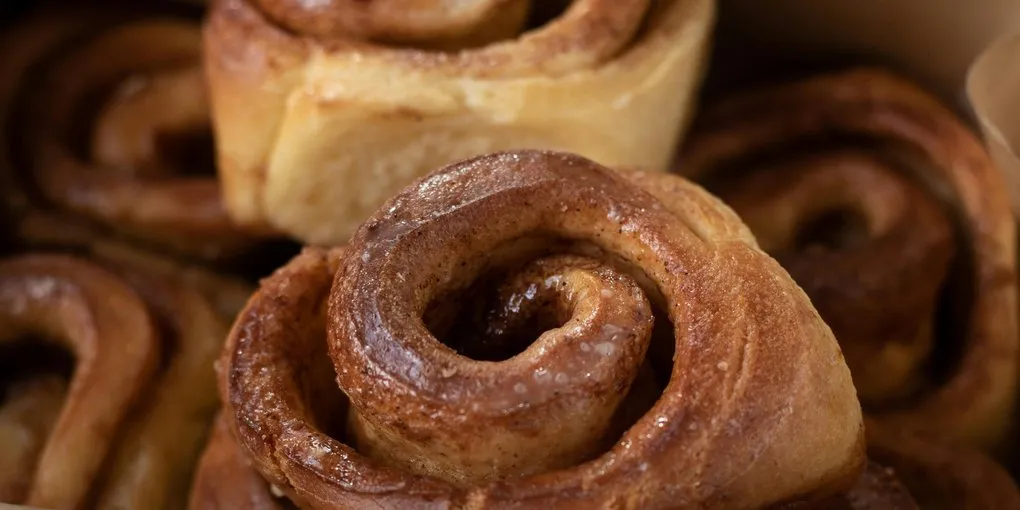
Sourdough cinnamon rolls use a young leaven (built from 15g starter + 100g flour + 100g water, used within 8-12 hours before peak acidity) to leaven an enriched dough with butter, eggs, and sugar. Mix and shape Saturday evening, cold retard overnight in the fridge, then proof and bake Sunday morning. Total active time: about 45 minutes. The overnight cold retard at 37-40F develops flavor complexity while slowing fermentation nearly to zero.
Sourdough cinnamon rolls replace commercial yeast with an active sourdough starter. The result is a slower rise, a more complex flavor, and a scheduling flexibility that actually makes these easier to fit into a weekend morning than the yeasted version. You mix the dough Saturday evening, shape the rolls, slide the pan into the fridge overnight, and bake Sunday morning. The cold retard does double duty — it slows fermentation to nearly zero so you can sleep, and it develops flavor compounds that commercial yeast can’t replicate.
The sourdough flavor here isn’t aggressive. This isn’t tangy bread with cinnamon bolted on. Using Robertson’s “young leaven” concept — a starter that’s active and buoyant but hasn’t reached peak acidity — you get lift without sourness. The bread tastes rich, slightly complex, with a fermented depth that sits behind the cinnamon and sugar rather than competing with it.
Building the Leaven
A young leaven is the key to sourdough cinnamon rolls that taste like cinnamon rolls, not sourdough bread with a sweet filling. Robertson’s approach is to seed a fresh leaven build with just a small amount of mature starter, then use it while the yeast is active but before acid has accumulated.
The evening before you plan to mix the dough — so Friday evening if you’re baking Sunday morning — build your leaven:
- 1 tablespoon (about 15g) mature sourdough starter
- 100g bread flour
- 100g water at 78-80F
Mix, cover, and leave at room temperature (75-78F). By the next morning (8-12 hours later), the leaven should be domed, bubbly throughout, and pass the float test — a small spoonful dropped in water floats rather than sinks. Use it at this point. Don’t wait for it to collapse or develop a sharp smell. A young leaven smells pleasantly yeasty, maybe slightly fruity. If it smells like vinegar, it’s too far gone for this application.
For a detailed guide to building and maintaining your starter, see our sourdough starter guide and feeding schedule.
Try It Yourself
The Starter Clock
Track your leaven's fermentation timeline and know exactly when it's ready for these cinnamon rolls.
Open ToolSourdough Cinnamon Rolls -- Overnight Schedule
Friday evening to Sunday morning
Build Leaven
15g starter + 100g flour + 100g water. Cover, room temp.
Leaven Ready
Domed, bubbly, passes float test. Use before it collapses.
Mix Dough
Combine all ingredients. Butter added after gluten develops. 15 min mix.
End Bulk
Dough expanded ~50%, puffy and airy. Roll, fill, cut, arrange in pan.
Into Fridge
Cover tightly. Cold retard slows fermentation nearly to zero.
Out of Fridge
Remove, leave covered at room temp. Proof 1.5-2 hours.
Proof Complete
Rolls expanded 50%, puffy, slow-filling poke test. Preheat oven 375F.
Bake & Glaze
25-30 min at 375F. Glaze while warm. Serve.
Illustrative stages. Watch the dough's readiness cues as well as the clock.
Total active time: ~45 minutes. The cold retard develops flavor while you sleep.
jayarrbread.comThe Recipe
Yield: 12 cinnamon rolls
Dough
| Ingredient | Weight | Baker’s % |
|---|---|---|
| Bread flour | 500g | 100% |
| Young leaven (100% hydration) | 200g | 40% |
| Whole milk, warm (90F) | 110g | 22% |
| Eggs (about 2 large) | 100g | 20% |
| Unsalted butter, softened | 75g | 15% |
| Sugar | 50g | 10% |
| Salt | 10g | 2% |
Total hydration: ~62% (counting the water in the leaven, milk, and eggs). This is a moderately enriched dough — softer and richer than sandwich bread, but not as butter-heavy as brioche.
Note on the leaven: The 200g of leaven contributes 100g flour and 100g water to the formula. The effective flour total is 600g. The baker’s percentages above are based on the 500g of flour added at mix time for simplicity, but if you’re scaling, account for the flour in the leaven.
Filling
| Ingredient | Amount |
|---|---|
| Unsalted butter, very soft | 60g |
| Brown sugar | 150g |
| Ground cinnamon | 2 tablespoons (12g) |
| Salt | pinch |
Cream Cheese Glaze
| Ingredient | Amount |
|---|---|
| Cream cheese, softened | 115g (4 oz) |
| Powdered sugar | 120g (1 cup) |
| Vanilla extract | 1 teaspoon |
| Whole milk | 15-30g (to thin) |
Method
Step 1: Mix the Dough (Saturday Evening)
Combine flour, sugar, salt, leaven, warm milk, and eggs in a stand mixer bowl. Mix on low speed with the dough hook for 3-4 minutes until a shaggy dough forms.
Increase to medium speed and mix for 5-6 minutes until the dough is smooth and pulls away from the bowl sides. It won’t pass a windowpane test yet — that’s fine.
Now add the softened butter in 3-4 additions, mixing on medium speed for 1-2 minutes after each addition. The dough will look greasy and broken after the first addition. Keep mixing. It comes back together. This follows Hamelman’s brioche method: butter is added after initial gluten development, not at the start. Adding fat too early coats the flour proteins and prevents gluten formation. By developing the network first, you get a dough that’s both rich and strong.
After all butter is incorporated, mix on medium speed for another 3-4 minutes. The dough should be smooth, elastic, slightly sticky, and pull away cleanly from the bowl. A windowpane test should show a thin, translucent sheet.
Total mix time: about 15 minutes. Final dough temperature should be 76-78F. If the dough is too warm (above 80F), the butter will feel greasy and the dough will be slack. If this happens, refrigerate for 20 minutes before proceeding.
Step 2: Bulk Fermentation (2-3 hours)
Transfer the dough to a lightly oiled container, cover, and let rise at room temperature (75-78F) for 2-3 hours. The leaven works slower than commercial yeast, so be patient. The dough should expand by about 50% and feel puffy and airy.
Perform one gentle fold at the 1-hour mark — reach under the dough, stretch up, fold over, rotate 90 degrees, repeat. This redistributes temperature and strengthens the gluten network without deflating the dough.
Because this is an enriched dough with fat and sugar, fermentation will be slower than a lean dough at the same temperature. Fat coats yeast cells and slows their access to sugars. At 10% sugar (relative to flour weight), you’re at the threshold where sugar begins competing with yeast for water — another factor slowing the rise. These aren’t problems — they’re features. The slow rise builds flavor.
Step 3: Roll and Fill
Turn the dough out onto a lightly floured surface. Roll into a rectangle approximately 18 x 14 inches, about 1/4 inch thick. The dough should be cool enough to handle easily — if it’s too soft or sticky, refrigerate for 15 minutes first.
Spread the very soft butter evenly across the surface, leaving a 1/2-inch border along one long edge (this will be the sealing edge). Mix the brown sugar, cinnamon, and salt, then distribute the mixture evenly over the butter. Press gently to adhere.
Starting from the long edge opposite the bare border, roll the dough into a tight cylinder. Use even pressure — you want a uniform spiral, not a loose center with a tight outer wrap. Pinch the seam to seal.
Step 4: Cut and Arrange
Using a sharp knife or unflavored dental floss, cut the log into 12 equal pieces (about 1.5 inches each). Dental floss is cleaner — slide it under the log, cross the ends over the top, and pull to slice without compressing the spiral.
Arrange the rolls cut-side up in a greased 9 x 13 inch baking pan, leaving about 1/2 inch between each roll. They’ll expand to fill the gaps during proofing and baking.
Step 5: Overnight Cold Retard
Cover the pan tightly with plastic wrap and refrigerate overnight, 8-14 hours.
During cold retarding at 37-40F, fermentation slows nearly to zero. The wild yeast in your leaven goes mostly dormant. But acetic acid bacteria remain slightly active even at refrigerator temperatures (Buehler). This means a small amount of organic acid continues to develop, adding flavor complexity without significant rise.
The cold retard also firms the butter in the dough, which is practical — cold rolls hold their spiral shape better during the initial phase of baking, before the butter melts and the structure sets.
Step 6: Warm and Proof (Sunday Morning, 1.5-2 hours)
Remove the pan from the refrigerator. Leave it covered at room temperature for 1.5-2 hours. The rolls need to warm up and complete their proof. They’re ready when they’ve expanded by about 50%, look visibly puffy, and a gentle poke leaves a slow-filling indent.
Don’t rush this step. Cold dough takes time to wake up. If your kitchen is cool (below 72F), it may take closer to 2.5 hours. If it’s warm (above 78F), check at 1.5 hours.
Preheat the oven to 375F during the last 30 minutes of proofing.
Step 7: Bake (25-30 minutes)
Bake at 375F for 25-30 minutes. Enriched doughs bake at a lower temperature than lean breads — Hamelman specifies 380F for enriched doughs like challah and brioche. The fat and sugar brown faster than lean dough, so a lower temperature ensures the interior cooks through before the exterior over-browns.
The rolls are done when the tops are golden brown and the internal temperature reaches 190F. If the tops are browning too fast, tent loosely with foil for the last 10 minutes.
Step 8: Glaze
While the rolls bake, beat the cream cheese, powdered sugar, and vanilla until smooth. Add milk a tablespoon at a time until the glaze is thick but pourable.
Spread or drizzle the glaze over the rolls while they’re still warm — the heat softens the glaze into the crevices. Let it set for 5 minutes, then serve.
For more on enriched dough handling, see our brioche guide and challah guide. And if the sweet tooth is ahead of the schedule — no overnight proof, no rolling — the discard jar also makes sourdough cookies in under three hours.
Why Sourdough Works Here
Sourdough isn’t just a flavor choice — it changes the bread’s structure and keeping quality.
The organic acids produced during fermentation (lactic and acetic) lower the dough’s pH. This does two useful things: it inhibits mold growth, and it slows retrogradation — the starch re-crystallization that causes staling (Buehler). Sourdough breads generally keep longer than straight commercial yeast doughs because the lower pH inhibits both mold and the retrogradation process. For cinnamon rolls that are often baked in a large batch and eaten over several days, that extended shelf life matters.
The acids also affect gluten behavior. A slightly acidic dough produces a more extensible, tender crumb — exactly what you want in a cinnamon roll. The combination of butter, eggs, sugar, and sourdough acids creates a texture that’s pillowy without being bready.
Timing Summary
| Step | Time | Notes |
|---|---|---|
| Build leaven | Friday evening | 8-12 hours before mixing |
| Mix dough | Saturday evening | ~15 min active |
| Bulk fermentation | Saturday evening | 2-3 hours, mostly hands-off |
| Roll, fill, cut, arrange | Saturday evening | ~20 min active |
| Cold retard | Overnight | 8-14 hours in fridge |
| Warm and proof | Sunday morning | 1.5-2 hours, hands-off |
| Bake | Sunday morning | 25-30 min |
| Glaze and serve | Sunday morning | 5 min |
Total active time: About 45 minutes. The rest is waiting.
Troubleshooting
Rolls didn’t rise enough: The leaven wasn’t active. Always confirm with the float test before using. If your leaven sinks, give it more time or rebuild with a larger seed of starter.
Filling leaked out during baking: The spiral wasn’t tight enough, or the rolls were cut too thin. Roll tighter and cut into slightly thicker pieces (1.5-2 inches).
Dough was too slack to roll: Too warm. Enriched doughs with butter become unworkable when warm. Refrigerate for 20-30 minutes and try again.
Rolls taste too sour: The leaven was too mature — it had passed peak and was well into acid accumulation. Use a younger leaven next time. Build it fresh from a small seed (1 tablespoon) and use within 8-12 hours, before it collapses.
Gummy center, dry edges: Under-baked. The center rolls in a tightly packed pan always take longer to cook through. Check internal temperature with a probe — 190F ensures the center is set.
Frequently Asked Questions
- Can you make cinnamon rolls with sourdough starter instead of yeast?
- Yes -- sourdough starter replaces commercial yeast entirely. The wild yeast in your starter provides the leavening, while the lactic acid bacteria add flavor complexity you can't get from commercial yeast. The process takes longer (overnight cold retard vs. a few hours), but the active hands-on time is about the same. The key is using a young, active leaven that passes the float test -- it should be buoyant and bubbly, not collapsed and vinegary.
- Do sourdough cinnamon rolls taste sour?
- Not if you use a young leaven. The sourness in sourdough comes from organic acids that accumulate over time -- lactic acid (mild, creamy) and acetic acid (sharp, vinegary). By building a fresh leaven from a small seed of starter and using it within 8-12 hours before it reaches peak acidity, you get lift and complexity without noticeable tang. The cinnamon, sugar, and butter are the dominant flavors.
- How long can sourdough cinnamon rolls stay in the fridge before baking?
- The overnight cold retard works well at 8-14 hours. Beyond 14 hours, the rolls may over-proof slightly even at refrigerator temperatures, since acetic acid bacteria remain slightly active in the cold (Buehler). If you need to hold them longer -- up to 18-20 hours -- reduce the bulk fermentation time before refrigerating, so the dough goes into the fridge less developed.
- Why is my sourdough cinnamon roll dough too sticky to roll out?
- Enriched doughs with butter become soft and sticky when warm. If the dough is unworkable after bulk fermentation, refrigerate it for 20-30 minutes before rolling. The cold firms the butter and tightens the gluten, making the dough smooth and manageable. A properly hydrated dough at ~62% should feel soft but not sticky at cool room temperature.
- Can I freeze sourdough cinnamon rolls before baking?
- Yes. Complete through cutting and arranging in the pan, then wrap tightly and freeze. When ready to bake, transfer from freezer to refrigerator the night before, then let come to room temperature and proof for 2-3 hours the next morning. Bake as directed at 375F.