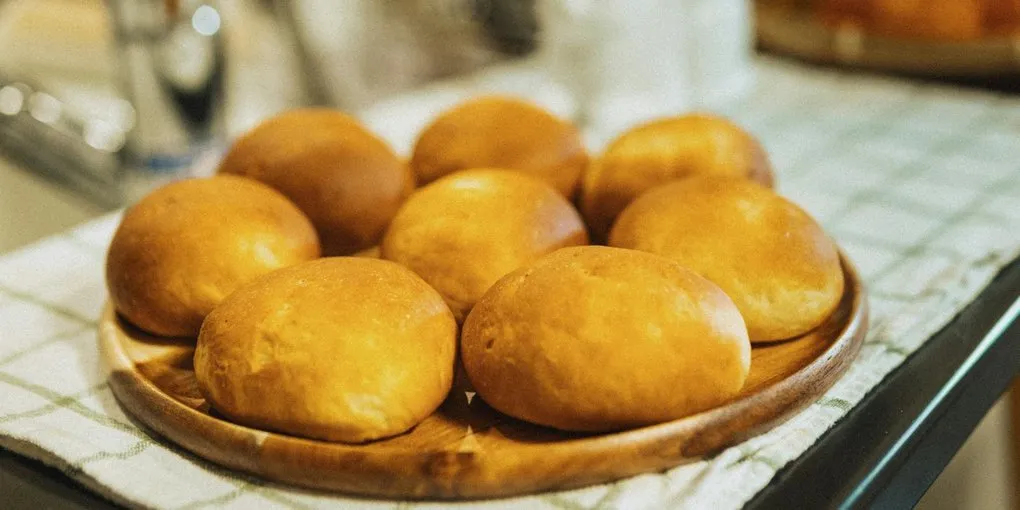
Dinner rolls use an enriched dough with butter, eggs, and milk at roughly 57% hydration. Mix the flour and liquids first to develop gluten, then add softened butter gradually. Bulk ferment 1-1.5 hours, shape into rounds, cloverleaf, knots, or pull-apart, proof 30-45 minutes, egg wash, and bake at 375°F for 18-22 minutes. Total time: under 3 hours.
Try It Yourself
The Baker's Bench
Scale this dinner roll recipe up or down for any batch size, with baker's percentages and a complete timeline.
Open ToolDinner rolls are enriched bread at its most approachable. The dough is soft, easy to handle, and forgiving of minor mistakes. The recipe uses eggs, butter, and a touch of sugar — the same family of ingredients behind challah, brioche, and milk bread, but in lower quantities that keep the dough manageable for hand-shaping. You can shape them four different ways from the same batch, mix them on a weeknight, and have warm rolls on the table in under 3 hours.
The key to great dinner rolls is a dough that’s rich enough to be tender but not so enriched that it fights you during shaping. At roughly 57% hydration (counting milk and egg liquid content) with moderate butter and eggs, this dough is smooth, pliant, and shapes easily. It’s the kind of dough that makes you understand why bakers talk about dough being “alive” — it responds to your hands.
The Dough: Enriched but Not Heavy
Enriched doughs contain fat, sugar, eggs, or dairy — ingredients that lean bread doughs don’t have. These additions change everything about how the dough behaves. Fat coats gluten strands, making the crumb tender and soft rather than chewy. Eggs add richness, color, and structure (the proteins coagulate during baking, strengthening the crumb). Sugar feeds the yeast initially, then contributes to browning and sweetness.
The trade-off is that fat and sugar both slow fermentation. Fat physically coats yeast cells, limiting their access to sugars in the flour. Sugar above 10% of flour weight starts to compete with yeast for water through osmotic pressure. This recipe uses 7.5% sugar — below that threshold, so fermentation proceeds at a reasonable pace. This is why enriched doughs use more yeast than lean doughs — you need the extra leavening power to compensate for the suppressive effects of enrichment. (The same enrichment on a wild-yeast clock is its own recipe: sourdough dinner rolls, an overnight schedule that trades speed for flavor depth and keeping quality.)
Hamelman’s approach to enriched doughs like brioche applies here: butter goes in after gluten development, not before. If you dump all the butter in at the start, it coats the flour proteins and prevents gluten from forming properly. Mix the flour, eggs, milk, and yeast first, develop the gluten network, then add the butter gradually. The result is a dough that’s both strong and tender.
For more on enriched dough science, see our brioche guide.
Four Ways to Shape Dinner Rolls
Same dough, different presentations
- 01
Classic Round
Cup hand over dough on unfloured surface. Rotate in circular motion -- counter friction tightens the skin into a smooth ball. Place seam-side down.
- 02
Cloverleaf
Divide each piece into 3 small balls (~20g each). Round each ball. Drop 3 into a greased muffin cup. They fuse during baking and pull apart at the table.
- 03
Knot
Roll each piece into an 8-inch rope. Tie a simple overhand knot and tuck the tail underneath. If dough springs back, rest 2-3 min and try again.
Let the dough relax if it resists rolling -- forcing it tears the gluten.
- 04
Pull-Apart
Round all pieces into balls. Arrange in a 9x13 pan, 1/2 inch apart. They expand to touch during proofing and bake into a connected slab. Tear apart at the table.
Pull-apart is the easiest shape and produces the softest rolls -- the connected sides stay moist.
jayarrbread.comThe Recipe
Yield: 16-18 dinner rolls
Ingredients
| Ingredient | Weight | Baker’s % |
|---|---|---|
| Bread flour | 600g | 100% |
| Whole milk, warm (90-95°F) | 210g | 35% |
| Eggs (about 2 large) | 100g | 17% |
| Unsalted butter, softened | 75g | 12.5% |
| Sugar | 45g | 7.5% |
| Salt | 12g | 2% |
| Instant dry yeast | 7g | 1.2% |
Egg wash: 1 egg beaten with 1 tablespoon milk
Total hydration: ~57% (counting milk and egg liquid content). This is a stiff-side enriched dough — firm enough to hold shaped forms during proofing, soft enough to produce a pillowy crumb after baking.
Equipment
- Kitchen scale
- Stand mixer with dough hook (hand-kneading works but takes longer)
- Rimmed baking sheet or 9 x 13 inch baking pan
- Parchment paper
- Pastry brush for egg wash
- Probe thermometer
Method
Step 1: Mix the Dough
Combine flour, sugar, yeast, and salt in a stand mixer bowl. Add the warm milk and eggs. Mix on low speed for 3 minutes until a shaggy dough forms.
Increase to medium speed and mix for 5-6 minutes. The dough should become smooth and start pulling away from the bowl sides.
Add the softened butter in 3 additions, mixing for 1-2 minutes after each. The dough will look slick and broken after each addition — keep mixing until it comes back together. After all butter is incorporated, mix on medium speed for another 2-3 minutes until the dough is smooth, elastic, and pulls cleanly from the bowl.
Final dough temperature target: 76-78°F. The warm milk compensates for room-temperature flour and mixer friction (24-28°F in a planetary mixer).
Step 2: Bulk Fermentation (1-1.5 hours)
Bulk fermentation transforms the dough from a uniform mass into a light, airy structure. Transfer the dough to a lightly oiled bowl, cover, and let rise at room temperature (75-78°F) until doubled. With 1.2% yeast, this takes about 1-1.5 hours.
One fold at the 30-minute mark helps strengthen the dough. Reach under, stretch up, fold over. Rotate, repeat.
The dough is ready when it’s puffy, domed, and a gentle poke leaves an indent that fills in slowly.
Step 3: Divide
Turn the dough out onto a lightly floured surface. Divide into 16-18 equal pieces (about 60-65g each). For consistent rolls, use a scale.
Step 4: Shape
This is where dinner rolls get fun. From the same batch of dough, you can make four different shapes. Choose one or mix them on the same pan for a holiday spread with visual variety.
For more on shaping fundamentals, see our bread shaping guide.
Shape 1: Classic Round
The simplest shape. Cup your hand over a piece of dough on an unfloured surface. Rotate your hand in a circular motion, using the friction of the counter to tuck the dough under itself and create a taut ball. The seam tightens against the counter. 5-6 rotations should produce a smooth, taut sphere.
Place seam-side down on a parchment-lined baking sheet, spacing 1.5 inches apart.
Shape 2: Cloverleaf
Divide each 60g piece into 3 equal balls (about 20g each). Round each small ball the same way — cup and rotate against the counter. Drop 3 balls into each cup of a greased muffin tin.
During proofing and baking, the three balls expand and fuse together, creating the signature cloverleaf shape. They pull apart easily at the table.
Shape 3: Knot
Roll each piece into a rope about 8 inches long and 3/4 inch thick. Tie a simple overhand knot — the same knot you start a shoelace with. Tuck the tail end underneath. The knot tightens during proofing and baking, creating a compact, attractive shape.
If the dough springs back while rolling the rope, let it rest for 2-3 minutes and try again. Gluten needs time to relax before it’ll cooperate with elongation.
Shape 4: Pull-Apart
Round all pieces into smooth balls as described in Shape 1. Arrange in a greased 9 x 13 inch baking pan, spacing about 1/2 inch apart (they’ll touch during proofing). The rolls bake together into a connected slab that tears apart at the table — soft sides everywhere, with a golden crust only on top. This is the easiest shape and produces the softest result because the sides stay moist from contact with neighboring rolls.
Step 5: Final Proof (30-45 minutes)
Cover the shaped rolls and let rise at room temperature for 30-45 minutes. They should puff up by about 50% and feel soft and pillowy when gently pressed.
Enriched doughs have a slightly wider proofing window than lean doughs — the fat slows fermentation and gives you more margin. But over-proofing still produces flat, deflated rolls with a dense crumb. When in doubt, use the poke test: a gentle press should leave an indent that fills in slowly.
Step 6: Egg Wash
Preheat the oven to 375°F during the final proof.
Beat 1 egg with 1 tablespoon of milk. Brush a thin, even coat over each roll using a pastry brush. This is the same egg wash technique Hamelman uses for challah — it produces a glossy, deep-golden crust that signals “freshly baked” from across the room.
Apply one coat. A second coat after 10 minutes of baking (optional) deepens the color further, but one coat is usually sufficient for dinner rolls.
Step 7: Bake (18-22 minutes)
Bake at 375°F for 18-22 minutes. Hamelman specifies 380°F for enriched doughs — the sugar and fat in the dough brown faster than lean bread, so a lower temperature prevents the exterior from darkening before the interior is done.
The rolls are done when deeply golden on top and the internal temperature reads 190°F. If using the pull-apart arrangement, the center rolls take slightly longer — check the center of the pan, not just the edges.
Let cool on the pan for 5 minutes, then transfer to a wire rack — or serve immediately, while they’re still warm. Dinner rolls are at their absolute best within 30 minutes of leaving the oven.
Make-Ahead Options
Same-day, overnight, and freezer methods all work with this dough, giving you flexibility for holidays and entertaining.
Same day: Mix in the morning, shape after lunch, bake before dinner. Total timeline: about 3 hours with breaks.
Overnight cold retard: After shaping (Step 4), cover tightly and refrigerate for 8-14 hours. The next day, remove from the fridge, let warm and proof at room temperature for 1.5-2 hours, then egg wash and bake. The cold retard develops slightly more flavor complexity — the same principle behind cold fermentation for bread.
Freeze after shaping: Shape and arrange on a parchment-lined sheet. Freeze until solid (about 2 hours), then transfer to a freezer bag. When ready to bake: arrange frozen rolls on pan, cover, and let thaw and proof at room temperature for 3-4 hours. Egg wash and bake as normal. Frozen rolls keep for 2-3 months.
Variations
Garlic butter rolls: After baking, brush with melted butter mixed with minced garlic, parsley, and a pinch of flaky salt.
Everything rolls: Before the final proof, brush tops with egg wash and press into a mix of sesame seeds, poppy seeds, dried garlic, dried onion, and flaky salt.
Honey wheat rolls: Replace 30% of the bread flour with whole wheat flour. Increase milk by 15g to compensate for bran absorption. Replace the sugar with 50g honey.
Cheese rolls: Add 100g of finely shredded sharp cheddar or gruyere to the dough during the last minute of mixing. The cheese melts into pockets during baking.
Storing Dinner Rolls
Enriched bread stays fresh longer than lean bread because the fat, eggs, sugar, and milk slow retrogradation — the starch re-crystallization process that causes staling. Room temperature in a sealed bag: 3-4 days. Frozen: 2-3 months. Reheat from frozen at 300°F for 8-10 minutes.
Never store fresh rolls in the refrigerator. Refrigerator temperature (35-39°F / 2-4°C) is the exact range where retrogradation is fastest. Bread goes stale faster in the fridge than on the counter — this is one of the most counterintuitive facts in baking, but the science is unambiguous. For long-term storage beyond a few days, freeze them. For more on the science of staling, see our bread storage guide. Soft rolls and skillet Southern cornbread are the two classic breads for a holiday dinner table.
Troubleshooting
Rolls are dense and heavy: Under-proofed is the most common cause. Let them rise longer before baking. Also check your yeast — if it’s old, it may not have enough activity.
Rolls spread flat instead of rising tall: Over-proofed, or the dough was too warm and slack during shaping. Shape on a cool surface, work quickly, and don’t over-proof.
Tops are brown but centers are raw: Oven too hot. Lower the temperature by 15°F and extend the bake time. Tent with foil if tops are browning too fast.
Crust is dull instead of glossy: Egg wash was too thick or unevenly applied. Thin with a bit more milk and brush a consistent, thin layer.
Rolls stuck to the pan: Insufficient greasing or no parchment paper. Always use parchment or grease generously with butter.
Frequently Asked Questions
- How far in advance can you make dinner rolls?
- You have three options. Same-day: mix, rise, shape, and bake within 3 hours. Overnight: shape the rolls, refrigerate covered for 8-14 hours, then warm at room temperature for 1.5-2 hours and bake. Freeze ahead: shape and freeze on a sheet pan, transfer to a bag, then thaw and proof for 3-4 hours before baking. The overnight method adds subtle flavor complexity from the extended cold fermentation. The freezer method works up to 3 months out -- useful for holiday planning.
- Why are my dinner rolls dense instead of fluffy?
- The most common cause is under-proofing -- the rolls weren't given enough time to rise before baking. Enriched doughs ferment slower than lean doughs because fat coats the yeast cells and limits their access to sugars. Give the rolls the full 30-45 minutes of final proofing, and verify they've expanded by about 50% and feel soft when pressed. Other causes: old yeast, dough temperature too cold, or over-mixing that overdeveloped and then broke down the gluten.
- What temperature do you bake dinner rolls at?
- 375°F for 18-22 minutes. Enriched doughs bake at lower temperatures than lean bread because the fat and sugar brown faster. At 460°F+ (standard for lean bread), dinner rolls would burn on the outside before the interior cooks through. Hamelman specifies 380°F for enriched doughs like brioche and challah -- the same principle applies here. Internal temperature should reach 190°F.
- Can you make dinner rolls without a stand mixer?
- Yes. Combine all ingredients except butter by hand, then knead on a lightly floured surface for 10-12 minutes until smooth. Add softened butter by smearing it across the dough and folding repeatedly -- it's messier than a mixer but produces identical results. The butter incorporation takes an extra 5 minutes by hand. Total kneading time is about 15-18 minutes versus 10-12 in a stand mixer.
- What's the best shaping technique for beginners?
- Pull-apart rolls are the most forgiving shape. Round each piece into a ball, arrange in a greased 9x13 pan, and let them proof until they touch. The rolls bake together and tear apart at the table -- no fancy technique needed. The connected arrangement also produces the softest result because the sides stay moist from contact with neighboring rolls. Cloverleaf and knot shapes look impressive but require more practice to get consistent.