Traditional Irish soda bread is four ingredients: plain flour, buttermilk, baking soda, and salt. No yeast, no kneading, no rising time, and no raisins. The buttermilk's lactic acid reacts with the baking soda to produce the CO2 that leavens the loaf, so you mix in about five minutes, shape a round, cut a deep cross, and bake hot at 425F for 35-40 minutes. The raisin-and-sugar version sold in March is a separate Irish-American tradition -- delicious, but a different bread.
Here is what traditional Irish soda bread contains: flour, buttermilk, baking soda, and salt. That is the entire ingredient list. It is mixed by hand in under five minutes, shaped into a round, scored with a cross, and baked hot. No yeast. No kneading. No rising time. No raisins. No caraway seeds. No sugar. No butter. No eggs. Nothing that an 1840s Irish farm kitchen would not have had on hand.
What Americans sell as “Irish soda bread” in March every year — sweet, dense, studded with raisins, sometimes flavored with caraway or orange zest — is a different food. Those are welcome variants with their own cultural standing (particularly within Irish-American communities), but they are not the soda bread that was and still is the everyday bread of rural Ireland. The original is a plain daily bread, eaten warm with butter and a bowl of stew or soup, replaced within 24 hours with a fresh loaf. This recipe is that bread.
Cultural Context: Why Four Ingredients Changed Irish Baking
Soda bread exists because of three 19th-century developments: the introduction of bicarbonate of soda to European commerce, the structure of Irish wheat, and the realities of rural Irish kitchens.
Bicarbonate of soda (baking soda) became widely available in the UK and Ireland in the 1840s, right at the time of the Great Famine, through imports from the newly industrialized sodium carbonate industry. Unlike yeast, which is a living organism that needs feeding, warmth, and time, baking soda is a shelf-stable chemical that works on contact with acid. For a rural Irish household without a reliable bread oven, without commercial yeast, and without wheat that had the protein to make a good yeasted loaf, soda bread was a revelation. Mix, bake, eat — all in under an hour.
The wheat grown in Ireland at the time (and today) is soft wheat, low in protein (typically 8-10%), which does not develop strong gluten. Yeasted breads made with soft wheat are flat and dense. Soda-leavened breads, which do not depend on gluten development for rise, work beautifully with low-protein flour. The Irish climate — wet, cool, short summers — also suited soft wheat, so the farmers were not going to switch crops. The bread had to adapt to the flour.
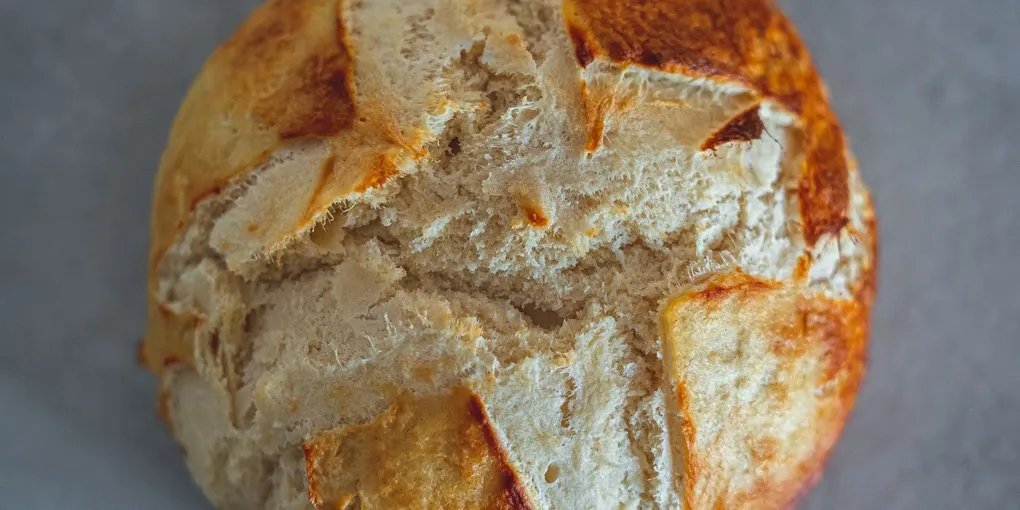
The bastible (a cast iron pot with a lid, set over an open peat fire) was the standard cooking vessel in rural Irish cottages well into the 20th century. Coals were piled on the lid to provide top heat. Soda bread baked in a bastible produces a hemispherical dome with a thick crust and soft interior — the same geometry as modern soda bread baked in a preheated Dutch oven. The cross scored into the top has a folk origin (often explained as letting the fairies out or blessing the loaf) and a practical one: it opens up the dense dough to allow steam to escape and the bread to rise properly.
The distinction between “white soda bread” and “brown soda bread” (sometimes called “Irish wheaten bread”) matters. White soda uses all-purpose or plain white flour. Brown uses whole wheat, often stone-ground, sometimes with steel-cut oats added. Both are traditional. This recipe is for the white version, which is the more common everyday loaf in southern Ireland and the form that shows up in Cork and Dublin bakeries today. Brown soda bread is more common in Northern Ireland and Ulster.
Note for modern adaptation: many Irish-American traditions add raisins (sometimes called “spotted dog” in Ireland when raisins are included), caraway seeds, and a small amount of sugar and butter. These are honest variations with their own long history in the Irish-American community, but they are not the traditional Irish farmhouse loaf. If you want the sweet raisin version, double the salt, add 60g sugar, 45g butter, 120g raisins, and 1 egg — but bake it aware that you are making a distinct bread, not the everyday Irish loaf.
Ingredients
This recipe yields one round loaf, roughly 20 cm across, serving 6-8.
| Ingredient | Grams | US measure |
|---|---|---|
| Plain white flour (all-purpose, 10-11% protein) | 500 | 4 cups |
| Baking soda (bicarbonate of soda) | 6 | 1 tsp |
| Fine sea salt | 8 | 1 1/2 tsp |
| Buttermilk, whole-fat, shaken | 400 | 1 2/3 cups |
Notes on ingredients:
Flour. Soft wheat flour is traditional, but American all-purpose flour at 10-11% protein is a reasonable substitute. Do NOT use bread flour — the higher protein will produce a tough, chewy soda bread, which is wrong. If you have access to imported Irish flour (Odlums cream flour, for example), use that. King Arthur all-purpose works well in American kitchens.
Baking soda. Must be fresh. Baking soda older than 6 months loses potency and the bread will not rise. Test with a few drops of vinegar — it should fizz vigorously. If it does not, replace it.
Buttermilk. The single most important ingredient after flour. Real cultured buttermilk — lactic acid activates the baking soda, and the fat contributes to the crumb. Milk-plus-vinegar substitutes work in an emergency but produce a noticeably less tender loaf. The traditional Irish version used actual leftover buttermilk from butter making, which is thicker and more acidic than modern cultured buttermilk, but modern cultured works fine.
Salt. 1.6% is slightly higher than standard bread salt (2% of flour would be 10g), but soda bread benefits from a firm salt level because the bread has no fermentation flavor to carry it. Skimp on salt and the bread tastes flat.
Four Ingredients, Five Steps
55 minutes total. Five minutes of your time.
1. Preheat
- Time
- 20 min
- Oven
- 425F
- Oven to 425F with a baking stone or cast iron skillet inside.
- High, continuous bottom heat is essential.
- The loaf needs it to establish rise before the crust sets.
2. Mix Dry
- Time
- 1 min
- Whisk flour, baking soda, and salt together thoroughly.
- Break up any soda lumps.
- This is your only distribution step -- you can't knead.
3. Add Buttermilk by Hand
- Time
- 2-3 min
- Make a well; pour the buttermilk in.
- One hand, circular motion, drawing flour from the edges.
- Stop when shaggy and rough. DO NOT KNEAD.
4. Shape & Score
- Time
- 1 min
- Pat into an 18 cm round, 4 cm thick.
- Cut a deep cross nearly to the bottom.
- Four knife-tip pricks -- fairies out, steam out.
5. Bake
- Time
- 35-40 min
- Internal
- 195-200F
- 425F on the hot stone until deep golden and hollow-sounding.
- Cool 30 minutes on a rack before slicing.
- Cutting hot gives a gummy center.
The deep cross is structural, not decorative -- it lets steam escape so the dense, yeast-free loaf can rise.
jayarrbread.comMethod
Total working time: 5 minutes. Total time from start to sliced bread: 55 minutes.
Stage 1 — Preheat the oven
Set your oven to 425°F / 218°C, with a rack in the middle position. If you have a baking stone or heavy cast iron skillet, place it in the oven to preheat — you’ll bake the loaf directly on the stone or in the skillet. At minimum, preheat for 20 minutes before baking.
Stage 2 — Mix the dry ingredients
In a large mixing bowl, whisk together the flour, baking soda, and salt. Whisk thoroughly — 30 seconds, breaking up any lumps of baking soda. This is the only distribution step you’ll get, because you cannot knead soda bread.
Stage 3 — Add the buttermilk
Make a well in the center of the dry ingredients. Pour in most of the buttermilk — hold back about 30-40g (a small splash). Using one hand (yes, one hand, this is traditional and practical), mix with your fingertips in a circular motion from the center outward, drawing in the flour gradually. The goal is a rough, shaggy dough — wetter than bread dough, drier than scone dough. It should hold together but still look rough.
Add the reserved buttermilk only if the dough feels too dry. Flour absorbs liquid differently depending on humidity and storage, so you may need slightly more or less than 400g. The correct dough is tacky but not sticky, rough but not crumbly.
The moment the baking soda contacts the buttermilk, CO2 generation begins. Work quickly — you have about 10 minutes before the leavening begins to weaken.
Stage 4 — Shape
Turn the dough out onto a well-floured surface. Do NOT knead — this is the cardinal rule of soda bread. Kneading develops gluten, which makes soda bread tough and dense. This is a genuinely no-knead bread, leavened by chemistry rather than gluten structure. Pat the dough gently into a round, 15-18 cm across and about 4 cm thick. Use a light touch. The dough should look rustic and imperfect.
Stage 5 — Score
Using a sharp serrated knife or bench scraper, cut a deep cross into the top of the loaf — nearly all the way through, stopping about 1 cm from the bottom. This is not a decorative score; it is structural. The cross allows the dense dough to open up as steam expands inside, which is essential for the loaf to cook through. Prick the four quadrants with the tip of the knife once each — the folk explanation is “letting the fairies out,” the practical explanation is venting.
Stage 6 — Bake
Transfer the loaf to your preheated stone, skillet, or a parchment-lined sheet pan. Bake 35-40 minutes at 425°F, until the crust is deep golden brown, the bottom sounds hollow when tapped, and the internal temperature reaches 195-200°F / 90-93°C.
Do not open the oven for the first 20 minutes — the loaf needs continuous high heat to establish oven spring before the crust sets.
Stage 7 — Cool (essential)
Transfer the baked loaf to a wire rack and cool for at least 30 minutes before slicing. Soda bread continues cooking internally after it leaves the oven, and cutting too early will give you a gummy center. Cool fully (2-3 hours) if you plan to slice thinly for sandwiches.
Stage 8 — Eat within 24 hours
Traditional Irish soda bread has a lifespan. It is excellent for the first 24 hours, acceptable toasted on day 2, and by day 3 has become a breadcrumb candidate. Unlike yeasted bread, which stales gradually through starch retrogradation, soda bread dries out and stiffens within hours because it has no fermentation-based moisture retention. Our bread storage and freshness guide explains why — but the traditional solution is simpler: make a small loaf and eat it the day you bake it, which is exactly how Irish households have done it for 180 years.
Troubleshooting
Bread is gummy inside even though the crust is dark. Underbaked — pull it at a higher internal temperature next time (200°F), and extend baking by 5-7 minutes. Also, did you cool it for 30 minutes before slicing? Hot soda bread always looks gummy; the structure sets during cooling.
Bread is dense and heavy. Three possible causes. First, the baking soda may be old and inactive — test with vinegar. Second, you may have kneaded the dough — don’t. Just mix and shape. Third, the buttermilk may not have been acidic enough (old buttermilk loses acidity) or you substituted milk-plus-vinegar, which is weaker. Fresh cultured buttermilk gives the best rise.
The cross did not open up during baking. You cut it too shallow. Next time score nearly all the way through the loaf. Soda bread dough is dense; a shallow score closes up during baking instead of opening.
Loaf spread out flat instead of rising up. Dough was too wet. Next time use a little less buttermilk (hold back 50g at first, only add what you need). Also shape more firmly — the rough round should hold its dome before going in the oven.
The bread tastes metallic or soapy. Baking soda excess. Measure by weight (6g) rather than volume — tablespoon measures of soda vary by 30% depending on how it was scooped. Or your buttermilk was insufficient to neutralize the soda — use fresh, acidic buttermilk.
Crust is pale, crumb is damp. Oven temperature was too low. Soda bread needs the full 425°F to develop crust color and drive off moisture. Calibrate your oven with a separate thermometer; many home ovens run 15-30°F below the dial setting.
Because it takes five minutes and forgives almost everything except kneading, soda bread is one of the best first loaves you can bake — a natural companion to our best breads for beginners and to its no-yeast, buttermilk cousin, Southern cornbread.
Frequently Asked Questions
- Why don't traditional Irish soda breads have raisins?
- Rural Irish households of the 1840s-1950s, when soda bread became the default daily bread, did not treat dried fruit as an everyday ingredient. Soda bread was the plain bread eaten with every meal -- it accompanied stew, soup, butter, cheese, porridge. Raisins would have been expensive and reserved for Christmas cake, barmbrack, or teatime treats. The raisin-studded 'Irish soda bread' sold in American bakeries in March is a legitimate Irish-American tradition that evolved in diaspora communities in New York, Boston, and Chicago, but it was not the bread eaten on farms in County Cork or County Kerry. In Ireland itself, a raisin-studded soda bread is called 'spotted dog' and is treated as a distinct, slightly festive variant -- not the same thing as plain soda bread.
- What's the difference between white soda bread and brown soda bread?
- White soda bread uses all-purpose or plain white flour and produces a soft, pale crumb with a thin crust -- this is the more common version in Dublin, Cork, and southern Ireland. Brown soda bread (sometimes called 'Irish wheaten bread') uses whole wheat flour, often with steel-cut oats or wheat bran mixed in, producing a nuttier, denser, darker loaf. Brown soda is more associated with Northern Ireland and Ulster and is the version you're most likely to encounter in Belfast or Derry. Both are genuine; neither is more Irish than the other. They are regional preferences.
- Can I use regular milk instead of buttermilk?
- Not really. Buttermilk is doing two jobs -- the lactic acid activates the baking soda (which is what rises the bread), and the fat contributes to tenderness. Plain milk has no acid, so the baking soda will not activate properly and the bread will be dense and taste soapy. If you don't have buttermilk, make a substitute by stirring 15g (1 Tbsp) of white vinegar or lemon juice into 400g whole milk, letting it sit 10 minutes until curdled. This works but gives a noticeably less tender loaf than real cultured buttermilk. Plain whole-fat yogurt thinned with a little milk to the consistency of buttermilk is another solid substitute.
- Why does my soda bread get stale so fast?
- This is a feature, not a bug. Traditional soda bread is designed to be baked and eaten the same day -- rural Irish households baked fresh every morning or every other day, which was easy because the bread takes 5 minutes to mix. Unlike yeasted breads, which have fermentation-driven moisture retention and stale more slowly, soda bread has no long fermentation and therefore dries out within 24-36 hours. The solution is not to add preservatives -- it's to make smaller loaves and bake more often, or to accept that day-2 soda bread is best toasted and day-3 soda bread is best crumbled into soup or turned into breadcrumbs.
- Can I make soda bread ahead and freeze it?
- Yes. Soda bread freezes well, better than most yeasted breads because its dense crumb structure resists freezer damage. Cool the loaf completely, wrap in two layers -- plastic or beeswax wrap first, then foil -- and freeze up to 3 months. To thaw, leave wrapped at room temperature for 4-6 hours. To revive the crust, unwrap and warm in a 350F / 175C oven for 8-10 minutes. Freezing a freshly baked loaf is actually a traditional way of stretching a bake -- an Irish grandmother might bake 2 loaves at once, freeze one, and serve the other that day.