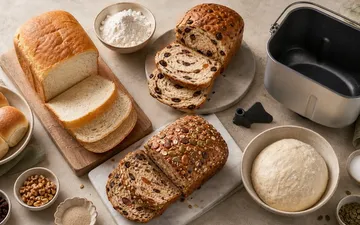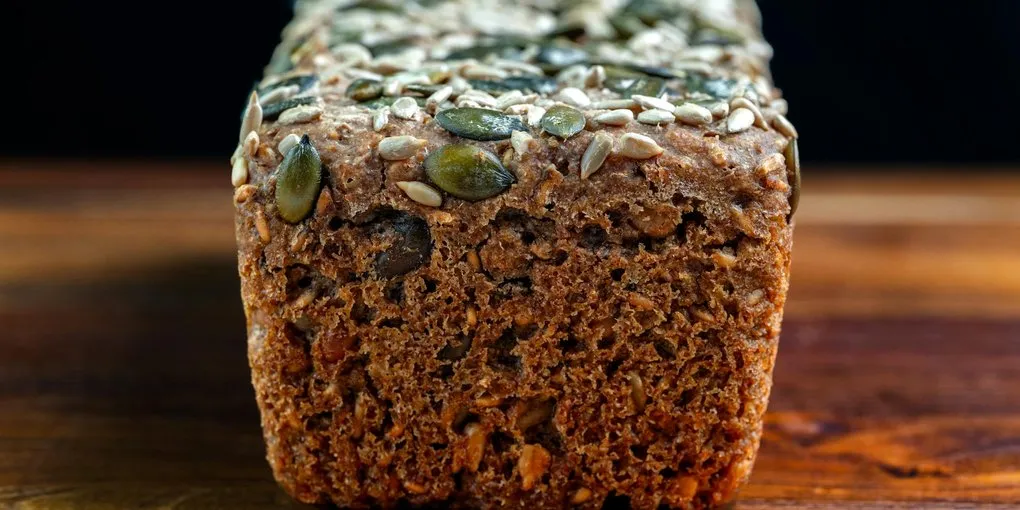
A properly made multigrain seed bread uses a soaker — seeds and whole grains combined with an equal weight of water and rested 8-12 hours — so the grains arrive at the dough fully hydrated and won't steal moisture from the flour. Blend 60% bread flour, 25% whole wheat, and 15% rye. Target 75% hydration for the main dough (not counting soaker water). Bulk ferment 2-2.5 hours with three stretch-and-folds, shape, proof, and bake to an internal temperature of 200-205F.
Multigrain bread has a reputation problem. Most versions are either dense bricks that taste like obligation, or grocery store loaves where a few seeds are glued to the crust of otherwise white bread. Neither is worth your time. A properly made multigrain seed bread — one where multiple grains and seeds are integrated into the dough with the right technique — delivers complex flavor, genuine nutrition, and a crumb that’s open enough to actually enjoy eating.
The key is treating seeds and whole grains as ingredients that need preparation, not decorations you throw in at the end. A soaker softens tough grains overnight. Flour blending ratios keep the gluten network functional despite the bran interference. And hydration adjustments account for the fact that whole grains drink water like they’ve been lost in a desert. Get these three things right and the bread practically makes itself.
How Flour Blending Works in Multigrain Bread
Whole wheat flour behaves differently than white flour in every way that matters to bread structure. The bran — which makes up about 14% of the wheat kernel — physically punctures gluten strands as they form. The germ adds oils that can interfere with gluten development. And the whole package absorbs significantly more water than refined flour.
Robertson raises hydration to 80% for his whole wheat country loaf. Forkish notes that for a mostly whole wheat dough to be considered “wet,” it would probably need at least 82% hydration. But in a multigrain bread where whole wheat is only part of the flour blend, you don’t need to go that high. The white flour in the mix carries the gluten load.
For this recipe, the flour blend is 60% bread flour, 25% whole wheat flour, and 15% rye flour. That 60% bread flour provides enough high-quality glutenin and gliadin to build a functional gluten network. The whole wheat adds nutty depth and fiber. The rye contributes earthy flavor and moisture retention through its pentosans — water-binding carbohydrates that form a gel and keep the crumb soft for days.
The target hydration for this blend is 75%. That’s higher than a standard white bread (65-72%) but well below what you’d need for a 100% whole wheat loaf. The bran in the whole wheat and rye absorbs the extra water. If your dough feels stiff after mixing, add water in 10g increments until it’s tacky and workable. For a deeper dive into how bran and whole grain flours interact with water, see our hydration guide.
Try It Yourself
The Baker's Bench
Plug this formula into the Baker's Bench and scale it to any number of loaves with a matching timeline.
Open ToolThe Soaker Technique: Why It Matters
Raw seeds and whole grains are hard, dry, and hungry for moisture. Drop them directly into bread dough and two things happen: they steal water from the flour (tightening the crumb and making the bread dense), and they stay tough and unpleasant to chew. The soaker technique — a Hamelman staple — solves both problems.
A soaker is simple — combine your seeds and grains with an equal weight of water in a bowl, cover, and leave at room temperature for 8-12 hours (overnight). The grains absorb water, soften to a chewable texture, and arrive at the dough fully hydrated. They won’t pull moisture away from the flour because they’ve already got all the water they need.
For this recipe, the soaker contains sunflower seeds, flax seeds, rolled oats, and millet. Each brings something different to the final bread. Sunflower seeds add crunch and fat. Flax seeds contribute omega-3s and a subtle binding quality (they form a mucilaginous gel when wet). Rolled oats bring softness and a faint sweetness. Millet adds a mild, corn-like flavor and visual interest.
The soaker water is not counted in the dough hydration calculation. It’s a separate system — the grains absorb it, and it stays locked inside them during baking.
Seeds and Grains for Bread Baking
Hydration impact, flavor, and what each brings to the loaf
Sunflower Seeds
Nutty crunch, high fat content. Stays firm after soaking.
Flax Seeds
Omega-3s, subtle binding gel. Forms mucilage when wet.
Rolled Oats
Soft, slightly sweet. Absorbs heavily — adds moisture to crumb.
Millet
Mild, corn-like flavor. Small golden beads add visual interest.
Sesame Seeds
Toasty, rich. Best as a topping — minimal water absorption.
Pumpkin Seeds (Pepitas)
Earthy, green, buttery. Stays crunchy even after baking.
Chia Seeds
Neutral flavor. Forms thick gel — reduce dough hydration 2-3%.
Cracked Wheat (Bulgur)
Chewy, wheaty, hearty. Needs full overnight soak to soften.
Soak all seeds and grains in equal weight of water for 8-12 hours before adding to dough.
jayarrbread.comThe Recipe
Yield: 2 loaves
Soaker (prepare 8-12 hours ahead)
| Ingredient | Weight | Notes |
|---|---|---|
| Sunflower seeds | 50g | Raw, unsalted |
| Flax seeds | 30g | Whole — they’ll partially gel |
| Rolled oats | 40g | Old-fashioned, not instant |
| Millet | 30g | Raw |
| Water | 150g | Room temperature |
Combine in a bowl, cover, and leave at room temperature overnight. The mixture will absorb most of the water and form a thick, porridge-like mass.
Main Dough
| Ingredient | Weight | Baker’s % |
|---|---|---|
| Bread flour | 480g | 60% |
| Whole wheat flour | 200g | 25% |
| Whole rye flour | 120g | 15% |
| Water (85°F) | 600g | 75% |
| Salt | 16g | 2% |
| Instant dry yeast | 4g | 0.5% |
| Soaker (drained, see above) | ~300g | — |
| Sesame seeds (topping) | 20g | — |
| Poppy seeds (topping) | 10g | — |
Total flour weight: 800g Total hydration (dough only): 75%
For help scaling this formula to different loaf sizes, see our baker’s percentages guide.
Equipment
- Kitchen scale
- Large mixing bowl or stand mixer
- Bench scraper
- Two 9×5 loaf pans or two bannetons for freeform loaves
- Probe thermometer
- Dutch oven or baking stone with steam setup
A complete rundown of what each of these tools actually does in a bread bake is in our bread baking equipment guide.
Method
Step 1: Autolyse (30 minutes)
Combine the three flours and water in a large bowl. Mix until no dry flour remains — it will be shaggy and rough. Cover and rest for 30 minutes. This autolyse lets the whole wheat and rye fully hydrate without mechanical force, and it gives enzymes a head start on breaking down starch and developing extensibility. Hamelman notes that autolyse reduces mixing time by roughly 50% and is especially effective for high-protein flours, sourdough, and whole-wheat breads.
Step 2: Add Remaining Ingredients and Mix
Sprinkle the salt and yeast over the autolysed dough. Add the soaker. Mix on low speed for 3 minutes to incorporate everything, then medium speed for 5-6 minutes. By hand, use the pincer method — squeeze through the dough with thumb and forefinger, fold, rotate, repeat for 6-8 minutes.
The dough is ready when it holds together, feels slightly tacky, and passes a moderate windowpane test. It won’t stretch as thin as a white dough — the bran fragments interrupt the gluten sheets — but you should see translucency before it tears.
Target dough temperature: 76-78°F. If your kitchen runs cool, use warmer water (up to 90°F). If warm, pull the water temperature down.
Step 3: Bulk Fermentation (2-2.5 hours)
Transfer the dough to a lightly oiled container. Cover. Perform three stretch-and-fold sets during the first 90 minutes — one every 30 minutes. Each set: reach under the dough, stretch up, fold over. Rotate 90 degrees, repeat on all four sides. That’s one set.
Don’t fold during the last hour. Forkish is emphatic about this — folding late in bulk deflates the gas you’ve been building.
The dough is ready when it has increased in volume by about 50-75%, feels airy, and jiggles when you nudge the container. The surface should be slightly domed with visible bubbles. For a deeper look at what you’re watching for, see our bulk fermentation guide.
Step 4: Divide and Pre-shape
Turn the dough out onto a lightly floured surface. Divide into two equal pieces (about 800-850g each). Pre-shape each piece into a loose round. Cover and rest for 20 minutes. This bench rest lets the gluten relax so final shaping is easier and doesn’t tear the dough.
Step 5: Final Shape
For loaf pans: Press each piece into a rough rectangle. Fold the top third down, the bottom third up, and seal the seam with the heel of your hand. Place seam-down in a greased 9x5 loaf pan. Mist the top with water and press sesame and poppy seeds onto the surface.
For freeform boules: Shape each piece into a tight round on an unfloured surface (Robertson’s technique — the stickiness provides traction). Transfer seam-up into a well-floured banneton. The seeds go on after scoring, just before baking.
For more on shaping technique, see our shaping guide.
Step 6: Final Proof (1-1.5 hours or overnight retard)
Cover the shaped loaves. Proof at room temperature for 1-1.5 hours until the poke test shows the dough springing back slowly and leaving a slight indent.
Overnight option: Cover tightly and refrigerate immediately after shaping. Bake directly from the fridge the next morning — no need to warm to room temperature first. Cold retarding firms the dough for cleaner scoring and extends flavor development.
Step 7: Bake
Loaf pans: Preheat oven to 425°F. Bake for 35-40 minutes until the internal temperature reads 200°F and the crust is deep brown. Remove from pans immediately and cool on a wire rack.
Freeform (Dutch oven): Preheat Dutch oven at 475°F for 45 minutes. Score the loaf, lower it in, lid on for 25 minutes (steam phase), lid off for 20 minutes (crust phase). Target internal temperature: 200-205°F.
For more on steam’s role in baking, see our baking with steam guide.
Step 8: Cool
Let the loaves cool for at least 1 hour before slicing. The starches are still setting inside. Cutting too early produces a gummy interior no matter how well you baked. Whole grain breads benefit from even longer cooling — 2 hours is better.
For storage advice, see our bread freshness guide.
Multigrain Seed Bread — Start to Finish
About 15 hours total, mostly hands-off soaking and fermenting
- 01
Soaker
8-12 hrsCombine seeds, oats, millet with equal weight water. Rest at room temp overnight
- 02
Autolyse
30 minFlours and water only. Rest before adding salt, yeast, soaker
- 03
Mix
8-9 minAdd salt, yeast, soaker. Low 3 min, medium 5-6 min, or pincer method by hand
- 04
Bulk Ferment
2-2.5 hrs76-78F. Three stretch-and-folds in first 90 min, undisturbed last hour
- 05
Shape
30 minDivide, pre-shape, rest 20 min, final shape into pans or bannetons
- 06
Final Proof
1-1.5 hrsRoom temp until poke test shows slow spring-back, or overnight in fridge
- 07
Bake
35-45 min425F loaf pans or 475F Dutch oven. Internal 200-205F
- 08
Cool
1-2 hrsWhole grain loaves benefit from 2 hours before slicing
Times assume a 76-78F kitchen. Cooler rooms extend fermentation and final proof.
jayarrbread.comUnderstanding Hydration in a Multi-Flour Dough
Hydration in multigrain bread isn’t a single number you can set and forget. Different flours absorb water at different rates, and the seeds in the soaker are a separate hydration system entirely.
White bread flour at 75% hydration produces a slack, sticky dough. Whole wheat flour at 75% hydration produces a medium, workable dough — because the bran and germ absorb the extra water. Rye flour absorbs even more aggressively, and keeps absorbing during mixing.
This is why the recipe targets 75% hydration despite using a mix of flours. The effective feel of the dough is closer to what you’d experience at 68-70% with all-white flour. If you swap the ratios — say, 40% whole wheat instead of 25% — you’ll need to push hydration to 78-80% to maintain the same dough consistency.
The rule from every major bread author: when switching flours, adjust hydration based on the feel of the dough, not the recipe number. If you want the chemistry behind why different flours drink different amounts, see our fermentation science guide and the ancient grains guide for how wheat relatives like spelt and emmer shift the equation again. For a bread built on a different grain entirely, our stone-ground Southern cornbread leans on cornmeal instead of wheat.
Try It Yourself
The Baker's Shelf
Use the Hydration Adjuster on the Baker's Shelf to dial in a new flour blend without blowing up your dough consistency.
Open ToolVariations
Seeded rye multigrain: Increase rye to 25% and reduce bread flour to 50%. Add 30g caraway seeds to the soaker. Push hydration to 78%. The result is darker, earthier, and keeps well for nearly a week thanks to rye’s pentosans and the sourdough option below. Our rye bread guide covers the rye percentage spectrum in detail.
Sourdough multigrain: Replace the instant yeast with 160g of active sourdough starter (100% hydration). Reduce bread flour by 80g and water by 80g to account for the flour and water in the starter. Bulk fermentation extends to 4-6 hours. The acidity from the starter improves shelf life and complements the earthy grain flavors.
Nut and fruit version: Add 60g chopped walnuts and 60g dried cranberries to the soaker. The nuts soften slightly while the cranberries plump. Makes an excellent toast bread.
Higher seed ratio: Double the seed quantities in the soaker (and the soaker water). This produces a bread that’s more seed than crumb — dense, chewy, and packed with nutrition. Slice thin and toast.
Troubleshooting
Dense, heavy loaf: The most common issue with multigrain bread. Likely causes: under-hydrated dough (whole grains need more water than you think), skipping the soaker (dry seeds stole moisture from the flour), or under-fermented dough. Try increasing hydration by 3-5% and extending bulk fermentation by 30 minutes. Full diagnostic in our why bread is dense guide.
Seeds sinking to the bottom: Add the soaker after the autolyse, when the dough has some structure. If added too early to a very wet dough, heavy seeds migrate downward during fermentation.
Gummy interior: Under-baked. Multigrain loaves are denser than white bread and need a higher internal temperature to fully set. Target 200-205°F on a probe thermometer. Also confirm you waited at least an hour before slicing.
Bland flavor despite all those grains: Check your salt — 2% of total flour weight is the standard. Also consider cold retarding overnight, which develops flavor complexity that a same-day bake can’t match.
Frequently Asked Questions
- Why do you soak the seeds and grains overnight?
- Raw seeds and whole grains are dry and hard. Added directly to bread dough, they absorb water from the flour — tightening the crumb and making the bread dense — while staying tough and unpleasant to chew. Soaking them in an equal weight of water for 8-12 hours lets them fully hydrate before they enter the dough. They arrive soft, chewable, and won't steal moisture from the gluten network. The soaker water stays locked inside the grains during baking.
- What hydration should I use for multigrain bread?
- For a blend of 60% bread flour, 25% whole wheat, and 15% rye, target 75% hydration. This is higher than standard white bread (65-72%) because whole grains absorb more water — bran and germ soak up moisture that would otherwise hydrate the gluten network. If you increase the whole grain percentage, push hydration higher. Robertson uses 80% for his whole wheat country loaf, and Forkish notes that mostly whole wheat dough needs at least 82% to be considered wet.
- Can I make this bread with sourdough instead of yeast?
- Yes. Replace the instant yeast with 160g of active sourdough starter at 100% hydration. Reduce bread flour by 80g and water by 80g to account for the flour and water in the starter. Bulk fermentation will extend from 2-2.5 hours to 4-6 hours. Sourdough adds flavor complexity and extends shelf life — the lower pH from organic acids inhibits mold growth and slows staling.
- How long does multigrain seed bread stay fresh?
- With commercial yeast only, expect 3-4 days at room temperature in a sealed bag. With a sourdough base, 5-6 days. The rye flour in the blend helps — rye's pentosans retain moisture in the crumb longer than wheat alone. For longer storage, freeze after the loaf has fully cooled. Wrap tightly in plastic then foil. Frozen bread stops retrogradation (the starch re-crystallization that causes staling) completely and keeps for 2-3 months.
- Do I need to adjust the recipe if I use different seeds?
- The technique stays the same — soak any seeds or grains overnight in an equal weight of water. But different seeds behave differently. Flax and chia form a gel when wet, which adds binding but also adds moisture to the dough. Pumpkin seeds and sesame seeds absorb less water and add more crunch. If you use high-gel seeds (flax, chia), you may need to reduce dough hydration by 2-3% to compensate. If in doubt, go by the feel of the dough after mixing — it should be tacky and workable, not soupy.
- Can I skip the soaker if I'm short on time?
- Not without adjustments. If you skip the soaker, you must increase dough hydration by at least 8-10% to feed the dry seeds during mixing and early fermentation — otherwise they'll pull water from the gluten network and the crumb will tighten. Even then, the seeds stay tougher. A minimum short-soak of 2-3 hours in warm water will get you most of the benefit if you truly can't do overnight.