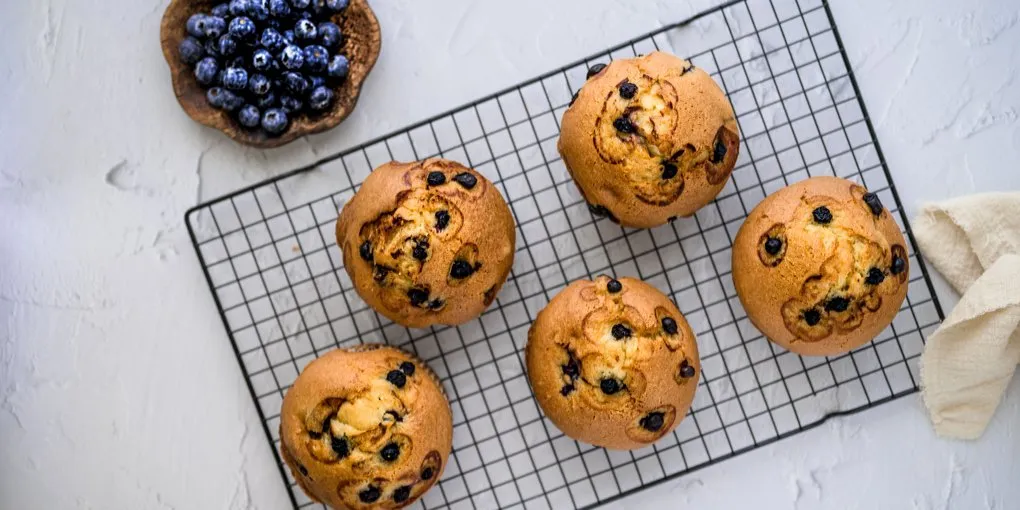
Muffins are the fastest use for sourdough discard -- no overnight ferment, just stir, scoop, and bake. The discard's acidity (pH 3.5-4.5) does two jobs at once: it reacts with baking soda for a tall, domed top, and it weakens gluten just enough for a tender, cakey crumb. This master base takes one bowl and about 25 minutes of baking, and it flexes into blueberry, banana, or chocolate muffins.
Muffins are the single fastest use for sourdough discard. No overnight ferment, no long rest, no shaping — stir, scoop, bake. The acid in the discard does two jobs at once: it reacts with baking soda for a high, domed top, and it weakens gluten just enough to produce a tender, cakey crumb rather than a bready one.
This is a master base recipe. One bowl, one whisk, 25 minutes of bake time. The last section gives you three variations — blueberry, banana, and chocolate — that swap ingredients in and out without touching the base ratios.
The muffins keep three days at room temperature, freeze beautifully, and make a strong case for keeping a jar of discard on the counter instead of in the fridge.
What Makes Discard Different
Discard is mature starter at 100 percent hydration — equal weights of flour and water — sitting between pH 3.5 and 4.5. This acidity comes from lactic acid bacteria (Fructilactobacillus sanfranciscensis and relatives) producing lactic and acetic acid over the hours between feedings. Warmer, shorter ferments skew lactic (mild, creamy); cooler or longer ferments skew acetic (sharper).
For muffins, three mechanisms matter:
- Leavening boost. Baking soda + discard acid = CO2. Muffin batters normally rely on baking powder (acid built in) for lift. When you add a genuinely acidic liquid like discard, baking soda can do extra lifting on top of the baking powder, producing the tall, domed “bakery muffin” top.
- Tenderization. Acid slows gluten formation. Proteases and acid attack peptide bonds in gluten strands, and discard batters are naturally lower-gluten than their non-discard counterparts. The crumb is cakey, not bready.
- Flavor. A gentle tang that cuts sweetness. Discard is subtle in muffins — you will not taste “sourdough” per se, but sweetness feels more balanced and less flat than a standard muffin.
Ingredients
Makes 12 standard muffins.
Master base:
| Ingredient | Grams | US measure |
|---|---|---|
| All-purpose flour | 240 g | 2 cups |
| Granulated sugar | 150 g | 3/4 cup |
| Baking powder | 6 g | 1 1/2 tsp |
| Baking soda | 3 g | 1/2 tsp |
| Fine sea salt | 4 g | 3/4 tsp |
| Large eggs | 100 g | 2 eggs |
| Sourdough discard, 100 percent hydration | 200 g | 3/4 cup + 1 tbsp |
| Whole milk | 120 g | 1/2 cup |
| Neutral oil (canola, vegetable, light olive) | 80 g | 1/3 cup + 1 tbsp |
| Vanilla extract | 5 g | 1 tsp |
Variations (choose one):
Blueberry:
- 200 g fresh or frozen blueberries
- 10 g lemon zest (1 lemon)
- Optional: coarse sugar for topping
Banana:
- 230 g mashed ripe banana (2 large or 3 medium)
- Reduce milk to 60 g (bananas add liquid)
- 60 g chopped toasted walnuts (optional)
Chocolate:
- 30 g cocoa powder (add to dry ingredients; reduce flour to 210 g)
- 150 g chocolate chips or chunks
- Espresso powder, 2 g (deepens chocolate flavor)
Method
Step 1 — Preheat and prep. Set oven to 400 F. Line a 12-cup muffin tin with paper liners, or grease the cups generously.
Step 2 — Whisk dry ingredients. In a large bowl, whisk 240 g flour, 150 g sugar, 6 g baking powder, 3 g baking soda, and 4 g salt. If making the chocolate variation, also whisk in 30 g cocoa (and reduce flour to 210 g) and 2 g espresso powder.
Step 3 — Whisk wet ingredients. In a second bowl, whisk 100 g eggs, 200 g discard, 120 g milk, 80 g oil, and 5 g vanilla. For the banana variation, add the mashed banana here and reduce milk to 60 g.
Step 4 — Combine. Pour the wet ingredients into the dry. Fold with a rubber spatula just until no dry streaks remain — about 15 strokes. The batter will look lumpy. Do not over-mix. Overworking activates gluten and produces tunnels and tough, domed-but-pointy tops.
Step 5 — Add fruit or chips. Fold in the variation ingredient last — 200 g blueberries (tossed with 10 g flour to prevent sinking), 60 g walnuts for banana, or 150 g chocolate chips. 5 additional folds, no more.
Step 6 — Scoop and top. Fill each muffin cup to the top — nearly level with the rim for bakery-style domes. A #16 or #20 disher is ideal. Sprinkle coarse sugar on top if using.
Step 7 — Bake. 400 F for the first 5 minutes (this sets the top crust and triggers a dramatic oven spring), then reduce to 375 F for an additional 15 to 18 minutes. Total bake time: 20 to 23 minutes. Muffins are done when a toothpick comes out with moist crumbs but no wet batter, tops are domed and golden, and edges pull slightly from the liners.
Doneness cues: domed, cracked top with a matte-golden shell, internal temperature 200 to 205 F on an instant-read thermometer, springy rebound when pressed with a fingertip. Pale tops = underbaked; return for 3 minutes. Flat tops = over-mixed batter or too-cool oven.
Step 8 — Cool. Rest in the tin 5 minutes, then transfer to a rack. Eat warm, or cool fully and store.
Discard Muffins: Three Variations, One Base
Same wet/dry ratio, swap the mix-in
Blueberry
- Fruit
- 200 g blueberries
- Flavor accent
- 10 g lemon zest
- Adjust milk?
- No
- Bake
- 400 to 375F, 20-23 min
- Toss frozen or fresh berries in 10 g flour to prevent sinking.
- Coarse sugar on top optional -- adds crunch.
Banana
- Fruit
- 230 g mashed banana
- Optional add
- 60 g toasted walnut
- Adjust milk?
- Yes -- 60 g
- Bake
- 400 to 375F, 22-25 min
- Bananas add liquid and sugar -- reduce milk by half.
- Ripest bananas (black-spotted) give the deepest flavor.
Chocolate
- Cocoa
- 30 g (reduce flour to 210 g)
- Chips/chunks
- 150 g
- Flavor boost
- 2 g espresso powder
- Bake
- 400 to 375F, 20-22 min
- Espresso powder doesn't taste like coffee -- it just deepens the chocolate.
- Fold chips in last -- over-mixing melts them into streaks.
Discard pH 3.5-4.5. The acidic batter plus baking soda gives dramatic dome lift; acid weakens gluten for a cakey, tender crumb.
jayarrbread.comNotes and Variations
Why the 400-to-375 F drop? The high initial heat sets the crust and pushes dramatic oven spring — the same principle as baking bread in a blast-hot oven. Dropping to 375 F lets the interior cook through without burning the tops. Baking straight at 400 F burns; baking straight at 375 F gives flat tops.
Whole-wheat discard. Use as-is. The muffins will be slightly darker with a faintly nuttier flavor. No adjustments needed.
Other mix-ins. Raspberries (handle like blueberries), diced apple + cinnamon, dried cranberries + orange zest, poppy seed + lemon zest all work cleanly on the master base.
Storage. Room temperature up to 3 days in a tin with a paper towel on the bottom to absorb moisture. Refrigerated muffins go stale faster — skip the fridge.
Freezing. Cool completely, wrap individually in plastic, freeze in a zip-top bag up to 3 months. Reheat from frozen at 300 F for 10 minutes, or microwave on medium power 30 seconds.
Mini muffins. Same batter, 375 F for 12 to 14 minutes. Makes about 36.
Jumbo muffins. 400 F for 5 minutes, then 375 F for 22 to 26 minutes. Makes 6.
For more discard ideas, see our sourdough discard recipes roundup. To build the starter that is feeding this jar, see how to make sourdough starter and the sourdough feeding schedule.
Frequently Asked Questions
- Why does sourdough discard make muffins tender?
- Acid weakens gluten. Discard sits at pH 3.5 to 4.5 (meaningfully acidic), and when acidic batter meets wheat flour, proteases and acid break down gluten strands faster than they can form. The result is a cakey, tender crumb -- closer to a pound cake than a bread roll -- while the exterior crisps normally.
- Can I use starter that hasn't been fed?
- Yes -- discard is by definition unfed starter. That is the entire point of these muffins. Fed, peaked starter works too, but contributes less flavor; you are paying for leavening capability you do not need in a chemically-leavened batter.
- How old can my discard be?
- Refrigerated discard is usable for about 7 days in a covered jar. Older discard leans more acetic (sharper, more vinegary). For muffins, slightly older discard is actually welcome -- the extra tang cuts sweetness. Past 10 days, flavor pushes into too-sour territory. Hooch (clear-to-brown liquid on top) is normal; stir it in. Pink, black, or fuzzy mold means toss it.
- Why do I bake at 400 F and then drop to 375 F?
- The high initial heat sets the top crust fast, which pushes a dramatic oven spring -- the same principle as blast-baking a loaf. Dropping to 375 F lets the interior cook through without burning the exterior. Straight-400 F burns tops; straight-375 F gives flat tops. The two-stage bake gives you the tall dome and the moist center.
- Does this work with whole-wheat discard?
- Yes, no adjustments needed. The muffins are slightly darker and nuttier. If you want an even more whole-grain muffin, swap 60 g of the all-purpose flour for white whole-wheat flour; add 10 g extra milk to compensate for the extra absorption.