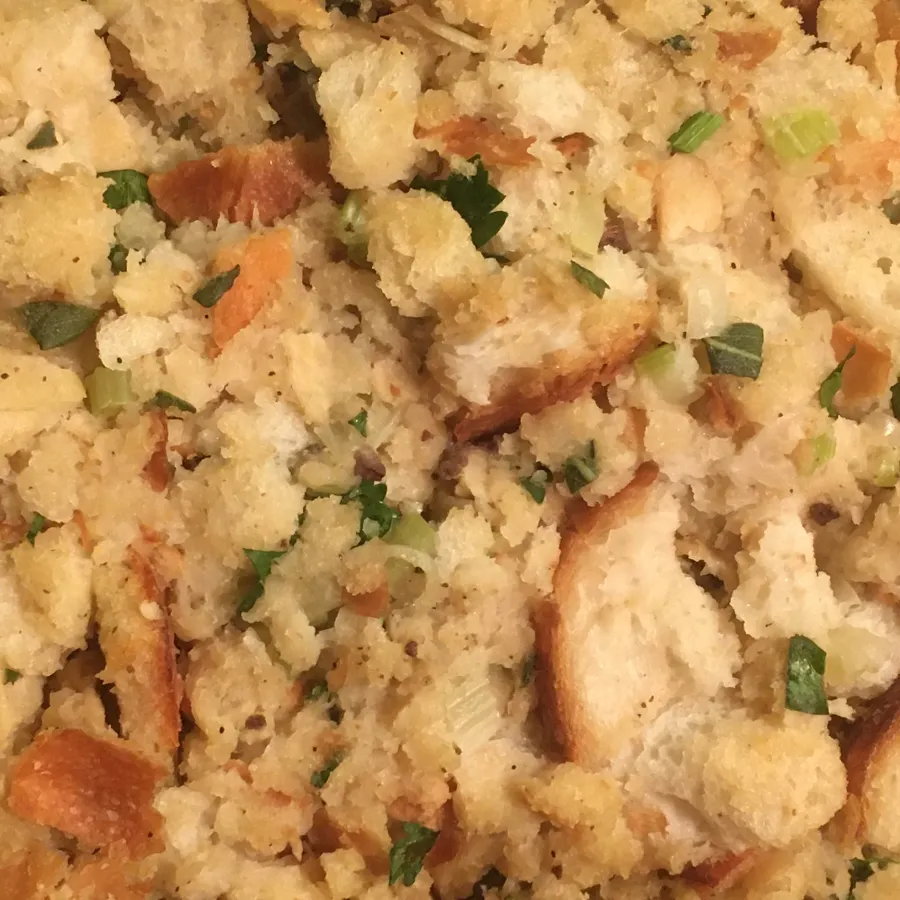
Hero photo: Dorevabelfiore via Wikimedia Commons, CC BY-SA 4.0; orientation normalized, cropped, and resized. The image derivative remains available under the same license.
Sourdough makes excellent stuffing because its sturdy crumb can absorb egg and stock while keeping recognizable edges, and its tang balances the butter and stock. The other half of the method is drying, not merely staling: oven-dry 2cm cubes at 250F until crisp throughout, add stock gradually, then bake the assembled dressing until its center reaches 165F. Stale bread has firmed as its starch reorganized, but fully dried bread has actually lost the water that the seasoned custard needs to replace.
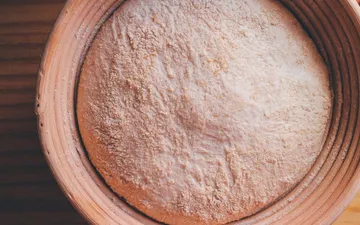
Stuffing is bread pudding that went savory, and the bread you build it on affects how it holds together. Soft sandwich bread can work once properly dried. A lean sourdough with developed structure — such as the loaf from our country bread method — can keep more recognizable cube edges in this formula, though the result still depends on loaf moisture, crumb openness, and drying. That variability is why the stock is a range rather than a promise. The tang also balances the butter, stock, and starch.
The Recipe
Development note: This formula is desk-developed and editorially cross-checked, not test-baked in the JayArr kitchen. Bread moisture varies, so treat the stock as a range and follow the squeeze test in step 6 rather than forcing in every gram.
Yield: 10-12 servings in a 9x13 dish | Active: about 30 minutes | Total: about 2 1/2 hours, allowing longer if the cubes need more drying or cooling
Ingredients:
- 700g sourdough bread (about one large loaf), cut into 2cm cubes; usually 450-500g once fully dried
- 113g unsalted butter
- 250g yellow onion, diced (2 medium)
- 150g celery, diced (3 ribs)
- 6g garlic, minced (2 cloves)
- 8g fresh sage, chopped
- 6g fresh thyme leaves
- 4g fresh rosemary, chopped
- 450g low-sodium chicken or turkey stock, plus up to 150g more to adjust
- 100g eggs without shells (about 2 large)
- 6g fine sea salt (use less if the stock is salted)
- 2g black pepper
Method:
- Spread the bread cubes on two sheet pans and bake at 250F for 40-60 minutes, stirring twice, until fully dry and crisp but not browned. Cool completely.
- Heat the oven to 350F and butter a 9x13 baking dish.
- Cook the onion and celery in the butter over medium heat until soft but not browned, 8-10 minutes. Add the garlic, sage, thyme, and rosemary; cook 1 minute more.
- Whisk 450g stock with the eggs, salt, and pepper.
- Toss the dried cubes with the vegetable mixture. Pour the custard over in stages and fold gently until every cube is moistened but still holds its shape.
- Rest 10 minutes. Squeeze a cube: it should be moist through but retain its edges. If dry pockets remain, fold in reserved stock 25g at a time, using no more than 150g extra.
- Pack loosely into the dish. Cover with foil and bake 30 minutes; uncover and bake 20-25 minutes more, until the top is deep golden and a food thermometer at the center reads 165F.
- Rest 10 minutes before serving.
Dry vs. Stale: They Are Not the Same Thing
The oldest stuffing instruction — “use stale bread” — is half-wrong, and the reason is worth knowing because it changes what you do the night before.
Staling is retrogradation: gelatinized starch recrystallizing over days. Starch reorganization and water redistribution contribute to firming even in sealed bread. Bread exposed to air can also lose water. A stale cube may therefore be firm without being dry throughout; its age alone does not tell you how much stock it will take.
Drying is water actually leaving. At 250F, check the cubes through the 40–60-minute window and continue as needed until crisp throughout. Drying improves consistency, but loaf composition and cube size still affect absorption. This is the same distinction that explains why bread stales fastest in the refrigerator — refrigeration generally accelerates crumb firming compared with room-temperature storage — and why warming can temporarily soften a stale loaf. There is no single heat threshold that restores every loaf exactly.
Practical rule: use sound bread, dry it thoroughly, and add stock to the texture described. Oven drying is convenient; an exact elapsed time or merely leaving bread on the counter is not a dryness test.
The Custard Ratio
| Component | Amount | Ratio logic |
|---|---|---|
| Dried bread | Usually 450-500g (from 700g fresh) | Weighing is informative; crisp-through texture is the gate |
| Stock | 450g + up to 150g reserve | Start near the dried-cube weight, then adjust after the rest |
| Eggs | 100g (2) | The setting protein: sliceable, not wet |
| Butter | 113g | Flavor and crumb-coating fat |
There is no universal stock number because a tight bakery boule and an open, high-hydration loaf dry to different weights and absorb at different rates. Start with 450g, rest the dressed cubes, then add reserved stock in 25g increments only where the squeeze test still finds a dry center. Moist through with intact edges is the target; pooling liquid or collapsing cubes means stop.
Make-Ahead, Because It Is a Holiday
- Cubes: cool fully after drying before airtight storage. For longer make-ahead storage, freeze them; residual moisture and kitchen humidity make a universal week on the counter unreliable. Discard moldy bread rather than drying or baking it to rescue it.
- Components, not casserole: USDA stuffing guidance says wet and dry ingredients may be prepared ahead and chilled separately, but should not be combined until just before cooking. Prepare the cooked aromatics and whisked custard the day before, refrigerate them in separate covered containers, then combine with the cubes immediately before baking.
- Baked and leftover: within 2 hours of cooking — or within 1 hour when the ambient temperature is above 90F — divide stuffing into shallow covered containers and refrigerate at 40F or below. Use or freeze it within 3-4 days. Reheat in a 325F-or-hotter oven or microwave until a food thermometer at the center reads 165F; elapsed time is only an estimate, not the safety gate. These limits follow the same USDA stuffing guidance.
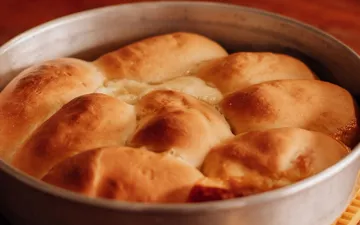
The same custard logic scales to whatever loaf is on your counter: a challah makes a richer, softer stuffing; a whole-wheat country loaf a nuttier one. What you want on the table alongside it: classic make-ahead dinner rolls.
Frequently Asked Questions
- Does sourdough stuffing taste sour?
- Usually only mildly tangy, but the result depends on the loaf. Butter, stock, and herbs can soften the sour impression; a strongly acidic bread will still be more noticeable than a mild country loaf.
- Can I use a bought sourdough loaf?
- Yes. You want a lean loaf (flour, water, salt, culture) around 700g. A lean bakery boule suits this formula, but enriched or soft breads can also make stuffing with a different texture. Dry the cubes and adjust stock; day-old does not necessarily mean dry.
- Stuffing or dressing?
- This is dressing in the technical sense -- baked in a dish, not in the bird. Cooking it separately is also simply better and safer: the top crisps, the texture is controllable, the bird cooks faster and more evenly, and the dish can be checked directly for the 165F center temperature that USDA guidance requires for stuffing either way.
- Why did my stuffing turn out mushy?
- Possible causes include insufficiently dried bread, a fragile or very open crumb, small cubes, too much stock, rough mixing or insufficient baking. These are possibilities, not an exhaustive diagnosis. Start near equal weights of stock and fully dried bread, rest, then adjust 25g at a time; moist centers with intact edges are the goal.
- Can I add sausage, mushrooms, or nuts?
- Yes, but additions change yield, moisture and baking time: use 300-450g sausage fully cooked according to its safe-temperature instructions and drained; 250-300g mushrooms sautéed until their released liquid has evaporated; or 75-150g toasted nuts. Cook raw meat before adding it, consider nut allergens, and still bring the stuffing center to 165F. Added moisture does not automatically mean mush; adjust stock and assess the cubes.
For a first-party comparison of bread textures, see King Arthur’s stuffing trials. For spoiled bread, USDA recommends discarding moldy baked goods.