Sourdough dinner rolls need a vigorous starter, developed dough, sufficient proofing and a thorough bake. Overnight scheduling can use a refrigerated pause; a fixed number of hours or a single poke test cannot guarantee readiness. The formula on this page has not had a documented kitchen trial, so its softness, liquid level and timetable remain unvalidated.
Milk, butter, egg and sugar can give rolls a richer, more tender character than a lean dough. Sourdough adds fermentation flavor, but it does not automatically make a better-tasting or longer-lasting roll than commercial yeast. Both approaches can produce excellent bread.
Recipe development note: the quantities below are a starting formula, not a kitchen-tested promise of pillowy rolls. Its relatively low liquid level makes dough consistency a particular point to test with the chosen flour. For a holiday meal with a fixed deadline, use an established recipe such as The Perfect Loaf’s soft sourdough rolls or King Arthur’s soft sourdough rolls. Those are different formulas: the first uses tangzhong, while the second combines starter with instant yeast. Their testing does not validate the formula here.
The Formula, in Percentages
The 100 g starter contributes 50 g flour and 50 g water, giving 550 g total flour. Baker’s percentages use that total:
| Ingredient | Amount added | Percentage of total flour |
|---|---|---|
| Bread flour | 500 g | 90.9% |
| Flour within the starter | 50 g | 9.1% |
| Water within the starter | 50 g | 9.1% |
| Whole milk | 200 g | 36.4% |
| Butter | 60 g | 10.9% |
| Egg, without shell | 50 g | 9.1% |
| Sugar | 40 g | 7.3% |
| Salt | 10 g | 1.8% |
The starter flour is 9.1% pre-fermented flour. Milk, egg and butter percentages describe whole ingredients, not pure water or pure fat; the milk percentage is not the dough’s hydration.
The dough totals 960 g before finishing butter, or 12 portions of 80 g before small handling losses. The additional 20 g butter goes on after baking. This is more enriched than lean bread dough, but substantially less rich than many brioche formulas. Enrichment can affect dough development and fermentation; butter does not simply block a culture above a fixed percentage.
Development Method
Use 500 g bread flour, 200 g whole milk, 100 g ripe starter at 100% hydration, 60 g softened unsalted butter, 50 g beaten egg, 40 g sugar and 10 g salt. Have 20 g melted butter and optional flaky salt ready for finishing.
- Mix and rest. Combine everything except the butter into a dough, cover, and rest for about 30 minutes. A large egg is only an approximation: weigh the portion without its shell. The formula’s milk amount remains subject to testing; do not assume it will produce the same consistency with every bread flour.
- Develop the dough. Knead until the dough begins to gain structure, then incorporate the softened butter a little at a time. Look for smoother, more elastic dough that can stretch into a thin film without immediately tearing. The necessary time depends on flour, temperature and technique. If using a mixer, follow its dough-speed, batch-size and runtime instructions.
- Monitor the first rise. Cover and look for expansion, gas and a lighter feel. Start early enough to observe the dough. For an overnight pause, refrigerate it covered rather than treating an unattended eight-to-ten-hour counter rise as a dependable schedule for this untested formula. Refrigeration slows fermentation; it does not finish an underfermented dough automatically.
- Divide and shape. Once the dough is sufficiently aerated and manageable, divide into twelve portions of about 80 g. Round each without tearing its surface and place seam-side down, three by four, in a greased 9x13-inch pan.
- Proof. Cover and allow the rolls to expand and become puffy. They may approach or touch one another, but pan spacing affects that cue. A gentle finger press can contribute information alongside volume and feel; cold butter and dough stiffness affect the response. See underproofing and overproofing for the broader assessment.
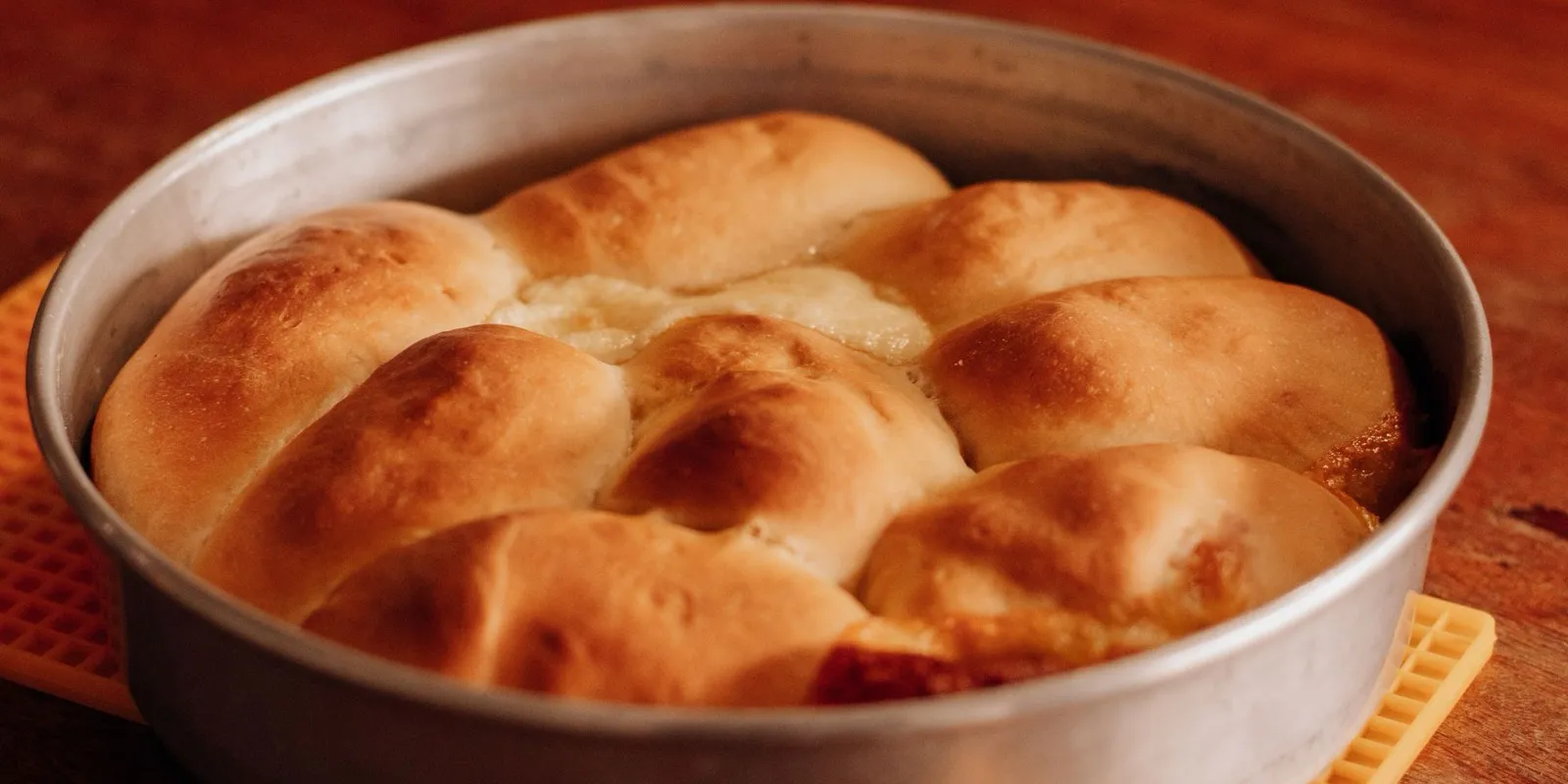
- Bake. Preheat to 375°F/approximately 190°C. Begin checking around 22 minutes; that is an inspection point, not a guaranteed completion time. Look for colored tops and set sides and centers. A thermometer can add information, but 190°F alone does not prove this exact formula is fully baked. If the tops brown before the center is ready, tent loosely with foil and continue checking.
- Finish and cool. Brush with the finishing butter and add flaky salt if wanted. Allow the crumb to set before pulling apart. Cool completely before wrapping for storage.
Plan Around the Dough
For an overnight version, plan a first day for starter preparation, mixing and observed fermentation, followed by a covered refrigerated pause and time the next day to finish fermentation, shape, proof and bake. Keep the refrigerator at 40°F/4°C or colder, consistent with FDA refrigerator guidance. That temperature recommendation is not a validated fermentation timetable for this dough.
A shaped refrigerated pause is another possibility, but the point at which to refrigerate and the final proof need testing. King Arthur’s cold-fermentation guidance explains the general options; a refrigerator does not stop dough expansion instantly. Do not assume every pan will tolerate moving directly from cold storage into a hot oven.
Feed the starter according to its established routine and use it when it shows consistent activity: rise, bubbles and a change in texture. Being fed within the past eight or twelve hours is not itself proof of readiness. Our feeding schedule guide explains that variability. Discard may contain living yeast, but its age and condition make it an unreliable direct replacement here; use a purpose-designed discard recipe instead.
For making rolls well ahead, fully bake, cool and freeze portions tightly wrapped, then thaw and warm for serving. The exact par-bake temperature and reheating time for this formula have not been established. Do not use an arbitrary internal temperature as a universal partial-baking endpoint.
Softness, Storage and Variations
Staling involves starch recrystallization and changes in water distribution; moisture loss can also affect eating quality. Sourdough can slow firming in some formulas, but acidity alone is not a guarantee. An original study comparing sourdough with chemical acidification found the effect depended on fermentation and the cultures used. A 2024 experiment likewise studied particular cultures and formulations, not these dinner rolls. We cannot promise this batch stays soft for a set number of days or beats every yeasted version.
Wrap fully cooled rolls for short-term storage and freeze portions you will not eat soon. For the general mechanisms, see why bread goes stale. The stale bread playbook offers uses for bread that has lost freshness.
Whole-wheat substitution changes absorption and dough development; an automatic extra 15 g milk has not been tested here. Garlic seasoning, garlic butter, or a braided challah-style loaf also make variations to test, with a different bake time for a larger loaf. Our yeasted dinner rolls provide a separate formula to compare.
Frequently Asked Questions
- Can I add commercial yeast?
- Starter and commercial yeast can be used together, as in established hybrid sourdough-roll recipes. Adding yeast changes the timetable but does not erase the starter's flavor. Use a formula designed for both instead of guessing a dose and keeping this schedule unchanged.
- Why might the rolls be dense?
- Possible causes include limited starter activity, insufficient fermentation or proofing, a dough that is too firm, inadequate development, overproofing, or an incomplete bake. This formula's liquid level still needs testing. Review dough expansion and consistency as well as the starter; a finger dent cannot isolate the cause.
- Will they taste sour?
- The level of tang depends on the starter, flour, fermentation and your taste. Enrichment does not guarantee mildness. A longer refrigerated stage can change the flavor, but cooler dough is not a universal switch to more acetic acid.
- Can I bake sourdough dinner rolls the same day?
- Yes, with a ripe starter and a suitable tested formula and schedule. This exact formula has no validated four-to-five-hour bulk or mandatory two-to-four-hour final proof. Temperature matters, but readiness depends on the dough's actual development and fermentation.
- What internal temperature proves enriched rolls are done?
- There is no single temperature that proves every enriched roll is done. King Arthur uses 190°F for one tested soft-roll recipe, while other formulas use higher temperatures. Assess the center roll along with structure and color; 195°F is not a universal threshold at which rolls turn tough.
King Arthur’s doneness guidance explains why a center temperature can be reached before baking is complete.