This sourdough cookie base uses 230g flour, 170g butter, 240g mixed sugars, one egg, and 120g of 100%-hydration discard. The discard contributes 60g each of flour and water plus variable acidity. Five variations change the mix-ins and ingredient balance. Chill the dough until firm, and bake a trial cookie before committing a whole tray to a timing estimate.
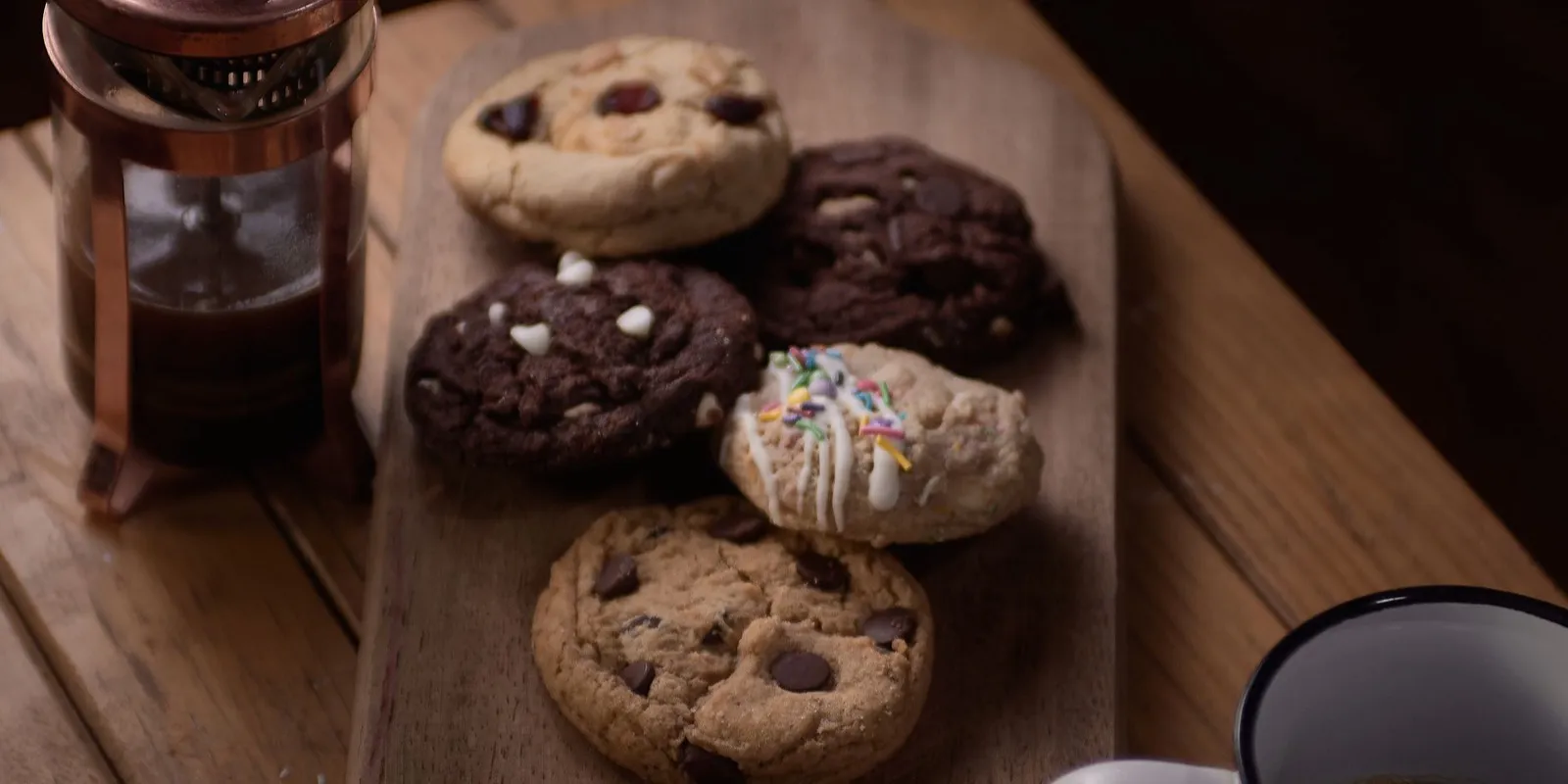
One base dough can organize a cookie tin around five flavors: chocolate chunk, oatmeal raisin, snickerdoodle, double chocolate, and peanut butter. The useful constant is the weighed discard; the variations do change fat, flour, water, and acidity, so they will not behave identically.
These are starting formulas, not a documented set of controlled baking trials. Keep the ingredient weights consistent on your first batch, note the discard’s condition, and bake one trial cookie to check spread and doneness. For a separately published recipe, King Arthur’s sourdough chocolate chip cookies are another option; their formula is different from this one.
What Discard Contributes
As with discard muffins, count the flour and water in the starter as ingredients, rather than an extra flavoring added on top.
| Contribution | What it means in this dough |
|---|---|
| Acidity | Can add tang and react with baking soda to release carbon dioxide; its amount varies with starter and storage |
| Flour | 120g of 100%-hydration discard contributes 60g flour, making 290g total in the base |
| Water | The same discard contributes about 60g water, affecting dough consistency, hydration, and spread |
| Fermentation products | Contribute flavor; their effect is not identical to salt, espresso, or browned butter |
Acid does not itself drive stronger Maillard browning. Higher pH generally favors that reaction, and baking soda can raise dough pH; this ACS cooking-chemistry lecture explains that relationship. The final balance depends on the complete dough, including brown sugar and any cocoa or cream of tartar. A starter’s pH alone cannot establish how much soda it will neutralize.
Similarly, fermentation can modify proteins in the starter, but that does not guarantee a tender cookie or predict its spread. Mixing, flour, fat, sugar, portion size, and baking also matter. There is no measured basis here for assigning every discard batch a particular pH or a fixed texture outcome.
The Base, in Baker’s Terms
Against 290g total flour, 170g butter is 58.6% and 240g sugar is 82.8%. The base weighs 827g before mix-ins.
Using illustrative water contents of 75% for the egg and 16% for butter, discard plus egg contribute 97.5g water, or 33.6% of flour weight. Adding the butter’s estimated 27.2g raises that to 124.7g, or 43.0%. This is an approximation for those ingredients, not a measured total: vanilla and brown sugar also contain some water, and ingredient composition varies. Cookie texture cannot be inferred from that percentage alone.
Salt remains a separate flavoring and functional ingredient; it does not do the same chemical job as discard acid. See salt in bread for the bread-specific role.
Choose Suitable Discard
Use discard from a healthy, established starter, stored cleanly and refrigerated when saved for later. Do not use the early discards from a new culture that is not yet established. King Arthur’s discard guidance makes this distinction.
If there is mold, pink or orange discoloration, or an abnormal rotten smell, discard the entire affected batch; do not scrape off a patch and bake the rest. CSU Extension’s starter guidance also distinguishes normal alcoholic liquid from mold. Appearance alone cannot prove food safety. Do not taste starter or raw cookie dough: FDA identifies both flour and eggs as potential raw-food hazards.
The Recipe
Yield: about 15–20 cookies depending on variation | Prep: about 15 minutes | Chill: at least 2 hours, until firm | Bake: 375°F (190°C); begin checking at 11 minutes. The 11–13-minute range is a starting estimate, not a guarantee for every variation.
Ingredients:
- 230g all-purpose flour
- 4g baking soda
- 5g fine sea salt
- 170g unsalted butter, softened
- 140g dark brown sugar
- 100g granulated sugar
- 50g egg (1 large)
- 120g sourdough discard (100% hydration)
- 8g vanilla extract
- mix-ins per the variation table below
Method: Choose a variation first and apply its flour, sugar, butter, and dry-ingredient adjustments before mixing. The structured recipe describes the chocolate chunk version.
- Whisk the chosen variation’s flour and other dry ingredients with 4g baking soda and 5g salt.
- Cream the chosen variation’s butter and sugars until light, about 3 minutes. The base uses 170g butter, 140g brown sugar, and 100g granulated sugar.
- Beat in 50g egg, 120g discard, and 8g vanilla until smooth.
- Fold in dry ingredients, then the variation’s mix-ins.
- Cover and refrigerate at 40°F or below for at least 2 hours, until firm. Keep dough chilled between trays.
- Preheat the oven to 375°F (190°C). Space 55g portions well apart on a parchment-lined baking sheet. Begin checking at 11 minutes; continue until the edges and tops are set and the centers are baked through. Soft centers should not mean raw, wet dough. Adjust the timing for the variation, dough temperature, and oven.
- Cool 5 minutes on the sheet before racking.
Butter and Chocolate Choices
Butter: The base uses softened butter so it can be creamed with the sugar. Brown butter changes both flavor and water content. The loss depends on the butter and cooking endpoint, so neither a fixed 20g loss nor 10g of milk is a reliable correction. For a first batch, keep the softened butter. If you want browned butter, use a formula designed around its finished weight and consistency; cooled brown butter can be creamed again when sufficiently firm. King Arthur’s brown-butter guidance describes different ways to handle that substitution.
Chocolate: Chips tend to hold their outline, while chopped bars create pieces of different sizes and larger melted pockets. A half-and-half mix is one option. All-bar cookies do not inevitably collapse, and all-chip cookies are not inherently less flavorful. Choose a chocolate you enjoy; 55–70% dark chocolate is a useful preference range rather than a cutoff above which the recipe fails.
The Five Variations
| Variation | Add | Adjust | Yield (55g) | Note |
|---|---|---|---|---|
| Chocolate chunk | 280g chopped chocolate | none | ~20 | The reference version — see the bakery-style upgrade below |
| Oatmeal raisin | 140g rolled oats, 120g raisins, 3g cinnamon, 30g milk | drop flour to 180g | ~19 | The oats and added milk change water binding and texture; assess the trial cookie rather than assuming an exact flour equivalence |
| Snickerdoodle | 2g cream of tartar in the dry mix; roll in 50g sugar + 6g cinnamon | drop brown sugar to 100g, granulated up to 140g | ~15 | Cream of tartar adds a known acidic ingredient; variable discard acidity does not make it an exact substitute. Yield excludes coating sugar |
| Double chocolate | 40g Dutch cocoa, 200g chocolate chunks | drop flour to 190g | ~19 | Cocoa differs from flour in starch, fat, and pH; this substitution needs its own spread and texture check |
| Peanut butter | 180g creamy peanut butter | drop butter to 115g | ~17 | PB adds fat and solids. Crosshatch before baking and check independently; natural and stabilized peanut butters can behave differently |
Every variation retains 120g discard and 4g soda, with at least a 2-hour refrigerated chill. That common amount does not prove identical acid balance across all five formulas. At 55g per portion, yield follows dough mass, not mix-in volume: approximately 1107g chocolate chunk, 1070g oatmeal raisin, 829g snickerdoodle before coating, 1027g double chocolate, and 952g peanut butter. Allow for a small remainder and dough left in the bowl.
The Flagship: Bakery-Style Chocolate Chunk
The chocolate chunk row above is the reference version. For the richer, bakery-style cookie — crisp edges, fudgy center, deeper color — upgrade the base: bump flour to 250g, brown sugar to 150g, and salt to 6g, add one egg yolk (18g), and use 300g of chocolate, half chopped bar and half chips. The yolk adds fat and emulsifiers; the extra flour changes structure. This is a separate variation, so check its spread and timing with a trial cookie. Its 1176g of dough makes about 21 portions at 55g.
The balance changes with the additional yolk, flour, sugar, and chocolate. Mild discard may give a subtle fermented note; more acidic discard can taste tangy. Sugar quantity alone cannot guarantee that sourness will be undetectable.
Chilling and Storage
Keep the 2-hour chill as the starting schedule for this dough, extending it if the dough is not yet firm. Chilling firms fat and allows hydration; it does not remove the discard’s water. King Arthur’s direct chilling comparison found changes in spread, color, and flavor, but it does not establish that this formula is always better at 24 hours or best at 48 hours.
Refrigerate covered dough at 40°F (4°C) or below. An overnight rest is an option; bake or freeze within the USDA’s 2–4-day guidance for homemade cookie dough. For longer storage, freeze scooped portions airtight; USDA gives about 2 months for quality. Freezing does not make raw dough safe to eat. Bake frozen portions until done, allowing extra time rather than assuming exactly two additional minutes.
Once baked and completely cooled, store the unfilled cookies airtight. Plan to enjoy them within a few days for quality, or freeze for longer storage. There is no controlled evidence here that discard extends this cookie’s keeping quality by one or two days. Bread staling research cannot establish that result for a high-fat cookie; see why bread goes stale for the different bread system. Discard banana bread is another recipe category with its own moisture and storage considerations.
Troubleshooting
Too flat: Check the weights, butter consistency, dough temperature, hot baking sheets, and oven temperature. Stir sound 100%-hydration discard homogeneous before weighing; its thickness alone does not reveal hydration because fermentation changes its structure. A normal hooch layer can be stirred in or poured off, but doing the latter changes the ingredient balance. For starter care, see how to make and maintain a starter.
Too cakey: Check flour measurement, portion size, and baking time before changing the formula. Reducing discard from 120g to 100g would remove about 10g each of flour and water plus some acidity; it is not a universal cure.
Gummy center or dry cookie: Check doneness on a cooled trial cookie. If the center remains raw or paste-like, bake the next tray longer rather than deliberately pulling it earlier. If it is dry throughout, shorten the next bake while still cooking it through. Cookies and loaves cool differently; our gummy sourdough guide does not provide a cookie-doneness test.
If your discard jar is deeper than one batch, the rest of the roster — pancakes, muffins, scones, crackers — is in the discard hub.
Frequently Asked Questions
- Do these cookies taste like sourdough?
- They can. Flavor depends on the discard's acidity, storage, and the variation. Mild discard may contribute a subtle fermented note; more acidic discard can make the cookies noticeably tangy. The sugar amount does not guarantee that sourness disappears.
- Does the discard need to be fed or active?
- It need not be freshly fed, but it must come from a healthy, established starter. This dough uses chemical leavening and creamed-in air rather than a planned yeast rise. Healthy fed starter at the same hydration can also be used, though its acidity may differ.
- How old can the discard be?
- There is no proven 7–10-day sweet spot for these cookies. Use cleanly stored, refrigerated discard from an established starter. Its age alone cannot certify safety. Discard the entire affected batch if you find mold, pink or orange discoloration, or an abnormal rotten smell; do not taste it raw.
- Can I skip the chill?
- Keep the recipe's at-least-2-hour chill for your first batch and wait until the dough is firm. Chilling can limit spread by firming fat and allowing hydration. It is a recipe step, not a universal requirement that every sourdough cookie needs exactly two hours.
- Why does the dough feel wet?
- The 120g of 100%-hydration discard contributes about 60g of water and 60g of flour. Butter condition, egg size, and the selected variation also affect softness. Weigh ingredients and chill until firm; starter thickness alone does not establish its water percentage.
- Why is there no baking powder?
- The base specifies baking soda, which reacts with acidic ingredients and affects pH. That choice does not prove that every discard supplies exactly enough acid for 4g of soda. Baking powder contains its own acid and can be used in chewy-cookie formulas too; it does not automatically make a cookie cakey. Do not substitute the two by equal weight.
- Can I use whole wheat or bread flour?
- Those are further recipe variations. Bread flour and whole wheat change protein, flavor, and water absorption, so identical height or chew is not guaranteed. Start with a partial substitution and a trial cookie; there is no verified universal 15–20g milk correction for a full swap in this formula.