Sourdough discard turns banana bread into a taller, tenderer, tangier loaf. Discard sits at pH 3.5-4.5 -- more acidic than buttermilk -- so it fires the baking soda harder for a bigger dome, softens the gluten for a cake-like crumb, and adds a subtle creamy tang. This is a one-bowl recipe: mash bananas, whisk in discard and wet ingredients, fold in the dry, and bake at 350F for 55-65 minutes.
Before you buy or bake
- Naturally gluten-free is not the same as gluten-free
- Rice, buckwheat, sorghum, teff, millet, and oats carry no gluten as crops, but they are routinely grown, stored, transported, and milled alongside wheat. The grain being naturally gluten-free is necessary and not sufficient — what matters is the finished bag. Buy flours that carry a gluten-free label, and note that several major brands decline to label some naturally gluten-free flours precisely because of supply-chain cross-contact.
The jar of unfed starter in the back of your fridge is the single best thing you can add to banana bread. It is already at 100 percent hydration — equal weights flour and water — and its pH has dropped to somewhere between 3.5 and 4.5, which is more acidic than buttermilk. That acid is exactly what banana bread needs: it fires the baking soda harder for a taller dome, softens the gluten for a tenderer crumb, and adds a subtle creamy tang that balances the sweetness of very ripe bananas.
This recipe is one bowl, one spoon, and about 70 minutes start to cooled loaf. There is no creaming of butter, no sifting, no separated eggs. You are trading the usual buttermilk for discard and letting the chemistry do the lifting.
A note on “discard”: in this recipe it means unfed, mature starter pulled straight from the jar, not ripe peaked starter used for leavened breads. Discard is past-peak. Its wild yeast is exhausted, but its acid and flavor are maxed out — which is what we want for a quick bread leavened by baking soda.
Why Discard Works in Quick Bread
Three things happen when you fold discard into a banana bread batter.
Baking soda gets more lift. Baking soda needs acid to fizz. A batter’s pH determines how much CO2 the soda can release. Ripe discard sits at pH 3.5 to 4.5 — significantly more acidic than buttermilk (roughly 4.4 to 4.8) or yogurt (4.0 to 4.5). More acid means a faster, more complete neutralization reaction in the oven, which translates to a taller dome and a lighter crumb.
Gluten goes slack. Mild protease activity and low pH together weaken the gluten network. In bread you fight this; in quick breads it is the goal. A slack batter bakes into a tender, cake-like crumb instead of a chewy, gummy one. This is why buttermilk and sour cream show up in every serious banana bread recipe — discard is the same mechanism, turned up.
Flavor deepens. Lactic acid contributes a mild creamy sourness; acetic acid contributes a sharper vinegary note. The balance is a product of fermentation: fresh, warm discard leans lactic; week-old cold discard leans acetic. Either works in banana bread, but if yours has been sitting more than five days, cut the quantity back by 20 percent to keep the tang from pushing past pleasant.
The discard also contributes flour and water to the formula — 120 g of discard is 60 g flour plus 60 g water. Because discard runs at 100 percent hydration, the recipe below accounts for that in the totals so the loaf does not come out wet.
This is a wheat recipe. That 60 g of flour inside the discard is wheat flour, so this loaf is not gluten-free and is not appropriate for anyone with celiac disease or a wheat allergy — swapping the all-purpose flour for a gluten-free blend does not change that, because the discard stays in. A genuinely gluten-free version needs gluten-free discard as well, from a starter cultured on gluten-free flours.
Ingredients
Makes one 9x5-inch loaf.
| Ingredient | Grams | US measure |
|---|---|---|
| All-purpose flour | 190 g | 1 1/2 cups |
| Light brown sugar | 150 g | 3/4 cup packed |
| Fine sea salt | 4 g | 3/4 tsp |
| Baking soda | 5 g | 1 tsp |
| Ground cinnamon | 2 g | 3/4 tsp |
| Very ripe bananas, mashed | 340 g | 3 medium bananas |
| Sourdough discard, 100 percent hydration | 120 g | 1/2 cup |
| Neutral oil or melted butter | 80 g | 1/3 cup |
| Large eggs | 100 g | 2 eggs |
| Vanilla extract | 5 g | 1 tsp |
| Toasted walnuts, chopped (optional) | 80 g | 3/4 cup |
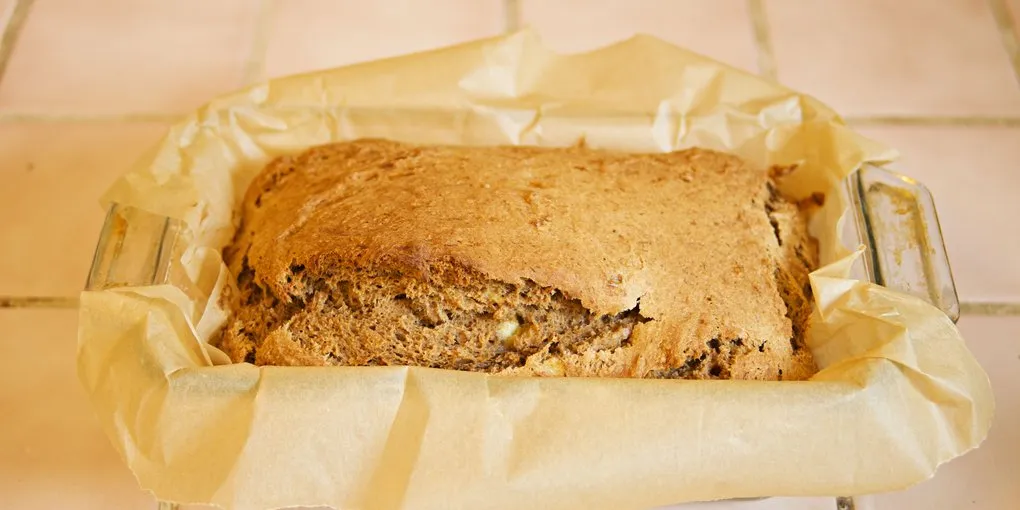
Total batter weight: roughly 1,075 g. The loaf will rise to the top of a 9x5 pan with a dramatic crack down the center.
A note on bananas: you want them black-spotted at minimum, fully black skin if possible. Green and yellow bananas are mostly starch; black bananas have converted that starch to sugar and developed volatile flavor compounds (mainly isoamyl acetate — the banana ester). If yours are not ripe enough, bake them in the skin at 300 F for 15 to 20 minutes until the skin blackens and the flesh softens.
Method
Step 1 — Preheat and prep the pan. Heat oven to 350 F (175 C). Grease a 9x5-inch loaf pan and line it with a parchment sling so you can lift the loaf out later.
Step 2 — Whisk the dry ingredients. In a medium bowl, whisk 190 g flour, 4 g salt, 5 g baking soda, and 2 g cinnamon until fully combined. Lumps of baking soda will leave bitter streaks in the finished loaf, so break them up now.
Step 3 — Mash and mix the wet ingredients. In a large bowl, mash 340 g bananas with a fork until mostly smooth — small lumps are fine. Whisk in 150 g brown sugar, 80 g oil, 100 g eggs, 120 g discard, and 5 g vanilla. The batter will look slightly curdled; that is the acid reacting with the fat. Keep going.
Step 4 — Combine wet and dry. Pour the dry into the wet. Fold with a spatula until no streaks of flour remain — roughly 20 to 25 strokes. Stop the moment it is uniform. Over-mixing develops gluten and turns the crumb rubbery. If using walnuts, fold them in with the last five strokes.
Step 5 — Scrape into the pan. Transfer the batter to the prepared pan. Rap the pan on the counter twice to settle it and pop surface bubbles. The batter should reach about three-quarters of the way up the sides.
Step 6 — Bake. 55 to 65 minutes at 350 F, until a skewer inserted into the center comes out with a few moist crumbs but no wet batter. Internal temperature should read 200 to 205 F. The top will crack down the middle; this is correct. If the top is browning too fast at 40 minutes, tent with foil.
Step 7 — Cool in the pan for 15 minutes, then lift out. Pull the parchment sling, transfer to a wire rack, and cool another 30 minutes before slicing. The structure is still setting while warm — cut it now and it will crumble and taste raw in the center.
Doneness cues: deep mahogany top, fully split crack, internal temp 200 to 205 F, clean skewer with a few moist crumbs. If the center is still pale and domed when the edges are dark, bake 5 more minutes and re-check.
One Base, Three Routes: Discard Banana Bread
Same wet/dry ratio -- change one thing, change the loaf
Classic Walnut
- Mix-in
- 80 g toasted walnuts
- Spice
- 2 g cinnamon
- Bananas
- 340 g very ripe
- Bake
- 350F, 55-65 min
- Toast walnuts at 300F for 8 minutes before folding in.
- Fully black bananas give the deepest banana flavor.
Chocolate Chip
- Mix-in
- 150 g dark chocolate chips
- Spice
- Reduce cinnamon to 1 g
- Bananas
- 340 g very ripe
- Bake
- 350F, 55-65 min
- Cinnamon fights the chocolate -- keep it minimal.
- Fold chips in last to keep them distinct in the crumb.
Seeded & Oaty
- Mix-in
- 40 g oats + 40 g pumpkin seeds
- Sugar
- Reduce to 120 g
- Bananas
- 340 g very ripe
- Bake
- 350F, 60-70 min
- Less sweet, more texture -- good for breakfast.
- Sprinkle extra seeds on top before baking for a crunchy crust.
Discard pH 3.5-4.5. The acidic batter fires baking soda harder for a taller dome; acid also weakens gluten for a tenderer, more cake-like crumb.
jayarrbread.comNotes and Variations
Discard age. Refrigerated discard is good for roughly 7 days. After that, acetic-acid character dominates and can push the loaf past pleasant tang. Cut to 100 g and add 20 g milk if yours is that old. Hooch on top (clear or brown liquid) is fine — stir it back in.
Chocolate chip variation. Fold in 150 g dark chocolate chips in place of walnuts. Reduce cinnamon to 1 g; it fights the chocolate.
Whole-wheat discard. If your starter is fed whole-wheat, expect a darker, earthier loaf. Everything else stays the same.
Bigger crack, taller dome. Run a thin knife down the center of the batter after it has set for 20 minutes in the oven, splitting the skin. This gives you a controlled crack instead of a volcanic one.
Storage. Wrapped in plastic at room temperature, 4 days. Wrapped and refrigerated, 7 days. Freezes well for 3 months; slice first so you can pull single slices as needed.
Make-ahead. Batter can sit in the loaf pan, covered, for up to 4 hours in the fridge before baking. The discard keeps working — flavor deepens, rise drops slightly.
For more ways to clear your discard jar, see our sourdough discard recipes roundup. To build a healthy starter that produces good discard in the first place, start with how to make sourdough starter.
Frequently Asked Questions
- Can I use fed starter instead of discard?
- You can, but the loaf will be less tangy and the crumb slightly tighter. Fed, peaked starter has lower acidity (closer to pH 4.5) because the lactic acid bacteria have not had hours to accumulate organic acids. That means less gluten softening and less baking-soda neutralization. For the tall dome and cake-like crumb this recipe targets, unfed discard is the better tool.
- How ripe do the bananas need to be?
- Black-spotted at a minimum, fully black if possible. Green and yellow bananas are mostly starch and will taste flat. Black bananas have converted most of that starch to sugar and developed the isoamyl acetate ester that reads as banana flavor on the palate. If yours are only yellow, bake them in the skin at 300 F for 15 to 20 minutes until the skin blackens and the flesh softens -- this is the fastest shortcut.
- Why did my banana bread come out gummy in the middle?
- Three usual suspects. One, under-baked -- the center should read 200 to 205 F internal, and a skewer should come out with only a few moist crumbs. Two, over-mixing -- developing gluten in a quick-bread batter turns it rubbery and can trap a gummy zone around the crumb. Three, too much banana -- if your bananas were unusually large, you may have exceeded the 340 g target and pushed hydration too high.
- Can I cut the sugar?
- You can drop to 120 g brown sugar without changing the structure. Going below that risks a pale, under-browned crust because Maillard browning depends on reducing sugars. If you want less-sweet banana bread, do 120 g sugar and swap 30 g of the flour for rolled oats to add texture without adding sweetness.
- Can I make this with gluten-free flour?
- You can swap the flour, but doing so does NOT make this loaf gluten-free -- and that distinction matters if anyone eating it has celiac disease or a wheat allergy. The 120 g of sourdough discard is wheat, it stays in the recipe, and it contributes roughly 60 g of wheat flour to the batter. Swapping the all-purpose flour alone leaves a loaf that is not safe for anyone avoiding gluten. For a genuinely gluten-free version you need BOTH a gluten-free flour blend and gluten-free discard from a starter cultured on rice, sorghum, or another labeled gluten-free flour -- see our gluten-free sourdough starter guide. If you are simply reducing wheat by preference rather than for a medical reason, the flour swap works with two tweaks: add 5 g extra baking soda (10 g total) because GF batters are denser, and let the batter rest in the pan 10 minutes before baking, since hydration is slower without wheat gluten. Expect a slightly more crumbly texture.