Sourdough discard makes an excellent same-day pizza crust. The discard -- mature, 100 percent hydration starter that has dropped to pH 3.5-4.5 -- contributes tang, gluten-relaxing tenderness, and faster crust browning, while a pinch of instant yeast handles the rise so you skip the 24-hour ferment. Mix and fold, bulk ferment 3-4 hours, ball and proof, then stretch and bake on a hot stone or steel at 500F or higher.
The jar of discard in your fridge is the best pizza-dough starter you are not using. It is already 100 percent hydration, already full of organic acids, and already packed with enzymes that have been working on the flour for hours or days. For a crust that wants tenderness and a subtle tang without a 24-hour ferment schedule, discard is the perfect short-circuit.
This recipe is not a pure sourdough pizza — the levain in true naturally-leavened pizza is peaked and active. Discard is past-peak and acidic. The distinction matters. To get same-day timing and reliable oven spring, we use discard for flavor plus a pinch of instant yeast for lift. You can go pure-wild if you want to plan 12 hours ahead, and the notes cover that variation.
If you are running a full pizza night, the dough comes together in ten minutes, needs four to five hours of bulk rise, then balls up and bakes. It is forgiving enough to stretch by hand and strong enough to top heavy. After one round you will stop buying store-bought crusts.
What Makes Discard Different
Discard is mature, unfed starter at 100 percent hydration — equal weights of flour and water. A healthy starter carries both wild yeast and lactic acid bacteria (Fructilactobacillus sanfranciscensis, Kazachstania humilis, and others), and over the hours between feedings the bacteria produce organic acids that drive pH down to roughly 3.5 to 4.5. That is more acidic than ripe starter at peak.
For pizza dough, that acidity is a feature, not a bug. Three things happen:
- Gluten relaxation. Acidic pH and mild protease activity soften the gluten network, which is why discard dough stretches without snapping back.
- Flavor depth. Lactic acid contributes a mild creamy tang; acetic acid contributes a sharper vinegary note. The balance skews toward lactic when discard is warm and fresh and toward acetic when it is cold-stored in the fridge for several days.
- Crust browning. Organic acids accelerate Maillard reactions at oven temperatures, giving you better blister and char in the same bake time.
The downside: discard has almost no leavening power. Wild yeast in mature discard is exhausted. This is why we add 0.3 percent instant yeast — enough to do the lifting while letting the discard carry the flavor.
Ingredients
Makes two 12-inch pizzas (about 500 g dough balls).
| Ingredient | Grams | US measure |
|---|---|---|
| Bread flour (12-13 percent protein) | 400 g | 3 cups + 2 tbsp |
| Sourdough discard, 100 percent hydration | 200 g | 3/4 cup + 1 tbsp |
| Water, 85 F | 200 g | 3/4 cup + 1 tbsp |
| Fine sea salt | 10 g | 1 3/4 tsp |
| Instant yeast | 1.5 g | 1/2 tsp |
| Olive oil | 15 g | 1 tbsp |
Total dough weight: 826 g. Hydration (including flour and water contributed by discard): 70 percent.
Flour note: bread flour gives the chew you want in a pizza crust. All-purpose works but produces a softer, focaccia-adjacent texture. 00 flour (Caputo Pizzeria or similar) is the Italian standard but absorbs less water — reduce water by 10 g if using it.
Try It Yourself
The Baker's Bench
Scale this dough for any number of pizzas -- the Baker's Bench tool adjusts every weight and keeps the baker's percentages intact.
Open ToolMethod
Step 1 — Autolyse the flour and discard. In a large bowl, whisk 400 g bread flour with 200 g discard and 200 g water. Cover and rest 20 minutes. The flour will hydrate fully and the enzymes in the discard will start softening the gluten, which saves kneading time. Do not add salt or yeast yet. If you want the full rationale for this rest, see our guide to the autolyse.
Step 2 — Mix in salt, yeast, and oil. Sprinkle the 10 g salt and 1.5 g yeast over the dough. Drizzle in the 15 g oil. Pinch the dough with wet fingers for 2 minutes to incorporate — the Forkish pincer method works well here. The dough should come together as a shaggy, slightly tacky mass.
Step 3 — Strengthen with folds. Over the next 60 minutes, perform three sets of stretch-and-folds at 20-minute intervals. Wet your hand, grab a quadrant of dough, stretch it up, and fold it over. Rotate the bowl, repeat for all four quadrants. By the third set the dough should feel smooth and elastic.
Step 4 — Bulk fermentation. Cover and rest at 75 to 78 F for 3 to 4 hours, until the dough has grown by roughly 50 to 75 percent. It will not triple — the yeast load is intentionally low. You are looking for a domed, jiggly, bubbled dough, not a frothy one.
Step 5 — Divide and ball. Turn the dough onto a lightly floured counter. Divide into two 400 g pieces (or three 275 g pieces for thinner 10-inch pies). Shape each into a tight ball by dragging it on the counter under a cupped hand. Place seam-side down on a floured tray or in individual proofing containers.
Step 6 — Bench proof. Cover with plastic or a damp towel and rest for 60 to 90 minutes at room temperature. The balls should be puffy and jiggle when nudged. Alternative: refrigerate up to 48 hours for deeper flavor; pull out 60 minutes before stretching.
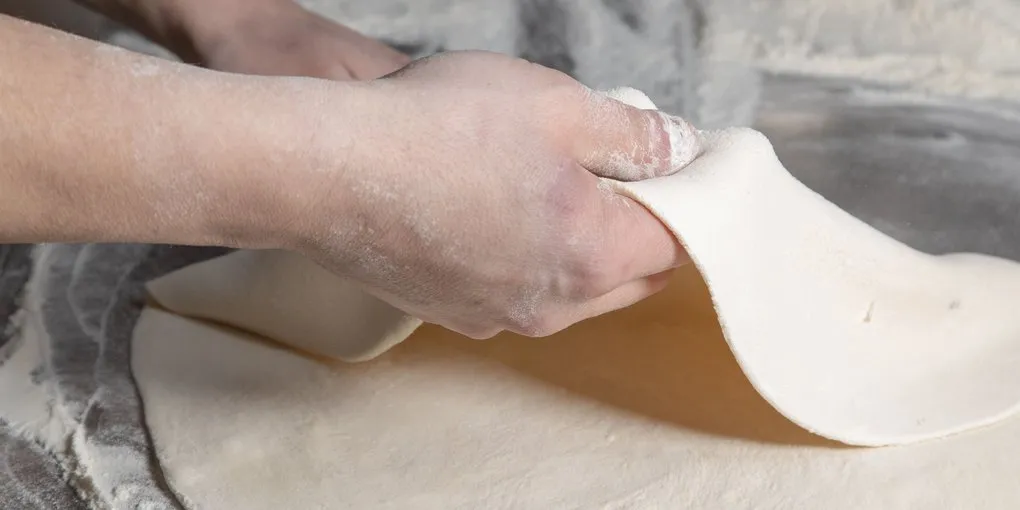
Step 7 — Stretch and top. Flour the counter. Press each ball flat with fingertips, leaving a raised edge. Stretch gently by draping over fists and gravity-pulling, or by pressing outward on the counter. Do not roll — rolling pins crush the gas bubbles you spent hours building. Aim for 11 to 12 inches, roughly 1/4 inch thick, with a thicker rim.
Step 8 — Bake. On a preheated pizza stone or steel at 500 F or higher, 7 to 9 minutes until the rim is blistered, the underside is spotted dark brown, and the cheese is just past melting. A 1-inch Baking Steel at 550 F and 6 minutes is closer to Neapolitan territory; a stone at 500 F runs 8 to 9 minutes.
Doneness cues: leopard-spotted rim, crisp-but-chewy bottom that holds its weight without flopping, cheese with a few brown freckles. If the rim browns but the center is pale, your stone is not hot enough — preheat 45 minutes next time. If the bottom chars before the cheese melts, move the rack up a notch.
Same-Day Discard Pizza: 5-Hour Timeline
From jar to oven in one afternoon -- discard for flavor, a pinch of yeast for rise
- 01
Autolyse
20 minutesWhisk flour, discard, and water. Rest 20 minutes.
Flour fully hydrates; enzymes in the discard soften gluten before kneading. - 02
Mix & fold
60 minutesAdd salt, yeast, oil. Pincer-mix 2 min, then 3 stretch-and-folds at 20-min intervals.
Dough should feel smooth and elastic by the third fold. - 03
Bulk ferment
3-4 hours at 75-78FRise until dough grows 50-75 percent. Domed, jiggly, bubbled surface.
Will not triple -- intentionally low yeast load. - 04
Divide & ball
5 minutesTwo 400 g balls or three 275 g balls. Tighten against the counter.
Seam-side down; lightly flour the tray. - 05
Bench proof
60-90 minutesCover and rest at room temperature until puffy.
Alternative: refrigerate 24-48 hours for deeper flavor; warm 60 min before stretching. - 06
Stretch & bake
6-9 minutesHand-stretch to 11-12 inches. Bake on stone or steel at 500F+.
Leopard-spotted rim and dark bottom; never roll with a pin.
Same-day hybrid (this recipe)
- 200 g discard + 1.5 g instant yeast
- 4-5 hour total time
- Reliable rise, moderate tang
- 70 percent hydration
Pure sourdough variation
- 250 g ripe peaked starter, no yeast
- 8-10 hour bulk at 75 F, or overnight in fridge
- Assertive sourdough flavor
- Same hydration and bake
Discard pH 3.5-4.5. Acidity softens gluten, relaxes the stretch, and accelerates crust browning in the oven.
jayarrbread.comNotes and Variations
Pure sourdough version. Skip the instant yeast and use 250 g of ripe, peaked starter instead of 200 g of discard. Bulk fermentation runs 8 to 10 hours at 75 F, or overnight in the fridge (10 to 14 hours at 38 F). Flavor is more assertive.
Discard age. Refrigerated discard is good for about a week. The longer it sits, the more acetic-acid character it develops (sharper, vinegary). Week-old discard can push the dough past pleasant tang into “too sour” — cut it to 150 g and add 50 g extra water.
Whole-wheat discard. If your starter is fed whole-wheat, the discard will be darker and earthier. Reduce water by 5 to 10 g because whole-wheat absorbs more. Expect slightly slower rise.
Scaling. The recipe doubles cleanly. If you are feeding a crowd, mix 1,650 g total dough weight, divide into four or five balls, and stagger the bakes so each pie hits the oven hot.
Storage. Dough balls hold 48 hours in the fridge and 3 months in the freezer (wrap tightly, thaw overnight in the fridge, proof 2 hours at room temp before stretching).
Cross-domain note: if you want to take this further, our sister site has a full guide to pizza oven thermodynamics and dough chemistry that goes deep on heat transfer and crust structure.
For more ideas from your discard jar, see our sourdough discard recipes roundup. To build and maintain the starter in the first place, start with how to make sourdough starter and the sourdough feeding schedule.
Frequently Asked Questions
- Can I use discard straight from the fridge?
- Yes. Cold discard slows the mix slightly but works fine -- the water in the recipe is 85 F, which evens out the dough temperature. If your discard has been refrigerated for more than 5 days, expect a sharper, more acetic flavor; cut it to 150 g and add 50 g extra water to soften the tang.
- How old can my sourdough discard be?
- Refrigerated discard stays usable for about 7 days in a covered jar. Past that, the acetic acid character dominates and the flavor pushes toward too sour. If you see a layer of clear-to-brown liquid (hooch) on top, stir it back in -- that is alcohol from wild yeast metabolism and it is fine. Black, pink, or fuzzy mold means toss the whole jar.
- Can I skip the instant yeast and go pure sourdough?
- Yes, but you trade same-day timing for an 8 to 10-hour bulk fermentation. Replace the 200 g discard with 250 g ripe, peaked starter (active, doubled in 4 to 6 hours), skip the yeast, and bulk at 75 F until the dough rises 75 to 100 percent. Flavor is more assertive.
- Does this recipe work with whole-wheat discard?
- Yes. Whole-wheat discard makes a darker, nuttier crust. Reduce water by 10 g because whole-wheat absorbs more than white flour. Expect a slightly slower rise and a tighter crumb -- the bran fragments sever some gluten strands.
- Can I freeze the dough balls?
- Yes. Shape into balls, wrap tightly in plastic, and freeze up to 3 months. Thaw overnight in the fridge, then bench-proof at room temperature for 2 hours before stretching. Do not freeze after stretching -- the gas bubbles collapse on thaw.