Real injera is made from one ingredient that matters -- teff -- fermented wild for two to three days, then poured onto a hot dry griddle and cooked on one side only. The long ferment (native yeasts and lactic acid bacteria on the teff grain, no commercial yeast) is what gives injera its tart flavor and its lacy surface of 'eyes.' Mix teff and cool water on day one, let it sour for 48 to 72 hours, thin it to a pourable batter, and cook each round about 90 seconds under a lid. No flipping.
Before you buy or bake
- Naturally gluten-free is not the same as gluten-free
- Rice, buckwheat, sorghum, teff, millet, and oats carry no gluten as crops, but they are routinely grown, stored, transported, and milled alongside wheat. The grain being naturally gluten-free is necessary and not sufficient — what matters is the finished bag. Buy flours that carry a gluten-free label, and note that several major brands decline to label some naturally gluten-free flours precisely because of supply-chain cross-contact.
Injera is the national bread of Ethiopia and Eritrea — a flat, flexible, spongy round that serves as plate, utensil, and bread simultaneously. A shared platter of injera is spread flat; mounds of wots (stews), tibs (sautes), and vegetables are spooned directly onto the surface; diners tear strips of additional injera to scoop up the toppings. The bread is sour, porous, cool to the touch, and stretchy like a thin pancake that has been fermented into something more complex. Made correctly, it looks like the surface of the moon — covered in thousands of tiny eyes (pores) that are the visible evidence of a two to three day wild fermentation.
Making real injera at home is harder than making most breads because of one ingredient: teff, a tiny ancient grain native to the Ethiopian highlands, the only flour that will produce genuine injera. It is also harder because of one technique: fermentation with wild yeasts and bacteria for 48-72 hours, followed by cooking on a wide flat griddle called a mitad. This recipe walks through both, including the compromises required for American home kitchens.
A quick note on tradition: injera is inseparable from a food culture shaped by roughly 180 Orthodox fasting days a year, on which meals are vegetarian and served entirely on injera. That larger story — the role of teff, the fasting calendar, and the communal platter — is its own subject, and we cover it in our Ethiopian bread culture and injera guide. This page is the recipe.
Why Teff, and Why the Wild Ferment
Teff (Eragrostis tef) has been cultivated in the Ethiopian highlands for at least 4,000 years. It is the smallest grain in widespread cultivation — 150 grains weigh less than a single grain of wheat — and it is the only flour that makes true injera. Its unique combination of starch composition and the endogenous microflora living on the grain is what makes injera injera; substitute oat, buckwheat, millet, or sorghum at 100% and you get a fermented flatbread that is not injera. Source teff from Ethiopian grocery stores, Amazon (look for Maskal Teff or Bob’s Red Mill whole grain teff flour), or specialty health stores; expect USD 6-10 per pound.
The fermentation is wild. No commercial yeast is added in traditional preparation — the native microorganisms on the teff grain itself (a mix of Saccharomyces cerevisiae, Candida species, and lactic acid bacteria including Lactobacillus plantarum and Lactobacillus brevis) drive a two to three day ferment that produces the sour flavor, the characteristic gray-brown color, and the carbon dioxide that leaves the surface pocked with eyes when it hits the griddle. The process is very similar to sourdough in its biology, though the ratio of yeasts to bacteria tends toward the bacterial end, which is why injera is more tart than most Western sourdoughs. Teff is a member of the same ancient-grain family covered in our ancient grains bread guide.
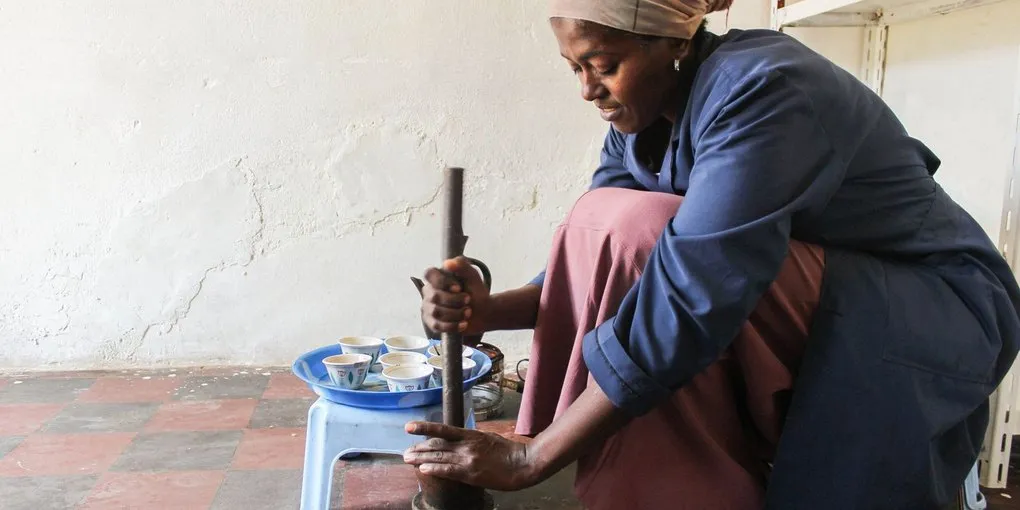
The mitad — a traditional clay griddle about 55 cm across, heated over a wood fire and covered with a woven grass lid — is the authentic cooking surface, now usually electric in modern Ethiopian homes. In an American home kitchen, the best substitute is a large nonstick crepe pan (30 cm or larger) or a wide cast-iron griddle. The result is a smaller round than authentic injera, but the texture can be correct.
Ingredients
This recipe yields 8-10 injera rounds, approximately 25 cm across.
The Ferment (Day 1)
| Ingredient | Grams | US measure |
|---|---|---|
| Ivory or brown teff flour | 500 | ~ 4 cups |
| Cool filtered water (non-chlorinated) | 750 | 3 1/4 cups |
Day 3 — Cooking
| Ingredient | Grams | US measure |
|---|---|---|
| Fermented teff batter (above) | all | all |
| Warm water, as needed | 100-200 | 1/2 to 1 cup |
| Fine salt | 5 | 1 tsp |
Notes on ingredients:
Teff flour. The critical ingredient. Ivory teff is lighter in color and slightly milder in flavor; brown teff is darker, earthier, and more commonly used in Ethiopia. Either works. Do not substitute with other flours at 100% — oat, buckwheat, millet, and sorghum all produce breads that are not injera.
Water. Must be non-chlorinated. Chlorine in tap water will kill or suppress the wild fermentation. Use filtered water, or leave tap water uncovered overnight to off-gas chlorine. Cool water is traditional — not warm — because the ferment is slow and deep, not fast.
A blend option for modern adaptation. If you want to stretch expensive teff, use 250g teff flour + 250g all-purpose flour. Note that this makes the injera no longer gluten-free — all-purpose flour is wheat, so the blended version is not appropriate for celiac disease or a wheat allergy. The resulting bread will be more pliable, slightly less sour, and visually paler — closer to what Ethiopian restaurants in the US typically serve. It is not traditional, but it is widely practiced.
The 72-Hour Injera Fermentation
Wild yeasts and lactic acid bacteria -- no commercial leavening
- 01
Mix
Day 1, Hour 0500g teff flour + 750g cool filtered water. Smooth batter, consistency of heavy cream. Cover loosely, place at 75-85F.
- 02
First bubbles
Day 1, Hour 12Surface dotted with small bubbles. A thin yellow liquid (essa) separates on top -- leave it. Yeasts are active; bacteria are establishing.
- 03
Active fermentation
Day 2, Hour 24Surface covered in bubbles. Yeasty smell, slightly sour taste. Yeasts produce CO2; bacteria produce lactic acid.
- 04
Sour stage
Day 2, Hour 48Distinctly tart with a yogurt-like smell. A gray-white haze on the surface is normal. Bacteria now dominate the culture.
- 05
Ready
Day 3, Hour 60-72Fully sour. Optional: make absit (cook 100g of batter into a thick paste, cool, stir back in). Add salt and thin with warm water to pancake consistency.
- 06
Cook on the mitad
Day 3Pour onto a hot dry pan, spiral-spread, and cover. Eyes form in 30-60 seconds. Cook about 90 seconds total, one side only -- no flipping.
Catch the ferment at the sour-yogurt stage. If it smells of nail polish or alcohol, it has gone too far -- start over.
jayarrbread.comMethod
Stage 1 — Mix the ferment (Day 1, Morning)
Whisk the teff flour and water together in a large non-reactive bowl (glass or food-grade plastic, not metal). The batter should be smooth and about the consistency of heavy cream. Cover loosely with a breathable cloth or a lid set askew — the ferment needs air exchange but should not be exposed to dust or fruit flies.
Place in a warm spot, ideally 75-85°F / 24-29°C. On top of a refrigerator, near a warm radiator, or in an oven with the light on all work. If your kitchen is cool, the ferment will take longer — up to 4 days at 65°F.
Stage 2 — Watch the fermentation (Day 1-3)
Day 1 evening: bubbles begin to form on the surface. A thin yellowish liquid will separate on top. This is normal and is called “essa” in Ethiopia — do not pour it off.
Day 2 morning: the surface is covered in bubbles. The smell is slightly yeasty, slightly sour, a bit like active sourdough starter. The essa layer is more defined.
Day 2 evening to Day 3 morning: the batter has risen, bubbled, and begun to smell distinctly sour — like plain yogurt or white vinegar. The surface may have a light gray-white haze; this is normal. If the batter smells of nail polish, alcohol, or rotten fruit, the ferment has gone too far; start over. If the ferment smells only faintly sour after 48 hours, give it another 12-24 hours in a warmer spot.
A correctly fermented batter tastes distinctly tart, smells yogurt-like, and has a surface of small bubbles that break when you stir.
Stage 3 — Traditional “absit” step (Day 3, Optional but Authentic)
Traditional Ethiopian injera uses an optional step: a portion of the fermented batter is cooked with water into a thick paste (called absit), cooled, and stirred back into the main batter. This pre-gelatinizes some of the starch, which helps the bread form its characteristic bubble structure and improves pliability.
To do absit: bring 200g water to a boil. Whisk in 100g of the fermented batter. Cook, whisking constantly, 2-3 minutes until the mixture thickens like pudding. Cool completely (15-20 minutes). Stir the cooled absit back into the main batter along with the salt. If you skip this step, the bread still works but the pores will be less pronounced. First-time injera bakers can skip it without disaster.
Stage 4 — Final batter consistency
Stir the fermented batter (with absit if using, plus salt). Add warm water gradually, 20-30g at a time, until the batter is the consistency of a thin pancake batter — about like heavy cream thinned slightly, or like a very loose crepe batter. This is the single most common failure point: too-thick batter gives a dense, pancake-like injera; too-thin batter tears on the griddle. Aim for a pour that coats the back of a spoon but drips off cleanly.
Stage 5 — Cook on the mitad (or substitute)
Heat a 30 cm (12-inch) nonstick crepe pan or wide cast iron griddle over medium-high heat until a drop of water dances and evaporates in 1-2 seconds. Do not oil the pan — injera is cooked dry.
Pour about 120-150g of batter into the center of the hot pan. Immediately pick up the pan and tilt it in a spiral motion (from center outward), spreading the batter thinly and evenly across the surface. Set the pan flat. This must happen quickly, within 3-4 seconds, before the batter begins to set.
Within 10-15 seconds, the surface will begin to form bubbles (called “eyes”). More bubbles will appear over the next 30-60 seconds, covering the entire surface — this is the key visual sign of correct fermentation and correct batter consistency. If no bubbles form, your batter is too thick or under-fermented.
Cover the pan with a lid and cook 60-90 seconds more, until the surface is set (no wet spots) and the edges begin to curl away from the pan. Do NOT flip injera — it is cooked on one side only, by steam and contact heat combined. The bottom will be lightly browned; the top will be pale gray with the characteristic eyes visible.
Slide the finished injera onto a clean cloth or wicker tray. Do not stack hot — injera sticks to itself when warm. Let cool 5 minutes before stacking.
Repeat with remaining batter. The pan does not need to be wiped between injeras.
Stage 6 — Serve
Spread a fresh injera flat on a large round platter. Arrange wots (Ethiopian stews), tibs, and vegetables in mounds directly on the bread. Provide additional rolled injera on the side for scooping. Tear with the right hand, scoop stew, eat. No utensils.
Leftover injera stores wrapped in a clean cloth at room temperature for 2 days, or refrigerated for 5 days. Revive by warming briefly in a covered pan. If you like this style of thin, griddled bread, our roti and chapati recipe works on a similar batter-to-griddle rhythm.
Troubleshooting
No bubbles on the surface of the cooking injera. Batter was under-fermented or too thick. Fermentation may need 12-24 more hours; add warm water to thin the batter to heavy cream consistency.
Injera is tearing when I try to lift it. Too thin, or under-cooked. Use slightly more batter per round (up to 180g), and cover the pan during cooking so the top sets fully.
Bread is sour but not tart enough / tart but bland. Fermentation variables. Tartness comes from lactic acid bacteria activity, which peaks at 80-85°F. A cooler, slower ferment (65-70°F over 3-4 days) produces a more complex, less aggressive sourness. A warmer, faster ferment (85°F over 2 days) produces a sharper, brighter sourness.
Bottom is burning before the top sets. Pan is too hot. Lower the heat by one notch and cover the pan sooner to trap steam on the top surface.
Injera smells strongly of alcohol or nail polish. Over-fermented. The yeasts have run out of starch to feed on and are now producing ethanol. You can rescue by using the batter immediately rather than fermenting longer, but the bread will have an off-flavor. Next time, catch the ferment at the sour-yogurt stage, not the alcohol stage.
Using teff blend — bread is too soft and pale, not sour enough. Wheat flour dilutes both the flavor and the distinctive sponginess of teff. For better texture at 50/50 blend, extend the ferment by 24 hours. For more authentic flavor, push the teff ratio up to 70-80%. True 100% teff is always the benchmark.
Injera sticks to the pan. Pan is not nonstick enough, or not hot enough. Season a cast iron griddle heavily before the first use; replace a nonstick pan when the coating shows wear. Also ensure you are using no oil — oil causes teff batter to seize on the surface.
Frequently Asked Questions
- Can I make injera without teff flour?
- Not really, if you want real injera. Teff has a unique starch composition and a native microbial community that together produce the specific texture, flavor, and porosity that define the bread. Substitutes made with buckwheat, sorghum, millet, or rice will give you a spongy fermented flatbread, but it will not be injera. If cost or sourcing is an issue, a blend (30-50% teff, the rest all-purpose or sorghum flour) is widely used in Ethiopian-American households and Ethiopian restaurants outside Ethiopia, and it produces a bread much closer to the real thing than a no-teff substitute. Order teff from Amazon, Ethiopian grocery stores, or direct from Maskal Teff or Bob's Red Mill -- expect USD 6-10 per pound, and a 2 lb bag makes approximately 30 injeras.
- Why does my injera not have the 'eyes' (holes on top)?
- The eyes come from CO2 generated by wild fermentation, escaping through a correctly thin batter as it cooks. If your injera is smooth or has only a few small holes, one of three things is wrong. First, the fermentation was incomplete -- give it another 12-24 hours at a warmer temperature. Second, the batter is too thick -- add warm water until it's the consistency of heavy cream or thin crepe batter. Third, the pan is not hot enough -- you need heat high enough that bubbles form within 10-15 seconds of pouring. Also, try the traditional absit step (pre-cooking a portion of batter into a thick paste and stirring it back in) -- this dramatically improves pore formation.
- How long does the starter (fermented batter) keep?
- A fermented injera batter can be refrigerated for up to 5 days after it reaches the tart-yogurt stage. Some Ethiopian households keep an ersho (a reserved portion of fermented batter) going indefinitely as a sourdough-style starter, adding fresh teff flour and water every few days and using a portion for bread-making. If you plan to make injera frequently, save 100g of ferment from each batch, refrigerate, and add it to the next batch of teff-and-water on Day 1 -- this shortens the ferment from 2-3 days to 18-24 hours because you're inoculating with active microbes instead of waiting for wild culture to establish.
- What's a mitad, and do I really need one?
- A mitad is a wide flat griddle, traditionally made of unglazed clay and heated over a wood fire, now usually electric in modern Ethiopian homes. It is 50-55 cm across -- large enough for a full-size injera, which is meant to cover a communal platter. For home cooking outside Ethiopia, no, you don't need one -- a large nonstick crepe pan (30 cm / 12 inch) works well and produces injera that is smaller but correct in texture and flavor. A wide cast iron griddle also works, though it requires careful seasoning to prevent sticking. Electric mitads sold to diaspora communities run USD 100-200 and are worth it only if you plan to make injera weekly.
- Is injera gluten-free?
- Yes, if made with 100% teff flour. Teff contains no gluten. However, the popular diaspora version that blends teff with wheat flour contains gluten. If you are making injera for a gluten-free diet, use 100% teff flour only, and be careful about cross-contamination -- some commercial teff flour is milled in facilities that also process wheat. Look for certified gluten-free teff flour brands like Bob's Red Mill. Note that this article is not medical advice; people with celiac disease should consult with their physician about any bread introduction.