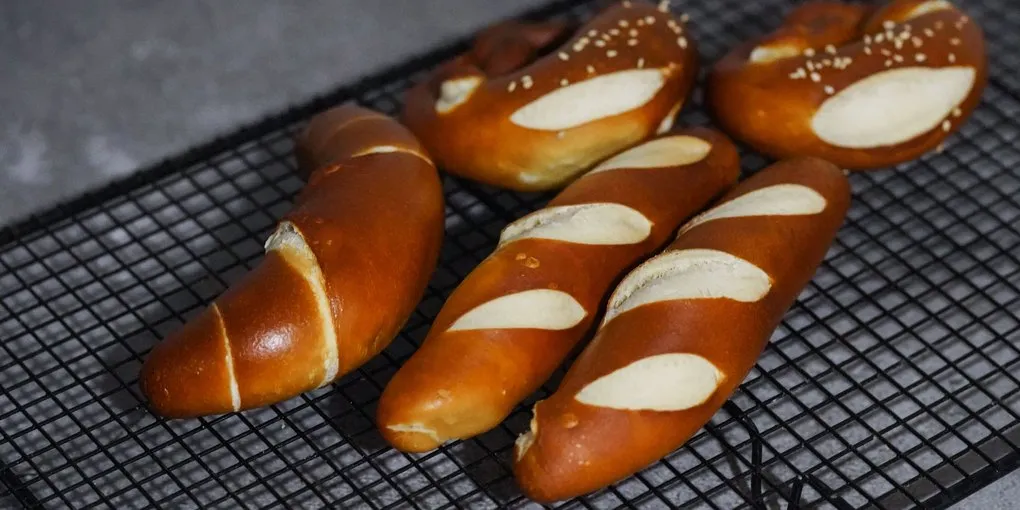
Sourdough discard soft pretzels get fermented depth from the discard and their signature mahogany crust from an alkaline bath before baking. A real Bavarian pretzel uses a 4 percent food-grade lye (NaOH) dip; a boiled baking soda bath -- especially baked baking soda -- gets you about 80 percent of the way with zero safety risk. Discard is the flavor carrier and tenderizes the crumb; commercial yeast handles the 90-minute rise. Dip 15 to 20 seconds, salt, slash, and bake at 450F until deep mahogany.
A proper Bavarian Laugenbrezel gets its mahogany crust, faint bitterness, and that chewy, almost-slick exterior from one thing: a bath in alkaline solution before baking. Traditional bakeries use food-grade sodium hydroxide — lye — at about 4 percent strength. It is dangerous if handled carelessly and it is also why nothing else tastes quite the same.
This recipe gives you both paths. The lye version is the real thing, and if you follow the safety protocol it is no more hazardous than handling a can of drain cleaner with gloves and eye protection (which is exactly what it is, food-grade). The boiled baking soda alternative is safer, still very good, and the crust comes close. You can test the boiled-soda version first and graduate to lye once you have run the dough two or three times.
What makes this recipe better than generic soft pretzel recipes is the sourdough discard. Discard contributes hydration, fermentation flavor, and acid that tenderizes the dough and deepens the crust color. It is not a leavening source here — we still use commercial yeast for a reliable 90-minute rise. Discard is the flavor carrier; the yeast is the engine.
Why Discard Plus Alkaline Bath
Three things are happening.
Discard softens the crumb. Pretzel dough runs low hydration (62 to 65 percent) and high protein. That makes a dense, chewy interior — which is what you want, up to a point. Discard’s acidity (pH 3.5 to 4.5) mildly slackens the gluten so the interior reads tender rather than rubbery, while the exterior stays firm for the classic pretzel bite.
Alkaline bath hyper-accelerates Maillard. Maillard browning depends on amino acids, reducing sugars, heat, and pH. Alkaline surface pH (above 10) makes the reaction run hundreds of times faster than at neutral. That is why a 30-second lye dip before baking produces mahogany crust at 450 F in 12 minutes — unreachable with a plain water wash.
Flavor signature becomes Bavarian. Dipped pretzels have a distinctive faint bitterness on the crust (from alkaline-transformed proteins) and a slick, almost-leathery surface texture. That is the flavor memory of a Bavarian bakery. Discard adds a layer of fermented wheat depth beneath it.
“Discard” in this recipe means unfed, mature starter pulled straight from the jar — not ripe, active starter used for leavened bread. Its wild yeast is mostly exhausted but its acids and flavor are fully developed. That is the right chemistry for a yeast-leavened pretzel dough.
Safety: Working With Food-Grade Lye
Read this section before you skip to the ingredients. Lye is sodium hydroxide (NaOH). It is caustic. At 4 percent it will burn skin on contact and cause permanent eye damage if splashed.
You need:
- Food-grade NaOH (not technical-grade or drain-cleaner pellets with additives). Sold by pretzel-bakery suppliers and soap-making suppliers. Look for 99 percent pure, food-grade.
- Chemical-resistant gloves (nitrile or rubber kitchen gloves, not latex).
- Safety glasses or goggles (splash-rated, not ordinary glasses).
- A stainless steel or glass bowl (NOT aluminum — lye reacts with aluminum and generates hydrogen gas).
- A slotted spoon or spider strainer.
- White vinegar on hand as a neutralizer in case of skin contact.
Procedure rules:
- Always add lye to cold water, never water to lye. Reverse causes a violent exothermic reaction.
- Mix in a well-ventilated area; avoid breathing the vapor.
- Make the solution in the bowl you will dip in — do not transfer hot solution.
- Label the bowl clearly while working.
- When done, pour the bath down the drain followed by plenty of water. Do not save it.
In case of skin contact: Flush with cold water for 15 minutes. Apply vinegar to neutralize residual lye. If eyes are affected, flush for 15 minutes and seek medical care.
If any of this sounds like too much risk for your kitchen, use the boiled baking soda alternative below. The crust will be slightly less dark and the flavor slightly less distinctive, but the pretzels are still very good.
Ingredients
Makes 8 pretzels, about 4 ounces each.
Dough
| Ingredient | Grams | US measure |
|---|---|---|
| Bread flour (12-13 percent protein) | 500 g | 4 cups |
| Sourdough discard, 100 percent hydration | 150 g | 1/2 cup + 2 tbsp |
| Water, 95 F | 240 g | 1 cup |
| Fine sea salt | 10 g | 1 3/4 tsp |
| Instant yeast | 5 g | 1 1/2 tsp |
| Unsalted butter, softened | 30 g | 2 tbsp |
| Barley malt syrup (or brown sugar) | 15 g | 1 tbsp |
Bath (choose one)
Option A — Lye bath (real Bavarian):
| Ingredient | Grams |
|---|---|
| Food-grade NaOH pellets | 40 g |
| Cold water | 960 g |
Option B — Boiled baking soda bath (safer alternative):
| Ingredient | Grams |
|---|---|
| Baking soda | 60 g |
| Water | 2,000 g |
Baked baking soda intensifies this route further: spread 200 g baking soda on a sheet pan and bake at 250 F for 60 minutes before using. This converts sodium bicarbonate (pH ~8) to sodium carbonate (pH ~11), which browns closer to lye. Use 40 g of baked soda in 2,000 g of water.
Topping
- Pretzel salt or coarse flake salt, about 30 g total
- Everything-bagel mix, sesame, or poppy as alternatives
Method
Step 1 — Mix the dough. In a stand mixer with dough hook, combine 500 g flour, 150 g discard, 240 g water, 10 g salt, 5 g yeast, 30 g butter, and 15 g malt syrup. Mix on low for 2 minutes until shaggy, then medium-low for 6 to 8 minutes until the dough is smooth and passes a windowpane test — thin, translucent membrane without tearing. The dough will feel stiff; that is correct. If you are new to gauging dough development, our guide to kneading bread covers the windowpane check.
Step 2 — Bulk ferment. Transfer to a lightly oiled bowl, cover, and rest at 75 to 78 F for 60 to 90 minutes. The dough should grow 50 to 75 percent. It will not double; the low hydration slows visible rise.
Step 3 — Divide and pre-shape. Turn onto a clean (unfloured) counter. Divide into 8 pieces of about 115 g each. Roll each into a tight ball, cover with a towel, and rest 10 minutes. The rest relaxes the gluten so you can roll long ropes without snap-back.
Step 4 — Roll ropes. Roll each ball into a rope 22 to 24 inches long. The rope should taper slightly at the ends and be slightly thicker in the middle. If it snaps back, rest it 5 more minutes. Do not flour the counter — a little friction helps the rope stretch.
Step 5 — Shape the pretzel. Form a U with the rope, cross the ends into a twist, and fold the twist down onto the belly of the U. Press gently to seal. Classic pretzel shape. Place on parchment-lined trays.
Step 6 — Cold rest. Uncovered, refrigerate 30 minutes minimum, up to overnight. The cold rest dries the surface — critical for the bath to work properly. Wet dough in the lye bath produces a streaky crust.
Step 7 — Heat oven and prep bath. Preheat to 450 F with a rack in the upper third. Prepare the bath:
For lye: Put on gloves and goggles. In a stainless bowl, add 960 g cold water first, then slowly add 40 g lye pellets, stirring with a stainless or wooden spoon. Solution will warm slightly. Let it cool to room temperature before dipping (5 minutes).
For baking soda: Bring 2,000 g water to a simmer in a wide pot. Add 60 g baking soda (or 40 g baked baking soda). Reduce to a bare simmer.
Step 8 — Dip. One at a time, lower each pretzel into the bath for 15 to 20 seconds, flipping once with a slotted spoon. Lift and drain. Place on a fresh parchment-lined tray. The surface should look faintly tacky and darker than the raw dough.
Step 9 — Slash and salt. With a sharp blade or razor, cut a 3 to 4 inch slash across the belly (the thick bottom curve) of each pretzel. Sprinkle with coarse pretzel salt while the surface is still tacky so it sticks — regular table salt dissolves too quickly; you need large crystals that stay visible on the crust.
Step 10 — Bake. 12 to 15 minutes at 450 F, until deep mahogany (lye) or deep reddish-brown (baking soda). Internal temperature should read 205 to 210 F. Do not under-bake; pale pretzels taste doughy.
Step 11 — Cool on a rack. Transfer to a wire rack. Eat within 4 hours for peak texture. Pretzel salt pulls moisture from the air, so longer storage softens the crust.
Doneness cues: mahogany crust with visible salt, glossy-matte surface, split slash showing paler dough contrast, internal temp 205 to 210 F.
Pretzel Bath: Three Routes to Mahogany Crust
Same shaped dough -- the bath decides the flavor signature
Lye (Bavarian)
- Solution
- 4 percent NaOH (40 g / 1 L water)
- Safety gear
- Gloves + goggles + stainless bowl
- Dip time
- 15-20 seconds
- Crust color
- Deep mahogany, glossy
- Always add lye to cold water, never water to lye.
- Authentic Bavarian flavor; faint crust bitterness from alkaline protein transformation.
Baked Baking Soda
- Solution
- 40 g baked soda / 2 L simmering water
- Safety gear
- Normal kitchen care
- Dip time
- 15-20 seconds
- Crust color
- Deep reddish-brown
- Bake soda at 250F for 60 min to convert NaHCO3 to Na2CO3 (pH ~11).
- Close to lye flavor with zero safety risk. Best non-lye option.
Plain Boiled Baking Soda
- Solution
- 60 g baking soda / 2 L simmering water
- Safety gear
- Normal kitchen care
- Dip time
- 20-25 seconds
- Crust color
- Medium brown
- Easiest route -- pantry ingredients only.
- Less dark and less distinctive than lye, but still recognizably pretzel.
Alkaline pH (above 10) accelerates Maillard browning hundreds of times faster than neutral. Discard in the dough adds fermented-wheat depth beneath the alkaline crust signature.
jayarrbread.comNotes and Variations
Dunk time matters. Under 10 seconds and color is weak. Over 30 seconds and the crust turns leathery. 15 to 20 is the sweet spot.
Everything pretzels. Swap pretzel salt for everything-bagel seasoning. Same technique.
Pretzel bites. Cut ropes into 1-inch pieces before dipping. Bath time drops to 10 seconds. Bake 8 to 10 minutes.
Pretzel rolls. Shape as round rolls instead of twists. Dip 20 to 25 seconds. Slash in an X on top. Bake 15 to 18 minutes.
Discard age. Refrigerated discard is good for about a week. Older, sharper discard pushes the dough more tangy. Cut to 120 g if your discard is past five days.
Storage. Best eaten same day. Reheat in a 350 F oven for 5 minutes to restore crust. Freeze fully cooled up to 2 months; reheat from frozen at 350 F for 10 minutes.
If you are nervous about lye, start with the baked baking soda version. The crust comes out roughly 80 percent of the way to lye — noticeably better than plain boiled baking soda, and zero personal-safety risk. Graduate to lye on your third or fourth round once the shaping and timing are automatic.
For a straightforward yeasted take without discard, see our classic soft pretzels recipe. For more starter ideas, see our sourdough discard recipes roundup. If you are still building the starter that produces this discard, our how to make sourdough starter guide covers the first two weeks in detail.
Frequently Asked Questions
- Is it actually safe to use lye at home?
- Yes, if you follow the protocol. Food-grade NaOH at 4 percent is caustic but not explosive or toxic to inhale in small amounts. Chemical-resistant gloves and splash-rated goggles are non-negotiable. Always add lye to cold water, never water to lye -- the reverse causes a violent exothermic reaction. Use a stainless or glass bowl (never aluminum -- it reacts with lye to produce hydrogen gas). Keep white vinegar nearby to neutralize splashes. If any of that sounds like more risk than you want in a home kitchen, the boiled baking soda alternative in the recipe gets you about 80 percent of the way there with zero safety concerns.
- Where do I buy food-grade lye?
- Look for pretzel-bakery suppliers, soap-making retailers, or online chemical suppliers. The label should specify "food grade" or "99 percent pure sodium hydroxide NaOH." Do not use drain cleaner products -- those contain additives (aluminum shavings, surfactants) that you cannot put on food. Expect to pay 15 to 25 dollars per pound; a pound will last through dozens of batches.
- Why do I bake the baking soda?
- Baked baking soda is chemically different. Sodium bicarbonate (NaHCO3) loses water and carbon dioxide at 250 F for 60 minutes, converting to sodium carbonate (Na2CO3). Sodium carbonate has a higher pH (roughly 11 vs 8 for regular baking soda), which makes Maillard browning run much faster -- closer to lye's effect. This Harold McGee trick is the best non-lye workaround and worth the effort if you want a dark crust without handling caustic chemicals.
- Can I use discard instead of commercial yeast for leavening?
- You can shift the ratio, but going fully wild makes the timeline impractical for pretzels. Pretzel dough is stiff (62 to 65 percent hydration) and low in sugar, which slows wild yeast significantly. A pure-sourdough pretzel needs 12 to 16 hours of bulk fermentation -- doable, but planned. The hybrid approach in this recipe uses discard for flavor and a small dose of commercial yeast for reliable 90-minute bulk. You get the sourdough depth without losing same-afternoon timing.
- Why does the cold overnight rest matter?
- Two reasons. First, it dries the dough surface, which is essential for the bath to adhere evenly and produce a glossy, streak-free crust. Wet dough in the lye or soda bath makes spotty, uneven color. Second, the cold rest develops flavor -- slow fermentation in the fridge lets enzymes break down starch into more complex flavor compounds. Minimum 30 minutes, but overnight in the fridge is better. You can shape in the evening, rest overnight, and dip and bake in the morning.