Sourdough discard makes scones rise taller and bake flakier. Its acid (pH 3.5 to 4.5) fires the baking powder harder for a dramatic lift and keeps the gluten short so the crumb stays tender, while contributing a creamy tang that plain buttermilk scones lack. Keep the butter cold, mix minimally, and rest the shaped scones in the fridge before baking. Discard is not the leavening here -- baking powder does the lifting.
Most scone recipes fail for one of two reasons: either the butter gets too warm and melts into the flour before the oven has a chance to create steam pockets, or the dough gets over-mixed and the gluten turns the crumb rubbery. Discard fixes the second problem almost automatically. Its acid (pH 3.5 to 4.5) inhibits gluten development in a batter that barely gets kneaded to begin with, and the acid also fires the baking powder harder for the tall, cracked lift that makes a scone look like it is reaching for the ceiling.
You still have to keep the butter cold. Nothing about discard changes that. But if you handle the butter right, discard gives you a scone with deeper flavor, taller rise, and a flakier layer structure than any buttermilk-and-flour recipe will produce.
“Discard” in this recipe means unfed, mature starter straight from the fridge jar — past-peak, acid-rich, wild-yeast-exhausted. Not ripe leaven. The yeast is not the leavening source here; baking powder is. Discard contributes flavor, hydration, acid, and its enzyme load. If yours is on the older side (week-plus), it will push the scones sharper; adjust if needed.
Why Discard Makes Better Scones
Three mechanisms.
Baking powder gets more reliable lift. Baking powder contains both acid and base built in, but the reaction runs faster and further in an already-acidic batter. Discard’s low pH pushes the first reaction (triggered when wet ingredients meet the powder) closer to completion in the bowl, and the second reaction (heat-activated in the oven) runs harder because the remaining acid reservoir is larger. Result: taller scones with a more dramatic crack down the side.
Gluten stays short. Flakiness in pastry comes from distinct butter layers that stretch gluten into thin sheets around pockets of steam. Over-developed gluten collapses those pockets into a dense, chewy mass. Discard’s acid mildly inhibits gluten formation, so even if your dough gets handled a few extra seconds, it still reads tender and flaky rather than tough.
Flavor comes from the dough, not just the mix-ins. Plain scones without mix-ins are usually dull. Discard changes that with a creamy tang underneath whatever you fold in — blueberries, currants, cheese, chocolate. The scone tastes like something on its own, and the mix-in becomes an accent rather than the entire flavor payload.
Technique matters more than ingredients. Cold butter, minimal mixing, a pre-shape that laminates butter layers into the dough, and a hot oven. Discard is the flavor and chemistry edge — not a substitute for getting those fundamentals right.
Ingredients
Makes 8 wedge scones.
| Ingredient | Grams | US measure |
|---|---|---|
| All-purpose flour | 300 g | 2 1/2 cups |
| Granulated sugar | 50 g | 1/4 cup |
| Baking powder | 12 g | 1 tbsp |
| Fine sea salt | 4 g | 3/4 tsp |
| Cold unsalted butter, cubed | 115 g | 1 stick / 8 tbsp |
| Sourdough discard, 100 percent hydration | 140 g | 1/2 cup + 1 tbsp |
| Heavy cream, cold | 120 g | 1/2 cup |
| Large egg, cold | 50 g | 1 egg |
| Vanilla extract | 5 g | 1 tsp |
| Mix-in (blueberries, chips, currants, etc.) | 150 g | 1 cup |
| Cream for brushing | 20 g | 1 tbsp |
| Coarse sugar for topping (optional) | 20 g | 2 tbsp |
Total dough weight, pre-mix-in: roughly 800 g. Each scone, post-mix-in, about 120 g raw.
Butter tip: freeze butter for 20 minutes before cubing. Colder is always better for pastry structure. Cut into 1 cm dice so it distributes evenly through the flour.
Method
Step 1 — Preheat and prep. Heat oven to 400 F (200 C). Line a half sheet pan with parchment. Pull the butter from the fridge or freezer and cube it now — you want it cold when it hits the flour.
Step 2 — Whisk the dry ingredients. In a large bowl, whisk 300 g flour, 50 g sugar, 12 g baking powder, and 4 g salt until fully combined. Lumps of baking powder leave bitter streaks.
Step 3 — Cut in the cold butter. Add 115 g cold cubed butter to the dry ingredients. Toss quickly with your fingertips to coat each cube in flour. Then rub the butter into the flour between your fingertips — flatten each cube into a thin flake. Stop when the largest butter pieces are the size of a pea and the mixture looks coarse and uneven. Do not pulverize into a uniform mealy texture; visible butter flakes are the source of lamination.
Step 4 — Whisk the wet ingredients. In a separate bowl, whisk 140 g discard, 120 g heavy cream, 50 g egg, and 5 g vanilla until smooth. The mixture will look slightly thickened — discard is viscous.
Step 5 — Combine wet into dry. Pour the wet over the flour-butter mixture. Using a spatula or your hands, fold just until a shaggy dough comes together. Visible streaks of unincorporated flour are fine at this stage. Over-mixing melts butter and builds gluten — both flakiness killers.
Step 6 — Fold in mix-ins. Scatter 150 g of your mix-in over the dough. Fold gently 3 or 4 times to distribute. Mix-ins will not be perfectly even; that is correct.
Step 7 — Laminate with a fold. Dump the dough onto a lightly floured counter. Pat into a rough 1-inch-thick rectangle. Fold in thirds like a letter. Pat back into a rectangle. Fold in thirds again. This layered fold creates butter sheets that puff into flakes in the oven.
Step 8 — Shape and cut. Pat the laminated dough into a round disc about 1 1/4 inches thick. Cut into 8 wedges with a sharp, floured knife. Transfer wedges to the parchment-lined sheet pan, spacing at least 1 inch apart.
Step 9 — Rest cold. Refrigerate the unbaked scones on the sheet pan for at least 15 minutes, or up to overnight. This re-chills the butter for maximum oven spring. Skipping this step costs you significant lift.
Step 10 — Brush and top. Brush tops with 20 g cream. Sprinkle coarse sugar generously if using. Cream plus sugar gives you the glossy, crackly browning on top.
Step 11 — Bake. 20 to 25 minutes at 400 F, until deeply golden brown on top, cracked on the sides showing the layered structure, and set to the touch. Internal temperature should read 200 to 210 F.
Step 12 — Cool 10 minutes. Transfer to a wire rack. Scones are at peak texture 10 minutes to 2 hours out of the oven.
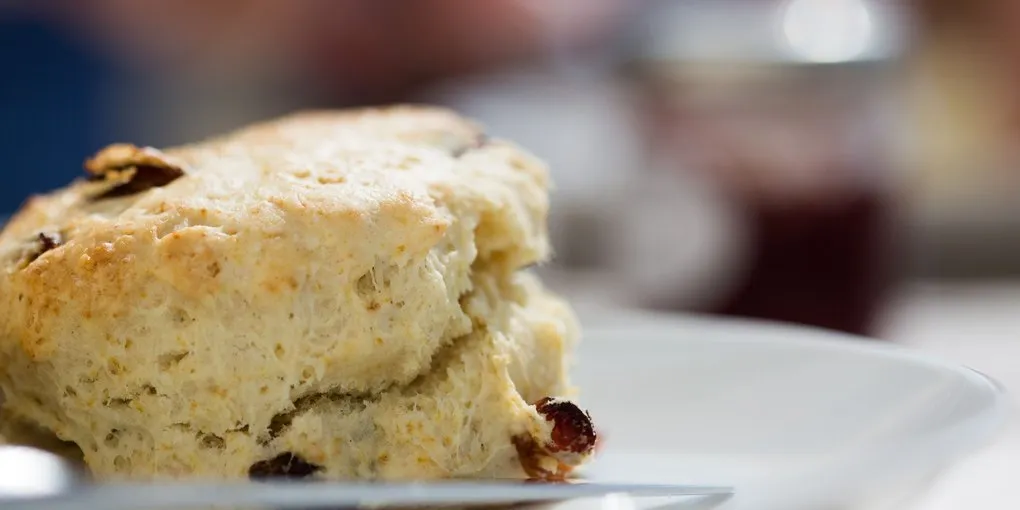
Doneness cues: dark golden tops, visible flake layers bursting from the sides, firm but not hard when pressed on top, internal temp 200 to 210 F. Under-baked scones taste raw and collapse when cooled; do not pull them early even if they look done.
Discard Scones: Four Mix-In Directions
Same dough base -- change the mix-in, change the scone
Blueberry Lemon
- Mix-in
- 150 g blueberries + 15 g lemon zest
- Sugar
- 50 g (base recipe)
- Fold carefully
- 3 folds max
- Bake
- 400F, 20-25 min
- Frozen berries stain less than fresh -- toss them in 10 g flour first.
- Lemon zest goes into the dry mix; it bloom-releases oils in the flour.
Chocolate Chunk
- Mix-in
- 150 g mini chocolate chips
- Sugar
- 50 g (base recipe)
- Flavor add
- 2 g espresso powder in the dry
- Bake
- 400F, 20-25 min
- Espresso powder deepens chocolate without tasting like coffee.
- Mini chips distribute better than full-size; less risk of hot pockets.
Cheddar Chive (savory)
- Mix-in
- 150 g sharp cheddar + 5 g chopped chives
- Sugar
- Reduce to 25 g
- Pepper
- 2 g black pepper in the dry
- Bake
- 400F, 20-25 min
- Shred cheese on the large hole of a box grater, not finely.
- A dusting of extra cheese on top before baking adds a crisp lid.
Apricot Cardamom
- Mix-in
- 150 g chopped dried apricot
- Sugar
- 50 g (base recipe)
- Spice
- 5 g ground cardamom in the dry
- Bake
- 400F, 20-25 min
- Cardamom pairs with the discard tang -- complementary brightness.
- Soak apricots in warm water 10 min if they're very dry; drain well.
Discard pH 3.5-4.5. Acidic dough fires baking powder harder for taller rise; acid also keeps gluten short for flaky, tender layers. Keep butter cold -- lamination beats kneading.
jayarrbread.comNotes and Variations
Mix-in ideas. 150 g blueberries (fresh or frozen), 150 g mini chocolate chips, 150 g dried currants plus 15 g lemon zest, 150 g sharp cheddar plus 5 g chopped chives (reduce sugar to 25 g for savory), 150 g chopped dried apricot plus 5 g ground cardamom.
Discard age. Refrigerated discard is good for about a week. Older, sharper discard yields tangier scones. Cut to 110 g and add 30 g cream if your discard is past five days.
Overnight route. Shape the scones, refrigerate uncovered on the sheet pan overnight, and bake straight from the fridge in the morning. The long cold rest produces noticeably deeper flavor and even taller rise. Bake 2 to 3 minutes longer than the 20 to 25 minute window.
Freezer route. Shape, freeze on the sheet pan until solid (about 2 hours), transfer to a zip-top bag. Bake frozen at 400 F for 25 to 30 minutes. No thawing needed. This is the weekday-morning move — fresh scones in 30 minutes without prep.
Butter temperature matters more than anything. If your kitchen is warm, chill the mixing bowl and the butter cubes before starting. You can even freeze the flour for 20 minutes. Cold wins.
Don’t over-mix at the mix-in step. Blueberries especially want to break and streak the dough purple. Three folds max after adding them.
For more starter-driven breakfast ideas, see our sourdough discard recipes roundup — the same acid-plus-baking-soda trick powers our sourdough discard muffins, and the overnight batter behind our sourdough discard crepes works on the same principle. If you are still building the starter that feeds this discard stream, our how to make sourdough starter guide walks through the first two weeks.
Frequently Asked Questions
- Why do I need baking powder if I'm using sourdough discard?
- Because discard is not a leavening source here. The wild yeast in unfed, past-peak discard is mostly exhausted; what's left is acid and flavor. Baking powder does the lifting. Discard's acid fires the baking powder harder and more completely, which is why these scones rise taller than a cream-and-flour recipe -- but the powder has to be there to do the work in the first place. Ripe, active starter could leaven a slow-proofed scone, but the timeline pushes into 8-plus hours, which defeats the point of a quick-bread pastry.
- Can I use cold butter straight from the fridge, or does it need to be frozen?
- Cold fridge butter works if your kitchen is under 70 F and you move fast. If your kitchen runs warm, or you tend to work slowly, freeze the butter 20 minutes before cubing. Colder butter means larger distinct fat particles going into the oven, which means more steam pockets and flakier layers. The folding step (Step 7) is where warm butter will betray you the most -- it melts into the flour instead of laminating.
- My scones spread flat in the oven. What went wrong?
- The butter was too warm going in. Possible causes: the dough was handled too long and body heat warmed it, the kitchen is hot, or you skipped the cold rest before baking. Fix it next time by freezing the butter longer, chilling the bowl and flour, and always resting the shaped scones in the fridge 15 to 30 minutes before baking. If the kitchen is truly hot, bake from the freezer -- shape and freeze the scones solid, then bake 5 minutes longer than normal.
- How old can my discard be?
- Refrigerated discard stays usable for about 7 days in a covered jar. Beyond that, the acetic-acid character dominates and can push scones past pleasant tang into harsh territory. Cut to 110 g and add 30 g cream if yours is over 5 days old. Clear or brown liquid (hooch) on top is harmless alcohol from wild yeast metabolism -- stir it back in. Pink, orange, or fuzzy mold means toss the jar.
- Can I freeze unbaked scones?
- Yes, and this is the best make-ahead move. Shape the scones, freeze them solid on the sheet pan (about 2 hours), then transfer to a zip-top bag. Bake from frozen at 400 F for 25 to 30 minutes -- no thawing required. Fresh-baked scones in 30 minutes on a weekday morning. They keep 3 months in the freezer this way.