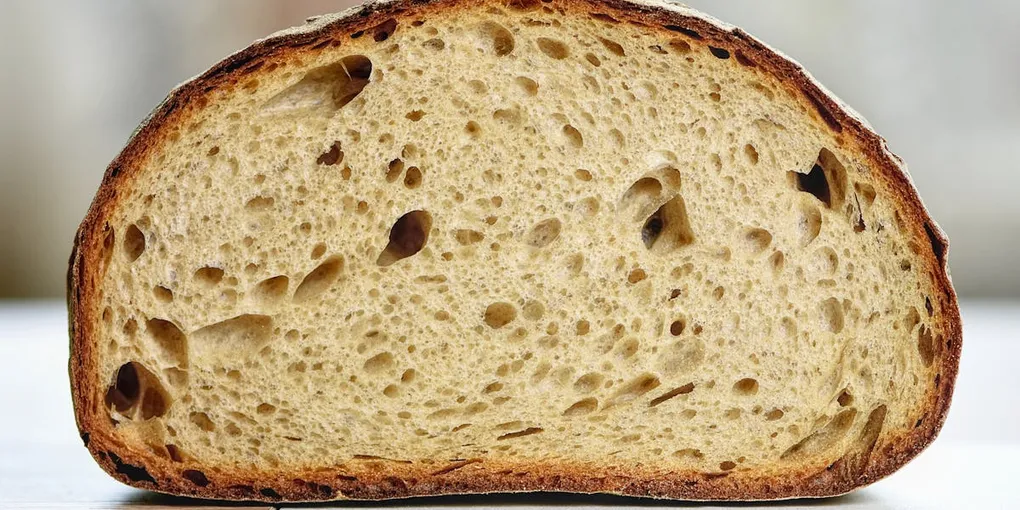
Dense bread has one primary cause: under-fermentation. The dough didn’t produce enough gas, the gas it produced wasn’t retained, or the gas was lost before or during baking. Everything else — flour problems, shaping mistakes, oven issues — is a variation on one of those three failures.
This guide works through every cause of dense bread, ordered by likelihood. Start at the top. The fix for your bread is almost certainly in the first three sections.
Cause 1: Under-Fermented Dough (Most Common)
Under-fermentation is responsible for the majority of dense loaves in home kitchens. The dough didn’t rise long enough during bulk fermentation, didn’t proof long enough after shaping, or both.
How to Identify It
Cut into the loaf. If you see a crumb with dense, tight, uniform small holes throughout — no variation in bubble size, no open patches anywhere — under-fermentation is almost certainly the cause. The gas cells never had enough CO2 to inflate into the open, irregular structure that characterizes well-fermented bread.
Why It Happens
Kitchen temperature is the invisible variable. Every bread recipe specifies a fermentation time — “3-4 hours” or “until doubled.” But fermentation rate depends on temperature. Yeast approximately doubles its activity with every 17°F (8°C) increase. A recipe that takes 3 hours at 78°F will take 5-6 hours at 68°F.
Most home bakers under-estimate how cold their kitchen is. A 70°F thermostat doesn’t mean the dough is at 70°F — kitchen counters near exterior walls, stone countertops, and drafty spots can be significantly cooler.
Following time instead of the dough. The timer says “3 hours,” so you shape at 3 hours. But your kitchen is 5 degrees cooler than the recipe assumes, and your dough needed 4.5 hours. Always watch the dough, not the clock.
How to Fix It
- Measure your dough temperature. Use a probe thermometer immediately after mixing. Target 75-78°F (24-26°C) for most lean breads. If your dough is cooler, use warmer water on the next mix.
- Watch volume, not time. During bulk fermentation, most sourdough should increase 20-30% (Robertson) to 2.5-3x (Forkish, for yeasted). During proofing, use the poke test.
- Use a clear container for bulk fermentation — a straight-sided Cambro or glass bowl — so you can see the volume change. Mark the starting level with tape or a rubber band.
- Create a warm spot. The oven with just the light on often holds 78-80°F. A microwave with a cup of hot water inside works. A proofing box is the professional solution.
Cause 2: Dead or Weak Yeast/Starter
If your leavening agent isn’t active, no amount of time will produce a risen loaf.
Commercial Yeast Problems
- Expired yeast. Active dry and instant yeast lose potency over time, especially once opened. Store opened yeast in the freezer.
- Heat-killed yeast. Yeast begins dying at 116°F (47°C) and is completely killed by 140°F (60°C). If you used hot water anywhere in that range or above, the yeast is compromised or dead.
- Test it: Dissolve a pinch of yeast in warm water (100-110°F) with a pinch of sugar. If it doesn’t foam within 10 minutes, the yeast is dead. Buy new yeast.
Sourdough Starter Problems
- Starter not active enough. A starter that doesn’t reliably double in 6-8 hours after feeding isn’t ready for bread. Give it several more days of consistent feeding before attempting a bake.
- Leaven past peak. If you built a levain and it has already collapsed (surface is concave, it’s falling rather than rising), the yeast has consumed all the available food and may not have enough energy to leaven bread. Use the levain while it’s still rising and domed.
- Failed float test. If a spoonful of leaven sinks in water, it doesn’t have enough CO2 to leaven bread. Wait until it floats.
For a deeper starter diagnostic, see Sourdough Starter Not Rising.
Cause 3: Over-Proofed Then Collapsed
This seems counterintuitive — over-proofing causes density? Yes. When dough over-proofs, the gluten network stretches to its maximum, the yeast exhausts its food supply, and the entire structure deflates. The dough collapses inward, losing the gas that would have kept it open.
How to Identify It
Over-proofed-then-collapsed bread often looks different from under-fermented bread. You may see:
- Large tunnels near the top of the loaf (where the last gas rose before collapse)
- A dense, compressed interior below the tunnels
- A flat or concave top crust
- A sunken center with more open edges
How to Fix It
- Shape earlier — don’t let bulk fermentation go too far. For sourdough, stop at 20-30% volume increase, not double.
- Shorten the proof after shaping, or cold-retard in the fridge instead of proofing at room temperature.
- Check sourdough with the poke test earlier and more often.
- See Overproofed vs Underproofed for detailed visual diagnostics.
Cause 4: Insufficient Gluten Development
Even if fermentation is perfect, weak gluten can’t trap the gas effectively. The CO2 escapes through the dough matrix instead of inflating discrete bubbles.
Common Reasons for Weak Gluten
Wrong flour. Low-protein flour (below 10%) doesn’t have enough glutenin and gliadin to form a strong network. Cake flour, pastry flour, and some cheap all-purpose flours don’t have the protein for bread. Check your flour — bread flour vs all-purpose explains what protein content you need.
No autolyse or too-short autolyse. The autolyse step lets flour hydrate and begin developing gluten passively. Skipping it means you start behind. For standard bread, 20-30 minutes. For whole wheat, 40-60 minutes.
Not enough folds. In no-knead or low-handling methods, folds replace mechanical kneading. If you skip the folds entirely in a recipe that calls for them, the gluten may not develop enough to hold gas.
Too much whole wheat or rye. Bran particles physically puncture gluten strands. Rye has almost no gluten-forming protein at all — it relies on pentosans for structure. Above 35% whole wheat or any significant rye percentage, expect a denser crumb regardless of technique.
Over-mixing (rare in home baking). Excessive machine mixing can break gluten bonds. More relevant for stand mixer users who run the dough hook on high speed for too long. Symptoms: dough becomes slack and wet after appearing to be well-developed.
Cause 5: Insufficient or Poorly Timed Steam
Steam in the first 10-15 minutes of baking keeps the crust flexible so the loaf can expand. Without steam, the crust sets early, trapping the loaf in a rigid shell. The interior may be well-fermented but physically prevented from rising.
Signs of a Steam Problem
- The crust is thick, pale, and matte (no sheen)
- The loaf has a shape like a hockey puck — wide and flat rather than tall
- The scoring patterns didn’t open much
- There may be side-blowouts where the bread forced its way out through the weakest point
How to Fix It
Use a Dutch oven — it’s the single best solution for home steam. If you can’t, use an inverted roasting pan over the loaf on a preheated stone, or a heavy pan with boiling water on the oven floor.
Cause 6: Oven Temperature Too Low
If your oven is running 50°F below the set temperature — and many home ovens do — the initial burst of heat that drives oven spring is muted. The loaf rises less in the first 10 minutes and sets into a denser form.
How to Diagnose
Buy an oven thermometer ($5-10) and hang it from the center rack. Compare the reading to your oven’s display. Differences of 25-50°F are common.
How to Fix It
Calibrate by setting your oven higher to compensate, or have the thermostat professionally adjusted. For bread specifically, a preheated baking stone or steel provides consistent thermal mass that compensates for air temperature fluctuations.
Cause 7: Cut Too Soon
This isn’t a density problem — it’s a perception problem. If you cut into bread before the crumb has fully set, the still-gelling starch compresses under the knife. The interior looks gummy and dense even if the bake was perfect.
After baking, starch continues to gel as the loaf cools. Cutting interrupts this process. The crumb that would have been open and airy becomes compacted and wet.
Minimum cooling times:
- Standard yeasted bread: 45-60 minutes
- Sourdough: 2-4 hours
- Rye bread: 12-24 hours (high-rye: 48-72 hours)
If your bread seems gummy at the center, wait 30 more minutes and try a slice from the other end. If the gumminess is gone, the issue was timing, not baking. For more on this, see why sourdough bread is gummy.
Cause 8: Not Enough Water
Low hydration doesn’t directly cause density — plenty of excellent breads live at 55-65% hydration (bagels, sandwich loaves). But if you’re following a recipe designed for 75% hydration and you accidentally use 65%, the dough will be too stiff. The yeast produces gas but the tight dough can’t expand to accommodate it. The result is a loaf that’s smaller and denser than intended.
How to avoid: Weigh your water. Don’t use measuring cups. A difference of 20-30g of water — easily lost to an inaccurate cup measurement — changes the dough character noticeably. A kitchen scale is non-negotiable for bread baking. See our scale guide.
Cause 9: Too Much Flour During Shaping
Excess bench flour gets folded into the dough during shaping. Those dry flour pockets don’t hydrate, don’t participate in the gluten network, and create dense spots in the finished bread.
Fix: Use less flour. Robertson shapes on an unfloured surface — the dough’s stickiness provides traction for building surface tension. If you need flour, use it sparingly — a light dusting, not a snowdrift.
Cause 10: Old, Damaged, or Wrong Flour
Starch damage. During milling, some starch granules are physically damaged. Damaged starch absorbs water excessively during mixing, then releases it during baking. Symptoms: slack dough, poor oven spring, dense loaf. American flour averages 8-9% starch damage. If you’ve switched brands and your reliable recipe suddenly fails, starch damage levels may differ.
Rancid whole wheat. The oils in whole wheat germ go rancid within weeks of milling at room temperature. Rancid flour produces bread with off-flavors and poor rise. Store whole wheat in the freezer.
Wrong wheat. Durum wheat has the highest protein of any wheat class (12-16%) but the wrong kind of gluten for bread. It can’t retain gas effectively. If your flour is durum or semolina, it’s not a bread flour regardless of protein content.
Forkish’s 10-Question Troubleshooting Checklist
When a loaf comes out dense, work through these questions in order:
- What was the dough temperature at the end of mixing?
- Was bulk fermentation too long or too short?
- Did the dough get enough folding?
- Was the room temperature colder or warmer than usual?
- Was the pre-ferment (if used) over- or under-developed?
- Did the dough feel right — proper strength and hydration?
- Was a measurement off? (Salt and yeast at small quantities need an accurate scale)
- Was the bread under-proofed or over-proofed?
- Was the oven temperature correct? Enough steam? Sufficient baking time?
- New bag of flour, different brand, different harvest?
If you can answer all 10, you’ll find your problem. Most dense-bread issues live in questions 1, 2, and 4 — temperature and time.
When Dense Bread Is Normal
Some breads are supposed to be dense. This isn’t a problem — it’s a style.
- 100% rye bread (Vollkornbrot): Dense, moist, sliceable. Relies on pentosans, not gluten. Correct texture.
- Pumpernickel: Baked at low temperature for 16-24 hours. Dense by design.
- Bagels: 55-58% hydration, deliberately tight crumb. Dense is the goal.
- High whole wheat (80%+): Will always be denser than white bread due to bran disruption. Adjust expectations, not technique.
For a full list of bread problems and their solutions, see the bread troubleshooting guide.
Frequently Asked Questions
- Why is my bread dense on the bottom but open on top?
- This usually means insufficient folding during bulk fermentation. Gas migrates upward and isn't redistributed. Do 3-4 sets of stretch-and-folds in the first half of bulk fermentation to distribute gas evenly throughout the dough.
- Can I fix dense bread after it's baked?
- No. Once baked, the crumb structure is set. Dense bread still makes excellent toast, breadcrumbs, croutons, or bread pudding. Note what went wrong and adjust your next bake.
- Why is my bread dense even though it rose well?
- The dough may have over-proofed and then collapsed during baking. If the loaf rose dramatically during proofing but came out flat and dense, the gluten was exhausted. Shape earlier and proof for less time on your next bake.
- Does adding more yeast fix dense bread?
- Sometimes, but it's rarely the right fix. If your yeast is active, the problem is almost always temperature or time — not yeast quantity. More yeast speeds fermentation but doesn't fix a cold kitchen or an under-proofed loaf.
- Why is my sourdough always denser than yeasted bread?
- Sourdough ferments more slowly than commercial yeast, so it requires longer bulk fermentation and proofing. It also produces a naturally tighter crumb than yeasted bread at the same hydration. A well-made sourdough will have an open crumb, but it won't match a baguette made with commercial yeast.